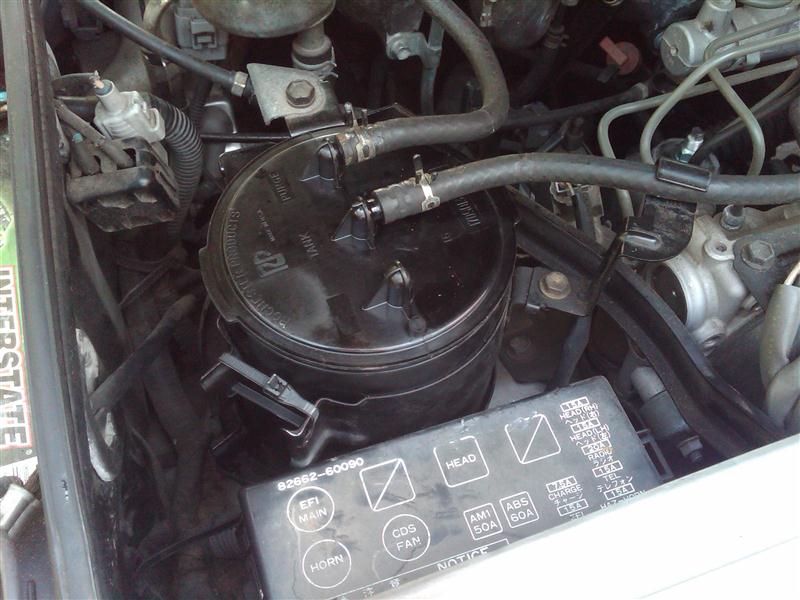
Charcoal Canister - Great Option!

This site may earn a commission from merchant affiliate
links, including eBay, Amazon, Skimlinks, and others.

oh man, you fellas are still dinking around with the Vatozone special canisters? I switched over a GM vapor canister like what @TYM4FUN did and never looked back. $25 for an used one from U pull N pay, and mounted it under the cab then forget about it. No more smells. Bonus is that you get some space freed up in that original CC spot. :)

View attachment 4058102
I would damage that in short order.
Looks very vulnerable Then again most don’t use their 80 the way I do
 
I would damage that in short order.
Looks very vulnerable Then again most don’t use their 80 the way I do
Yeah, I'm not sure I'd want it in that spot without some sort of extra protection. Still, a something shaped like a brick is easier to package than a canister. I'm pretty happy with my rebuilt OEM can, but I can see finding a safe home for that somewhere underneath if I needed the space in the engine compartment.
 
Last edited:
I would damage that in short order.
Looks very vulnerable Then again most don’t use their 80 the way I do

Looks like a skid could be easily added between the slider and the frame though
 
Looks like a skid could be easily added between the slider and the frame though
Yep on most 80s
The bottom of my sliders are higher the the bottom of that canister, no low hanging fruit for me.

Good night Joe
 
yeah, I stopped rock crawling 1,500# and 15 years ago so this location is fine for my needs. I don't need a skid plate since it's above the slider and I don't plan on jamming a rock in that narrow space after sliding off the slider. Like I said, at 7500# and with 250# on the roof, she ain't crawling anytime soon. Oh, water doesn't get into the vapor canister since this isn't an amphibious vehicle.
 
yeah, I stopped rock crawling 1,500# and 15 years ago so this location is fine for my needs. I don't need a skid plate since it's above the slider and I don't plan on jamming a rock in that narrow space after sliding off the slider. Like I said, at 7500# and with 250# on the roof, she ain't crawling anytime soon. Oh, water doesn't get into the vapor canister since this isn't an amphibious vehicle.
Yep I get it we all use our rigs differently

I think you’re over the GVWR just a little. 🙄
 
Yeah, I'm not sure I'd want it in that spot without some sort of extra protection. Still, a something shaped like a brick is easier to package than a canister. I'm pretty happy with my rebuilt OEM can, but I can see finding a safe home for that somewhere underneath if I needed the space in the engine compartment.
I was looking at relocating my Vatozone special under the rig as well. However, with two fuel tanks, the vapor was still happening in the heat of the summer so it was time for a re-design. The ideal place for the GM canister is at the rear cross member, where Tym4fun placed his. My subtank prevented that from happening, unfortunately.

I rebuilt the OEM can long time ago, then switched to the Vatozone special. The GM unit is badass and so plentiful. It's form factor is sweet, comes with its own mounting bracket, and it's easy to mount.

I found my thread on this project Evap/charcoal canister relocation - https://forum.ih8mud.com/threads/evap-charcoal-canister-relocation.1367241/
 
One issue others may have including me is it’s part of the smog equipment and in theory should not be moved or changed.
 
One issue others may have including me is it’s part of the smog equipment and in theory should not be moved or changed.

yeah in theory we shouldn't be doing lots of stuff, but that's not really stopping us, is it? :) I don't think the emissions guy in CA is looking for your charcoal canister in the engine bay during the SMOG test, but I could be wrong.
 
yeah in theory we shouldn't be doing lots of stuff, but that's not really stopping us, is it? :) I don't think the emissions guy in CA is looking for your charcoal canister in the engine bay during the SMOG test, but I could be wrong.
Probably depends on the guy. I'd wager there are some that would reject the autozone canister if they notice it isn't OEM. I live outside emissions territory (Oregon has different rules depending where the vehicle is licensed), so I run the emissions controls that seem like they solve more problems than they create and ditch the stuff that doesn't (cough cough EGR...), but I've seen enough emissions threads with people talking about shopping for the right place to get their tests done. That really says volumes about what an effective system it is. Make no mistake, I'm all in favor of things that actually help. 'Kay, let me stop now before I go into a full bore rant. 😆
 
We’re talking relocation to under the truck, so at first look it would look like it was removed.
To me it’s just not worth the chance.
 
FYI: VC120 has no check valves. (sorry if this has been said. I found nothing when searching)

I have had a VC 120 in my 1993 385,000 mile 80 many years with good results. Two weeks ago wheeling in 90 degree Moab temps I had fuel tank pressure. Have not had it in a while. Live a mile high in Denver. My VSV works properly.

I have hoarded OE canisters so I opened one, changed the charcoal, and got rid of the "to tank" pipe check valve. I used Randy's / Precision Land Cruisers instructions. There is a second check valve on the center pipe that is linked to the "to tank" pipe and extends down to the middle of the canister and charcoal. It is behind a small filter and retained by a disc retained by the pipe so it spun and I decided not to bother trying to get it out. "Check valve" is being generous. Its a small BB and ballpoint pen size spring. It would have also been easy to push some brake cleaner through the valves. Not sure if they were stuck or sticking. Air moved them easily.

Any concern I had about free-flow into the top of the canister went away after I cut open the VC120. VC120 has no check valves.

Left to right is order of components bottom to top.Tan filer was bottom most. Charcoal was between the two dark filters.

IMG_9960.webp
 
FYI: VC120 has no check valves. (sorry if this has been said. I found nothing when searching)

I have had a VC 120 in my 1993 385,000 mile 80 many years with good results. Two weeks ago wheeling in 90 degree Moab temps I had fuel tank pressure. Have not had it in a while. Live a mile high in Denver. My VSV works properly.

I have hoarded OE canisters so I opened one, changed the charcoal, and got rid of the "to tank" pipe check valve. I used Randy's / Precision Land Cruisers instructions. There is a second check valve on the center pipe that is linked to the "to tank" pipe and extends down to the middle of the canister and charcoal. It is behind a small filter and retained by a disc retained by the pipe so it spun and I decided not to bother trying to get it out. "Check valve" is being generous. Its a small BB and ballpoint pen size spring. It would have also been easy to push some brake cleaner through the valves. Not sure if they were stuck or sticking. Air moved them easily.

Any concern I had about free-flow into the top of the canister went away after I cut open the VC120. VC120 has no check valves.

Left to right is order of components bottom to top.Tan filer was bottom most. Charcoal was between the two dark filters.

View attachment 4112451
What do you think caused the pressure build-up with the VC-120 if there are no checks?
 
I just ordered the VC120 from Autozone. Is it plug and play or must I drill a hole in the bottom?

Per this youtube video, I'm hoping to get rid of the hiss and get the engine to turn over fewer times before starting. Have not noticed excessive fuel smell.


Been having a really bad fuel smell for longer than I care to admit. Finally got around to installing the VC120 I'd had buried in my garage and the fuel smell went away almost completely. If I'm gunning it on an uphill, I can still get a fuel smell to develop, but...it's weirdly muted? Like I don't get the eye-watering fuel smell I used to get.

Anyway, similar to the gentleman in the quoted youtube video, I also noticed that my idle dropped a bit and my start up time got much quicker. Like 1-2 cranks instead of the 5-6 I'd grown accustomed to. Just thought I'd add my 2 cents to this invaluable thread.
 
Been having a really bad fuel smell for longer than I care to admit. Finally got around to installing the VC120 I'd had buried in my garage and the fuel smell went away almost completely. If I'm gunning it on an uphill, I can still get a fuel smell to develop, but...it's weirdly muted? Like I don't get the eye-watering fuel smell I used to get.

Anyway, similar to the gentleman in the quoted youtube video, I also noticed that my idle dropped a bit and my start up time got much quicker. Like 1-2 cranks instead of the 5-6 I'd grown accustomed to. Just thought I'd add my 2 cents to this invaluable thread.
How old is your battery? 5-6 cranks is not normal.
My big fuel kit 80 with 800cc injectors would start between 2-3 cranks. And my 97 within half a crank.
 
How old is your battery? 5-6 cranks is not normal.
My big fuel kit 80 with 800cc injectors would start between 2-3 cranks. And my 97 within half a crank.
It's only 3 years old. I've just replaced the canister today and noticed the reduced crank time. Could also be distributer cap, spark plugs, wires. A tune-up's in my near future anyway.
 
All -

After owning my 80 for over 2 years, experiencing higher than normal pressure when removing the gas cap the entire time, I tried many solutions. However, I've been reluctant to replace the charcoal canister due to the cost -- approx $300 (plus or minus), and it's a dealer-only item.

Many of us have posted/read info on this thread:
Excessive fuel tank pressure - https://forum.ih8mud.com/80-series-tech/292965-excessive-fuel-tank-pressure.html

I tried a junk yard canister from a 1997 80 with absolutely no affect. I tested hoses, attempted to test pressures, made sure the VSV worked correctly, etc. As best I could tell the system was at least functioning.

After much research, I found this alternative canister for $36 !!!
If the link gets stale, it's Autozone part VC120 for early 1990s GM cars with the 3.1L V6 (pontiac, oldsmobile). The dimensions were close enough to ours, so I pulled the trigger on a hunch. And it works beautifully! I wanted to run thru several fill-ups before I posted, and I can say that after 6 fill-ups, my 80 finally operates like a normal car (as the gas pump anyway). No sound, no air escaping, etc.

It has the same style connectors and pulls in fresh air from the bottom just like the 80s. Using the highly calibrated "blow with your mouth" technique, I confirmed that this canister is almost identical to the stock 80s as described in the FSM. Minor details on mounting:

  • There is no hose connection on the bottom like the 80s, so you can remove the hose completely. This replacement canister has it's own filter and cover on the bottom. In stock 80s, the hose simply routes down to the frame area. I assume to pull in fresher, cooler air.
  • The diameter is just a bit larger than the stock 80s, but you can see in the pic below that it fits in the stock bracket, in the stock location, using the stock hoses. You'll notice that I used a ziptie in place of the bolt on the bracket - a longer bolt would be better, but I didn't have one around. And it's a tight fit, so I don't think it's going anywhere
  • The "tank" port on the canister uses a larger diameter hose barb, but a little persuasion works.
Info/links:
How to test your canister from 1997 FSM
-I suspect that the purge check valve in my canister was sticking. You should have suction into the engine on the purge hose as described in the link above. This suction should be able to keep up with vapors generated in the tank as long as the canister flows freely.


lc_cnstr.jpg


I haven't tested this after driving up to high elevations yet, but based on my experience so far, I think it's going to do great. Hope this helps out the community as much as it's helped me.

So what do you do with the open connection for the bottom portion that the OEM used? Do you leave it open or cover it?
All -

After owning my 80 for over 2 years, experiencing higher than normal pressure when removing the gas cap the entire time, I tried many solutions. However, I've been reluctant to replace the charcoal canister due to the cost -- approx $300 (plus or minus), and it's a dealer-only item.

Many of us have posted/read info on this thread:
Excessive fuel tank pressure - https://forum.ih8mud.com/80-series-tech/292965-excessive-fuel-tank-pressure.html

I tried a junk yard canister from a 1997 80 with absolutely no affect. I tested hoses, attempted to test pressures, made sure the VSV worked correctly, etc. As best I could tell the system was at least functioning.

After much research, I found this alternative canister for $36 !!!
If the link gets stale, it's Autozone part VC120 for early 1990s GM cars with the 3.1L V6 (pontiac, oldsmobile). The dimensions were close enough to ours, so I pulled the trigger on a hunch. And it works beautifully! I wanted to run thru several fill-ups before I posted, and I can say that after 6 fill-ups, my 80 finally operates like a normal car (as the gas pump anyway). No sound, no air escaping, etc.

It has the same style connectors and pulls in fresh air from the bottom just like the 80s. Using the highly calibrated "blow with your mouth" technique, I confirmed that this canister is almost identical to the stock 80s as described in the FSM. Minor details on mounting:

  • There is no hose connection on the bottom like the 80s, so you can remove the hose completely. This replacement canister has it's own filter and cover on the bottom. In stock 80s, the hose simply routes down to the frame area. I assume to pull in fresher, cooler air.
  • The diameter is just a bit larger than the stock 80s, but you can see in the pic below that it fits in the stock bracket, in the stock location, using the stock hoses. You'll notice that I used a ziptie in place of the bolt on the bracket - a longer bolt would be better, but I didn't have one around. And it's a tight fit, so I don't think it's going anywhere
  • The "tank" port on the canister uses a larger diameter hose barb, but a little persuasion works.
Info/links:
How to test your canister from 1997 FSM
-I suspect that the purge check valve in my canister was sticking. You should have suction into the engine on the purge hose as described in the link above. This suction should be able to keep up with vapors generated in the tank as long as the canister flows freely.


lc_cnstr.jpg


I haven't tested this after driving up to high elevations yet, but based on my experience so far, I think it's going to do great. Hope this helps out the community as much as it's helped me.

I'm about to install this. I notice you said you don't need the bottom hose, so what do you do with the uncovered opening that the hose used to connect to? See picture

20260407_152232.webp
 
Back
Top Bottom