

Congratulations! I’m sure you going to love it. According to the manual, you should connect your trailer in the low position. I measured the height and level of the trailer in the N position.I found and purchased a 2015 LX570. It has 133k miles and spent its entire life in Austin and San Antonio area. No rust, no leaks and everything seems to work as it should. I am installing a new REDARC brake controller this weekend and will be setting up the WDH I already own for my 19' TT that grosses at 5K and has about 750 lb tongue weight. Do I do the WDH setup with the AHC system in 'N' position and the AHC system turned off? I haven't had the vehicle long enough to assess the condition of the AHC fluid yet but the function of the system seems good. I don't know if any accumulators have been replaced or the last time the system was flushed/bled. I'll see if I still rate it 'good' once I get the WDH setup and try some test towing around the area.
First two photos are on the Subaru lot in Georgetown. The last two are when I stopped by to visit my son who is attending school at the Austin Presbyterian Theological Seminary.
View attachment 4081533
View attachment 4081534
View attachment 4081535
View attachment 4081536
Navigation
Install the app
How to install the app on iOS
Follow along with the video below to see how to install our site as a web app on your home screen.
Note: This feature may not be available in some browsers.
More options
Style variation
You are using an out of date browser. It may not display this or other websites correctly.
You should upgrade or use an alternative browser.
You should upgrade or use an alternative browser.
This site may earn a commission from merchant affiliate
links, including eBay, Amazon, Skimlinks, and others.

Wow I had no idea the manual states to hook up in low.Congratulations! I’m sure you going to love it. According to the manual, you should connect your trailer in the low position. I measured the height and level of the trailer in the N position.


Wow, that is totally different from any experience that I have had. If you set it up in Low when the truck goes to N (or Norm or Medium) the WDH would be loose and there would be almost no WD happening, in my opinion. Even after hearing what the manual says I will never do that. I tend to "seat of my pants" things but I usually set the truck to Hi, install the bars with a little tension and drop to M to set the WD at what works for me. This is after initial set up, done correctly, and a little experience on the road with the set up.Congratulations! I’m sure you going to love it. According to the manual, you should connect your trailer in the low position. I measured the height and level of the trailer in the N position.
I had a look through the manual later and there is a line that suggests putting the truck in Low to get under the socket and then raise it up to N. This, in my opinion, is to reduce jacking the trailer by hand instead of using the 360 hp hydraulic system and has nothing to do with setting the WDH. Personally when I am unhitching I put the truck in Hi and drop the jack, then I put the truck in Lo and drop the truck from under the trailer. Reverse to hook up.
Last edited:

Yes, but I believe that is only if I was towing in a weight-carrying hitch arrangement, not a weight distributing hitch setup.Congratulations! I’m sure you going to love it. According to the manual, you should connect your trailer in the low position. I measured the height and level of the trailer in the N position.
I'm guessing the process in the manual is intended just to make things easier so you don't have to do as much jacking on the tongue jack, let the car do some of the work for you. But I also suspect it's for lighter weight tongues where you're just in a weight carrying configuration, not when using a WDH. My camper has an electric tongue jack so I use that sucker to lift up the rear of the vehicle when securing or disconnecting the load bars. It helps to put them in position where there is very little tension, rather than when they're loaded in the Nominal towing height.Wow, that is totally different from any experience that I have had. If you set it up in Low when the truck goes to N (or Norm or Medium) the WDH would be loose and there would be almost no WD happening, in my opinion. Even after hearing what the manual says I will never do that. I tend to "seat of my pants" things but I usually set the truck to Hi, install the bars with a little tension and drop to M to set the WD at what works for me. This is after initial set up, done correctly, and a little experience on the road with the set up.
I had a look through the manual later and there is a line that suggests putting the truck in Low to get under the socket and then raise it up to N. This, in my opinion, is to reduce jacking the trailer by hand instead of using the 360 hp hydraulic system and has nothing to do with setting the WDH. Personally when I am unhitching I put the truck in Hi and drop the jack, then I put the truck in Lo and drop the truck from under the trailer. Reverse to hook up.
Last edited:

I usually set the truck to Hi, install the bars with a little tension and drop to M to set the WD at what works for me. This is after initial set up, done correctly, and a little experience on the road with the set up.
Exactly what I do, too.
Sidenote: White LX w/ empty dual-motorcycle trailer through Vernon yesterday wasn't you, was it?
All of this is my logic as well, for how to set up the WDH initially and then later how I would hitch and unhitch the trailer. I just wanted to see if my logic holds correctly and other's have actually put it into practice. I just don't want to do something bad and break something in the AHC system.Wow, that is totally different from any experience that I have had. If you set it up in Low when the truck goes to N (or Norm or Medium) the WDH would be loose and there would be almost no WD happening, in my opinion. Even after hearing what the manual says I will never do that. I tend to "seat of my pants" things but I usually set the truck to Hi, install the bars with a little tension and drop to M to set the WD at what works for me. This is after initial set up, done correctly, and a little experience on the road with the set up.
I had a look through the manual later and there is a line that suggests putting the truck in Low to get under the socket and then raise it up to N. This, in my opinion, is to reduce jacking the trailer by hand instead of using the 360 hp hydraulic system and has nothing to do with setting the WDH. Personally when I am unhitching I put the truck in Hi and drop the jack, then I put the truck in Lo and drop the truck from under the trailer. Reverse to hook up.

All of this is my logic as well, for how to set up the WDH initially and then later how I would hitch and unhitch the trailer. I just wanted to see if my logic holds correctly and other's have actually put it into practice. I just don't want to do something bad and break something in the AHC system.
No need to baby AHC. There's nothing you can do in that manner that will break it. It's as robust, or possibly more robust, than almost anything out there form my experience.
@GordJ is spot on.

No, you connect it in low then set it up in N. Just makes it easier to connect.Wow, that is totally different from any experience that I have had. If you set it up in Low when the truck goes to N (or Norm or Medium) the WDH would be loose and there would be almost no WD happening, in my opinion. Even after hearing what the manual says I will never do that. I tend to "seat of my pants" things but I usually set the truck to Hi, install the bars with a little tension and drop to M to set the WD at what works for me. This is after initial set up, done correctly, and a little experience on the road with the set up.
I had a look through the manual later and there is a line that suggests putting the truck in Low to get under the socket and then raise it up to N. This, in my opinion, is to reduce jacking the trailer by hand instead of using the 360 hp hydraulic system and has nothing to do with setting the WDH. Personally when I am unhitching I put the truck in Hi and drop the jack, then I put the truck in Lo and drop the truck from under the trailer. Reverse to hook up.
No, you connect it in low then set it up in N. Just makes it easier to connect.
Whether it'll be easier is going to be pretty subjective.
My tailer sits quite high ("off road" package, yo), and my driveway is also an inch or two higher than the street. I have to be parked on the street when hooking up (driveway barely fits the trailer itself), so I end up with the vehicle wheels lower than the trailer wheels, and a trailer sitting high to begin with. If the LX is not in HI when hooking up, I simply can't get the trailer on the hitch and off the trailer tongue jack; the jack runs out of retraction room before the coupler connects to the ball. So in my case, I hook up with the LX in HI, then drive out and park on the street in N height, and set WD tension.
In level campsites I can usually hook up in N, but HI just makes it easier.
No, you connect it in low then set it up in N. Just makes it easier to connect.
Simple, use whatever position helps you put the ball in the coupler. AHC does not care.
@GordJ 's point, if I may, is that you may want to use AHC high to engage the WD mechanism That's because almost all WD tensioners relax when the hitch/tongue is lifted. Versus extra tensioned when in AHC low.
Most without AHC will use the tongue jack to lift extra high to make it easier to engage or tension up WD. We have the luxury of AHC to help.
I've got a similar 'off-road' camper with a higher frame. But I have a long, flat driveway to set it up and get everything set level and properly tensioned. Only challenge is that the driveway is gravel so it makes it a little harder to make the before and after fender height measurements when getting the tension bars set correctly.Whether it'll be easier is going to be pretty subjective.
My tailer sits quite high ("off road" package, yo), and my driveway is also an inch or two higher than the street. I have to be parked on the street when hooking up (driveway barely fits the trailer itself), so I end up with the vehicle wheels lower than the trailer wheels, and a trailer sitting high to begin with. If the LX is not in HI when hooking up, I simply can't get the trailer on the hitch and off the trailer tongue jack; the jack runs out of retraction room before the coupler connects to the ball. So in my case, I hook up with the LX in HI, then drive out and park on the street in N height, and set WD tension.
In level campsites I can usually hook up in N, but HI just makes it easier.
Last edited:
I have the same hitch as you and after I set the hitch once to where I am happy I count the links and after that I never have to change anything. Just back up to the trailer, put the AHC in Hi and when it is up I attach with the right number of links. It doesn’t matter what the ground is like because I set it up with “X” number of links in the chain on level payment the first time. I also do periodic eyeball confirmations by checking that the truck and trailer are sitting level on pavement. But I have also done driving comparisons with my “off-road” trailer, which is much like yours, and I tow it without a WDH because I found that with a smaller trailer like these there is no noticeable benefit to using the added weight and complexity of the WDH. And if you have take off the hitch and put it back on to drive around your back is grateful that you left it at home.I've got a similar 'off-road' camper with a higher frame. But I have a long, flat driveway to set it up and get everything set level and properly tensioned. Only challenge is that the driveway is gravel so it makes it a little harder to make the before and after fender height measurements when getting the tension bars set correctly.
View attachment 4081926
View attachment 4081929
View attachment 4081930
View attachment 4081931
View attachment 4081932
I've got a similar 'off-road' camper with a higher frame. But I have a long, flat driveway to set it up and get everything set level and properly tensioned. Only challenge is that the driveway is gravel so it makes it a little harder to make the before and after fender height measurements when getting the tension bars set correctly.
View attachment 4081926
View attachment 4081929
View attachment 4081930
View attachment 4081931
View attachment 4081932
A long, flat driveway is a good problem to have!
Hard to tell from the photos, but I think my trailer sits even higher.
This was on the street in front of my house in 2024. I was on 33" Falkens back then:
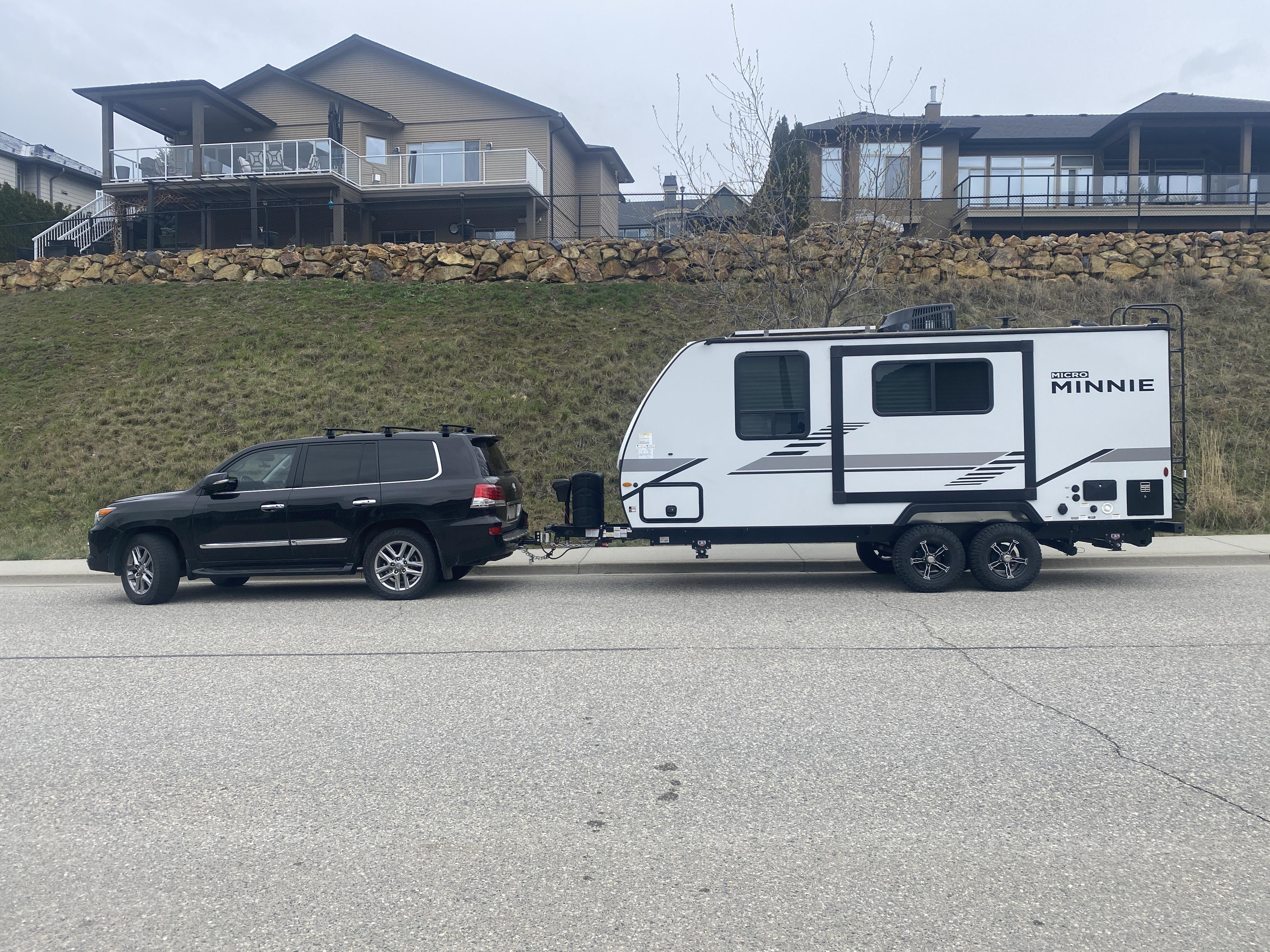
I understand, I hook up in high. I was just explaining that he misread what the previous poster had written about what was in the manual.Simple, use whatever position helps you put the ball in the coupler. AHC does not care.
@GordJ 's point, if I may, is that you may want to use AHC high to engage the WD mechanism That's because almost all WD tensioners relax when the hitch/tongue is lifted. Versus extra tensioned when in AHC low.
Most without AHC will use the tongue jack to lift extra high to make it easier to engage or tension up WD. We have the luxury of AHC to help.
This is the style of WDH I have because it's what came with the trailer. It's rated to 12K lbs, which is massive overkill but I never could find anything that said it was a problem to run a WDH that had significant capacity beyond the trailer weight.I have the same hitch as you and after I set the hitch once to where I am happy I count the links and after that I never have to change anything. Just back up to the trailer, put the AHC in Hi and when it is up I attach with the right number of links. It doesn’t matter what the ground is like because I set it up with “X” number of links in the chain on level payment the first time. I also do periodic eyeball confirmations by checking that the truck and trailer are sitting level on pavement. But I have also done driving comparisons with my “off-road” trailer, which is much like yours, and I tow it without a WDH because I found that with a smaller trailer like these there is no noticeable benefit to using the added weight and complexity of the WDH. And if you have take off the hitch and put it back on to drive around your back is grateful that you left it at home.
Reese Integrated Sway Control Weight Distribution Hitch, 8K
Shop the Reese Pro Round Bar Weight Distribution Kit with integrated sway control, designed for up to 8000 lbs. GTW. Enhance your towing experience. Buy now.
This is the style of WDH I have because it's what came with the trailer. It's rated to 12K lbs, which is massive overkill but I never could find anything that said it was a problem to run a WDH that had significant capacity beyond the trailer weight.
Reese Integrated Sway Control Weight Distribution Hitch, 8K
Shop the Reese Pro Round Bar Weight Distribution Kit with integrated sway control, designed for up to 8000 lbs. GTW. Enhance your towing experience. Buy now.www.campingworld.com
This is a case where overkill is worse than meets the eye. And perhaps less is more because the 200-series doesn't need a lot of WD compensation for smaller trailers.
Hitches exist to articulate. The job of WD is to compensate for a cantilevered bumper pull and apply just enough tension to transfer some of the load back to the front axle. While being tender enough in spring rate to still allow articulation when going over dips and bumps.
A high spring rate will essentially lock out the hitch and transfer huge forces to the tow vehicle and trailer frame when articulated in vertically. Off-road, the dynamic and repetitive forces will be compounded and the weakest link will give. With a beefy hitch, and tow vehicle, that often becomes the trailer tongue. Look that up, and you'll see far too many examples, with owners not understanding the contributing factors, and often blaming trailer manufacture.
I would encourage you to get a more appropriately sized hitch.
A useful trick - as we talked about raising the hitch to relieve WD tension, AHC high is useful again to be able to relax WD on the fly when hitting off-pavement or campgrounds.
Thanks for the perspective. I tried to get opinions about this 8 months ago when I bought the trailer and couldn't find anyone that had one. An appropriately 'sized' WDH sounds like a better approach. The only caveat is that the tongue weight can be 400 - 700 lbs depending on dry/empty or full and what stuff I threw into the cargo hold at the front of the trailer. But also, wouldn't the capacity be less of a concern for stiffness and more importantly the amount of tension the spring bars are set to in the nominal towing setup? Yes, the hitch is a monster and the bars are bigger. But the loads placed on the frame and weight shifting are primarily a result of the tension on the spring bars. I set everything up to provide the tension that is required to get the front fender height returned to their pre-loaded height. And when I get to the campsite and need maneuverability, I actually remove the spring bars so I have more vertical and turning articulation.This is a case where overkill is worse than meets the eye. And perhaps less is more because the 200-series doesn't need a lot of WD compensation for smaller trailers.
Hitches exist to articulate. The job of WD is to compensate for a cantilevered bumper pull and apply just enough tension to transfer some of the load back to the front axle. While being tender enough in spring rate to still allow articulation when going over dips and bumps.
A high spring rate will essentially lock out the hitch and transfer huge forces to the tow vehicle and trailer frame when articulated in vertically. Off-road, the dynamic and repetitive forces will be compounded and the weakest link will give. With a beefy hitch, and tow vehicle, that often becomes the trailer tongue. Look that up, and you'll see far too many examples, with owners not understanding the contributing factors, and often blaming trailer manufacture.
I would encourage you to get a more appropriately sized hitch.
A useful trick - as we talked about raising the hitch to relieve WD tension, AHC high is useful again to be able to relax WD on the fly when hitting off-pavement or campgrounds.
Last edited:
That's my line of thought, too. So long as the correct amount of tension is in place, the tool placing the tension really shouldn't matter. (Outside of its own weight, usability, etc.)But also, wouldn't the capacity be less of a concern for stiffness and more importantly the amount of tension the spring bars are set to in the nominal towing setup? Yes, the hitch is a monster and the bars are bigger. But the loads placed on the frame and weight shifting are primarily a result of the tension on the spring bars. I set everything up to provide the tension that is required to get the front fender height returned to their pre-loaded height. And when I get to the campsite and need maneuverability, I actually remove the spring bars so I have more vertical and turning articulation.
Thanks for the perspective. I tried to get opinions about this 8 months ago when I bought the trailer and couldn't find anyone that had one. An appropriately 'sized' WDH sounds like a better approach. The only caveat is that the hitch weight can be 400 - 700 lbs depending on dry/empty or full and what stuff I threw into the cargo hold at the front of the trailer. But also, wouldn't the capacity be less of a concern for stiffness and more importantly the amount of tension the spring bars are set to in the nominal towing setup? Yes, the hitch is a monster and the bars are bigger. But the loads placed on the frame and weight shifting are primarily a result of the tension on the spring bars. I set everything up to provide the tension that is required to get the front fender height returned to their pre-loaded height. And when I get to the campsite and need maneuverability, I actually remove the spring bars so I have more vertical and turning articulation.
Two parts to a spring. Spring rate (stiffness of a spring), and applied load (force applied to the spring to compress it).
Sure, you can get the right tension with any spring.
Problem is that the rate increases significantly faster, with far higher tension increase with any articulation. Much like the gentle riding 200-series, versus a stiffly sprung F350. You're putting F350 forces into the 200-series hitch and trailer tongue.
Glad to hear that you're removing the spring bars when entering campsites. But do think about dips in intersections and bigger gutter dips entering gas stations.
Things bend and the 12k bars wont be doing their part against a comparatively lightweight 4500lb Jayco tongue.