Points gap verse dwell

This site may earn a commission from merchant affiliate
links, including eBay, Amazon, Skimlinks, and others.

Joined
Dec 21, 2012
Threads
3
Messages
14
Greetings all,
I just tuned my FJ 40 after an engine rebuild (1974 cruiser with a 1970 F motor). In order to get the dwell angle between 39-44, I ended up having to gap at 0. 20mm vice the published 0.45mm. I'm assuming that actual dwell angle trumps gap. Any thoughts on this?
Yuma
 
The generally accepted rule here is to set the points using the gap spec rather than the dwell. It seems that most find that the specs are inconsistent-as you have found.
 
The LAST thing I would do in your scenario is run the factory gap.

STOP RIGHT NOW!

You only have ONE chance to properly seat the rings in a rebuilt engine. Factory point gap in your situation will leave you with a weak spark, meaning you are going to have unburned gas potentially washing your rings out. Then they will never seat properly.:frown:

You HAVE to run at the correct dwell to get the correct voltage out of the coil and the correct spark, even if it means that you end up burning points prematurely. Points are a lot cheaper and faster to change than piston rings.:hhmm:

In the long run, you should consider installing an electronic ignition. Dwell is pre-set and not affected by your obviously worn dizzy.

Best

Mark A.
 
Dwell is how long the points stay closed. The parts that affect this in the system are the lobes of the distributor shaft and the phenolic (or whatever it is made of) contact bush on the points themselves. I haven't gotten around to fully setting my 11/73 yet (I set my point gap within spec, but dwell is at 55.8* IIRC). The options are either new points and hopefully the bush is longer and takes it up, or a new distributor shaft (these usually come wrapped in a new distributor, which seems to be NLA).

I believe another option for proper rectification is electronic points. I've had poor luck with these in the past, and I've had good luck. The brand is important. I want to say Pertronix was the one that did me well enough. The problem is that electronic points can fail in weird and inconsistent ways...
 
Mark, what he is finding, and what I have read here often, is that to meet the dwell spec, the point gap needs to be too SMALL. He's setting the point gap at about .008" instead of .018". Isn't it true that the narrow point gap will cause the weak spark and then the other issues you are talking about?
 
For what it is worth I had to reduce the gap to get the dwell angle up. At 0.20mm I got 40. Motor also runs better and I was able to time at 7 deg BTDC.
Brad
 
edwjmcgrath said:
Mark, what he is finding, and what I have read here often, is that to meet the dwell spec, the point gap needs to be too SMALL. He's setting the point gap at about .008" instead of .018". Isn't it true that the narrow point gap will cause the weak spark and then the other issues you are talking about?

On the contrary, higher dwell=higher spark. While points are closed,voltage is building in the coil. Unfortunately,a small point gap increases the likelihood that the points will arc and burn prematurely. At .008" I wouldn't expect them to last more than a week of daily driving.

Best

Mark A
 
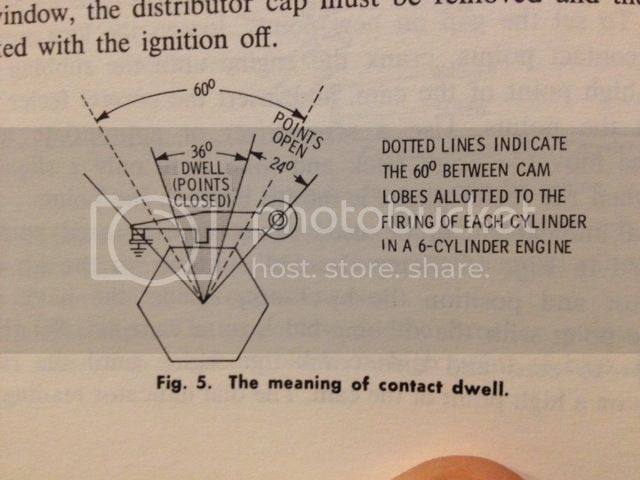
Expanding and illustrating further, dwell is the time (typically expressed in degrees rotation, though I've seen some older Fords express it as a percentage) that the points are in contact as illustrated.

photo-6_zpsff4707fd.jpg


Dwell angle is inversely proportional to point gap, thus increasing the point gap decreases dwell and vice versa.

Too small a point gap will pit and wear quickly due to a higher total average current through the points, too far and you'll have ignition failure at higher RPM due to point bounce.

Ergo, you set your point gap within the tolerances specified in the manual in order to attain the dwell tolerances specified in the manual. If these two specifications can not be met simultaneously, a new set of points is in order (necessary for a taller rubbing block to make up the delta in the geometry due to excessive wear). If the condition is not rectified by a new set of points, a new distributor shaft is in order (or just a new distributor, as previously mentioned). Electronic points bypass the wear point issues that may arise between the rubbing block and the distributor shaft, and are an excellent alternative when (as may be the case) a new distributor is NLA.
 
Last edited:
The generally accepted rule here is to set the points using the gap spec rather than the dwell.

You HAVE to run at the correct dwell to get the correct voltage out of the coil and the correct spark,
Mark A.


Well, shoot...I always thought that the Dwell spec was a typo, 'cause I could never get the gap and dwell to coincide. I fixed it with a Pertronix years and years ago.
 
Expanding and illustrating further, dwell is the time (typically expressed in degrees rotation, though I've seen some older Fords express it as a percentage) that the points are in contact as illustrated.


Dwell angle is inversely proportional to point gap, thus increasing the gap increases dwell and vice versa.

Too small a point gap will pit and wear quickly due to a higher total average current through the points, too far and you'll have ignition failure at higher RPM due to point bounce.

Ergo, you set your point gap within the tolerances specified in the manual in order to attain the dwell tolerances specified in the manual. If these two specifications can not be met simultaneously, a new set of points is in order (necessary for a taller rubbing block to make up the delta in the geometry due to excessive wear). If the condition is not rectified by a new set of points, a new distributor shaft is in order (or just a new distributor, as previously mentioned). Electronic points bypass the wear point issues that may arise between the rubbing block and the distributor shaft, and are an excellent alternative when (as may be the case) a new distributor is NLA.
^^^This
 
As far as dwell vs spark goes, either too much dwell or too little can cause weak spark. When the points close, current begins flowing in the coil. At first the current is limited by the time constant (inductance, capacitance, and resistance) of the coil circuit. Eventually, the current reaches the point where it becomes limited by the resistance alone. If the points stay closed beyond that point, no increase in current or coil output voltage will be seen. If the points open before the coil is at full current, you will get weak spark. This is mostly a high RPM issue.

When the points open, again, the points need to stay open long enough for the magnetic field to collapse and induce the voltage on coil secondary. If they are not open long enough, the spark will be weak. But beyond a point determined by the coil circuit R,L,C, longer opening does not give you stronger spark. This is mostly a low RPM issue.

Like many people on this board, I found that I could not get my (new) points to be at the specified gap and the specified dwell. I've messed about with old vehicles with points for almost 50 years now and I've never seen such a disconnect between specified gap and dwell. Maybe we all have worn dizzy's but somehow I doubt it. I decided that Pertronix points replacement was the right answer for me. I set it and forget it several years ago. I do carry a set of points in my glove box (just in case). If I need to install them, .018 is about the thickness of a matchbook cover. I'll have to find a smoker to help me out.

And by the way, it's VERSUS, not VERSE. http://en.wikipedia.org/wiki/Verse
 
Last edited:
I decided that Pertronix points replacement was the right answer for me. I set it and forget it several years ago.


X3 on the Pertronix. 12 years on mine now, works flawless. Not having to gap points in that long is worth the cost right there.


I do carry a set of points in my glove box (just in case). If I need to install them, .018 is about the thickness of a matchbook cover. I'll have to find a smoker to help me out.

I also kept my points just in case but have never needed them. When I did have them I always used the .018 gap which seemed to work the best. I learned the matchbook trick many years ago when I had VW's. This has saved me and several friends many times over the years. I always have a matchbook or two stashed in the cruiser "pocket" to use as an improvised feeler gauge or just the mundane task of lighting the campfire. The ones that come in MRE's last the longest and stay dry. :cool:
 
This is a great thread. Everyone is spot on. In order to agree with the manual, everything must be exact...;
1. Cam lobes have no wear
2. Dist. shaft has no real wear.

Even then, as soon as the points are installed the wear begins. Most points have a grease to use on the phenolic to decrease this, but , being mechanical, it will begin.

I am running a pertronix also and they are making a living on converting the "points" concept to a more forgiving electronic , not mechanical, system.

You can always keep the points in the glove box , as I do , in case.
 
On the contrary, higher dwell=higher spark.

Yes, but only up to the point that the coil is fully magnetized. Once the coil is saturated, there is no further increase in power. Your average coil takes a millisecond or two to fully magnetize, so the practical effect is that you only start to run into problems above 7,000 RPM. In other words, the dwell can be off by a whole lot and it will still have time to fully charge up a coil on a 2F.
 
Thanks for the great info. Can anyone provide a link for the pertronix electronic points that are mentioned above for a 1970 F motor?
 
You are always better off setting the dwell. It's a more accurate way of setting points and the preferred method of most maintenance facilities.

It takes the "fudge factor" out of feeler gage use. If the dwell method also can give a visual indication of wear in the distributor shaft or lobes.

Coonassjohn
'83 fj40,
 
Well maybe not "always".
If the dwell spec is inconsistent with the gap spec, and using the dwell spec results in the point gap being so narrow that the spark is weak, causing incomplete combustion and unburnt gasoline into the rings and oil, THAT would be bad.
Normally I would agree with you, but there seems to be enough evidence of a problem with this vehicle that I would measure both the gap and dwell. If the gap seems to be very narrow when the dwell is to spec, I would use the gap.
 
I was never able to get the "correct" dwell setting on my 2F, but it ran for 10 years at a gap of .016.
I made a living doing tune ups and this is the first engine that I could not get the dwell dialed in on.
YMMV
 
Well maybe not "always".
If the dwell spec is inconsistent with the gap spec, and using the dwell spec results in the point gap being so narrow that the spark is weak, causing incomplete combustion and unburnt gasoline into the rings and oil, THAT would be bad.
Normally I would agree with you, but there seems to be enough evidence of a problem with this vehicle that I would measure both the gap and dwell. If the gap seems to be very narrow when the dwell is to spec, I would use the gap.
Sounds like the problem may be something other than this basic timing issue. Look elsewhere!
 
Back
Top Bottom