


Navigation
Install the app
How to install the app on iOS
Follow along with the video below to see how to install our site as a web app on your home screen.
Note: This feature may not be available in some browsers.
More options
Style variation
You are using an out of date browser. It may not display this or other websites correctly.
You should upgrade or use an alternative browser.
You should upgrade or use an alternative browser.
Points gap verse dwell
- Thread starter Yuma Cruiser
- Start date
This site may earn a commission from merchant affiliate
links, including eBay, Amazon, Skimlinks, and others.


Took some effort but I found the unit at Summit Racing. There was no information on the Crane website or catalog. The unit sells for $107 and apparently you also need an installation kit for $35.

X-2 Gap trumps dwellThe generally accepted rule here is to set the points using the gap spec rather than the dwell. It seems that most find that the specs are inconsistent-as you have found.
Points lasted exactly three months. Hard starting and running on when switching off the key. No other changes than new points, which had cratered badly. Starts with a touch of the key and shuts down immediately. Runs smooth, idles perfectly and pulls strong pulling up onto the entrance ramp.

Your post is confusing. You say that it starts and shuts down immediately and then you say it idles perfectly.Points lasted exactly three months. Hard starting and running on when switching off the key. No other changes than new points, which had cratered badly. Starts with a touch of the key and shuts down immediately. Runs smooth, idles perfectly and pulls strong pulling up onto the entrance ramp.
What are conditions when it shuts down/runs on and when does it run smooth and idle perfectly?
And...A bad capacitor/condenser can cause points to burn out quickly.
In the discussion regarding points gap vs dwell a few months ago I decided to go with Pinhead's approach and use point gap. I put about 5,000 miles on that set of points and over the past couple of weeks it became hard starting and wanted to run on a little after turning off the key, so I would slowly engage the clutch to kill it. It would start up fine and run fine after it was warm. So two days ago I wanted to look things over, this was a major transformation of parts from my '70 to this "new" '79. This included suspension, wiring harness my "new" '83 motor, etc. So I wanted to check torque on spring plates, shocks, motor mounts. I got out my dwell meter and timing light and found the dwell down around 8* and no timing mark in the window. I pulled the distributor cap off and took a look. The points were badly cratered. So I installed new points at .016 gap, adjusted timing and now it starts with a touch of the key, like it did a few months ago, and idles smooth as, well, as smooth as a tractor motor will idle. Shuts off immediately when the key is turned off and is much smoother on acceleration. Appearance wise I have not noticed a difference in the points I buy at the Toyota parts store here, they do not say Toyota or Nippondenso, just made in Japan. That is the same for these last two sets of points I have purchased, just made in Japan, so I don't know if there is any difference in materials at the contacts. These two sets of points cost me less than $5.00 for the pair from one place, $8.00 each at the Toyota parts store. I am running NGK BPR5ES plugs at .028 gap with a Taylor-Vertex 45K epoxy filled coil and Mallory 1.5 ohm ballast. The car runs like a top, until the points start failing.
In that case, I'd start with a new condenser. It's purpose is to reduce sparking across the points as they open and close.
A bad condenser means points burn out in a few months.
A bad condenser means points burn out in a few months.
I can try that. Any idea on how you would verify whether a condenser is bad or not? I seem to recall FJ40 Jim saying that condensers rarely go bad but that he has had condensers that were new that were bad. Not sure how to check that.
Jim is right that they rarely go, but they cost around a buck or two. So if you experiencing the symptom that a failed one would cause, I'd just replace it.
Back in the day, points/rotor/condensor came together in a package and you replaced them with every "tuneup".
There are condensor testers that cost $50 but they're never sold because it's cheaper just to throw a new one in.
Back in the day, points/rotor/condensor came together in a package and you replaced them with every "tuneup".
There are condensor testers that cost $50 but they're never sold because it's cheaper just to throw a new one in.
I was just doing some research. Apparently a good tester is $200!?! Also, I was checking Summit Racing and generic condensers are $12 now. Wow, what a surprise. But I did find where the discharge of the condenser/capacitor is what is supposed to help the life of the points. So apparently the motor can run fine, the points just won't last as long.
Are you running the condenser inside the housing or outside?
Are you running the condenser inside the housing or outside?
I don't run a condenser at all. I put a pertronix in. I've changed enough points for many lifetimes already.
OEM Condensers are $5.
Genuine OEM Toyota CONDENSER | 90099-52060
OEM Condensers are $5.
Genuine OEM Toyota CONDENSER | 90099-52060
Expanding and illustrating further, dwell is the time (typically expressed in degrees rotation, though I've seen some older Fords express it as a percentage) that the points are in contact as illustrated.
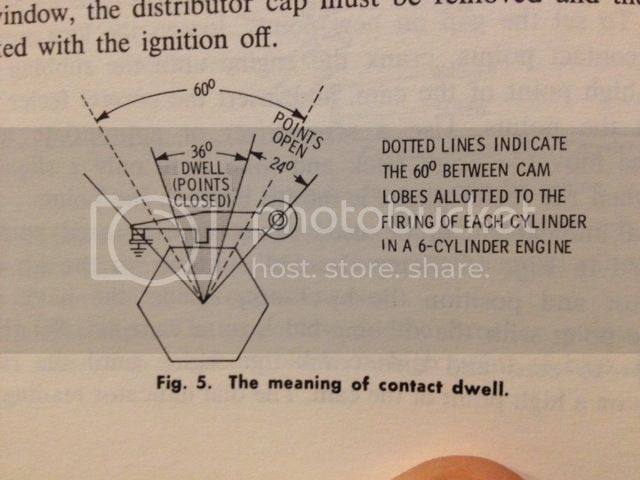
Dwell angle is inversely proportional to point gap, thus increasing the point gap decreases dwell and vice versa.
Too small a point gap will pit and wear quickly due to a higher total average current through the points, too far and you'll have ignition failure at higher RPM due to point bounce.
Ergo, you set your point gap within the tolerances specified in the manual in order to attain the dwell tolerances specified in the manual. If these two specifications can not be met simultaneously, a new set of points is in order (necessary for a taller rubbing block to make up the delta in the geometry due to excessive wear). If the condition is not rectified by a new set of points, a new distributor shaft is in order (or just a new distributor, as previously mentioned). Electronic points bypass the wear point issues that may arise between the rubbing block and the distributor shaft, and are an excellent alternative when (as may be the case) a new distributor is NLA.
Spectre, thanks for the photo, setting Dwell now.
Boaf
I don't run a condenser at all. I put a pertronix in. I've changed enough points for many lifetimes already.
OEM Condensers are $5.
Genuine OEM Toyota CONDENSER | 90099-52060
I have seen a couple of different Pertronix options. I am running a new, but conventional, points distributor. I use a Taylor-Vertex epoxy filled coil (45K volts) and a Mallory ballast resistor. Can you tell me what number Pertronix you are running? Thanks, Lenny.