do you solder or crimp?

This site may earn a commission from merchant affiliate
links, including eBay, Amazon, Skimlinks, and others.

Another technique that hasn't been discussed and that I hold from an old timer (a really old oldtimer now!) is that you should NOT straight cut the insulation. This technique is used mainly when wrapping wire around connection posts and prior to doing splice joints.

Straight-cut insulation can add stress which can eventually CUT the wire. It's especially important with heavily insulated, fine stranded, small caliber wires.

Of course it's not that easy as doing it manually with a knife, it can lead to cutting wire strands, but it has its place.

When dealing with regular spade, eye and other connectors, most good ones have, on top of the crimp area itself, an 'insulation grab' crimp area so this technique is not needed in that case.

Please correct my terminology if it's imprecise ;)

I've only seen this issue with very thick, very stiff or tough insulation and very fine stranded wire, and even then rarely.

Keep in mind that if heat shrink tubing is used, it will help to ease the transition from thick and/or stiff insulation to the very fine wires, giving a bit more support in this area.

I usually don't use wire strippers unless the wire is unusually tough. I use a very sharp small pair of wire cutters and judge my cut depth from experience. It saves me a bit of time. But that's something many people will not be able to do without a lot of experience, if ever. So my recommendation for most people is to get a very good pair of wire strippers, and pay attention to the wire gauge size for the wire and the striper hole.
 
I use Deutsch connectors when I alter or add something, they are crimp type but use a special crimper and matching pins and sockets.

Crimper is big bucks and the parts would have minimum order value, but we use them at work and the boss knows I can't use too many on two Toyotas. CAT use the same connectors on engines, imagine the duty for an oil pressure sensor on an engine running 97% up time a year or a dozer operating who know where.

Link below shows the Deutsch system, notice how they describe a crimp as a "cold" weld process.

Common Contact System by Deutsch ECD Industrial Products Division
 
crimping is actually a better connection. i dont know if this has already been stated on here but with a crimped connection there is less voltage drop over the connection and the connection isnt as brittle as with a soldered connection. i wish i could find the article i saw that had all this information in it.

-miles

For 12 years I was employed as a "technical writer" writing "technical education material" Miles. But I'm stating this not because I think you should take any more notice of what I have to say - Rather - for the opposite reasons!

I worked for the "Technical Correspondence Institute" (TCI) in Lower Hutt, Wellington. (Information just to prove I'm not bullsh*tting.)

IMO - Just because something is there in print shouldn't necessarily give it any more weight than if it is simply said verbally over a pint of beer.

I have no problems admitting there was cr*p in some of the printed material that came out of TCI. (And there will still be cr*p in the material coming out of "TOPNZ" which is what that outfit changed its name to. Although it is a considerably different organisation now.)


:cheers:
 
It has been "playing on my mind" that technique with both soldering and crimping is as important as having the correct tools.

(By the way - My big heavy battery leads are "crimped only" and I have no complaints with them! So I am not advocating soldering for everything.)

And I was recently shocked to see the "poor soldering technique" used by the editor of a 4x4 magazine over this way. His technique was being displayed "as an example for others to follow" as he showed us his installation of spot lights on his rangerover.

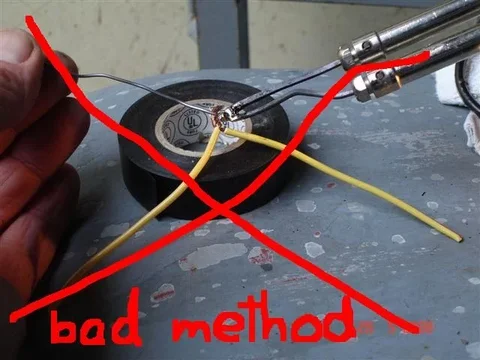
And his techique as I recall (I've given away the mag), was to twist the wires together like this for soldering:

badtechnique2.webp

Then he said he would wrap those joins with insulating tape.

Well insulating tape of the type used in my picture will ALWAYS tend to unwind (and risk exposing live wires to short-circuiting). This is why most of us go for heat shrink sleeving. (A trap we all fall into though is to forget to slip it on the wires before soldering. :D) You can of course (and I do) prevent this "unravelling" by securing the end of it with a light-duty cable-tie. But trying to protect something horrible like "this spike protruding at right-angles to the line-of-the-wire" is prone to failure anyway.
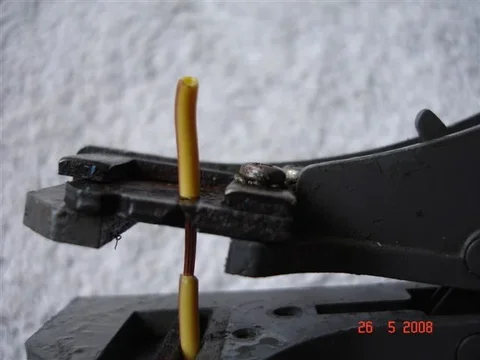
Here is a photo of my wirestrippers at work. They can remove the insulation easily without damaging any strands:

strip1.webp

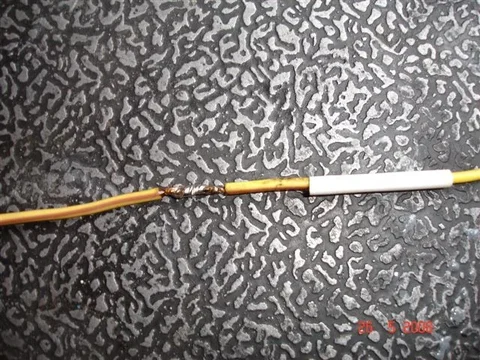
And such a joint should have really been done like this in my opinion:

bettertechnique3.webp
strip1.webp
bettertechnique3.webp
badtechnique2.webp
 
Last edited:
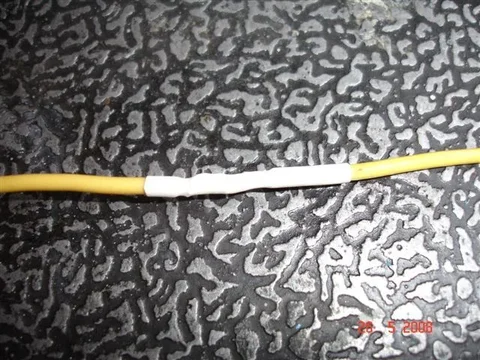
And here's the photo of the finished joint (although you can see I didn't centre the "heat shrink sleeve" properly which "hurts" for a fussy bugger like me.

done5.webp

By the way - You can join one wire to two or more wires in this way.

And I have done trailer wiring like this. There I actually put "neutral-cure silicone sealant inside the heat shrink prior to shrinking it".

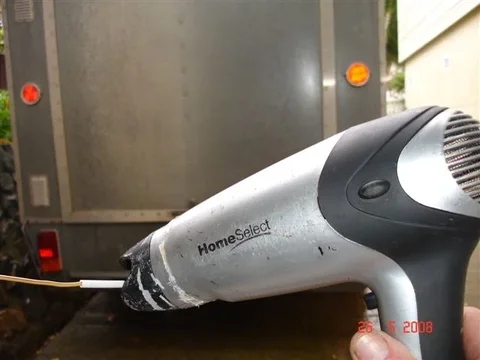
Ah yes. Best to avoid using cigarette lighters or matches to shrink your sleeving. A simple hair dryer works great. (Maybe not in Alaska in winter though :D)

shrink4.webp
done5.webp
shrink4.webp
 
Great write up and picture, Lostmarbles! (I always splice the wires the way you do it, as well, but I use silicone grease instead of the sealant you use, it stays soft) ;)

How do you get the pictures to be in line with the text and not bunched up at the end like when I attach mine?
 
Exactly

X2 Lostmarbles. Great write up and pics. This is exactly what a thread like this needs, pictures of the the techniques that people are discussing. Question as to the pros/cons of using silicon sealant v. silicon grease on top of a soldered join like this under the heat shrink sleeve, especially in light of the earlier discussion about the possible damaging effects of using solder or other materials on joined or crimped wire strands. thanks.:cheers:
 
It has been "playing on my mind" that technique with both soldering and crimping is as important as having the correct tools.

(By the way - My big heavy battery leads are "crimped only" and I have no complaints with them! So I am not advocating soldering for everything.)

And I was recently shocked to see the "poor soldering technique" used by the editor of a 4x4 magazine over this way. His technique was being displayed "as an example for others to follow" as he showed us his installation of spot lights on his rangerover.

And his techique as I recall (I've given away the mag), was to twist the wires together like this for soldering:

View attachment 233400

Then he said he would wrap those joins with insulating tape.

Well insulating tape of the type used in my picture will ALWAYS tend to unwind (and risk exposing live wires to short-circuiting). This is why most of us go for heat shrink sleeving. (A trap we all fall into though is to forget to slip it on the wires before soldering. :D) You can of course (and I do) prevent this "unravelling" by securing the end of it with a light-duty cable-tie. But trying to protect something horrible like "this spike protruding at right-angles to the line-of-the-wire" is prone to failure anyway.
Here is a photo of my wirestrippers at work. They can remove the insulation easily without damaging any strands:

View attachment 233401

And such a joint should have really been done like this in my opinion:

View attachment 233402
That is a good example of a Western Union or Line Mans splice. Twenty years ago it was the standard method of splicing stranded wire.

Nice job on the soldering.

The solder alloy is most likely Tin/Lead, probably Sn/Pb 63/37.

Lead alloy solder will soon be a thing of the past, then you can expect a grainy solder joint that is much harder to tell from a cold solder joint. I've been doing lead free processing for five years now, it's a much different game. We did a lot of re-training of our staff when we converted. it's much more difficult to solder with lead free alloys.
 
Lead alloy solder will soon be a thing of the past, then you can expect a grainy solder joint that is much harder to tell from a cold solder joint. I've been doing lead free processing for five years now, it's a much different game. We did a lot of re-training of our staff when we converted. it's much more difficult to solder with lead free alloys.

So stock up now?
 
I don't remember who said it, but it bears stating again" One of THE most critical parts of ensuring a trouble free connection is to SECURE the connection! It doesn't matter if you crimp, solder or some combination of both if you let the connection hand loose so it can move it WILL fail!

If you look at Toyota wiring in the Cruiser you will find they secured the harness in many locations to prevent any movement.

If you do connect to something like the engine where vibration and movement is an issue, then secure each end as close to the connection as possible so it can't move. Then leave a loop of excess material that can absorb any movement. An excellent example of this on the Cruiser is the brake line mounted on the firewall that goes to the rear of the vehicle. Notice how they coiled the line? That coil allows a lot of movement without causing any single point on the line to experience fatigue.

I am in the camp of crimp then solder and heat shrink. I also apply either dielectric grease or self fusing silicone tape or the liquid rubber stuff to critical joints. I have started using the Weather-Pak connectors on kits I sell and when I get to that phase of my restofication I will replace the OEM connectors with those in weather exposed connections.
 
hmm, good reading since I will be installing a radio soon.
So I plan on using those barrel connectors that you crimp on both ends. Sounds good?

I'll buy a dedicated crimp tool...
I saw that western union solder connection but don't know how you do it. looks time consuming, but clean.
 
For connection to a terminal I like these, the plastic outer coating for the connector is a shrink wrap. So in this case I crimped, no solder, heat to shrink. They make them to join wire to wire also, quite the difference in quality from make to make. I tracked these down at a hardware store. The good ones secure fast the wire. Oh and LostMarbles, WAY to get your message accross, No one should be confused now, the only way you could have made it any clearer I think would be to put a big circle and slash, maybe a skull and cross bones too, the red, a nice touch.
winchwires1.webp
 
........Oh and LostMarbles, WAY to get your message accross, No one should be confused now, the only way you could have made it any clearer I think would be to put a big circle and slash, maybe a skull and cross bones too, the red, a nice touch.


He he he.

Well I know what I'm like at skim reading posts so I thought I'd better make it ABUNDANTLY clear that I wasn't promoting that style of joint. :hhmm: (Hmm. Skull and crossbones could be a good idea for next time.)
 
I don't remember who said it, but it bears stating again" One of THE most critical parts of ensuring a trouble free connection is to SECURE the connection! It doesn't matter if you crimp, solder or some combination of both if you let the connection hand loose so it can move it WILL fail!

If you look at Toyota wiring in the Cruiser you will find they secured the harness in many locations to prevent any movement.

If you do connect to something like the engine where vibration and movement is an issue, then secure each end as close to the connection as possible so it can't move. Then leave a loop of excess material that can absorb any movement. An excellent example of this on the Cruiser is the brake line mounted on the firewall that goes to the rear of the vehicle. Notice how they coiled the line? That coil allows a lot of movement without causing any single point on the line to experience fatigue.

I am in the camp of crimp then solder and heat shrink. I also apply either dielectric grease or self fusing silicone tape or the liquid rubber stuff to critical joints. I have started using the Weather-Pak connectors on kits I sell and when I get to that phase of my restofication I will replace the OEM connectors with those in weather exposed connections.

I used these common metal / rubber loops to secure the harness. They are secured at the original locations. I placed a donut style grommet in the OE loop holes. The grommets hold a wood screw fairly well mounting the loop to the firewall. it always HAS to happen, some guy takes a perfectly good thread and tangents the thing right off the tracks! Some people I tell ya, WELL!
wireloom.webp
 
I don't remember who said it, but it bears stating again" One of THE most critical parts of ensuring a trouble free connection is to SECURE the connection! It doesn't matter if you crimp, solder or some combination of both if you let the connection hand loose so it can move it WILL fail!
.....
True to a point, but the reason we use stranded wire is because it flexes. If you don't allow for some flex you defeat the purpose.
I like to support a wire harness at many points but allow it to move inside the supports. DO NOT OVER TIGHTEN zip ties used to attach a wire loom to the chassis.
 
I used these common metal / rubber loops to secure the harness. They are secured at the original locations. I placed a donut style grommet in the OE loop holes. The grommets hold a woo
rsbcruiser, where do you find these "common" metal/rubber loops?

I must be living a third world country, never seen any (I know where to get the "common" plastic ones used in electronics, though)
 
Yeah, let's find out what they used!!!
 
Back
Top Bottom