do you solder or crimp?

This site may earn a commission from merchant affiliate
links, including eBay, Amazon, Skimlinks, and others.

+1

Edit: Here is a good short article on quality terminals and crimpers and what they look like - AeroElectric Connection - Crimp Tools Comparison

Joel,
Thanks for posting the article, a nice breakdown with pics. My take home message is that I need to upgrade my ancient POS radio shack crimper to something aspiring to the "El Cheapo" ratcheting crimper one mentioned in the article. LOL:doh:
 
I think rusty has already said it all, but I just wanted to add one more voice of support for crimped connections. I'm an aeronautical engineer at a company that makes communications satellites; every harness is crimped. For space applications there are obviously huge reliability concerns... everything has to endure launch loads and then 18 years of daily +80/-30C temperature changes without maintenance.

(Incidentally, when I was green I tried to specify connectors with solder cups because I was more familiar with them... I was none-too-kindly set straight. I should also add there are some other reasons not to use solder in space, like tin-whiskering phenomena, but thats beside the point.)
 
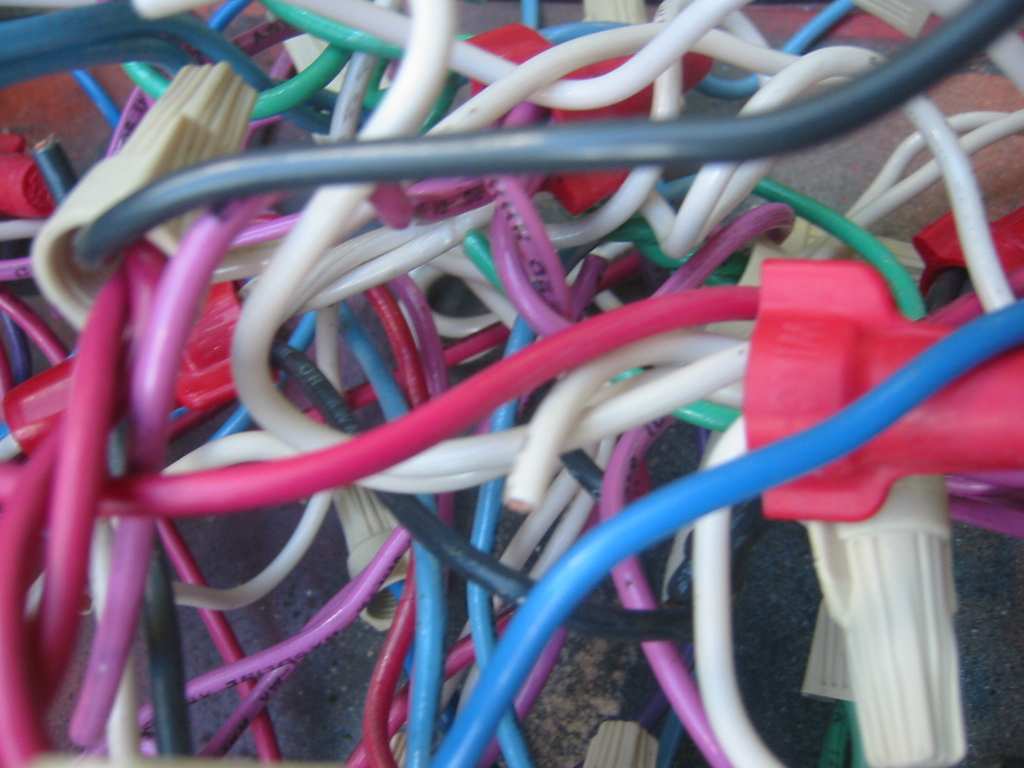
So would the experts here have anything to say about my personal technique??


050612-wirenut.jpg

Looks like the under the dash POS wiring job the PO of the rig left me to deal with :bang: hence my intense interest in the subject.:clap:
 
How about spot welding?

For stranded wire a proper crimp connection is more reliable than a soldered connection.
This is not opinion, it is fact based on studies conducted by NASA, IPC and JEDEC.

You will not find a single soldered wire connection in any production vehicle manufactured today. EVERY wire connection in the space shuttle or any satellite and EVERY wire connection in any military airplane, ship, boat or ground vehicle is a crimp connection.

Why soldered connections fail:
The solder binds the wire strands together and does not let them flex.
Solder contains flux which is corrosive, it wicks into the wire under the insulation and cannot be cleaned.​

Do yourself a favor and learn how to make a proper crimp connection.
Get a good pair of crimper's and the correct connectors to go with them. If you pick up the multi pack at Autozone and use their POS crimper you will have s*** connections. Panduit, Greenlee, and Amp all make good crimp tools.

I agree with you in principle, for two reasons: if you use wire and connector of the same chemical composition (let's say copper), proper crimping will actually anneal the metal and make a very strong connection, and if of the same metal, will resist electrolytic oxydation. But the problem in our cars, and I've seen it (have you seen how corroded a tailgate wiring harness becomes after 15 years in the salt belt? The wire is all black!), is that it oxydizes tremendously at the connector and it invariably fails there.

My solution is crimp, solder, clean, dip in silicone grease while hot, clean then heat-shrink. Some of my oldest repairs done like that are still OK after more than 10 years. But I do agree that soldering makes the wire more fragile at the interface between the soldered and non soldered section and it can snap there with enough vibration.

I would think that a more durable and one with lower resistance would be one using spot welding instead of solder. How about that, what do you think?
 
i do both.
i solder the wires that are under tho hood. mainly to prevent corrosion. and also to make sure they stay put, if i have to crawl up there to work on somthing.

rusty does bring a good point, the flux is corrosive.
there are two common types of flux, acid core and rosin core. rosin core is what to use when doing wires. it does not attract water like acid core. so acid core would be much more prone to corrosion than rosin. from what the manufacture says, rosin is safe to use. i dont know which flux you are reffering to, rusty

there is a method to crimping stuff. the butt connector are harder to crimp in the following way, but can be fastened tight enuff.

i use a long handle crimper from snap on. those stamped flat things are junk, and hard to make effective connections. mine has three functions. the very end is for snipping.
this next part may be hard to describe, but i will do my best, as it is a very effective reliable method.

you first crimp the connector with the end that has a tab, and half circle. if viewed from the side it may look like this

>)

you position the connector center, where the seam is, you know where the two ends meet. to the tab on the tool and crimp it hard.

then rotate the connector 90 degrees and crimp it with the part that looks kind of like thos

( )

once you crimp it twice, it make a double fold, very similar to what you would see on a factory crimp.

pay no attention to the writing on the tool, that says bare connector and insulated connector.

most of the time i take off the colored plastic thing, as it will usually fall off any way.
 
I've completely rewired several vehicles an use the crimp/heat shrink connectors. Never had any problems with that - I live in the south though. One vehicle has been in the mud quite often with no probs.
 
As a practical matter, I have seen a lot of crimp type connections fail, either by pulling out (improperly crimped), insulation problems or because of corrosion. No doubt that with the proper tools, connectors and techniques, that these problems could be minimized or eliminated, but many people making crimp connections don't have these tools or skills.

I just don't see soldered connections failing in automotive applications with the same frequency. The only soldered connections that fail are plug type connections to PC boards and this is more of a vibration problem breaking the PC trce rather than a problem with the solder joint. Solder in never a negative in automotive applications where the wire runs within a normal temperature range. It is like ginseng: always a positive influence.
 
As a practical matter, I have seen a lot of crimp type connections fail, either by pulling out (improperly crimped), insulation problems or because of corrosion. No doubt that with the proper tools, connectors and techniques, that these problems could be minimized or eliminated, but many people making crimp connections don't have these tools or skills.

I just don't see soldered connections failing in automotive applications with the same frequency. The only soldered connections that fail are plug type connections to PC boards and this is more of a vibration problem breaking the PC trce rather than a problem with the solder joint. Solder in never a negative in automotive applications where the wire runs within a normal temperature range. It is like ginseng: always a positive influence.
Exactly the point, you see failures because someone used crap material and crap tools. The same guy would make a crap solder joint.
Poor workmanship is poor workmanship.

It could be argued that it's easier to learn to make a good crimp connection than to learn to solder properly. I've taught dozens of people to do both.
 
X10 for crimping wires.

On occasion, I'll solder after crimping.

Been in the RF Radio/Electronics industry for over 25 years.

This tool is always in my bag.
20254.webp
 
X10 for crimping wires.

On occasion, I'll solder after crimping.

Been in the RF Radio/Electronics industry for over 25 years.

This tool is always in my bag.

Love this crimper. I've been into radios for 20 years and a ham for 8. I crimp and solder when I can. Solder and crimp both have their places. Either will fail in a harness if you don't secure the harness. A rats nest of wires will fail sooner than later. A properly routed and secured harness will last a long time.
In the ham radio field, I've never had a problem with well soldered rf (pl) connectors on coax. I've seen factory crimps fail on more than one occasion.
Like the statements voiced earlier, skill in either (or both) practices will greatly enhance the chances of connector survival.
My current project 40 is getting an EZ harness w/ weatherpack connections. I'm sure the iron will be used before the project is done.
 
i do both.
i solder the wires that are under tho hood. mainly to prevent corrosion. and also to make sure they stay put, if i have to crawl up there to work on somthing.

rusty does bring a good point, the flux is corrosive.
there are two common types of flux, acid core and rosin core. rosin core is what to use when doing wires. it does not attract water like acid core. so acid core would be much more prone to corrosion than rosin. from what the manufacture says, rosin is safe to use. i dont know which flux you are reffering to, rusty

there is a method to crimping stuff. the butt connector are harder to crimp in the following way, but can be fastened tight enuff.

i use a long handle crimper from snap on. those stamped flat things are junk, and hard to make effective connections. mine has three functions. the very end is for snipping.
this next part may be hard to describe, but i will do my best, as it is a very effective reliable method.

you first crimp the connector with the end that has a tab, and half circle. if viewed from the side it may look like this

>)

you position the connector center, where the seam is, you know where the two ends meet. to the tab on the tool and crimp it hard.

then rotate the connector 90 degrees and crimp it with the part that looks kind of like thos

( )

once you crimp it twice, it make a double fold, very similar to what you would see on a factory crimp.

pay no attention to the writing on the tool, that says bare connector and insulated connector.

most of the time i take off the colored plastic thing, as it will usually fall off any way.

Wristpin, Any chance that you could pictures to this music for those of us out here who are either just starting out or just realizing that our technique needs upgrading? Thanks.:cheers:
 
This has been a very educational thread. I can see that I need to upgrade my tool inventory.
 
Amen

This has been a very educational thread. I can see that I need to upgrade my tool inventory.
X5 I hope that this doesn't just die off. Some pics of the various techniques discussed would be very helpful.
Thanks.:cheers:
 
Hey! steve .where did you pick this crimper up from . anywhere local .surrey langley .????? i need a good one . this thread is awsome .

:cheers:
my buddy boris got them for me. but guillevins in burneby (not to far from the costco) will have the good ones. thats were he works now there only open for the weekdays but they do have some pretty harsh stuff when it comes to electrical.
 
Have been looking at a nice ratcheting crimper from THOMAS & BETTS to replace my very old Klien; any experience with this brand?; models recommended?; cannot find Ancor crimpers in this area:frown:TIA:cheers:

Lou
 
Another technique that hasn't been discussed and that I hold from an old timer (a really old oldtimer now!) is that you should NOT straight cut the insulation. This technique is used mainly when wrapping wire around connection posts and prior to doing splice joints.

Straight-cut insulation can add stress which can eventually CUT the wire. It's especially important with heavily insulated, fine stranded, small caliber wires.

Of course it's not that easy as doing it manually with a knife, it can lead to cutting wire strands, but it has its place.

When dealing with regular spade, eye and other connectors, most good ones have, on top of the crimp area itself, an 'insulation grab' crimp area so this technique is not needed in that case.

Please correct my terminology if it's imprecise ;)
 
Hey! steve .where did you pick this crimper up from . anywhere local .surrey langley .????? i need a good one . this thread is awsome .

:cheers:

I have one of the ratcheting crimpers that I bought from (hate to say it) harbor freight on line catalog. It was around 12$. Used it for about 3 yrs, no problems with the quality===yet. Haven't see one in the retail stores
 
crimping is actually a better connection. i dont know if this has already been stated on here but with a crimped connection there is less voltage drop over the connection and the connection isnt as brittle as with a soldered connection. i wish i could find the article i saw that had all this information in it.

-miles
 
crimping is actually a better connection. i dont know if this has already been stated on here but with a crimped connection there is less voltage drop over the connection and the connection isnt as brittle as with a soldered connection. i wish i could find the article i saw that had all this information in it.

-miles

I've never found that to be an issue with sensitive circuits. In fact, corrosion in non-soldered connections was more of an issue in harsh environments.
 
Back
Top Bottom