Vibration grinding sound after 3-inch OME lift--drop transfer case????

This site may earn a commission from merchant affiliate
links, including eBay, Amazon, Skimlinks, and others.

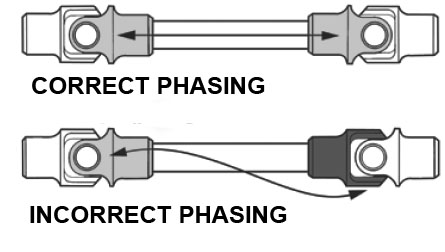
In phase.
Out of phase.
U-JOINT%20PHASING.jpg
Yes. That's what I refered to as "in time" but I guess it's called phase.
 
Really common with 4" lifts and new, unladen 3" lifts ESPECIALLY if using spacers. On my end there are three being built up. The cores are getting harder to come by in good condition. Cost of retubing/sizing yours depends on the area but I've priced it at Wenco by me and it was literally $10 more that what I sell them for :P

80 Series Double-Cardan Front Drive Shaft
 
So a little update here....I went to a reputable Driveline shop and they stated even before looking at the vehicle that they regularly install the castor correction bushings on FJ80's and that should fix the vibration sound. Mine apparently were not installed correctly so they redid the bushings based on a "template" they frequently use. They did find the rear driveshaft ujoints out of spec and replaced those. I drove the vehicle home.....same vibration sound although not as loud. Since then (it's been a couple of weeks now) the vibration has gradually diminished to the point I don't notice it or hear it.
 
I'd like to see a video like the advice showing the effect of putting a DC jointed driveshaft in a scenario such as a lifted rig with stock axle configuration.
Just sticking in a DC jointed driveshaft is not a great solution for the OPs issue.
 
So a little update here....I went to a reputable Driveline shop and they stated even before looking at the vehicle that they regularly install the castor correction bushings on FJ80's and that should fix the vibration sound. Mine apparently were not installed correctly so they redid the bushings based on a "template" they frequently use. They did find the rear driveshaft ujoints out of spec and replaced those. I drove the vehicle home.....same vibration sound although not as loud. Since then (it's been a couple of weeks now) the vibration has gradually diminished to the point I don't notice it or hear it.
A "driveline shop" that installs castor bushings does not specialize in Driveline's only, which raises and eyebrow right off the bat.
Secondly, driveline vibration should get worse after enough castor correction has been done to correct for an HD 3" because, at that point, the front pinion shaft should be pointed almost, if not, directly at the transfer case output flange which is perfect for running a D.C. shaft. Ditch those castor bushings and install castor plates and a D.C front shaft. It sounds like you have installed 850j springs. My first lift was 850J fronts with Slee castor plates and D.C. Shaft and I had no vibes at all.

Castor correction and driveline angles are independent from one another. It just so happens that an 80 series lifted a solid 3 to 4 inches and with proper castor correction, is automatically configured to run a D.C. Shaft in the front. Thanks those Toyoda engineers for thinking ahead. ;)
 
. It just so happens that an 80 series lifted a solid 3 to 4 inches and with proper castor correction, is automatically configured to run a D.C. Shaft in the front. Thanks those Toyoda engineers for thinking ahead. ;)

Your 80 must have been built in a different factory to mine.

If you have correct caster, your pinion angle is not going to be correct for a DC shaft
 
Your 80 must have been built in a different factory to mine.

If you have correct caster, your pinion angle is not going to be correct for a DC shaft
That's got to be one of the oddest statements I have read on this board. Take a look at Slee's 4" complete kit. What you are saying defies the general concensus.
 
That's got to be one of the oddest statements I have read on this board. Take a look at Slee's 4" complete kit. What you are saying defies the general concensus.

maybe, but what you are saying doesn't work physically, regardless of the consensus.

where does your consensus come from? it could be argued that there is also a consensus that DC shaft is far from ideal and is not without its own problems, yet DC shaft persists as a "solution"


if you lift your truck the radius arms rotate downward, as the diff housing is "fixed" in relation to the radius arms, you end up with the diff pinion pointing upward toward the transfer (more so than in standard form), and the king pin is angled forward at the top so you lose the built in caster
caster correction (plates, or bushes, or washer mod) changes the diff housing's "fixed" position at the radius arms, and rotates the front diff housing downward at the rear. the whole purpose of caster correction is to rotate the diff housing so it is as close as possible to its standard orientation in relation to the ground and chassis, and so the king pin angle is back within factory spec.

you cannot physically add caster correction with caster plates, caster bushes, or custom radius arms, and have the pinion pointing/angled to the transfer case. pinion angle and king pin angle are both an integral part of the front diff housing, you cannot change one without changing the other (without use of a grinder, or offset king pin bearings)

in stock trim, the transfer and diff pinion should both be parallel to each other (within a couple of degrees), lift the truck without caster correction, you change the front pinion angle. correct your caster so that it is within spec, and your diff pinion will again be parallel to the transfer pinion.

A DC shaft will vibrate in a situation where your diff and transfer pinion are parallel, they also tend to chew Uni joints more quickly

there's a great explanation of all this on Pirate in the Billavista tech pages (not sure I have the name right here)


I have previously used caster plates, and also caster correction bushes. none of these have left a pinion angle that is correct with a DC shaft.
I've also done a knuckle cut and rotate to correct caster which has a whole new set of problems

I have good mates that have gone down the DC shaft route, and after several failures, have gone back to standard shafts
 
maybe, but what you are saying doesn't work physically, regardless of the consensus.

where does your consensus come from? it could be argued that there is also a consensus that DC shaft is far from ideal and is not without its own problems, yet DC shaft persists as a "solution"


if you lift your truck the radius arms rotate downward, as the diff housing is "fixed" in relation to the radius arms, you end up with the diff pinion pointing upward toward the transfer (more so than in standard form), and the king pin is angled forward at the top so you lose the built in caster
caster correction (plates, or bushes, or washer mod) changes the diff housing's "fixed" position at the radius arms, and rotates the front diff housing downward at the rear. the whole purpose of caster correction is to rotate the diff housing so it is as close as possible to its standard orientation in relation to the ground and chassis, and so the king pin angle is back within factory spec.

you cannot physically add caster correction with caster plates, caster bushes, or custom radius arms, and have the pinion pointing/angled to the transfer case. pinion angle and king pin angle are both an integral part of the front diff housing, you cannot change one without changing the other (without use of a grinder, or offset king pin bearings)

in stock trim, the transfer and diff pinion should both be parallel to each other (within a couple of degrees), lift the truck without caster correction, you change the front pinion angle. correct your caster so that it is within spec, and your diff pinion will again be parallel to the transfer pinion.

A DC shaft will vibrate in a situation where your diff and transfer pinion are parallel, they also tend to chew Uni joints more quickly

there's a great explanation of all this on Pirate in the Billavista tech pages (not sure I have the name right here)


I have previously used caster plates, and also caster correction bushes. none of these have left a pinion angle that is correct with a DC shaft.
I've also done a knuckle cut and rotate to correct caster which has a whole new set of problems

I have good mates that have gone down the DC shaft route, and after several failures, have gone back to standard shafts
I appreciate you explaining the basics, which I have gone through on several different vehicles in 30 years of wheeling.
I'm far from the only member here who has installed 3-4" springs, a set of castor plates and a D.C. shaft and went vibration free there after.
What you may be unaware of is the fact that, from the factory, an 80 had a pinion that actually pointed above the transfer case output, which is why the front drive line was configured out of phase. So, when lifting no more than about 3-5" the pinion ends up in an acceptable position to run a D.C. shaft after an "acceptable" amount of castor correction has been dialed in.

This could only be accomplished with a high pinion differential and beginning with out of phase U-joint configuration where the pinion is actually pointed up.

It's obvious that Toyota engineers designed the 80 for certain furture modifications. One other example is the cavernous wheel wells that easily fit much larger tires.
 
Last edited:
Back
Top Bottom