Onboard shower install questions...

This site may earn a commission from merchant affiliate
links, including eBay, Amazon, Skimlinks, and others.

Could I have tapped into the wrong hardline coming up from the rear heater? I followed the rear hardlines up into the passenger side of the engine compartment right next to the starter. The one I chose is the closest to the engine, which is from what I can tell the outlet. I thought about the faucet putting out to much pressure as well maybe that has something to do with it. . . I'll put some more time into it this week. Highs in the upper 30's and leaks squirting in your face are not the most productive conditions unfortunetly. . .

Dylan
 
Last edited:
When I set up the shower on mine I tried a couple of differient style exchangers. The one like your's I never could get a good hot water flow through even though I had seen other people do it. I changed to a plate style that I bought on ebay and have had good luck with it. Here is one similar ro mine. http://cgi.ebay.com/30-Plate-Water-...ryZ20598QQssPageNameZWDVWQQrdZ1QQcmdZViewItem
The more plates the more heat that is exchanged. akraven
 
Could I have tapped into the wrong harline coming up from the rear heater? I followed the rear hardlines up into the passenger side of the engine compartment right next to the starter. The one I chose is the closest to the engine, which is from what I can tell the outlet. I thought about the faucet putting out to much pressure as well maybe that has something to do with it. . . I'll put some more time into it this week. Highs in the upper 30's and leaks squirting in your face are not the most productive conditions unfortunetly. . .

Dylan

Try turning the hose to a lowest flow you can and still have a decent shower. Also try adjusting the idle rpm (mine works best at 1,100 rpm). If that does not work it may be that your heat exchanger is just to small.
Good luck
 
Test the temp on the outside of the exchanger it should close to the engine water temp. If it not you could be hook up wrong. Make sure you have the feed for the exchanger before the heater. By running on the outlet side of the heater you will have a temp loss from the heater core.
 
Dylan, you haven't really told us much about your heat exchanger. It's capacity, rating, etc. They are not all the same. I tried to "design" a system using theory and --- hope you're sitting down --- math and physics. Theoretically, I could calculate everything up front and build the heat exchange myself using copper tubing.

Unfortunately, I was missing one important variable - the flow rate of the engine coolant through the heat exchange(HE). In other words, how many gpm of coolant going into the HE. The other variables, gpm of the fresh water (my 12VDC pump rating), the temp of the coolant, temp of the fresh water and even the coefficient for the copper and area of contact were all known. But I had no good way to get a flow rate for the coolant into the HE.

By the way, the area of contact is the critical part of the HE design. How much surface area separating the Hot and cold sides. The picture yhou provided doesn't really show me what's happening inside the HE.

Sadly, I'm lazy and have never got around to back calculating the coolant flow rate using the empirical data I've collected using my own shower. It shouldn't be hard, but I lost interest since the shower works great. ;)

Sooooooo....

Dylan, pull the HE out of the truck and hook up your garden hose to one port. Run the hose at a constant flow rate into a bucket. Measure and time it and you'll have a gallons per minute (gpm). You might even try to set the hose at about the same flow as the 12VDC pump you picked up. Then switch the hose to another port and get a gpm from that port using the same "setting" on the hose. Are these flows the same or is one side more restrictive? I think you should plumb your coolant through the "least" restrictive side.

Installing into the FJ60....

I tapped into my coolant system -before- the rear heater. If you look at the firewall, there are two metal tubes coming up from the rear heater. I think the one on the right (looking from the front or the one towards the center of the rig if that makes more sense) is the supply and the one on the left is the return. So... tie into the coolant hose before the supply, between it and the engine. This goes to the "coolant in" on the HE, the "coolant out" will go to the supply tube of the rear heater continuing the circuit. Again, this should be the least restrictive side of the HE from the previous test. Savvvy?

Next supply fresh water to the end of the HE near the "coolant out" so the "hot fresh" exits the HE near the "coolant in". That's the crossflow idea.

Obviously, you want to take extra care with the coolant connections since this is now part of your permanent cooling system and a leak will leave you on the side of the road. Set the heater slide to HOT on the rear heater and warm up the engine. As noted above, the HE should become as hot as the top of the radiator ~200 degrees. You can do this before plumbing the fresh water if you want to test it.

Now, plumb up the fresh water side. Using your garden hose is fine to test. Run water through the HE and use the bucket and stopwatch to calculate the gpm. Get a thermometer and measure the temp of the water going in and after to get a "delta" temp. A slower flow will get a higher "delta temp". Higher flows will get a low delta temp.

Get some numbers and let us know what you find.

You can't do much about the flow rate of the coolant - except idle the engine faster for more or close the heater slide switch for less. So you're left with controlling the flow rate from your 12VDC fresh water pump. If you don't get enough flow and "delta temp" you'll need a larger HE.

Whew, sorry for the long winded post...

FWIW, the HE in Knuckles is rated at a "1/2 Ton" and I get about 50 degrees "delta" temp with a 3gpm. I had a "1/3 Ton" HE that got about 30 degrees - not enough for me. I spare you why they are rated in tons. Hint: Mass and BTUs.

I have a R&M HE in Ruby and use a 1.5 gpm pump. It works well too, good heat but less flowrate. The larger HE and pump on Knuckles gives it the "Binford" edge. :D


:popcorn:
 
Sounds good, you're well on your way.

Related Trivia...
Water transfers heat significantly better than anti-freeze.
Weird since we use anti-freeze to transfer heat out of the engine.
 
Like I already wrote. Using a six or eight cylinder motor to make hot water is very inefficient and costly.

I have a factory made set up. (Holly I think) With 200 degree water going into the Heatx and 65 degree water circulating in a five gallon bucket I am only able to get a +15 degrees temp rise. AFTER circulating the water in the bucket for five minutes. Noting that my cold supply temp to the heax is increasing ever so little.

Playing with the rate of flow does have an impact. lower GPM is good. It allows better heat transfer.

For me wasting 2 gallons of precious gasoline to barely heat water in an expedition setting is not worth it. Running a V-8 to take a 'hot" shower is an exercise in vanity I am unwilling to entertain. In fact it is funny the lenght some people will go to acheive this. Different strokes...

Like I said, just go jump in the water. Lots of men and women do it.

So what I am saying again is why do it this way? If the creek water is to cold for your tender sensitivities why not spend the money on one of the Propane fired units that are proven to work? I think they are under 200 and come with a shower stall to hide your dainties.

JB
 
Like I already wrote. Using a six or eight cylinder motor to make hot water is very inefficient and costly.

I have a factory made set up. (Holly I think) With 200 degree water going into the Heatx and 65 degree water circulating in a five gallon bucket I am only able to get a +15 degrees temp rise. AFTER circulating the water in the bucket for five minutes. Noting that my cold supply temp to the heax is increasing ever so little.

Playing with the rate of flow does have an impact. lower GPM is good. It allows better heat transfer.

For me wasting 2 gallons of precious gasoline to barely heat water in an expedition setting is not worth it. Running a V-8 to take a 'hot" shower is an exercise in vanity I am unwilling to entertain. In fact it is funny the lenght some people will go to acheive this. Different strokes...

Like I said, just go jump in the water. Lots of men and women do it.

So what I am saying again is why do it this way? If the creek water is to cold for your tender sensitivities why not spend the money on one of the Propane fired units that are proven to work? I think they are under 200 and come with a shower stall to hide your dainties.

JB


Well...after burning up a Zodi I went with the HH. You can not conserve water with the Zodi...it always has to have water running through the copper heat exchanger coil when the flame is lit. If you accidentlly run out of water or the water supply line accidentlly is raised above the water line or pump battery goes dead then the Zodi goes into melt-down mode (literally!): Shower over.

Additionally the Zodi and others like it take up additional cargo space...not ideal for me.

The HH has worked flawlessly for me for the past year and a half or so. Yeah...you can talk about efficiency, V-8 and all the stuff but in reality it works, doesn't cost much to run it, doesn't take up any cargo space and has proven reliable & convenient.

Like you said: Different strokes...

This is mine.
 
Like I already wrote. Using a six or eight cylinder motor to make hot water is very inefficient and costly...
...wasting 2 gallons of precious gasoline to barely heat water in an expedition setting is not worth it. JB

Come on Big Jim, redundant, off-topic and not true.

The engine is already hot at the end of a dusty day of wheeling and there is no way I burn 2 gallons of gas idling my motor for shower. :rolleyes:

This is a fun project and a fun mod for *most* anyone.
 
Been waiting for your response

Firts of all some of what I write is tongue in cheek. I like to razz some folks... Its all good my brother.

Based on my installation using the parts that I have, that is an Edlebrock heatx, a 12 volt pump and 65 degree water my Heatx would need to run for a long long long time to heat water up to say 85 from 65. Perhaps long enough to burn 2 gallons of fuel, who knows exactly. Trail fuel for me is a precious commodity I am unwilling to waste when I am perfectly able to jump in a creek or stream. My .02.

Now I love home brewing stuff and plan to build my own HX for a domestic HW install and the drill that the OP is engaged in is a fine undertaking. I was only teasing a little, questioning the application, offering the results of my experiments and an alternate solution.

Stay clean and best regards to everyone.

BigJim

Come on Big Jim, redundant, off-topic and not true.

The engine is already hot at the end of a dusty day of wheeling and there is no way I burn 2 gallons of gas idling my motor for shower. :rolleyes:

This is a fun project and a fun mod for *most* anyone.
 
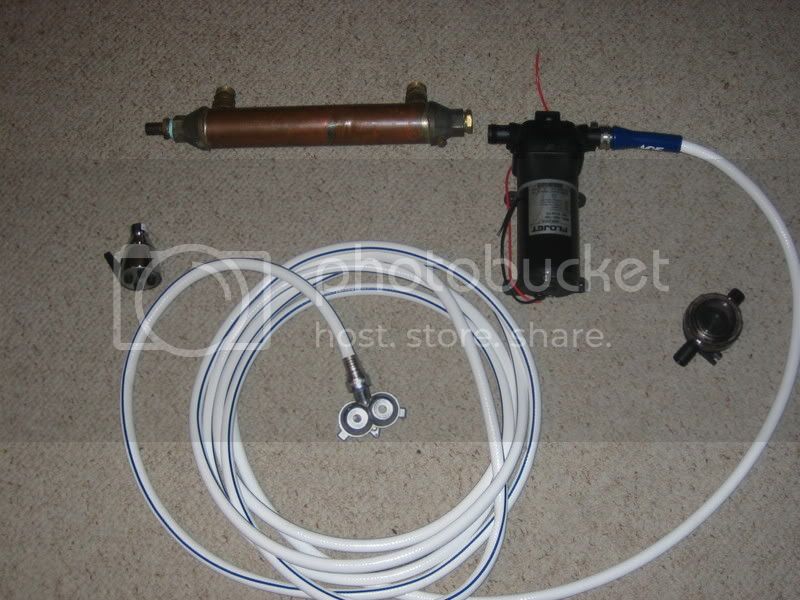
This weekend I am going to install a heat exchanger and pump for an onboard shower, and I am looking for opinions on a few thing. First of all, here is a shot of the materials I have right now, I figure I will make about ten trips to store tomorrow for supplys. . . This is going on my fj60, so if anyone has pics of their own install that would be cool to.


IMG_3517.jpg


(1) What kind of hose should I use for the the hot water side of the heat exchanger that will go to the shower head? I used Heater hose and cpvc but my system is a little different, most I have seen use a cheap garden hose.
What is a good length for the pickup side of the pump? My flowjet is 3.5 gpm I've run up to 150ft with no issues using cheap garden hose. Rise is the biggest issue. The higher the rise to the pump (vertical distance from water to pump) the less water output you will have.

(2) Should I just put a switch in the engine compartment to activate the pump? You have a auto pressure switch on your pump so when pressure drops it will cut on when it gets over like 80psi it will cut off. If you have a leak anywhere after the pump to the showerhead it will cycle on and off wich is not good long term so seal your leaks. You need a switch though and make sure you use a relay. MIne is in the cab and has a light when it is on.

(3) Is it best to interupt a hose after the heater core to be able to somewhat control the temp or is it going to limit my flow? Don't worry about regulating the flow to the heat exchanger. Your gonna want it wide open all the time. You will regulate heat by varying output from the showerhead. With a 2.5 -3.5 gpm pump a heat exchanger like the one you have is gonna struggle to put out 100 degree water at full flow. Unless your crazy and willing to run your 2f at around 3 or 4k with no load. Make sure you connect the heat exchanger before you go into the heater core.

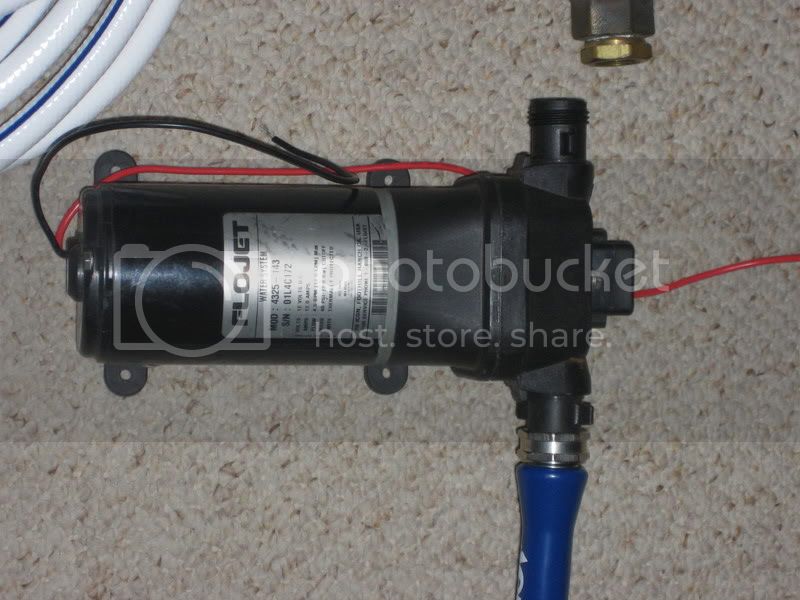
Here is a shot of the pump Flowjet is a good pump. Not sure on the model and the flow.

IMG_3518.jpg


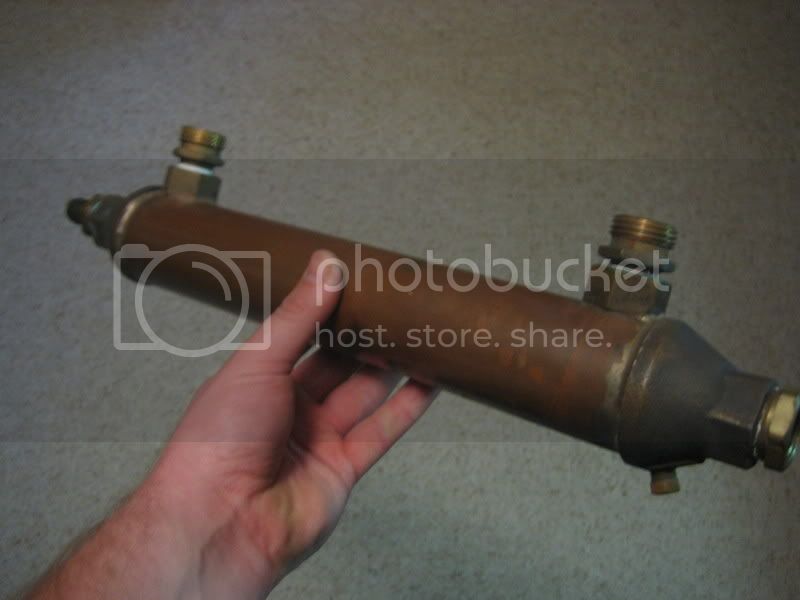
Here is a shot of the heat exchanger No idea of model but looks like a boat heat exchanger or similar. Coolant goes in the end. If it has a coil that runs in a loop front to back front to back it will not matter which end of the heat exchanger you attach the input and the output to for the fresh water. If it infact has aspiraled coil going from one end to the other or where flow is all in one direction you want to have your input opposite the inlet of the coolant. This allows better heat transfer.

IMG_3521.jpg


See red
 
This is the inside of a homemade unit.

attachment.php


Pros. Cheap to make

Cons. Low water volume
Poor heat transfer due to water moving from the hottest part of the coolant to the coolest and back again.


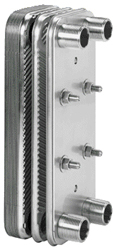
brazed-plate-unit.jpg

This is a plate heat exchanger.

Pros. great heat exchange
High flow

Cons. more expensive due to need for extra fittings and takes some creativity to mount.


The one below is how most exchangers work.

Pros good waterflow
good heat exchange
Very economical

Cons. not as easy to make
shell_tube%20ht%20exchgr.webp
 
Firts of all some of what I write is tongue in cheek. I like to razz some folks... Its all good my brother.

Based on my installation using the parts that I have, that is an Edlebrock heatx, a 12 volt pump and 65 degree water my Heatx would need to run for a long long long time to heat water up to say 85 from 65. Perhaps long enough to burn 2 gallons of fuel, who knows exactly. Trail fuel for me is a precious commodity I am unwilling to waste when I am perfectly able to jump in a creek or stream. My .02.

Now I love home brewing stuff and plan to build my own HX for a domestic HW install and the drill that the OP is engaged in is a fine undertaking. I was only teasing a little, questioning the application, offering the results of my experiments and an alternate solution.

Stay clean and best regards to everyone.

BigJim

Good stuff. You got me razzed. :D Carrying around a buch of propane, a heat unit that will get bounced around on the trail and low flow and having to wait for a shower for every person who is gonna use it. And then tell them to go fill the bucket and then wait 5-10 min for luke warm water that spits out on you all the while you are looking in the bucket to see if your gonna run out. And I hope everyone is not gonna need to haul one around and you will have fuel for everyone. Tellico this summer was hot and the campsite was dry except for a tiny stream that was about 150ft away in the woods. It took about 5 min to hook it up and have hot water as long as there was gas in the tank. A nice long shower for 15 of your friends with 3.5gpm and 100 degrees is priceless.:D
 
okay, the problem with running the shower water through the end caps is that you do not have nearly enough residence time for the water to heat up. the problem with running the water through the outer section is that the small inner tubes will cool very quickly. The design I have actually uses a copper coil in side a 2" outer sheath.. The coil has the shower water in it. The 2" has radiator fluid in it. Increase the flow as much as possible in the radiator portion so heat is uniform. It is directional as well. You want the intake for the showerr water to go in near the output for the coolant.. That way you are slowly heating the shower water against the flow of coolant instead of with the flow of coolant.. This increases the contact time of the "hot" coolant with the "cold" shower water.


Another option is to wrap copper tubing around the exhaust pipe.. That works freaking awesome..
 
as far as wrapping copper tube around the exhaust pipe, has anyone does this? how long is the winding and what kind of outlet temp results from that?

i know those compact HX work very well from reading other posts....but i have much more scr4p (it censored me!!) linesets than i do money to spend on a plate exchanger...
 
Last edited:
Heat xchanger has a home under the hood! It heats the water excellent at about 1300 rpm's and above, so I must have not gotten enough flow before. I still need to find a permanent mount for the 12 volt pump, but the testing phase is over! More pics soon. . .

Dylan
 
Dylan---Congrats. I may hit you up for a shower this summer! Way to stay on it.
 
Back
Top Bottom