American Heart Transplant: FJ60 + Vortec

This site may earn a commission from merchant affiliate
links, including eBay, Amazon, Skimlinks, and others.

Dan could you please explain? You don't think the 2F was parallel with the frame rails or do you think the front of the motor is higher than the rear? This is where you get no input from the swappers. I would love to know what everyone thinks is the ideal position for the motor. I'm starting with the Chevy fan clutch in the same spot as the 3FE, about 9" back from the front cross member. Not positive on where I.'m going to position motor height yet. I know your limited by your oil pan but I'm not sure on the 5.7. What are you using to determine your motor placement? Would love to here some input from Orange 45. later matt

Ya the 2f is slanted I believe, so the x-member is slanted too. Might be different on your 62....

For placement I think there are more important things to worry about such as oil pan clearance, pinion angles, hood clearance, and driveshaft angle (left to right).

You can build a shroud to fit wherever your fan ends up as long as its in the ballpark. I'm very experienced with fiberglass so if you want help with yours I'd be willing to lend my hands.

Me personally, Im going to go as high as possible (i added a 1.75" body lift too), and as far back as possible, and then as far to the driverside without screwing my angles too much. Hopefully I'll get ok oil pan clearance. If not Ill have the oil pan modified accordingly.

Im really worried more about the tranny pan being in the way of the driveshaft u-joint. With everything together it looks like it will reeeeaaaally close.

:beer:
 
I think is the TC that is slanted/on a angle along with the the Xmember.. The engine is not... but Im sure someone else can correct me if Im mistaken.

The way i put my engine in I went as high as possible enough to clear the hood, while keeping the Power steering pump away from the steering box. I put my engine as far back as possible but also with enough space where if I need to drop the tranny I can unbolt it and pull it back the 1.5" and then drop it.
I also put a lot of attention to my drive lines..I tried to lined them up as straight as possible....
 
A normal u joint will clear the transmission pan just fine. I used a CV since i'm SOA and it takes some serious work on the joint and trans to clear it to get it to clear with a 4l60e/advance adapter setup.
 
Dan... Im all new at this so I probably measure 20 times and tack welded the engine mounts a few times until I was happy with the way it lined up...
I had to take into account the clearance for the exhaust manifolds, steering linkage, power steering pump, oil pan to pumpkin or axle flange, fire wall clearance and hood clearance..
I did pull a piece of string from the rear diff flange to the front diff flange and made sure the TC flanges lined up with the string....

The pics below are from my 80 series frame but the idea is the same.. plus the frame you got is 3" wider at the front than the one I used.. so you should have plenty of space

String is centered a the rear and front diff flange TC is right where I want it.

manuchao-albums-fzj60-pjese-dy-picture16226-got-engine-seated-flanges-tc-pumpkin-line-up-really-nice-i-think-frame-will-awesome-upgrade-my-60.jpg


Hope this helps
 
After installing the torque converter and bolting the tranny to engine, I took measurements, and the torque converter mounting tabs are about 3/16" away from the surface of the flex plate. Does that sound ok? I read somewhere where it should be less... more like 1/8" to 1/6".

Can anyone confirm this? And if so, can/should I use washers between the two.

I cant imagine 1/16" being that critical...as long as the pump is engaged. Right?
 
that kit does not come with the transmission output shaft and requires a 2wd trans iirc.
please pm me with the specifics on your trans and i'll get you a quote and the part # for the proper kit you'll need. i know we already went thru this once but i'd rather confirm that we have everything right vs getting something that won't work for your application.

hth

georg @ valley hybrids

just a little different question if you dont' mind for those tracking this build. If the engine were a 5.7 would you have issues with oil pan clearance? 2nd part...2wd version of the 4L80E is good to go? with the aa adapter without swpping shafts are having to cut the shaft?
 
Guys!

I really need help with the pinon angles.

I measured the angle of the pinon flanges....

Front 7* up
Rear 3* up

How can I ever expect to get the pinon angles paralell when setting up the transfercase if the axles have different pinon angles?

How is it set from the factory?

What is my priority, set the rear angles exactly paralell, or set it in the middle of both?

Please help guys I want to tack in the mounts tonight!
 
Engine oil pan clearance depends on the amount of lift. Usually with SOA setups this is not an issue. I've never had to perform any oil pan mods on a TBI or first gen vortec.
The later vortecs with the cast aluminum pans can require some mods or the need for the camaro pan swap.

Are you asking me about a 2wd 4L60e or 4L80e? The shaft would have to be cut slightly on a 60e.

Engine placement. That's a good one because there is not "one" proper way to do it. All depends on what engine and trans you're using. With the standard transmissions you're a lot more limited due to shifter location. The engine can only be mounted as far forward as the shifter location allows. Otherwise the shifter would hit the dash and heater ducting.
The marks kit offered by AA works well for placing the engine where it needs to be and does away with the need to modify the x-member, floor, shifter locations, shift linkage and driveline. I'm not super fond of the double bell housing setup and the throwout bearing extension. But they do work as long as you use the flat diaphragm centerforce clutch kit recommended by AA.
With automatics you have more leeway.
 
Engine oil pan clearance depends on the amount of lift. Usually with SOA setups this is not an issue. I've never had to perform any oil pan mods on a TBI or first gen vortec.
The later vortecs with the cast aluminum pans can require some mods or the need for the camaro pan swap.

Are you asking me about a 2wd 4L60e or 4L80e? The shaft would have to be cut slightly on a 60e.

Engine placement. That's a good one because there is not "one" proper way to do it. All depends on what engine and trans you're using. With the standard transmissions you're a lot more limited due to shifter location. The engine can only be mounted as far forward as the shifter location allows. Otherwise the shifter would hit the dash and heater ducting.
The marks kit offered by AA works well for placing the engine where it needs to be and does away with the need to modify the x-member, floor, shifter locations, shift linkage and driveline. I'm not super fond of the double bell housing setup and the throwout bearing extension. But they do work as long as you use the flat diaphragm centerforce clutch kit recommended by AA.
With automatics you have more leeway.

Georg, can you please comment on pinon angle?

Thanks alot.
 
i was about to.......

front pinion angle is not nearly as crutial as the rear. realistically, it does not need to be. the only time it comes into play is when you're driving at speeds over 20-25mph in 4wd. if that is part of how the vehicle will be driven, then you have two choices:

1) set the pinion angle parallel with the t-case front putput flange and run standard u-joints. this will create a negative pinion angle, the drive shaft will be one of the first things to get hit when off roading and you might exceed the working angle of the u-joint depending on the amount of lift and articulation. not what i would do.

2) set the pinion so it points directly at the front t-case output flange. in this case, you'll need to run a cv joint at the case. luckily the early 60s had these from the factory and they're easy to retrofit onto the later 60s and 62s. on an soa 60/62, this is just about a must along with a cnt.

the only other scenario for the front end is a spring lift. most people don't go thru the trouble of a cnt with a mild 2-4" spring lift. and you really don't need to. setting the caster at the proper an gle is way more important than setting the pinion angle. we usually try to get 2 to 3 degs. again, how fast are you going to drive in 4wd........

rear pinion angle is a lot more crutial since the rear driveline is always transmitting power to the axle. i would set the pinion angle parallel to the t-case output and run standard joints. they tend to hold up better than CVs when exposed to constant use.

hth

georg
 
front pinion angle is not nearly as crutial as the rear. realistically, it does not need to be. the only time it comes into play is when you're driving at speeds over 20-25mph in 4wd. if that is part of how the vehicle will be driven, then you have two choices:

1) set the pinion angle parallel with the t-case front putput flange and run standard u-joints. this will create a negative pinion angle, the drive shaft will be one of the first things to get hit when off roading and you might exceed the working angle of the u-joint depending on the amount of lift and articulation. not what i would do.

2) set the pinion so it points directly at the front t-case output flange. in this case, you'll need to run a cv joint at the case. luckily the early 60s had these from the factory and they're easy to retrofit onto the later 60s and 62s. on an soa 60/62, this is just about a must along with a cnt.

the only other scenario for the front end is a spring lift. most people don't go thru the trouble of a cnt with a mild 2-4" spring lift. and you really don't need to. setting the caster at the proper an gle is way more important than setting the pinion angle. we usually try to get 2 to 3 degs. again, how fast are you going to drive in 4wd........

rear pinion angle is a lot more crutial since the rear driveline is always transmitting power to the axle. i would set the pinion angle parallel to the t-case output and run standard joints. they tend to hold up better than CVs when exposed to constant use.

hth

georg

Georg,

I am not going SOA. So I am a bit confused by you post.

The pinion angle does not change unless you cut and re-weld the perches correct?

So I am limited to changing the fore and aft placement of the driveline to determine my anlges... correct?

So as it stands its completely stock as far as the axles.

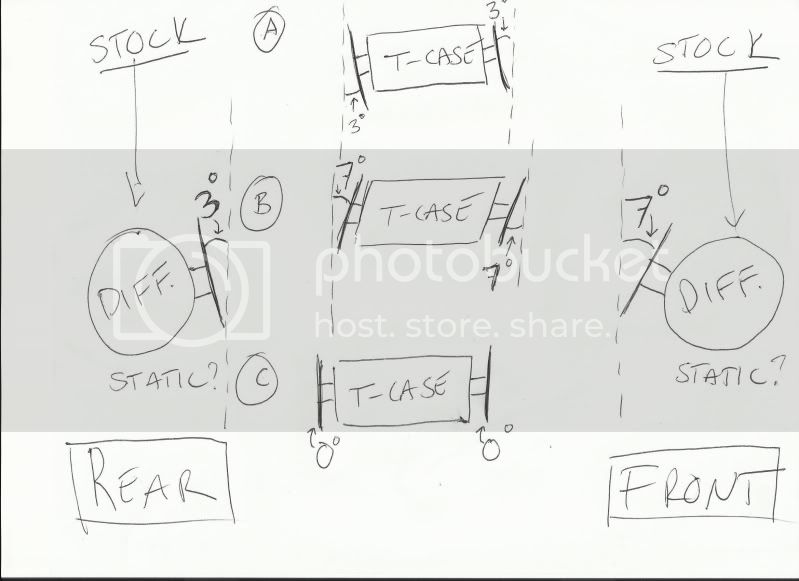
The front pinion angle points 7* up toward the t-case.
The rear pinion angle points 3* up toward the t-case.

The t-case output flanges are paralell to each other...

So I can either:

A) set the driveline such that the rear t-case output is paralell to the rear pinion.

B) set the driveline such that the front t-case output is paralell to the front pinion.

C) set the driveline such that it is not perfect with either, right in the middle.

I dont see any other options since Im not ,messing with cutting and re-welding the spring perches.

What is the best plan of attck here for the SUA/stock axel angles??

How are the set form the factory I guess is a better question?

Thanks for your help Georg, I'm a rookie, so its all a learning experience!
 
Last edited:
Im a visual person:

Drivelineangle.jpg


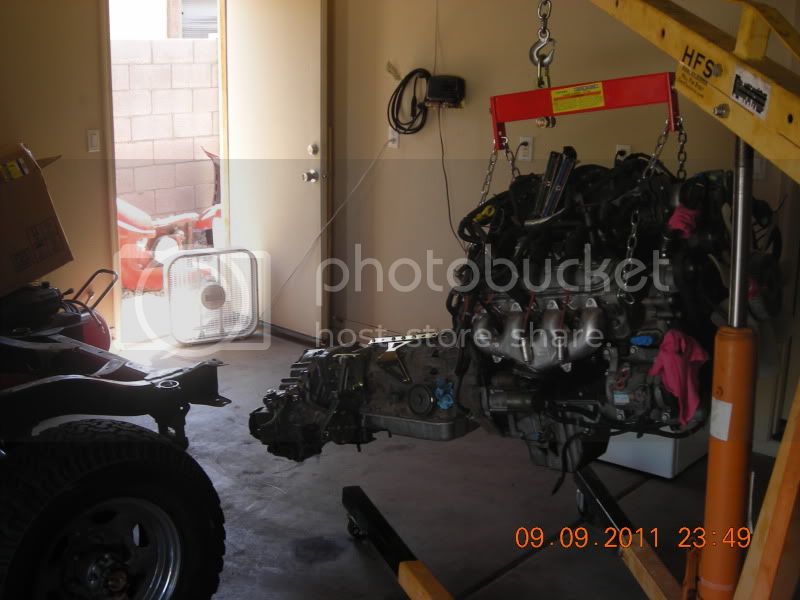
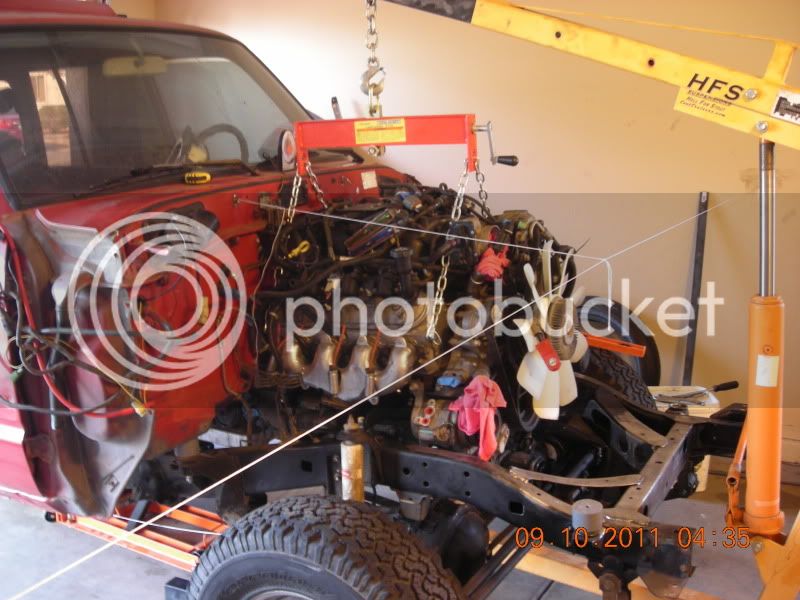
A few picture of driveline going in.

DSCN4368.jpg


DSCN4372.jpg


This show string I used to approximate hood clearances.

DSCN4374.jpg


And string underneath to make sure my drivetrain is "inline". Thanks Manuchao!

DSCN4376.jpg


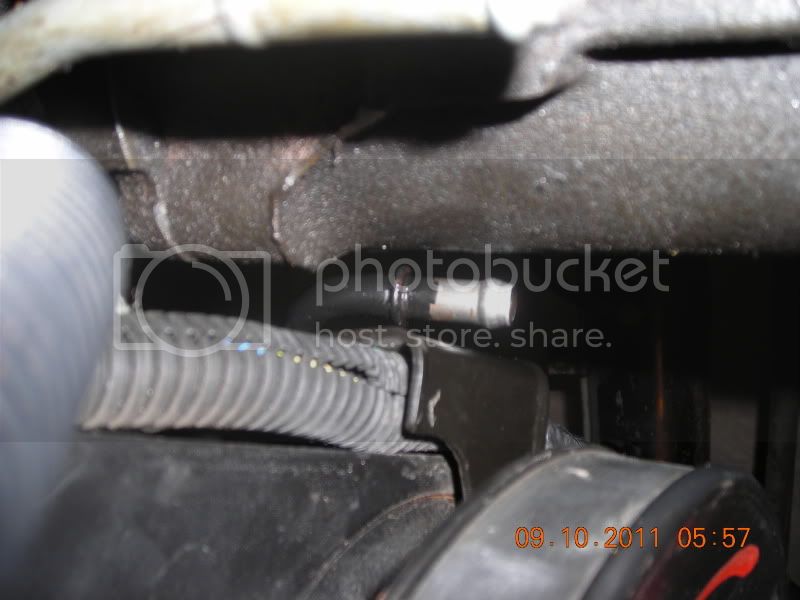
PS gearbox clearance is the limiting factor on the driver side.

The return line to the pump can be bent....

DSCN4379.jpg
 
Dan, on the Angle #'s on the pinions you posted....
Where they taken with the weight of the engine on the frame ?
Just curious.
Re: the TC flange angles...
You can decide on them once you have the engine in place.
You just need to know if you want to drop or lift the TC cross member (that is if you are making your own).
 
Dan, on the Angle #'s on the pinions you posted....
Where they taken with the weight of the engine on the frame ?
Just curious.
Re: the TC flange angles...
You can decide on them once you have the engine in place.
You just need to know if you want to drop or lift the TC cross member (that is if you are making your own).

Measurements were taken withou the weight of engine. Does it change with load?

I think Im going to shoot for paralell on the rear, and hope I dont blow up u joints on the front when in 4wd.

If someone else could get under thier truck and measure thier angles I would love to see how stock angles are on the t-case.
 
Stock front angles are not perfect from the factory. I know mine were around 2-4 degrees off stock. Its been so long I can't remember but they were defiantly off. Just get your rear correct, that is what really matters in your application. In theory the joints have to be parallel and not over a certain degree of total angle not to vibrate. In reality you can get by with a couple degrees with no harm done on a part time 4wd vehicle. The only way to achieve perfect angles on both drive shafts would be to install everything perfectly vertical, including diffs. I would say if your angles are less than 5 degrees off on the front I wouldn't worry about a thing.

If your really a nut job and are still worried about it pick up a double cv shaft and you can run whatever angle you want on the front.

I just wish I would have ditched the split case when I did my swap, did a ford 9" or chevy 14 bolt rear end and a Chevy t case.
 
I achieved my goal for the weekend of having the motor mounts tacked in. YAY!!!!

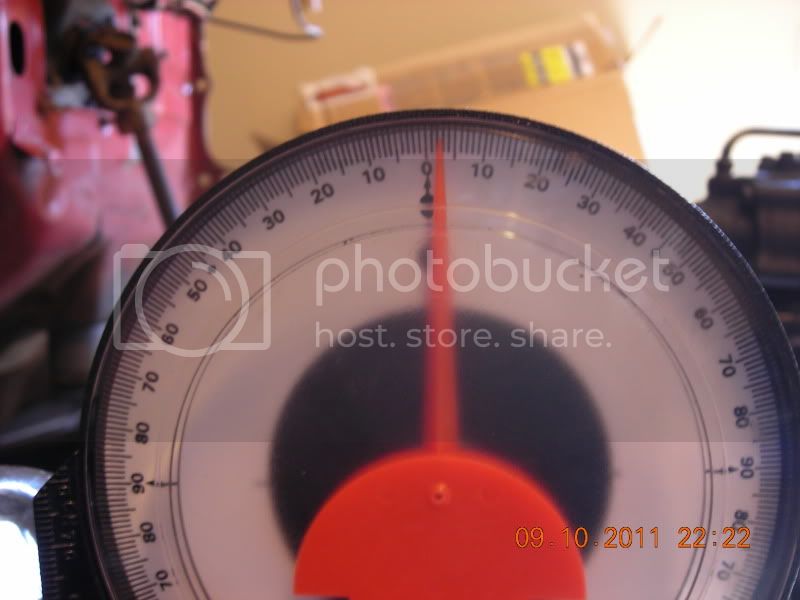
I spent several hours getting them as perfect as possible. I used the PS bolt holes on each side for reference, as well as other spots on the frame. I loosely used the shock towers, but I concluded that they are not perfectly simetrical. I also set the mounts at exactly 2.5* tilted back. I did this because thats how it mocked up best with the t-case pinion angles and such.

The engine side mounts sit barely (1/16") above the frame. This is great because on the driver side I didnt have to cut the end of the mount off, and if the frame mount fails (it wont ;)) the engine mount will fall onto the top of the frame. Call it an extra safety feature.
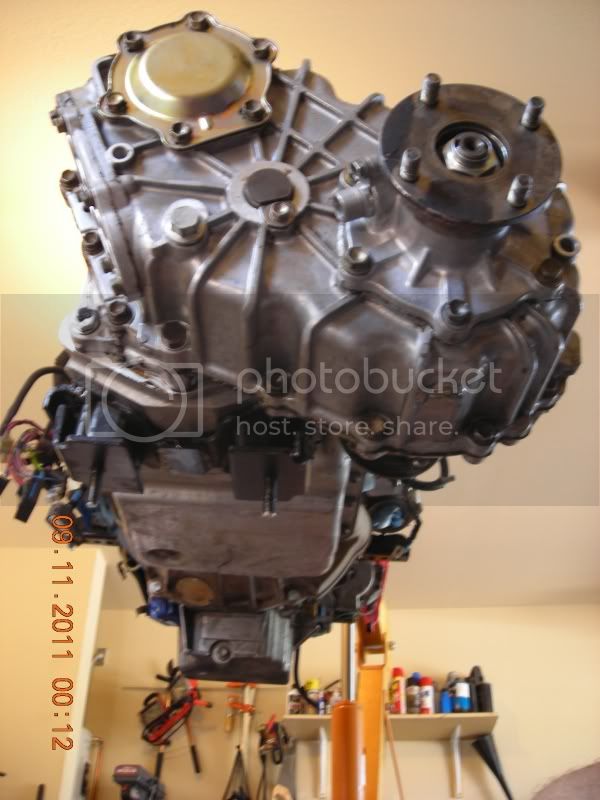
Firewall clearance is about 1 inch on each side between the head and the firewall.

PS clearance is about 1 inch.

The t-case/drivline is perfectly inline with the axles. As perfect as ou can get with taught string.

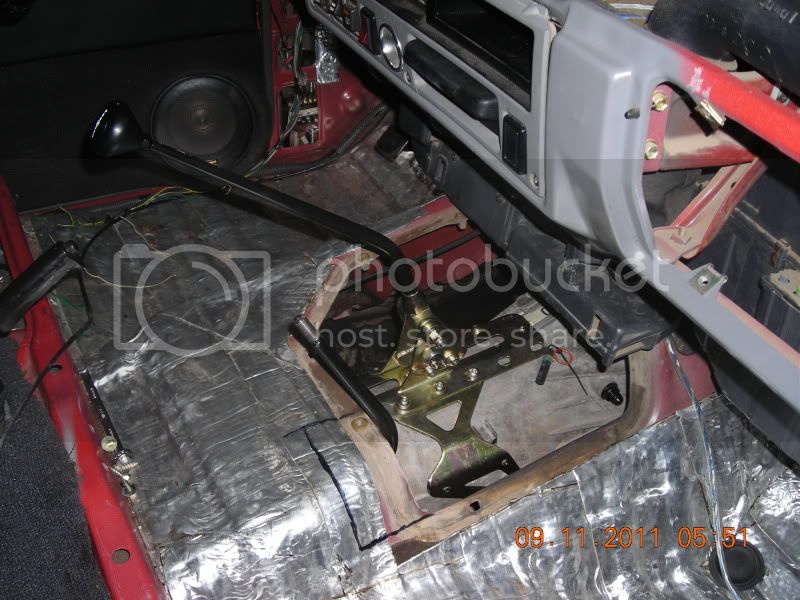
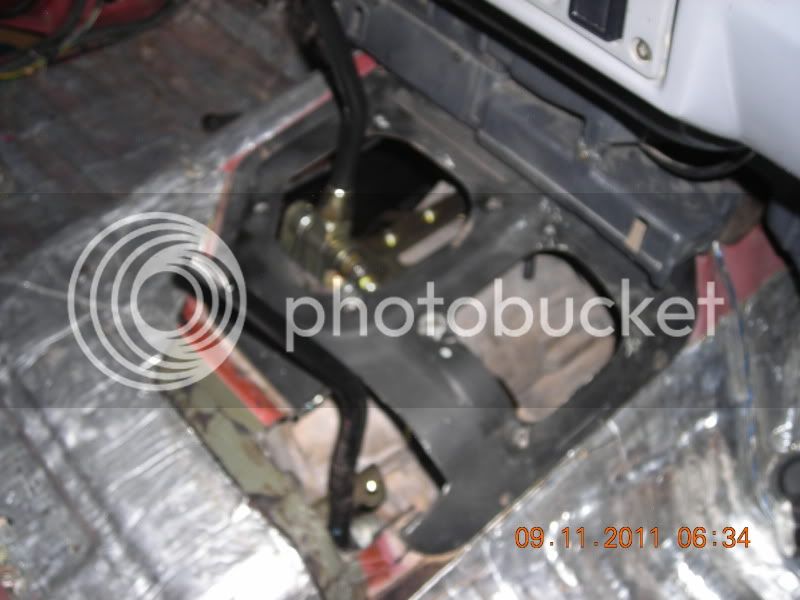
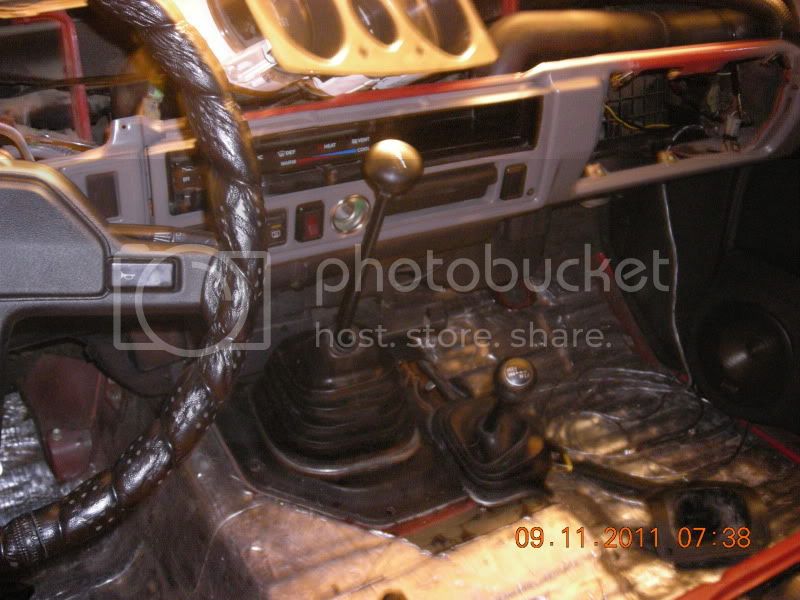
Biggest snag I ran into was the t-case shifter. It is moved significatly further back with the new drivetrain. I could have either cut and extended the shifter, or cut the floor. I decided to cut the floor because I like how the shifter is closer to the driver like this! it will be really easy to cover with some sheet metal.

The Lokar shifter position is perfect, and will re-use toyota boot.

I got the rear t-case pinion exactly where I want it which is ~3*. Exactly paralell with the rear axel pinion. It is not set permanently, have to fabb up crossmember. Should be simple.

Pictures :bounce:

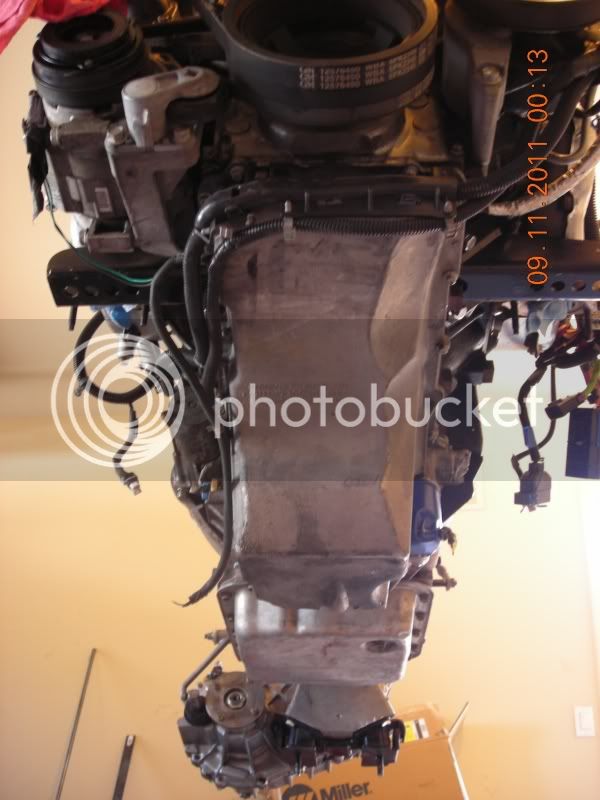
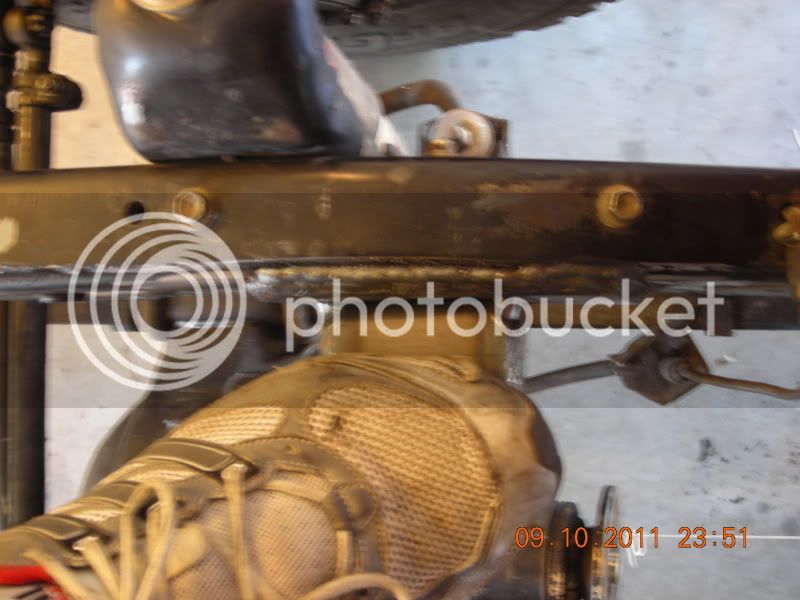
Kids, dont lay under a beatly piece of metal and snap photos for fun... You could die!

DSCN4386.jpg


DSCN4387.jpg


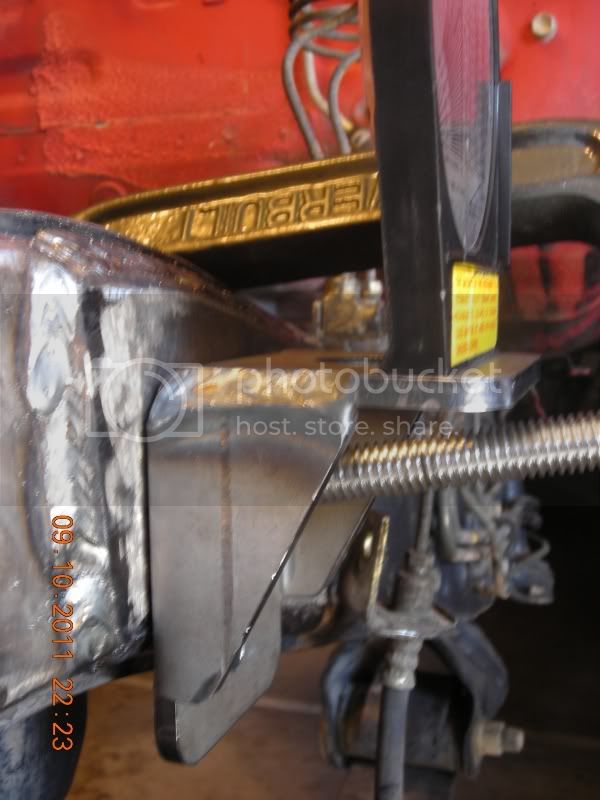
After hous of measuring over and over, and tweaking, the motor mounts are tacked in. It's always a good idea to test your tack welds by standing on them.

DSCN4384.jpg


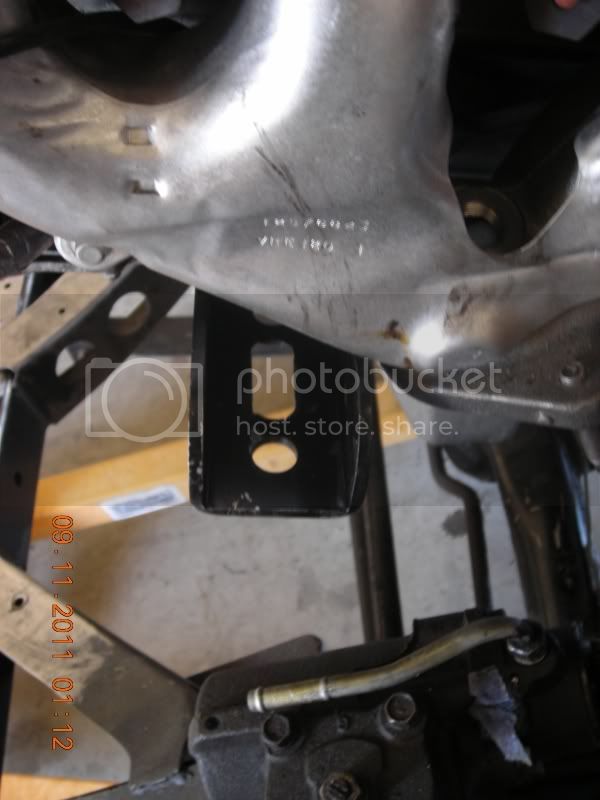
Dont be stupid and think the AA mounts are bolt on. They need adjustments. This is on drivers side. Pass. side was good.

DSCN4388.jpg


How I mocked my mounts up. This is after test fitting the motor to get idea of what I wanted.

DSCN4382.jpg


Exactly 2.5* tilted back on each side.

DSCN4381.jpg


DSCN4383.jpg


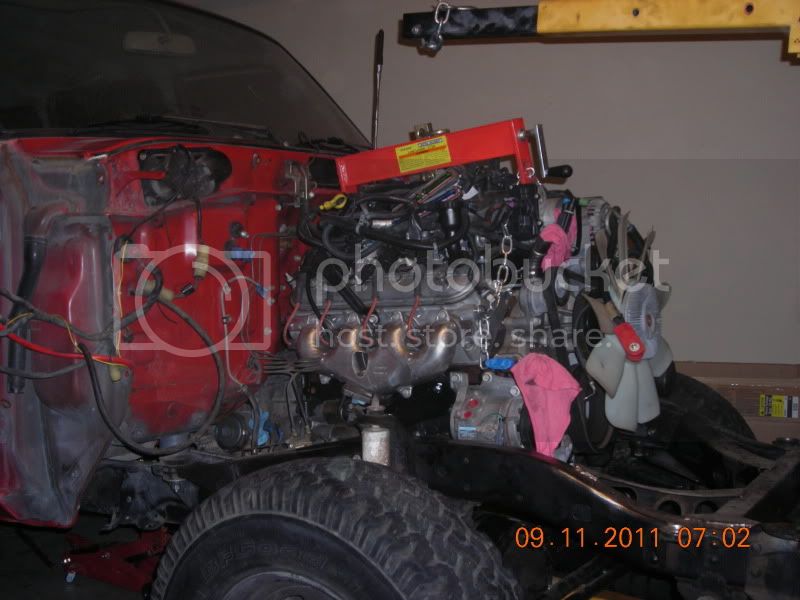
Motor in and on its own weight... Mounts holding up on the tacks no problem.

DSCN4399.jpg


Shifters... and little bit of cutting on the floor board.

DSCN4389.jpg


DSCN4396.jpg


Mocked up with boots. SWEEEEET!

DSCN4402.jpg


And that's were I left it!!!!!

Tune in again next time.
 
Back
Top Bottom