

Yummie ....... 80 High Steer setup from Frontrange!

This site may earn a commission from merchant affiliate
links, including eBay, Amazon, Skimlinks, and others.

48mm pistons instead of 45mm. Youll get a mushier pedal.

Good to know, I've only scratched the basics since I have a Tundra in the driveway & always find myself thinking "what can I rob for the 80?".
 
High steer is for people who want to push these rigs to the limit, it can be more durable when using over sized tires and provides better drag link and tie rod angles/clearance for a lifted vehicle.
Akerman is ignored because it is expensive to implement and can limit turning radius, it also has to have the tie rod behind the axle to achieve the correct angles, plus the evil tire manufactures dont like it because it lessens tire wear (scrubbing and cupping) by a considerable degree.
Which is why I like it! tires are expensive!!!
Also correct Akerman angle provides much better traction ( ie no scrubbing) especially in winter conditions!

Can you PLEASE go do some more research before spewing complete misinformation?
 
High steer is for people who want to push these rigs to the limit, it can be more durable when using over sized tires and provides better drag link and tie rod angles/clearance for a lifted vehicle.
Akerman is ignored because it is expensive to implement and can limit turning radius, it also has to have the tie rod behind the axle to achieve the correct angles, plus the evil tire manufactures dont like it because it lessens tire wear (scrubbing and cupping) by a considerable degree.
Which is why I like it! tires are expensive!!!
Also correct Akerman angle provides much better traction ( ie no scrubbing) especially in winter conditions!
I hope nobody reads your post. High steer arms incorporate Ackerman because it is just putting pivot points on a parallelogram.
 
Steering Geometry
The idea of steering the front wheels around separate axes was invented in 1817 by a Munich carriage builder named Lankensperger. His agent, a fellow by the name of Rudolph Ackerman, took out an English patent on the invention. Later in 1878, a French carriage builder, Charles Jeantaud, introduced a refinement known as the "Jeantaud Diagram" which provided a more precise prediction of the correct geometry. Today, Lankensperger's invention, along with Jeantaud's refinements, is usually referred to as "Ackerman Steering."
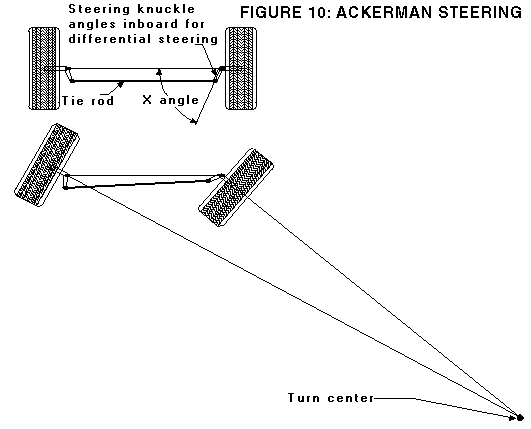
An important requirement for wheels steered around separate axes is that the inside front wheel must turn at a sharper angle than the outside wheel. This is due to the fact that the inside wheel moves through a smaller arc. The difference between the inside and outside steering angles progressively increases as the wheels are turned more sharply (higher lock angles). At the low steering angles typical of highway speeds, differential steering is relatively unimportant. Figure 10 illustrates the geometry of Ackerman Steering.

fig-10.gif


Ackerman angle

When a vehicle turns a corner, all the wheels must turn through a common centre in order that they may have a true rolling action and not scrub across the road surface. Although this is impossible to achieve under all conditions, it was found by a man named Ackerman, that by inclining the steering arms towards each other so that a line projected from each kingpin meets at a point on the centre-line of the vehicle just ahead of the rear axle, then almost true rolling action is obtained. The rear wheels are fixed to a solid axle and therefore this centre of rotation must lie on a line projected through the rear axle.

upload_2017-8-17_13-39-16.webp


It would be interesting to see a forward facing arm long enough and outboard of the kingpin (pivot point) enough to achieve correct Ackerman angle.
 
I suppose you could do it, but your scrub radius would be horrific..
 
It would be interesting to see a forward facing arm long enough and outboard of the kingpin (pivot point) enough to achieve correct Ackerman angle.

You mean like on virtually every OEM straight-axle ever?
 
Do I need to explain Scrub Radius?

No, but if you could please copy and paste an entire Wikipedia page to show your vast knowledge that would be awesome.
 
No, but if you could please copy and paste an entire Wikipedia page to show your vast knowledge that would be awesome.
We're all waiting for your reply which refutes @Cruzilla 's arguments. Without it the story ends.
 
Are they finally for sale? I have checked several times over last year and half, last time about a month ago, and they were not yet available. :(
 
Are they finally for sale? I have checked several times over last year and half, last time about a month ago, and they were not yet available. :(
Website says preorder. Have you tried calling or emailing them?
 
Many times! 11/29/18 reply from FROR:

“I really dont know an eta. We have several other items finishing through the shop before we can get to those again. Id like to say much sooner, but just had to put other items ahead of them in priority.”
 
Do I need to explain Scrub Radius?

from wiki:

As the steering moved, the wheels turned according to Ackermann, with the inner wheel turning further.[2] If the track rod is placed ahead of the axle, it should instead be longer in comparison, thus preserving this same "toe out"

Ackermann steering geometry - Wikipedia

The pivot point at which the tie rods are connected are along the same imaginary line, from a center point of the rear axle crossing the pivot point of the knuckle. When on the front side of the knuckle they are wider then a line between the pivot points, when placed behind the axle they are narrower.

If we are concerned about the exact precision of locating the connection/pivot point of the TRE's on the axle to get proper angle, consider this:

The two main suppliers of the most common vehicles with solid front axles in our market (Ford Super duty and Dodge Ram) have the steering arms at the front of the axle, do you think they have different knuckles made for short/long box vehicles, or single cab or double cab trucks, or do they just use one for different wheel bases? I'm pretty sure we know the answer, and we can assume that not having exact perfect ackerman angle is thrown out the window with major manufacturers as it just isnt a problem.

Edit: Having said that, I like high steer, I also like having a tie rod behind the axle where it is better protected, also having it behind the axle allows the tie rod to be shorter, and the connection point of where the TRE's mount inward further in comparison to a front mounted tie rod...

Putting your tie rod behind the axle has two main advantages, a slightly shorter rod is harder to bend, the TRE's further inward can give more clearance to your wheels/tires, some backspacing is tight to the TRE's

ackerman.webp
 
Last edited:
Yup. Claiming this setup doesn't have Ackermann just because it moves the mounting points higher up in the Z axis is complete baloney
 
Back
Top Bottom