Build The Clustertruck Rides Again - Refurbishing a 1975 Chevota

Member Build Threads

This site may earn a commission from merchant affiliate
links, including eBay, Amazon, Skimlinks, and others.

This is what I was thinking about. I'm sure you've read all the threads and of course there are many different ways these can be mounted...
https://forum.ih8mud.com/threads/rear-disc-brakes.152126/#post-2105553

Yup, basically debating between that and the upside-down bleeder option, which gives me the same height, just on the back side of the axle. I do see Poser's point though, the spring would protect that hose pretty well. I suppose I'll just run them forward. Seems like the cleanest setup. Plus, if it's good enough for Poser, it should be good enough for me!
 
Can you swap the calipers left to right?

I accidentally did this on my Mini Cooper (before I knew what I was doing, ha ha), and drove to the dealership with no brakes because the bleeders were at the bottom - yes, mechanics got a good laugh at this. (Self revelation is so cleansing.)

If you could, then it might solve the bleeder position and let you mount how you want.

The other option that made sense was to tap a new hole in it.
 
Sounds to me like you've done some real serious and careful thinking about your brakes. Good luck with whatever your decision is.

Don
 
Can you swap the calipers left to right?

I accidentally did this on my Mini Cooper (before I knew what I was doing, ha ha), and drove to the dealership with no brakes because the bleeders were at the bottom - yes, mechanics got a good laugh at this. (Self revelation is so cleansing.)

If you could, then it might solve the bleeder position and let you mount how you want.

The other option that made sense was to tap a new hole in it.

You can definitely swap left to right (which allows for the forward/rearward mounting options. The issue is the ANGLE at which they mount, which are dictated/limited by the bolt holes in the mounting brackets.

Sounds to me like you've done some real serious and careful thinking about your brakes. Good luck with whatever your decision is.

Don

Thanks, Don! No decision is too small for me to NOT agonize over it for weeks! Sometimes I can't see the forest for the trees, but in the end I hope the result is a pretty bomb-proof Land Cruiser.
 
Rick, I am not familiar w/Posers brackets, so maybe someone will chime in. I noticed in your pics you have the brackets mounted to the outside of the backing plate mounting flange. I know w/the 1's I'm using, they are mounted on the otherside of that flange w/the thin metal piece sandwiched between the bracket & that flange to space the caliper properly to the rotor.
 
Rick, I am not familiar w/Posers brackets, so maybe someone will chime in. I noticed in your pics you have the brackets mounted to the outside of the backing plate mounting flange. I know w/the 1's I'm using, they are mounted on the otherside of that flange w/the thin metal piece sandwiched between the bracket & that flange to space the caliper properly to the rotor.

Yeah, mine are mounted wrong, currently. Just for test fitting purposes. They go on the other side of the flange, as well, and will, when I tighten everything down. Can't remember why I mounted them like that at the time - had my hands full and was just easier, I think.
 
Ok, I think I've figured them out. I'm going to run them facing forward, and high. This will keep the bleeders up.

I think one of the issues with routing (and the reason mine won't look just like Poser's example) is because I'm using an axle T from the FJ60, which is welded to a little extension. This changes the location of the T just slightly - unfortunately in the direction that makes hard line routing a bear.

Here is what I'm thinking:

Routing basically a "U" pipe to directly under the T fitting. I think I can get a tight enough bend. Then I'll run a similar bend from the other arm of the T to head up and over the axle.

image.webp


image.webp
 
Progress for the weekend - not much (always too many other obligations) but a little!

Got the large hub bearings, as well as the hub seals, pressed into the hubs. You know the project is taking too long when your brand new rotors have begun to flash rust...

Packed the bearings:

Packed bearings.webp

Lubed up the races and put a thick coat on the inside of the hubs:

Coated Races and Interior.webp


Bearing Installed:

Bearing installed.webp


Used my 81mm seal driver to install the main hub seal:

Seal install.webp


Installed:

Seal Installed.webp
 
Then I got to cleaning up the rear axle, and had Paul (future father-in-law) weld on the brake tabs:

Axle Cleaning and Brake Tabs Installed.webp


Still don't have the axle QUITE clean enough (only spent about an hour and a half grinding with a wound-wire brush on the angle grinder). Needs to be much cleaner prior to paint. The rear axle was far rustier than than front, as it wasn't caked in years of grease/engine oil.
 
Well, work has, as usual, been progressing slowly - Delaware weather has a bad habit of starting to rain at the exact moment I get off work...every other day. Therefore, I can never paint, which is holding up the whole works. Plus, by the time I get to the truck after work, I only have about an hour of daylight to work with, which complicates things further. That said, I finally got a primer coat on the axle earlier this week. Tonight, I reinstalled the diff (with the paper gasket and some permatex for good measure) and routed the long hard line. The short line is proving difficult. This is a tight bend with no room for error, and errors abounded tonight. Will have to try again later!

Rear Axle Primed and Diff Installed.webp


IMG_2162.webp


Tomorrow I'll have a few hours to work on the truck, but it's calling for rain...If the weather holds, my plan is to (hopefully) get the front axles, hubs, and locking hubs installed. If time and weather permit, I'll also keep painting...
 
progressed on the front axle today. Got the FJ62 axles installed:

Axles Installed.webp


This took some serious persuasion. Ultimately, I found the best way to do it was apply constantly, heavy pressure inward, while rotating the differential flange. Eventually, the axle dropped in.

Then I packed the orifice with Moly grease, aligned the spindle gasket, and lined up the spindle:

Spindle and Gasket.webp


Getting all the seals/spindle/etc. Lined up is a challenge, as all the gaskets want to drop out of place.

There is some debate online as to the order of what comes next, the second spindle gasket, or the backing plate. I opted for the second gasket. My reasoning is that this gasket has a small "cut out" that seems to coincide with the "drain" on the front of the spindle:

Out Spindle gasket.webp


Some service manuals omit this detail altogether. Others show the backing plate going on first - but this made the most sense to me...

After this gasket comes the backing plate eliminator, then the gold seal, then the bolts, torqued down in a star pattern:

Spindle Installed.webp


The hub will come next, but I've lost the two bolts that attach the rotor and hub. Probably unnecessary since there are six pressed in studs holding them together, but I'm going to err on the side of caution...
 
I also got the final coats of paint on the axle. That said, I ran into some SERIOUS issues with my paint. I've run into it a couple times now. When laying down a second layer of Eastwood Chassis Black over a previous layer of the same paint, the paint will suddenly "bubble off" almost instantly, pulling the first coat with it, but leaving the primer (Chassis Black Primer). Not sure why this happens, but I have run into it on multiple parts:

IMG_2163.webp


Once this happens, the paint comes off in flakes/chunks - zero adhesion. The only option is to use acetone/rags to remove every last vestige of the problem paint, and start over. Very annoying, especially when one of the parts in question is the differential, with all its nooks and crannies.

Overall, I have NOT been pleased with Eastwood's products. The paint looks GREAT when it lays down properly, but I've had tons of issues with plugged aerosol cans and bad adhesion. Painting is the slowest part of the process, and these snafus have cost me a lot of time...

Nonetheless, after about an hour of sanding/wiping/cleaning, I have what I hope will be a painted axle, with good paint adhesion:

Axle Painted.webp


I also got a coat of paint on the rear springs - again, I didn't waste too much time here, but it's better than nothing:

IMG_2170.webp
 
you're painting the second coat too late. once the paint skins, you're stuck with that amount of paint until the paint has fully off-gassed. That can take from 24 hours to 30 days depending on the paint.

I love your build... and learning lots watching... keep up the great work!
 
Thanks! I appreciate the kind words, and the info on the paint. I thought it said on the can that you could top coat within 24 hours, or simply scuff if it has gone beyond that - I didn't see anything about a window, but I got the same answer from you and another guy in the thread I started about this issue specifically, so I'll take your words for it!

From a traditional restoration perspective I'm doing this the absolutely wrong way - but I have set out to build a decent looking driver, not a show car. Trying to make sure the important stuff gets done right though (mechanics, eventual metal work, etc.) I'm also trying to avoid redoubling my efforts on certain projects, which can be tricky when you're not fully tearing the truck down.

you're painting the second coat too late. once the paint skins, you're stuck with that amount of paint until the paint has fully off-gassed. That can take from 24 hours to 30 days depending on the paint.

I love your build... and learning lots watching... keep up the great work!
 
Thanks! I appreciate the kind words, and the info on the paint. I thought it said on the can that you could top coat within 24 hours, or simply scuff if it has gone beyond that - I didn't see anything about a window, but I got the same answer from you and another guy in the thread I started about this issue specifically, so I'll take your words for it!

From a traditional restoration perspective I'm doing this the absolutely wrong way - but I have set out to build a decent looking driver, not a show car. Trying to make sure the important stuff gets done right though (mechanics, eventual metal work, etc.) I'm also trying to avoid redoubling my efforts on certain projects, which can be tricky when you're not fully tearing the truck down.

yes but.... in my house, I have carte blanche to repair (in my lexicon, upgrade a broken part) an otherwise running vehicle, but the screws and clamps come out when I'm building one :D
 
Whoa!
Take a step back on your front knuckle! You have a few procedural errors here.
It goes in this order:
1. The cutout paper gasket goes between the knuckle face and the spindle, as you have it. Use some gasket stick if you are having trouble getting the gasket to stay. use a couple bolts to align the spindle bolt holes.
2. Round gasket with cutout at bottom
3. Backing plate or eliminator
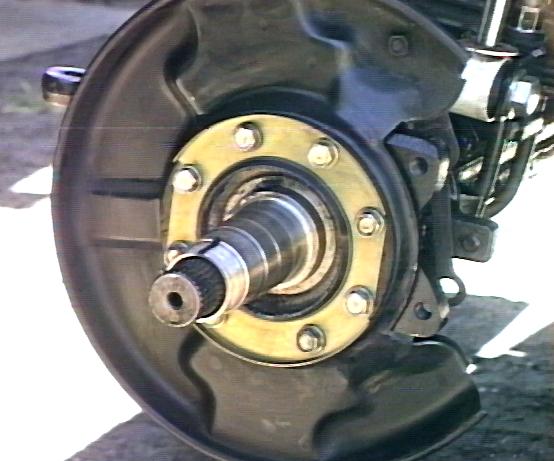
4. The gold shield hub assembly seal goes with the FLANGE facing OUTBOARD, as seen in the picture below. If you try to insert the hub assembly with the inner seal facing the direction you have it, you will bend the seal inward and deform or tear it.

*Also notice in the picture below, there is no paper gasket evident between the flange and the gold ring. The gasket is between the backing plate and the spindle face.


Faxle4.jpg
 
Whoa!
Take a step back on your front knuckle! You have a few procedural errors here.
It goes in this order:
1. The cutout paper gasket goes between the knuckle face and the spindle, as you have it. Use some gasket stick if you are having trouble getting the gasket to stay. use a couple bolts to align the spindle bolt holes.
2. Round gasket with cutout at bottom
3. Backing plate or eliminator
4. The gold shield hub assembly seal goes with the FLANGE facing OUTBOARD, as seen in the picture below. If you try to insert the hub assembly with the inner seal facing the direction you have it, you will bend the seal inward and deform or tear it.

*Also notice in the picture below, there is no paper gasket evident between the flange and the gold ring. The gasket is between the backing plate and the spindle face.

Faxle4.jpg

Good catch on the gold seal @Stumpalama - I will correct it. That said, I think I have everything else correct - Knuckle seal, followed by spindle, followed by circular seal with the cut-out down (matching the drain in the spindle) followed by the backing plate eliminator, and then the gold seal (currently on backward).

What appears to be the circular paper gasket in my picture above is actually the backing plate eliminator, the gasket is sitting behind it.
 
Back
Top Bottom