What do we need shackles for in the first place?
Simple, to allow for length changes of a leaf spring. A leaf spring suspension is a pretty simple thing, leafs position the axle under the vehicle, and supports the weight of the vehicle. As a leaf spring flexes up or down, its length from eye to eye changes. Since one end is mounted solidly, and cant move, all the length change happens at one end, which has a shackle between the spring and frame to allow for movement.
What are the pros/cons of different shackle lengths?
In relation to stock length, there are a bunch of things affected when you change shackle lengths.
A longer shackle will move one end of the leaf spring further away from the frame, doing several things.
- It rotates the axle down at the shackle side of the spring.
- It decreases castor angle of the front axle affecting the steerings stability at high speed, and reduces the steering ability to return to center after a turn.
- It increases pinion angle
- It increases leverage on the shackle mount
- It increases droop (down) travel
- It decreases approach/departure angle
- It adds lift to the suspension in the amount of half the difference between the new shackle and the original shackle. Example: stock YJ shackle is 4” from bolt to bolt; replacing it with a shackle 6” from bolt to bolt will provide 1” of lift)
While some of these can be good things, and some bad, it depends on your setup which one is which. If you’re starting a build, then these traits can be accounted for and made to work to your advantage when it comes to fine tuning a suspension to get maximum performance from it, which brings us to…
How do longer/shorter shackles affect wheel travel?
Bear with me here, this digs a little deeper into how leaf spring suspensions work. To start with, a shackles length can dictate overall travel, both droop and compression. Let’s start with the leaf spring. Stock jeep leaf springs sit pretty flat with the load of the jeep on em, not so with lift springs since they have a larger arch in order to provide that lift. Since lift springs are designed to bolt in with no changes to the mounts, the eye to eye dimension of the spring is the same as stock, but with the additional arch, the main leaf of the spring pack is actually quite a bit longer. So, in order for a lift spring to compress all the way to being flat, the eye to eye dimension is going to be greater than the stock spring. If the shackle is not long enough to allow this to happen, the spring will bind before it gets flat, if force is applied after this bind point, the spring pack will flex into a W shape, fatiguing the springs and shortening their lifespan.
How a shackle affects droop travel is a bit easier to picture. When a spring droops, it will do so until its eye to eye dimension is limited, it hits this limit when the shackle is in line with the arch of the main leaf of the spring. A longer shackle will allow for more droop travel since when it reaches the max droop angle, the shackle end of the spring will be further away from the frame then it was with the stock length shackle.
Now we get to figure out just how long a shackle needs to be to work properly with our suspension setup.
Its best to start this while actually installing a lift, or whatever other work you may do that involves taking apart your suspension. Get a length of string, any ole string will do, its just going to be our measuring stick for this operation. Tie it to the fixed spring mounting bolt, good and tight so it wont come off. Now, lay the string along the main leaf of the spring so it follows the arch. Mark the string where the shackle bolt would pass through the spring eye. You now have the total length of the main leaf. Pull the string tight, and rotate your shackle forward and see if it reaches the mark you made for spring length at a 45-50 degree angle. If it doesn’t, then measure from the mark on the string to the shackle mount, and this is how long you need the shackle to be for your suspension. Be aware of the other things a longer shackle will do to your suspension, and be able to account for them when you make the change.
What the heck is shackle inversion, and why is it a bad thing?
Shackle inversion usually happens on the front of jeep YJ’s and CJ’s when the suspension is drooping to its maximum point. As we discussed earlier, this is when the shackle is in line with the arch of the main leaf of the spring pack. While at this point, if something hits the shackle while moving forward, its possible, and probable, that the shackle will fold backwards instead of returning to its normal position when weight is put back on the wheel. The shackle folding back against the frame, shortens the eye to eye length of the spring, possibly bending it. Shackle inversion is usually pretty simple to remedy, a lever of some kind is used to pry the shackle away from the frame and past the point of max droop, and then the spring will do its job and spring back to where it should be. Be careful tho, as the spring attempts to spring back, it has some stored energy that will be released pretty quick like, possibly taking your lever and throwing it into the woods. Shackle inversion can be avoided by installing stops on the frame to limit the shackles travel, or designing a stop into the shackle itself. Some folks use boomerang shackles in the front with the short leg at the frame end so that the center brace acts as a stop, but its not what boomerang shackles were designed for, we’ll get to that in a minute.
Why do some shackles have braces welded in while others don’t?
Bracing between the two sides of a shackle can help or hurt, depending on what your goals are. To explain we’ll have to go back to how a leaf spring works a bit more. As the axle attached to the springs articulates (one side in compression, the other side in droop), the spring still has to do its two jobs, locating the axle, and supporting the weight of the vehicle. As the axle twists, the springs must change length, as well as twist with the axle. That’s the reason for rubber or polyurethane bushings in the spring eyes, they allow the spring to twist in relation to the bolts holding it in place. While this twisting is taking place, the sides of the shackle will also move a bit in relation to the spring, one side being slightly ahead of the other as its pushed by the bushing. Adding a brace (or a bolt with sleeve) between the two sides of the shackle will stop the shackle from twisting forcing the bushing to do more work, and transferring some of the twisting force to the shackle mounting point on the frame. Remember I said a shackle brace can help or hurt depending on your goals? If your goal is road handling like a sports car (don’t know why you would want this from a jeep, but whatever), then the brace is a good thing as it will help to firm up the suspension as the body rolls around corners. If your looking for the last bit of available wheel travel, then the solid braced shackle can hurt a bit. When is a braced shackle really needed? When the shackle length increases over about one inch over stock. As the sides of the shackle get longer, they will flex between the bolts as force is applied to them, adding a brace will reduce this flex, which can be a huge negative with long shackles, as they induce a vague feeling to the handling and allow the springs side to side movement to increase.
Now on to shackle shapes, and how they affect things.
Up until a few years ago, shackles were simple, strait pieces of metal, then came the tow shackle, and the boomerang shackle. The tow shackle is pretty simple, still 2 pieces of metal, but provisions have been made to allow the hookup of a tow bar for flat towing. Sometimes they are run backwards so that the tow bar attachment point is towards the axle of the vehicle, and with the pin installed will act as a shackle stop to reduce the chance of shackle inversion. The boomerang shackle was origionally designed for the rear of YJ’s. In the rear of YJ’s with lift springs, as the suspension compresses, the longer length of the main leaf and the added travel the shackle has to account for it would cause the shackle to contact the rear cross member limiting travel. Back in the day, before boomerang shackles, we’d just notch the crossmember where the shackle hit and things would be good. The boomerang shackle was just a bit more BLING way of getting around the problem. Boomerang shackles are also used by some in a front application with the short leg towards the frame to counter shackle inversion. Some mistakenly think that the different shape of the boomerang shackle will alter the angle of the shackle or how it travels through its range of movement. This is not true, the shackles angle is measured in a strait line between its mounting points, it can be a boomerang, zig zag, strait, or round, the shape does not change the angle of the shackle. On an unrelated note, this is why bent drag links and trac bars don’t change bump steer, the mounting points dictate the angle, not the shape of the bar.
Shackle Mechanics
The angle of the shackle can stiffen or soften a spring's normal rate. You can determine the effective angle of a shackle by drawing a line through the middle of both spring eyes and a line through the shackle pivots. Then measure the angle formed by the two lines (measure ahead of the shackle - see illus. 3). You can increase the effective rate of a leaf spring by decreasing the shackle angle. An increase in shackle angle will produce a decrease in the effective leaf spring rate of a leaf spring.
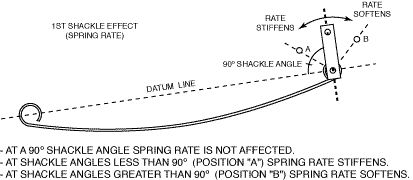
A good starting point for shackle angle is 90 degrees. In this position the shackle has no effect on spring rate. Keep in mind that the shackle angle changes (and consequently the spring's effective rate changes) whenever the suspension moves. Also, the shackle's angle will change whenever you change the chassis' ride height, the arch of the leaf, the load on the leaf, or the length of the shackle. Since the shackle direction changes when the leaf is deflected past a flat condition, you should avoid deflecting the right rear leaf to an extremely negative arch condition. This could cause a very large shackle angle at high loads and consequently a very soft spring rate. Excessive body roll and poor handling could result. You can correct this problem by decreasing the shackle angle, increasing the arch, of the spring by increasing the rate of the right rear leaf spring.
Shackle length is another factor affecting the rate of a leaf spring. A short shackle will change its angle (and the effective rate of the leaf spring) quicker than a long shackle upon deflection of the leaf. There is a second shackle effect on the stiffness of the rear suspension that counteracts and sometimes exceeds the shackle?s effect on spring rate. This second effect occurs whenever the shackle swings in its arc and moves the rear spring eye vertically.
The vertical movement of the rear spring eye causes a jacking effect. If the shackle movement forces the rear spring eye downward, the leaf will deflect and exert an upward force on the chassis that will add stiffness to the rear suspension. Conversely, the shackle will reduce suspension stiffness if t causes the rear spring eye to move upward during suspension travel.
The stiffening effect occurs during suspension deflection whenever the rear spring eye is ahead of the upper shackle pivot and the shackle is moving rearward (see illus. 4, example B). In this position, however, the shackle also produces a softening effect by reducing the effective rate of the leaf spring (due to the large shackle angle). The overall effect to the stiffness of the rear suspension is determined by the greater of the two shackle effects. Under opposite conditions, you can expect a reversal to the above effects. If the rear spring eye is located behind the shackle pivot (illus. 4 example A) the shackle effect will tend to reduce suspension stiffness whenever the shackle moves rearward. However, the small shackle angle will tend to stiffen the spring's rate. The overall effect to the suspension's stiffness is determined by the more dominant of the two shackle effects. Keep in mind that the movement of the rear spring eye (from its static position) is mostly forward under racing conditions.

If a leaf goes into negative arch the travel direction of the shackle changes and the shackle effects change. Handling is not consistent under these conditions.
The second effect of the shackle can be enhanced by increasing the length of the shackle. Generally, the second shackle effect (jacking)is dominant.



 approves the funds- but it seems that won't be for quite some time.


 )... as soon as I get it all said and done I will repost with my results.
