



While the discussion in the last paragraph is true, in the sense that a change in the shackle position as the spring eye distance lenghtens can contribute to lowering the effective spring rate, when I actually measured it, I found that it is so small for a low arch spring that you can't detect a difference between a 90 degree shackle and a 45 degree shackle. If you have a highly arched spring, like a 6 inch lift spring, then maybe it would be a measurable effect, but it still wouldn't be big enough to lose sleep over.
Navigation
Install the app
How to install the app on iOS
Follow along with the video below to see how to install our site as a web app on your home screen.
Note: This feature may not be available in some browsers.
More options
Style variation
You are using an out of date browser. It may not display this or other websites correctly.
You should upgrade or use an alternative browser.
You should upgrade or use an alternative browser.
Shackle Angle / Installation- Opinions Sought
- Thread starter ibejamie
- Start date
This site may earn a commission from merchant affiliate
links, including eBay, Amazon, Skimlinks, and others.

I'll refer back to my post above and say again that the angle is not a black and white thing and that if you don't have the fab and technical ability to determine that your rig has too much body roll, poor road handling characteristics, brake dive, or a myriad of other problems, you may want to take it to a shop where the guys can iron it out for you. There have been times when I had to change my angle 3-4 times and shackle lengths before I was happy with the ride.
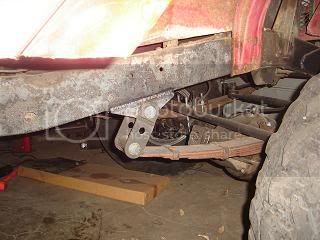
My SOA shackle angle
My SUA original shackle angle change
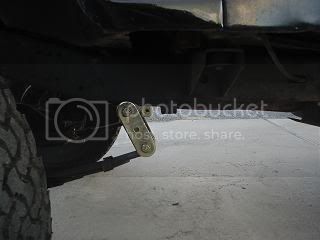
The problem it caused
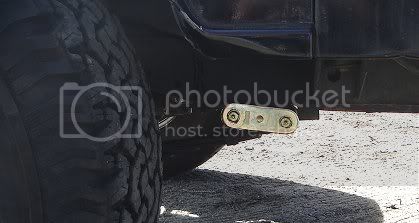
It's kinda hard to see but notice the difference in the spring arch when the shackle was pinned to the frame vs. normal weighted shackle angle due to the lengthening of the arched spring
My SOA shackle angle
My SUA original shackle angle change
The problem it caused
It's kinda hard to see but notice the difference in the spring arch when the shackle was pinned to the frame vs. normal weighted shackle angle due to the lengthening of the arched spring
Last edited:

- Thread starter
- #23
whoa.
thanks again!
thanks again!
There have been times when I had to change my angle 3-4 times and shackle lengths before I was happy with the ride.
You don't have to go through this by trial and error. A simple measurement would prevent you from getting in this situation. If you measure the length of the top leaf, this is the maximum eye to eye distance that is possible when the spring is flat. You can also measure the minimum eye to eye length with the weight of the axle on the spring and using these two lenghts you can calculate the position of the shackle hanger and the lenght of the shackle that will be necessary to get the full range of motion out of your springs. Nothing rides worse than a spring that can't compress because it is up against the frame.

Doing research on shackle angle and looking to figure out layout for shackle hanger. How do you determine position after measuring length of top leaf Maximum eye to eye) and minimum eye to eye? What's the calc to come up with correct position?You don't have to go through this by trial and error. A simple measurement would prevent you from getting in this situation. If you measure the length of the top leaf, this is the maximum eye to eye distance that is possible when the spring is flat. You can also measure the minimum eye to eye length with the weight of the axle on the spring and using these two lenghts you can calculate the position of the shackle hanger and the lenght of the shackle that will be necessary to get the full range of motion out of your springs. Nothing rides worse than a spring that can't compress because it is up against the frame.

The shackle needs to be at max angle with the suspension at full compression against the bump stop. If it's not then move the shackle mount until it is.

The video is pretty good at explaining it. You need to know the max eye to eye length at full compression and the minimum at full droop. The difference is the length of shackle travel. Then you have to pick a maximum angular motion of the shackle. For off road this could be as much as +/- 45 degrees or a total of 90 degrees. At 45 degrees the ride feels “floaty“ and unstable, so maybe +/- 30 degrees would be better on road. Remember that longer shackles are also less stable side to side. Then the rest is trigonometry to find the shackle length. Mount the shackle so that it is at your chosen angle at full compression using the compressed eye to eye length as a guide.
For example, using a +/- 30 degree swing, the shackle length would be equal to the shackle travel length. This is two times the sine 30 degrees times shackle travel. Since the sine of 30 degrees is 0.5, 2 x 0.5 = 1 so shackle travel = shackle length. In other words, in order for the shackle to swing + and - 30 degrees for the difference between full compression and droop, the shackle length would need to be equal to the difference in eye to eye length over the range of compression.
You can use a google search for other angle swings, such as 45 degrees. The sine of 45 degrees is .707 so 2x .707 is 1.414, so the shackle length would need to be 1.4 times the shackle travel.
For example, using a +/- 30 degree swing, the shackle length would be equal to the shackle travel length. This is two times the sine 30 degrees times shackle travel. Since the sine of 30 degrees is 0.5, 2 x 0.5 = 1 so shackle travel = shackle length. In other words, in order for the shackle to swing + and - 30 degrees for the difference between full compression and droop, the shackle length would need to be equal to the difference in eye to eye length over the range of compression.
You can use a google search for other angle swings, such as 45 degrees. The sine of 45 degrees is .707 so 2x .707 is 1.414, so the shackle length would need to be 1.4 times the shackle travel.
Last edited:
Great information, both video & Pin Heads follow up.
I'm clearly a newb and am looking for suggestions regarding proper angle for a capable off-road rig that has decent manners on pavement. I'm installing a SU, 3" OME lift - planning on running either 33's or 35's (rig came with a 1" body lift). Any recommendations and reasoning for max shackle angle on a FJ 40 Shackle Reversal?
I'm clearly a newb and am looking for suggestions regarding proper angle for a capable off-road rig that has decent manners on pavement. I'm installing a SU, 3" OME lift - planning on running either 33's or 35's (rig came with a 1" body lift). Any recommendations and reasoning for max shackle angle on a FJ 40 Shackle Reversal?
The OME system is designed to work with the stock spring hangers and axle perches to give the proper caster and pinion angles. The shackle angle will be whatever it is. I can’t see any compelling reason to do a shackle reversal. I have driven several rigs that have the shackles both ways and I can’t tell the difference.