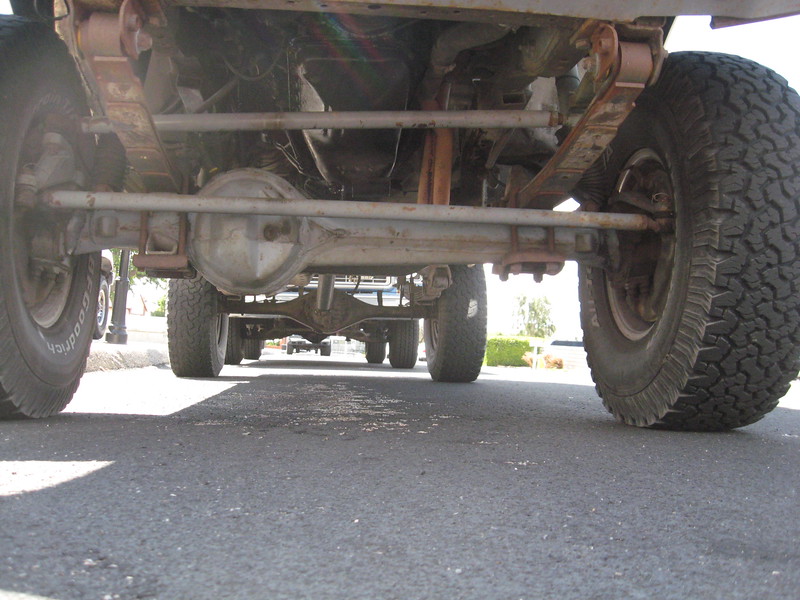
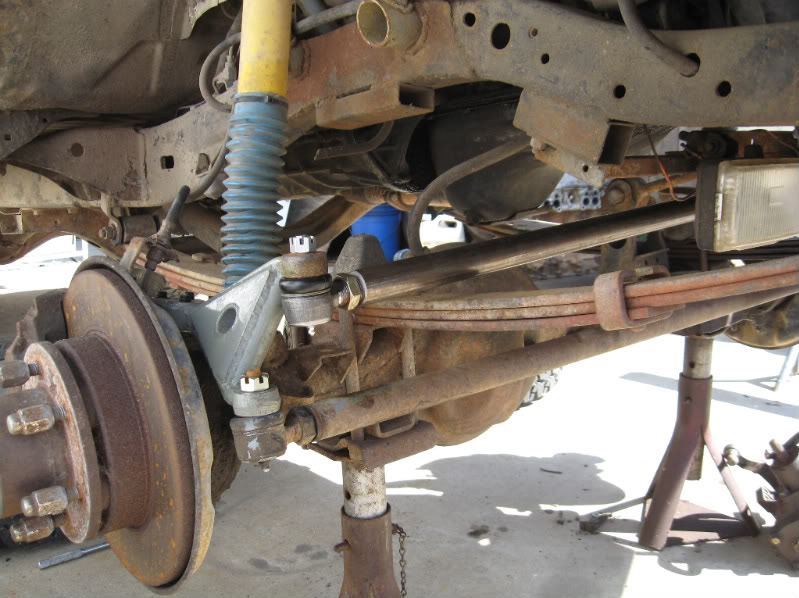
OME Dakar lift ordered for my 85

This site may earn a commission from merchant affiliate
links, including eBay, Amazon, Skimlinks, and others.

I have a lot of experience with these springs. I've run several variations of them front and rear. The shackle angle is not good in the rear, even with the light springs in a 4runner with a heavy 37" spare and tools in the back. I took the leaf pack apart and used the lower two springs (non overloads) with the upper 3 springs from the 89+ OME pickup pack. They are a couple inches longer. I moved the rear hanger back a couple inches and put a 5" shackle on it. Also using only the shortest of the overloads with it flipped upside down. Flipping them upside down is what I have found works best, as they are utilized far too quickly right side up when articulating the rear leaves and limit travel big time. This is a decent setup, but it's not perfect. The arch of the 4runner/3rd gen pickup springs is slightly different. I will likely be having a shop match the arch of the two leaf packs, but for now it is good enough. I also threw the original top two rear springs from the 4runner pack up front for a RUF setup. The lower leafs are from the OME front pack. The setup is stiff (especially with the fox shocks I'm running), but it works for me since this is a DD without any sway bars.

I also have the full OME shackle setup for sale, front and back. Used for a month. I went to longer shackles. Let me know if anyone wants them. High quality stuff but they are stock length.
 
Well. Just finished with the spring install. Sits pretty level. Hopefully they settle a little. Does anyone know if the driveshaft length is OK? Looks like it pulled out of the yoke maybe a couple of inches.

IMG_20161113_110927510.webp
 
I'm running stock drivelines with a one piece rear and it's been fine. I do need to rotate my front axle up though as I get a vibration when in 4wd at around 50-55.
 
Also wondering if I need an alignment. The truck drives straight and doesn't pull but the steering wheel moved off center about an inch or so.
 
Also wondering if I need an alignment. The truck drives straight and doesn't pull but the steering wheel moved off center about an inch or so.

With the factory push-pull steering you just need to pop off the steering wheel and put it where you want. An alignment will not straighten the steering wheel. With a lifted truck I would strongly consider cross-over/hi-steering. Bump steer is going to suck. BTDT.
 
I'm running the stock 2 piece shaft. I think it will be fine. Got a little clunking noise on the right front side when coming in to the driveway when the suspension unloads.
I ran the stock D-S's on mine. Your have a carrier bearing or is it one-piece?
 
Front: I had to get my D/S lengthened, but it's because I have the axle mounted almost 2" forward on the springs (using the other hole in the perches).

Rear: stock D/S but I made up some plates to move the axle forward an inch. I just wanted the splines buried more.

I've learned that OME springs are noisy. Lots of clunking.

Looking forward to getting mine installed.
 
The bump-steer that I had was so insignificant that I don't recall it at all. I went cross-over for other reasons, but cross-over on those springs is a trick. I kind of doubt that any of the commercial steering arms will work without having to reduce the up travel on the pass side and limit the droop on the driver's side. They're all made for taller lifts. I was told it couldn't be done by some who can't think outside of "bolt it on". I had to work really hard to modify my old school "two steering arms welded together" RS arm to get the drag-link's steering arm end at just the right height. Lots of 'mock this up and cycle it in the drive-way' time. And I still managed to put a small crease in the front of the oil pan while chasing a broken desert racer.
 
Third picture shows a raised bump-stop to reduce the up travel. I did it with the stock bump-stops. Best pic that I have of it:
i-dBxsvxw-L.jpg

The tubes welded to the underside of the frame mimic the original bump-stop landing pads that the PO cut off the truck. Can see the oil pan divot.
Even inverting the taper in the upper part of the arm didn't get the axle end of the drag-link low enough, had to cut into the arm and insert some bar stock at *just* the right height.
i-ckwtpdV.jpg

A flat pitman arm is required, and unless the steering box is spaced out from the frame by about 5/8"-3/4" the pitman arm's TRE's grease zerk will hit the edge of the spring at/near full up travel. BT, DT.
 
Clean truck! Without the any extra weight front/rear I would not expect the springs to settle much. Mine never did with the 4runner's extra weight.

I recommend high steer if you're planning on doing much offroading. If not, you'll be OK on the street, but not something I like to risk. You can make high steer work with those springs as mentioned above. A flat arm and good placement of your steering box is key. You'll be limited to approx 2" of up travel. This was part of the reason I redid the leaf packs and ended up with 5" or so of up travel.
 
Depending on the use the stock steering may be fine as-is. You'll know if you're working it too hard off-road because you'll notice that the once centered steering wheel now needs to be turned a little to go straight down the road. This is a sign that the 'horse-shoe' steering arm on the LH knuckle is bending. In my case it was opening up so I was having to steer a bit to the right to go straight. Also want to check that you're not flexing the suspension to the point of binding the ball-joints in the drag-link. Mine didn't, but it was close.
 
Funny because my current steering is doing the same thing as ntsqd which is why if I continue to use this trick highsteer will be going on, I've already bought it thankfully .
 
The trails that I'm on usually aren't too rough. I'll keep an eye on the arm and drag link though. The truck rides a lot better now and also have capability to put some weight in it.
 
Looks like I'll need longer front brake lines. Probably not a bad thing anyway since they are original!
 
The old school solution for the longer brake hose problem is to buy two rear hoses and two front hoses. The rear hoses are male by female ends where the fronts are female by female. So screw a rear hose into a front hose and install that assembly as a front hose. The resulting hose is pretty long though. My '84 came to me with this fix in place, but the first time that I rebuilt the front end I converted it to -3AN braided SS hoses that I made up using screw together hose ends so that I could make the hoses what ever length I wanted.
 
Back
Top Bottom