


Navigation
Install the app
How to install the app on iOS
Follow along with the video below to see how to install our site as a web app on your home screen.
Note: This feature may not be available in some browsers.
More options
Style variation
You are using an out of date browser. It may not display this or other websites correctly.
You should upgrade or use an alternative browser.
You should upgrade or use an alternative browser.
Landtank MAF surprising scangauge results
- Thread starter Brian894X4
- Start date
This site may earn a commission from merchant affiliate
links, including eBay, Amazon, Skimlinks, and others.


 Who's gonna be the first to go


won't you need injectors with 6 holes for that
 ?
?
This is just how ECUs work. Of course, if the sensor isn't actually doing a better job then the computer wouldn't gain any benefit, but if the sensor IS reading true more often, the computer will benefit in its monitoring and therefore its controlling ability.
[...]
When the computer samples the signal from this modified sensor setup it does not have to throw out nearly as many data points as noise because the sensor is not washing out in turbulence as often.
Assumption #1: assumed new MAF sensor is "reading true more often" and provides less "noisy" data than the original MAF without referring to data that shows increased accuracy. Please provide reference that shows an example of noisy vs. less noisy analog output from original vs. new MAF and point out the "noise" you are referring to.
It only relies on the initial assumption of "improved signal from the new sensor" to be true. If a computer is seeing noise from a sensor as important as the MAF, its ability to control the engine is degraded. If that signal improves, its ability to control the engine improves -- there is no assumption about this.
[...]
The ECU does not have to be "changed" to take advantage of a cleaner signal from one of its sensors.
[...]
The software adapts to this and a computer can indeed create "more numbers" or perhaps more accurately a better data curve from a cleaner signal.
Assumption #2: assumed that the new MAF sensor is providing data that is significantly different from original sensor in resolution and range after A/D conversion and reading of data by ECU. (The data provided by the new sensor is only relevant to us after A/D conversion and processing by the ECU, not before that). The ECU programming and bit resolution on the A/D are likely matched precisely to the sensitivity and range of the analog sensor (original MAF). The questions I think Christo is asking are related to this:
a) Limitations in the ECU programming (how it responds to small input changes) or quantization error in the A/D conversion could render any additional resolution provided by the new sensor meaningless after A/D conversion and processing by the ECU.
b) Hardcoded limits in ECU programming (might be programmed to only handle data within a certain range) or a limited-range A/D (one that maxes out before the higher max. output of the new MAF) could render any increase in range provided by the new sensor meaningless.
Please provide reference that indicates these things are not happening.
When the computer samples the signal from this modified sensor setup it does not have to throw out nearly as many data points as noise because the sensor is not washing out in turbulence as often.
Assumption #3: assumed code in ECU has programming to filter out "noisy" input from original MAF. Please provide reference that shows ECU handling of "noisy" data and how this noise is defined.
Last edited:

- Thread starter
- #84
I think there are a lot of legitimate questions here, but I don't want to turn this into an attackfest on Landtank and his mod. First of all, a lot of work clearly went into it and second of all, at least some of these issues were probably covered in other threads. So, I can understand if he and others who participated in the development of this mod are getting frustrated with having to answer the same questions over and over again.
I'm not an armchair speculator of this product. I'm an actual customer and it's on my truck right now. That means whatever the outcome of this discussion is will have a direct affect on my vehicle. So, I'm hoping to flush out a few issues and get a few questions answered without chasing away the one person who can help answer them the best, the original developer of this mod.
If getting a my emissions checked out will go a significant distance in answering some of these questions, I will gladly figure out a way to get my emissions check out, even if I have to pay someone to do it. Any other suggestions would be greatly appreciated.
On a slightly seperate, but related note, check out the 70 series 1FZ-FE thread again....
https://forum.ih8mud.com/70-series-tech/264657-1998-later-1fz-fe-engine-questions.html
There's some new interesting information. Apparently, the Venzualian 80 series, which continued production through 2007, used the same "old version" of the 1FZ-FE right up to 2007. There's a picture of it and you can see the same intake, apparently MAF, and even EGR and other features as our engines, all of which are changed on the 70 series version of the 1FZ starting sometime after 1998.
I'm not an armchair speculator of this product. I'm an actual customer and it's on my truck right now. That means whatever the outcome of this discussion is will have a direct affect on my vehicle. So, I'm hoping to flush out a few issues and get a few questions answered without chasing away the one person who can help answer them the best, the original developer of this mod.
If getting a my emissions checked out will go a significant distance in answering some of these questions, I will gladly figure out a way to get my emissions check out, even if I have to pay someone to do it. Any other suggestions would be greatly appreciated.
On a slightly seperate, but related note, check out the 70 series 1FZ-FE thread again....
https://forum.ih8mud.com/70-series-tech/264657-1998-later-1fz-fe-engine-questions.html
There's some new interesting information. Apparently, the Venzualian 80 series, which continued production through 2007, used the same "old version" of the 1FZ-FE right up to 2007. There's a picture of it and you can see the same intake, apparently MAF, and even EGR and other features as our engines, all of which are changed on the 70 series version of the 1FZ starting sometime after 1998.
Last edited:

Christo has made up his mind that I'm wrong about how this MAF works and how the fueling system on our truck works. There is nothing more to be said to him about this. Repeating myself another 100 times is not going to change anything and only lead to more disagreement.
I've stated numerous times that if you plug in the vacuum line from the FPR that the LTFT% will shift about 18% and not to do it. I've even stated it here earlier on.
So what does he do, he plugs in the FPR and has an issue with the fact that the LTFT% is way out of whack at idle.
He now what's answers to his questions as in his mind this is evidence that there is a problem with the MAF sensor. He knows full well what my answer is but refuses to accept it.
The basic problem here is that he refuses to accept the idea that he may be wrong about how the 80 fueling system works. He is not ready to question his own understanding and ready to consider another opinion.
I didn't read some tech manual or discuss this with some trained technicians I reversed engineered it. To understand what that means, I did a series of tests and evaluations on the system to determined there effect on how the ECU managed them.
The first and biggest assumption he has made is that the vacuum line is there to maintain a constant pressure differential. I don't know where he got this idea but I can tell you with great certainty that this is not the case.
I could go into detail how me and Cattledog determined this but it's more clear to just say that on a boosted truck with a stock MAF sensor at WOT the engine is running crazy rich. He already knows this and posted it up way back years ago and showed this to everyone on a dyno chart he has.
So if Toyota designed the system to need a constant pressure differential why is it running so rich? If anything you want less fuel and a drop in fuel rail pressure is needed.
What Christo needs to do is accept the idea that I might be right, install the unit as instructed and then get out of his chair and actually eval the piece for himself. This way at least he can ask some pertinent questions. And if he is sincere about wanting to sell these then he needs to do this anyway to validate the product.
But I'm sure I'll come back here with a line edited reply from him telling me why I'm wrong and how he knows better.
And that is why I've not been engaging with him on this thread and a few others. There is no point to it and only leads to the demise of a thread.
I've stated numerous times that if you plug in the vacuum line from the FPR that the LTFT% will shift about 18% and not to do it. I've even stated it here earlier on.
So what does he do, he plugs in the FPR and has an issue with the fact that the LTFT% is way out of whack at idle.
He now what's answers to his questions as in his mind this is evidence that there is a problem with the MAF sensor. He knows full well what my answer is but refuses to accept it.
The basic problem here is that he refuses to accept the idea that he may be wrong about how the 80 fueling system works. He is not ready to question his own understanding and ready to consider another opinion.
I didn't read some tech manual or discuss this with some trained technicians I reversed engineered it. To understand what that means, I did a series of tests and evaluations on the system to determined there effect on how the ECU managed them.
The first and biggest assumption he has made is that the vacuum line is there to maintain a constant pressure differential. I don't know where he got this idea but I can tell you with great certainty that this is not the case.
I could go into detail how me and Cattledog determined this but it's more clear to just say that on a boosted truck with a stock MAF sensor at WOT the engine is running crazy rich. He already knows this and posted it up way back years ago and showed this to everyone on a dyno chart he has.
So if Toyota designed the system to need a constant pressure differential why is it running so rich? If anything you want less fuel and a drop in fuel rail pressure is needed.
What Christo needs to do is accept the idea that I might be right, install the unit as instructed and then get out of his chair and actually eval the piece for himself. This way at least he can ask some pertinent questions. And if he is sincere about wanting to sell these then he needs to do this anyway to validate the product.
But I'm sure I'll come back here with a line edited reply from him telling me why I'm wrong and how he knows better.
And that is why I've not been engaging with him on this thread and a few others. There is no point to it and only leads to the demise of a thread.
I know enough to not care how it works and appreciate the huge amounts effort put forth to make this product. I bought it, installed it, used it, love it. It changed the shift pattern on my truck, especially at WOT. I definitely have more power, perceived or not, and I have been getting very very slight mpg improvements. Look its slight. Less then .5mpg buts it consistent and its there. Questioning the product at this point with SOO many successes seems completely counter productive. To be honest, as an outsider of this development it very much seems that there is more of a personal conflict going on that perhaps not everyone is aware of. I could be wrong but that is how this thread reads to me.
- Thread starter
- #87
Rick,
I have a few quick questions. Not challenges. Just questions. Unfortunately, please understand, I'm pretty ignorant on the fuel system managment and yes some of these questions are spurred on by some of what Christo said, but also from my own research.
1) Is is possible that Toyota intentionally wanted the engine to run rich to prevent detonation and other issues during certain conditions, such as extreme hot weather, desert running, etc?
2) Is is possible that Toyota wanted a very high rich condition with the TRD supercharger at WOT for those same reasons?
3) Do you have any idea why Toyota kept the FPR in place on the 1FZ-FE during the production years 1998-2008 when the 1995-1997 sensor was no longer being used? I would assume that Toyota had figured out a better way to regulate the fuel pressure at idle, but it would appear not? Although it should be noted that Toyota did not use this mod sensor for the 1FZ-FE ever, so maybe whatever it did use (hot wire temp sensor and maybe a MAP sensor) wasn't accurate enough?
4) Do other Toyota vehicles that use the same sensor we are using for this mod also have a FPR hooked up and if so, why do you think that is the case?
5) Do you think if I were get sniff emissions tested that it might provide any valuable information towards this modification?
Thanks.
I have a few quick questions. Not challenges. Just questions. Unfortunately, please understand, I'm pretty ignorant on the fuel system managment and yes some of these questions are spurred on by some of what Christo said, but also from my own research.
1) Is is possible that Toyota intentionally wanted the engine to run rich to prevent detonation and other issues during certain conditions, such as extreme hot weather, desert running, etc?
2) Is is possible that Toyota wanted a very high rich condition with the TRD supercharger at WOT for those same reasons?
3) Do you have any idea why Toyota kept the FPR in place on the 1FZ-FE during the production years 1998-2008 when the 1995-1997 sensor was no longer being used? I would assume that Toyota had figured out a better way to regulate the fuel pressure at idle, but it would appear not? Although it should be noted that Toyota did not use this mod sensor for the 1FZ-FE ever, so maybe whatever it did use (hot wire temp sensor and maybe a MAP sensor) wasn't accurate enough?
4) Do other Toyota vehicles that use the same sensor we are using for this mod also have a FPR hooked up and if so, why do you think that is the case?
5) Do you think if I were get sniff emissions tested that it might provide any valuable information towards this modification?
Thanks.
- Joined
- Sep 1, 2007
- Threads
- 34
- Messages
- 588
There is absolutely no need for mr T or anyone to get all elaborate with fuel pressure.
The actual fine tuning of the AFR is and should be accomplished via the ecu's injector pulse width outputs.
The manifold referenced FPR is SOP on nearly all EFI engines. It keeps the pressure differential constant. Lets forget about MAF changes for a secod and look at the effect of the reference port.
If you dont have the line hooked up then there is a higher pressure differential between the fuel in the rail and the vacuum in the intake. So it actually richens up idle.
Now if a larger MAF reads less airflow at idle then this would compensate for that.
For all I know the maf housing could flow well and have a good resolution from idle to the amount of air most need at full power.
However the proper way to do this is to use a programmable ECU or a chip you can tune yourself to recalibrate the ECU for the response curve of the MAF and other engine mods.
The actual fine tuning of the AFR is and should be accomplished via the ecu's injector pulse width outputs.
The manifold referenced FPR is SOP on nearly all EFI engines. It keeps the pressure differential constant. Lets forget about MAF changes for a secod and look at the effect of the reference port.
If you dont have the line hooked up then there is a higher pressure differential between the fuel in the rail and the vacuum in the intake. So it actually richens up idle.
Now if a larger MAF reads less airflow at idle then this would compensate for that.
For all I know the maf housing could flow well and have a good resolution from idle to the amount of air most need at full power.
However the proper way to do this is to use a programmable ECU or a chip you can tune yourself to recalibrate the ECU for the response curve of the MAF and other engine mods.

I have been using Rick's MAF for a while now and I can definitely feel an improvement in performance. My mileage went down a little though I suspect that is due to both my now heavier tires and my now heavier foot. I have a history of freely exercising the motor winding it out as high as 5.4K. The shifts have become very nice.
I have never seen any codes. No hiccups. No hints of any problems. If there were issues with the fuel rail pressure the wideband 02 sensor would realistically detect at least a hint of such a problem. Nobody has posted any facts that would suggest that the missing vacuum would or does cause detriment. Saying that the vacuum must be improtant because Mr T put it there doesn't fly with me. Its hearsay and without proof to the contrary I think it is safe to shelve the concern until someone actually can show a hint of lean operation. I suppose that a few of us could check a spark plug to see if there are any signs of a deformed electrode or a widened gap, but based on Rick's extensive research I am confident that the appearance of such damage is highly unlikely.
With 210K miles I am due to PM the HG so I will be taking advantage of the opportunity to build a performance head for atop of my bomb proof bottom end (cam, valve, and port work ). When I pull the head off here in the near future (I should have about 5K miles with Rick's MAF) I will be sure to check for burned exhaust valves. I don't expect there will be any.
Enjoy this well designed and extensively tested modification. It really is a beautiful advancement that functions flawlessly. Oh, and here is a side by side for those that have not had the opportunity to see all of the air...

Not only is the pod huge, but you can see the how the stock housing narrows close to the counter.

The intake of the stock MAF will literally fit inside the intake of the redesigned MAF.
I have never seen any codes. No hiccups. No hints of any problems. If there were issues with the fuel rail pressure the wideband 02 sensor would realistically detect at least a hint of such a problem. Nobody has posted any facts that would suggest that the missing vacuum would or does cause detriment. Saying that the vacuum must be improtant because Mr T put it there doesn't fly with me. Its hearsay and without proof to the contrary I think it is safe to shelve the concern until someone actually can show a hint of lean operation. I suppose that a few of us could check a spark plug to see if there are any signs of a deformed electrode or a widened gap, but based on Rick's extensive research I am confident that the appearance of such damage is highly unlikely.
With 210K miles I am due to PM the HG so I will be taking advantage of the opportunity to build a performance head for atop of my bomb proof bottom end (cam, valve, and port work
). When I pull the head off here in the near future (I should have about 5K miles with Rick's MAF) I will be sure to check for burned exhaust valves. I don't expect there will be any.Enjoy this well designed and extensively tested modification. It really is a beautiful advancement that functions flawlessly. Oh, and here is a side by side for those that have not had the opportunity to see all of the air...
Not only is the pod huge, but you can see the how the stock housing narrows close to the counter.
The intake of the stock MAF will literally fit inside the intake of the redesigned MAF.

I would guarantee the ECUs in the newer trucks with the newer engines are programmed differently. There's been a ton of advances since 1996. Heck, look, Ma, no more MAF! It isn't the same ECU with the same code.
How many of these trucks with Rick's MAF have gotten OBD inspections? OBD inspection failpoints are stricter than ASM tailpipe inspection failpoints. How much of a lean condition is a bad thing? Codes are set and the MIL is set to illuminate when conditions exist that would likely cause the emissions of an average vehicle to exceed the emissions standards by 1.5 times. So, in this case, if the emissions standards for NOx is "Y", then the MIL would come on when conditions exist that drive the NOx emissions to Y x 1.5.
Is running the engine consistently at Y x 1.4, for example, a long term bad thing? Running leaner and hotter and producing more NOx at a level just under the radar of OBD for tens of thousands of miles--any impact on the engine? I think this is Christo's question.
There's a lot of variables here, to be sure. I'm not picking sides, either, btw, just trying to add a little more info.
How many of these trucks with Rick's MAF have gotten OBD inspections? OBD inspection failpoints are stricter than ASM tailpipe inspection failpoints. How much of a lean condition is a bad thing? Codes are set and the MIL is set to illuminate when conditions exist that would likely cause the emissions of an average vehicle to exceed the emissions standards by 1.5 times. So, in this case, if the emissions standards for NOx is "Y", then the MIL would come on when conditions exist that drive the NOx emissions to Y x 1.5.
Is running the engine consistently at Y x 1.4, for example, a long term bad thing? Running leaner and hotter and producing more NOx at a level just under the radar of OBD for tens of thousands of miles--any impact on the engine? I think this is Christo's question.
There's a lot of variables here, to be sure. I'm not picking sides, either, btw, just trying to add a little more info.
My 1995 is OBD II, but because of the year is usually sniffer tested, not plugged in. Since I have this mod, if I could get it sniffer tested, what would I be looking for? What readings? And what would it prove?
On my old truck and sniff testing in Washington State they'd give you a print out that showed carbon monoxide/dioxide, hydrocarbons, oxygen and NOx. If your state sniff tests NOx (I would think most would, since NOx contributes to smog), you're in luck. I would think if we were running lean enough to cause any kind of damage, we'd fail the NOx sniff test. I don't know this for sure though!
I wonder if our emissions test facility would allow me to test even though I just got new tabs through Jan. 10. I also wonder if they'd humor me and give me a sniff test if I asked. I know I've seen a print out of NOx emissions on a Washington sniff test performed on my old truck. They're pretty by the books at these state run facilities and probably wouldn't allow this kind of exploratory testing though.
To have access to just a couple tests! I'd run it with the stock MAF and the modified one a few times and see if we're getting high NOx with the new MAF. I need to make a friend at the emission test facility.... hmm.
well, there is over a 150 trucks out there running this MAF and I have only heard of one issue and that was a visual in CA. (trickyT)
Does everyone just scan the ECU now? I have to believe some have had the sniff test.
Something to clarify on emissions testing here--it really depends on what program your state runs. Yes, 1995 and older vehicles get tailpipe tests and mostly 2-wheel dyno ASM (Acceleration Simulation Mode) tests at that (which measure NOx because that is produced under load).
HOWEVER, unless your state's program has 4-wheel dynos, most non-disengageable 4-wheel drive vehicles (Cruisers) DO NOT receive a loaded ASM dyno test. They receive a simpler TSI (Two-Speed Idle) test, which DOES NOT measure NOx because there is no real load put on the engine.
You'd have to do one of two things to get tailpipe readings for NOx--
1. Find a 4-wheel dyno and 5-gas analyzer.
2. Remove your front driveshaft and find a 2-wheel dyno and 5-gas analyzer.
And, the majority of states now only test the OBDII system in 1996 and newer vehicles. Some DO have fallback tailpipe testing in conjunction with the OBDII test, but again, the type of tailpipe test dictates whether you get a NOx reading or not.
And most OBDII tests only scan the system for codes and report pass or fail. They DO NOT churn out readings for the monitors.
Last edited:

This has created allot of confusion for most of the readers of this post.
The answer you seek christo are from another vendor and you should have worked this out in private.
You should worry more about some of your products that need attention over this thread.
Vendor to vendor this was just rude..
The answer you seek christo are from another vendor and you should have worked this out in private.
You should worry more about some of your products that need attention over this thread.
Vendor to vendor this was just rude..
I would hope that the Toyota engineers, who designed the programing for detecting lean operation, would be insightful enough to set the parameters of NOx detection in such a way that the engine would be protected from longer term damage.
The idea that they would fail to be appropriately conservative in designing this critical error detection feature seems like a far fetched "what if".
I still have the stock MAF set-up. If someone would like to purchase it send me a pm.
The idea that they would fail to be appropriately conservative in designing this critical error detection feature seems like a far fetched "what if".
I still have the stock MAF set-up. If someone would like to purchase it send me a pm.
I am gonna keep Landtank's MAF on with the new sensor and FPR caps; it's been flawless thus far; I also have the OEM MAF for backup and I ain't selling it, yet. I wish there was a 4WD dyno nearby so I could get some real data to clear up my own (and hopefully others') confusion. Pinged a semi local dyno test shop (about 60 miles away) and haven't heard back from'em yet. I am guessing I'd have to travel pretty far to find one.
If I may suggest this, I am sure this has come up numerous times before; nevertheless, Rick, may be you can do a dyno before and after your MAF install. I think this gives your product a more concrete value. You should raise the price for the product after the dyno results are public. Just my $0.02.
If I may suggest this, I am sure this has come up numerous times before; nevertheless, Rick, may be you can do a dyno before and after your MAF install. I think this gives your product a more concrete value. You should raise the price for the product after the dyno results are public. Just my $0.02.
Last edited:

Christo has made up his mind that I'm wrong about how this MAF works and how the fueling system on our truck works. There is nothing more to be said to him about this. Repeating myself another 100 times is not going to change anything and only lead to more disagreement.
I've stated numerous times that if you plug in the vacuum line from the FPR that the LTFT% will shift about 18% and not to do it. I've even stated it here earlier on.
So what does he do, he plugs in the FPR and has an issue with the fact that the LTFT% is way out of whack at idle.
He now what's answers to his questions as in his mind this is evidence that there is a problem with the MAF sensor. He knows full well what my answer is but refuses to accept it.
The basic problem here is that he refuses to accept the idea that he may be wrong about how the 80 fueling system works. He is not ready to question his own understanding and ready to consider another opinion.
I didn't read some tech manual or discuss this with some trained technicians I reversed engineered it. To understand what that means, I did a series of tests and evaluations on the system to determined there effect on how the ECU managed them.
The first and biggest assumption he has made is that the vacuum line is there to maintain a constant pressure differential. I don't know where he got this idea but I can tell you with great certainty that this is not the case.
I am sorry, but it is not an assumption. Here is the relevant pages from the Toyota training manuals. Please tell me where I assumed wrong?
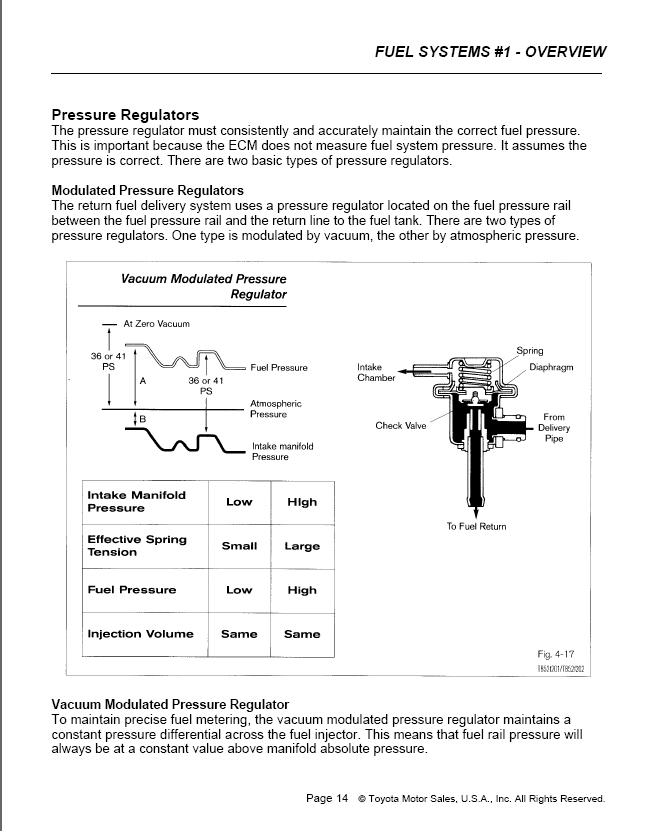
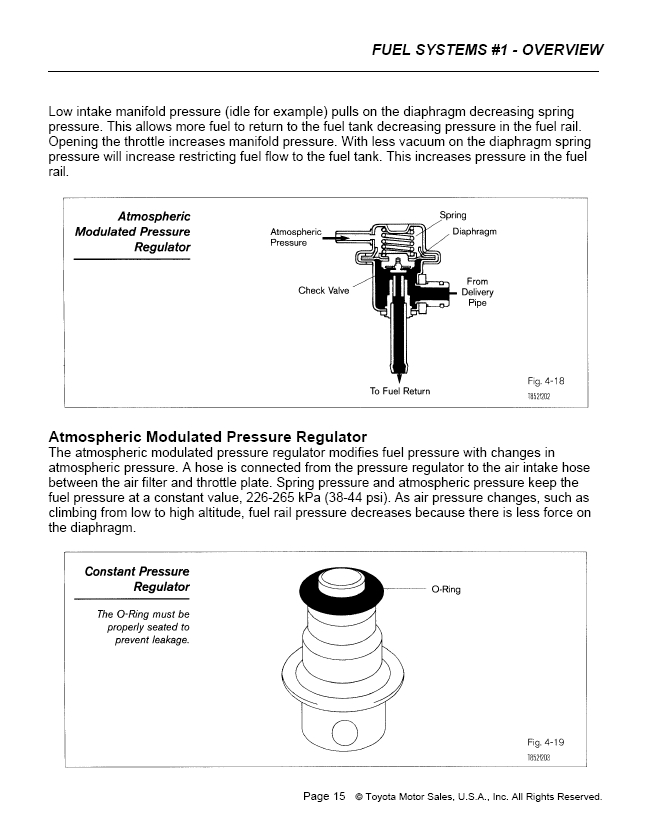
If you leave the FPR hooked up and the fuel trims go up, it means the truck is running lean with the new setup. This can only mean that there is a calibration issue with the sensor and housing as to what the ECU is expecting, ie, more air is entering the motor than what is being reported. Your unplugging the FPR is masking this by increasing the fuel pressure.
If there is a calibration error at idle, then there is an issue with the response curve of the sensor and/or the bore of the housing. Without doing a calibration on a flow bench and comparing the response curve with given flow between the stock and your MAF there is no way to know if you are correct.
Yes, you can monitor fuel trim and yes people are reporting better improvements, mostly because the truck is running leaner.
The bottom line is Toyota did not bandaid a inaccurate MAF sensor by connecting vacuum to the fuel pressure regulator.
I could go into detail how me and Cattledog determined this but it's more clear to just say that on a boosted truck with a stock MAF sensor at WOT the engine is running crazy rich. He already knows this and posted it up way back years ago and showed this to everyone on a dyno chart he has.
So if Toyota designed the system to need a constant pressure differential why is it running so rich? If anything you want less fuel and a drop in fuel rail pressure is needed.
I do not know why Toyota made the truck run that rich. Adding forced induction to a truck that was normally aspirated has it issues, and the overly rich condition is one of them. You started this development for your turbo build, and that was a good thing. However stating things about why mods are done that is incorrect is not.
What Christo needs to do is accept the idea that I might be right, install the unit as instructed and then get out of his chair and actually eval the piece for himself. This way at least he can ask some pertinent questions. And if he is sincere about wanting to sell these then he needs to do this anyway to validate the product.
We will do that when we get the time, however as the vendor of the product, you also have a responsibility to post the correct info, or at least obtain it.
But I'm sure I'll come back here with a line edited reply from him telling me why I'm wrong and how he knows better.
And that is why I've not been engaging with him on this thread and a few others. There is no point to it and only leads to the demise of a thread.
Yes, and I am sorry it has come to this. But facts are facts.
Last edited:

This has created allot of confusion for most of the readers of this post.
The answer you seek christo are from another vendor and you should have worked this out in private.
You should worry more about some of your products that need attention over this thread.
Vendor to vendor this was just rude..
Pot, meet kettle.
'Worry about some of your own products'. Nice.
'Vendor to vendor'. How about using a PM then?
Talk about rude.
I will add, that perhaps Christo could have PM'ed or phoned Landtank. However, this is another case of some people wanting to bury their heads in the sand and hope there isn't a problem. If I had done something to my truck on someone else's advice I'd be very interested to know why, especially if a person knowledgeable about the system had questions about its safety. If I were that knowledgeable person in a business and had to deal with possible future ramifications of a mod, I'd want an explanation as well. I'm not in any way taking sides on the actual issue, since I know nothing about the mod or the system, nor have I purchased the MAF in question. However, this situation is exactly why we have a forum- to discuss things.
-Spike
Last edited:

I do not have this mod, heck, after Sunday I wont even own an 80 anymore, but Slee does not seem to be thread crapping to me. He is bringing up important information and it needs to be discussed.
I do find it odd that Frankie is now advocating PMs as a vendor to vendor information exchange after seeing what happened in the spring thread.
I for one appreciate the vendors hashing the issues out with their customers in an open forum.
I do find it odd that Frankie is now advocating PMs as a vendor to vendor information exchange after seeing what happened in the spring thread.
I for one appreciate the vendors hashing the issues out with their customers in an open forum.
I say some one do a dyno so we can put an end to this. I would hope a dyno for a stock truck with or without forced induction is already available. All we need is a complete 4wd dyno for a truck with the modded MAF and sensor.
Ain't no one out there ???
???
Ain't no one out there
???
I say some one do a dyno so we can put an end to this. I would hope a dyno for a stock truck with or without forced induction is already available. All we need is a complete 4wd dyno for a truck with the modded MAF and sensor.
Ain't no one out there
It would still be apples and oranges. Same truck, same day, same temp, same gas, same as much as possible or it will solve nothing.
I have an email out to a local dyno about me dropping my front driveshaft to use their 2WD setup - maybe I'll give it a shot.

- Joined
- Dec 24, 2003
- Threads
- 136
- Messages
- 3,559
I am sorry, but it is not an assumption. Here is the relevant pages from the Toyota training manuals. Please tell me where I assumed wrong?
If you leave the FPR hooked up and the fuel trims go up, it means the truck is running lean with the new setup. This can only mean that there is a calibration issue with the sensor and housing as to what the ECU is expecting, ie, more air is entering the motor than what is being reported. Your unplugging the FPR is masking this by increasing the fuel pressure.
If there is a calibration at idle, then there is an issue with the response curve of the sensor and/or the bore of the housing. Without doing a calibration on a flow bench and comparing the response curve with given flow between the stock and your MAF there is no way to know if you are correct.
Yes, you can monitor fuel trim and yes people are reporting better improvements, mostly because the truck is running leaner.
The bottom line is Toyota did not bandaid a inaccurate MAF sensor by connecting vacuum to the fuel pressure regulator.
I do not know why Toyota made the truck run that rich. Adding forced induction to a truck that was normally aspirated has it issues, and the overly rich condition is one of them. You started this development for your turbo build, and that was a good thing. However stating things about why mods are done that is incorrect is not.
We will do that when we get the time, however as the vendor of the product, you also have a responsibility to post the correct info, or at least obtain it.
Yes, and I am sorry it has come to this. But facts are facts.
Christo, again another inquisitive and insightful post, and, for whatever its worth, I still don't see you attacking this mod (although I do see why people who don't know you or Rick personally would think that but you're both very brilliant people and you both have questioned one another's products in past so no harm no foul at least as I see it). However, I'd still like to twist this with you the way that I twisted this with Sumo who was making a major effort at attacking the mod if you ask me ... IF as my and others' widebands have proven over and over the AFR's are safe and steady at all ranges of operation including WOT, how much off can this calibration aspect you are worrying about be? IOW, the way that I see your statements is an incredibly stretched "What If" and you're asking Rick to answer that with formal flow bench tests, all sorts of gas analysees (sp?) and other expensive efforts. His answer is that through reverse engineering and normal band/wide band measurements, OBD-II measurements and all sorts of observations from users, everything is exactly within normal operating parameters except the AFR's are better, the economy is better and performance is better. You are deliberately doing something not suggested which is attaching the FPR and I understand why but to twist this the other way have you considered that the AFR's are 20% too rich in stock setup and this mod corrects that?
The equivalent analogy would be someone running your super sweet front bumper upside down and declaring that their approach angle sucks and that the stock bumper was 20% better than your bumper upside down. All along the truth was that the stock bumper was 20% worse than your bumper installed correctly. So, again, with all our observations thus far, how much off can this MAF mod really be. Respectfully, TC.