

Jerry Can Ladder Thingymabob feedback needed

This site may earn a commission from merchant affiliate
links, including eBay, Amazon, Skimlinks, and others.

Scott,

not sure what you are trying to explain, but is it something like this?
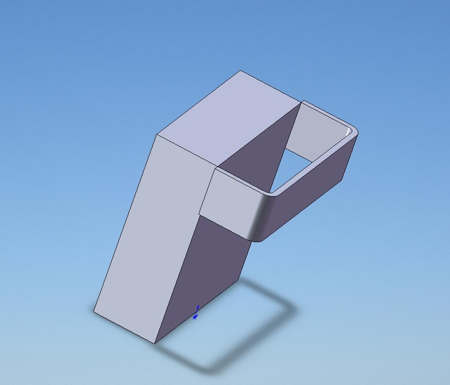
step1.jpg


The steps are only 4.5" wide. That is about the minimum we figured before your foot will slip off. I can see where a strap might be less material and not look as bulky. I will play with that option. I can see that it will look minimalistic, but I am not sure on the safety of that. We intend to dimple die the holes upwards for extra traction.

Currently the whole can holder is only two pieces and pretty easy to put together from a fabrication standpoint.
 
Scott,

not sure what you are trying to explain, but is it something like this?
step1.jpg


The steps are only 4.5" wide. That is about the minimum we figured before your foot will slip off. I can see where a strap might be less material and not look as bulky. I will play with that option. I can see that it will look minimalistic, but I am not sure on the safety of that. We intend to dimple die the holes upwards for extra traction.

Currently the whole can holder is only two pieces and pretty easy to put together from a fabrication standpoint.


Ok...to mix it up a little more :D. I think typical step ladders are less than 4.5" tread depth. Maybe you could trim an inch in the step depth here since you'll be perfing for extra traction/safety?
 
The catch is that a step ladder is open on the back. This has the jerry can in front so your toe will hit that before your foot is all the way on the ladder rung.
So why not hinge the ladder so it swings out when in use? Like a book cover.
Or make the steps fold up like a louvered blind?

I realize these options make the fabrication more difficult ($$$), but what you have just doesn't work on the back of a 100. It has an industrial look that wouldn't look bad on something like a FJ45 wagon or a Hummer but it just doesn't fit on a 100 IMHO.
Maybe when it's powder coated it will look better??

I hope that didn't come off to harsh, but you did want to hear what 100 owners thought.
 
unfortunately, there will always be an idiot who will slip, split his chin, and then say the thing was poorly designed.... :frown:

I'm still coming back to how much (or little) one needs a ladder back there. Yes, if it comes for free with the holder, so to speak, great, but if the ladder drives the whole thing and makes the holder start to be weird, then maybe not the best way to do it for me.

Somebody would come up with a portable light weight ladder that I can hook up to the side or rear of my roof rack and I'm all over it... (If it can serve as ditch bridger, I'll swoon and have nice dreams for a while too...:D) Christo?
 
OK, so let us ask another question then, how many jerry cans do most people want to carry? 1, 2 or 3? Also what other features would they like in a 2nd carrier?

Eric, the ladder that slips under the roofrack is something I have been thinking off. There are some design challenges with that as well but that is for another thread.
 
So why not hinge the ladder so it swings out when in use? Like a book cover.

Swing the carrier open, then hinge the ladder open from the back of the swing-out?

Or make the steps fold up like a louvered blind?

The one issue with any pivoting point or hinge is reliability when exposed to the elements. Simple bolt through holes work, but it wears on the powdercoat and eventually you get corrosion. This can be overcome with nylon/brass washers or bushings. The other aspect is how to make a hinge that does not rattle.

I realize these options make the fabrication more difficult ($$$), but what you have just doesn't work on the back of a 100. It has an industrial look that wouldn't look bad on something like a FJ45 wagon or a Hummer but it just doesn't fit on a 100 IMHO.
Maybe when it's powder coated it will look better??

Maybe I should sell this to the Hummer crowd and start from fresh. Actually in real life it does not look as big as the pictures.

I hope that didn't come off to harsh, but you did want to hear what 100 owners thought.

Not at all, that is why I started the thread.
 
OK, so let us ask another question then, how many jerry cans do most people want to carry? 1, 2 or 3? Also what other features would they like in a 2nd carrier?

Eric, the ladder that slips under the roofrack is something I have been thinking off. There are some design challenges with that as well but that is for another thread.


More is always better but 2 cans (~10-gallons) are a nice compromise that should allow for simpler/not as costly (noticed I didn't say "cheaper" :D) /less bulky/easier to engineer carrying via a bumper.
 
OK, so let us ask another question then, how many jerry cans do most people want to carry? 1, 2 or 3? Also what other features would they like in a 2nd carrier?
2 fuel cans min.
If I were hauling water back there 1 can would be enough. (I'm thinking of the guys with long range tanks that don't need to carry extra fuel.)

Swing the carrier open, then hinge the ladder open from the back of the swing-out?
That would work. It could also retain the cans.

The size isn't what puts me off as much as the industrial look.
 
OK, so let us ask another question then, how many jerry cans do most people want to carry? 1, 2 or 3? Also what other features would they like in a 2nd carrier?

Eric, the ladder that slips under the roofrack is something I have been thinking off. There are some design challenges with that as well but that is for another thread.

for me, I'd say I'd want the ability to carry 3 cans or a big box / cooler.
 
Aha, so is it the fact that it is sheet metal, the cut-outs, or what. Or is it that people are just used to see everything made out of tubing?
Sheet metal is fine. I think it's a combination of the blockyness and the cut outs that make it look quasi military to me. Some people will like that, it looks like it's built for rough use.
 
Aha, so is it the fact that it is sheet metal, the cut-outs, or what. Or is it that people are just used to see everything made out of tubing?

I am more of a minimalist, and the large expanses of flat plate just don't fit the look of the 100. Tubing might look better, but is not as secure a step. Actually, what you guys have done is very clever and functional, I just don't like the way it looks, but then stair steps to the top of my roof rack have never been a real priority for me.

I would think that a can carrier is more important than a ladder, so design a can carrier, and work a ladder into it, rather than designing a ladder for a 500 pound Land Cruiser driver, and building a can carrier into it.

For gas. 2 cans is about right. For travel in the USA, the 13 gallons of the factory subtank is nearly ideal, so 10 on the rack would be enough in 99.9% of USA circumstances. Crossing the Simpson Desert might take more fuel.

Please don't take any of this as anything other than constructive. I feel kind of quilty being critical, but you asked, and it's an honest opinion.

How about a basket for gas cans, and a ladder that is removable and attaches to the spare tire?
 
Scott,

not sure what you are trying to explain, but is it something like this?
step1.jpg


The steps are only 4.5" wide. That is about the minimum we figured before your foot will slip off. I can see where a strap might be less material and not look as bulky. I will play with that option. I can see that it will look minimalistic, but I am not sure on the safety of that. We intend to dimple die the holes upwards for extra traction.

Currently the whole can holder is only two pieces and pretty easy to put together from a fabrication standpoint.

The tread depth seems good, but the width seems excessive. Start with sides as deep as the jerry cans, maybe a little less. Bring the strap across the jerry can from the left side plate, toward the right, initially hugging the jerry can. About 2/3 across the jerry can, bend the strap out (rearward) about 4", then continue right until even with the right side plate. Bend it forward and weld it along the right side plate. I'm not sure about the dimensions, but this should give a reasonably wide step, 4" deep. It's not a step you'd want to stand on for a long time, just a way to get up to the roof conveniently. You could stagger the steps or make them identical. It would really thin that wide side plate, and make it slightly more skeletal looking. The sheet metal steps look enormously strong, much more than you really need for the occasional use. I don't think my attic steps are that big.
 
One more idea...

What about putting access to the cans on the backside, as in you would need to open the carrier to access (added benefit of security). Then on the face of the unit, use metal rungs so that you don't need the side handles. Simplicity and less bulky. Then narrow the rungs so the ladder portion only occupies 2/3 of the width, offset to the right side to make the entire unit look less bulky and allow better tail light visibility.
 
Last edited:
One more idea...

What about putting access to the cans on the backside (added benefit of security). Then on the face of the unit, use metal rungs so that you don't need the side handles. Simplicity and less bulky. Then narrow the rungs so the ladder portion only occupies 2/3 of the width, offset to the right side to make the entire unit look less bulky and allow better tail light visibility.


Good idea Hoser!


Or...how about eliminating the top can mount altogether and lengthen the bottom can mount slightly so that two cans could be stored and either accessed from the hatch side as Hoser suggested or from the right side end...so that you'd need to unlock the latch to be able to remove the cans. You would even have plenty of room to stand the cans upright thereby making the cantainer a little taller...thereby making the top step taller too. Just a thought to reduce the visual mass of this thing...and still retain most of the functionality.

A picture's worth a thousand words...sorry I can't draw you a picture :rolleyes:.
 
I vote for 3 can carrier. I'm not looking for approach or departure angles, we use the hundy for long distance, overland style traveling. Ladder not important.
 
The one issue with any pivoting point or hinge is reliability when exposed to the elements. Simple bolt through holes work, but it wears on the powdercoat and eventually you get corrosion. This can be overcome with nylon/brass washers or bushings. The other aspect is how to make a hinge that does not rattle.

I use bronze bushings and shoulder screws for hinges a lot. The bushings are under a buck, and you can simply press them out and press in new ones when you need, fairly servicable. There's no slop in hinges like that, and there are combinations of bronze, graphite, Teflon, and oil-filled bronze. The shoulder screws are precision ground and hardened, cheap, and very strong. If I'm going to carry weight with them I don't rely on the threads, I put the threads down in a reamed, slip-fit hole so the shoulder carries the weight. They're enormously strong in that configuration, you could even use them on your main pivots. A 3/4"x4" long shoulder screw would be overkill, at under $10 from McMaster. Flanged bronze bushings are a bit over $1, or graphite/bronze for a bit over $5.
 
What about a holder, with fold down side pegs (similar to footpegs on motorcycles).

I know this is a horrible drawing, but its my first 5 minutes at google sketch.

The pegs could be positioned more towards the back, with most of the side walls removed, leaving the top as a big step to stand on.
footpeg.webp
jerry can ladder.webp
 
OK, I went to the garage to see for myself (this is the Kaymar on my 80):

first try

- right foot on bumper in the middle
- left foot on top of jerrycan
- right foot on top of tire
- step up on roof rack....

that's it...! 1 :banana:


moral of the experiment: I don't need a full ladder, at the most one or 2 convenient footholds at the right place (for when I get real old :))

moral of the moral: I'd suggest that the can/cooler holder should drive the design, not the ladder
 
Back
Top Bottom