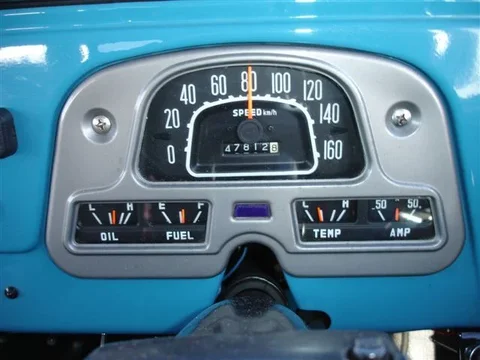
I ask because the temperature gauge needle in mine always sits in the first quarter (left) at operating temperature, the hottest I have seen it get was when the fan gave in after a long hot day and even then the needle only went half way up the gauge.
Is this normal or broken?
The oil pressure gauge always sits pretty low too, well below the line in the middle which I assume is the normal pressure. I'm going to check the oil pump when I do the sump gasket.
Unless this is normal?
I was in the same spot, did not know what the stock gauges indicated even though they were working.
I bought a cheapo 3 gauge panel from amazon, $29 I think. I'm sure they sell them at walmart and other places. Sunpro brand. Pretty easy to hook up and give you an actual reading for temp, battery, and oil pressure.
never bothered with the stock gauges they don't tell you what the actual temp or psi is I use autometer mechanical gauges to accurately see what's going on
Both my 77 gauges sit at about the same level as yours. I have a mechanical gauge for the oil pressure piped in parallel to make sure I have a good indication on the actual reading-it's usually around 50 psi(the normal bypass pressure) - even though the cluster gauge only shows ~3/4 up to the first mark.
I don't have a separate temp gauge set up yet, but I'm planning to add an Autometer gauge as well.(-planning on plugging a temp sending unit into the water pump outlet where the old BSV(?) was.
the water temp needle goes to somewhere between the middle and the second peg - when it goes past the second peg, I switch on the auxiliary electric fan
the oil pressure needle goes to one third of the gauge, normally - I have never seen it go higher
Numbers dominate my day job enough that I really do not want to carry that into my hobby
My truck appears to be running very cold. When driving hard on the freeway or offroad, the needs barely passes the first notch, which is roughly 1/3 or so.
Oil pressure wise, when starting cold and driving, it goes to 3/4s, drops down to half when idling. Once it gets warm, it's at 1/2 when driving and relatively low when idling, around 1/8th or so.
Hope that helps. Not sure if that's any good or not. But the truck runs well and doesn't explode
My temp is always (after it warms up) just at the low end of the normal bracket, Oil goes to the top and stays there, after long drive drops to top of normal bracket, newly rebuilt 2f, manual gauge says it goes to the regulator pressure 66 pounda and stays there. Old F engine barly made it anywhere.
I ask because the temperature gauge needle in mine always sits in the first quarter (left) at operating temperature, the hottest I have seen it get was when the fan gave in after a long hot day and even then the needle only went half way up the gauge.
Is this normal or broken?
The oil pressure gauge always sits pretty low too, well below the line in the middle which I assume is the normal pressure. I'm going to check the oil pump when I do the sump gasket.
Unless this is normal?
This is typical for my 1979 diesel once it's warmed up.
So I've always been the same as you with temperature.
And the needles always have sat in similar positions since I bought it in 1981... (Well, maybe the oil needle has dropped a tad if I'm going to be ultra-honest...)
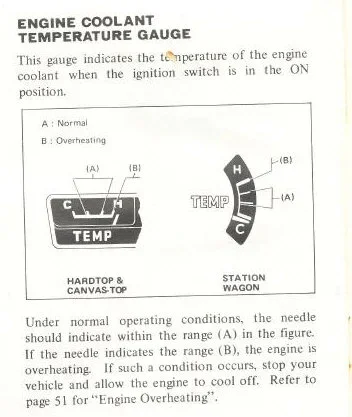
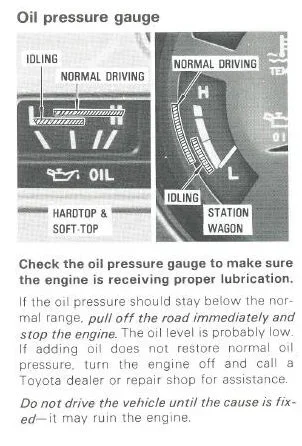
Here's what the 74 Owners Manual says:
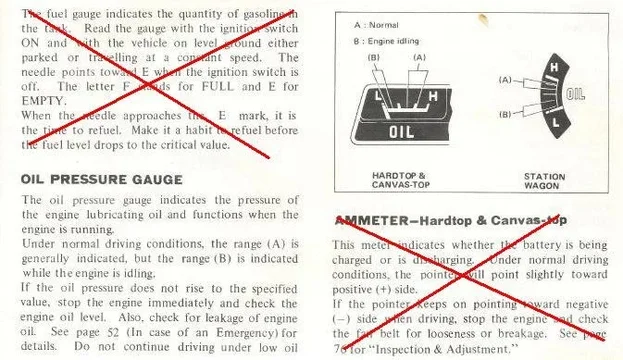
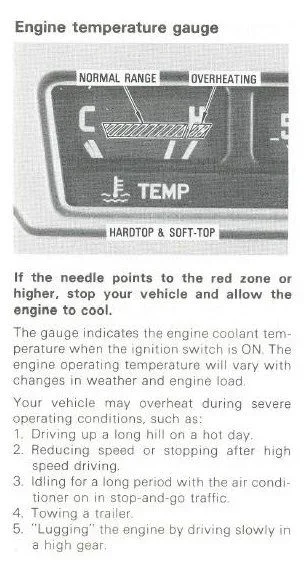
And here's what the 81 Owners Manual says:
So no cause for alarm..
Edit: PS. In my 1979, my temp gauge graduation-spacing looks similar to the one shown in the 74 Owners Manual and my oil pressure gauge graduation-spacing looks similar to the one in the 1981 Owners Manual (And I like to restrict which Manual I read for each gauge so as to continue to feel reassured that my needle positions are fine.)
I had the same condition in my '66 fj40 years ago. When I needed better heat in the high sierras (and I'll do it here in TX too...) I put a piece of thick cardboard in front of the radiator. This would raise the engine temp and cab heat too.
My oil pressure stays above the first line - closer to the second. On idle it rests just above first line.
pbgbottle-thanks for posting this--it eases my mind about my temp readings--but raises questions as to my oil pressure-mine stays low (less than the first hash mark), even though the mechanical oil pressure gauge I have in parallel reads 50-60 psi.
pbgbottle-thanks for posting this--it eases my mind about my temp readings--but raises questions as to my oil pressure-mine stays low (less than the first hash mark), even though the mechanical oil pressure gauge I have in parallel reads 50-60 psi.
There seems to me to be quite a variation in where the graduations are placed on the gauge-faces and also on the range of acceptable needle positions in the Owners Manuals.
Most of us have some degree of OCD and perhaps one of us with more severe symptoms (and associated more-demanding OCD NEEDS) should now do a thread correlating all the variations with the corresponding model years and with the appropriate "Owner's Manual acceptable-needle-position blurbs".
PS. Despite what I'm saying here, I can't see why some people condemn the OEM gauges (in favour of aftermarket) when simply adding figures to the OEM gauge-faces would probably satisfy them. (Regardless of whether you have "the letters L and H and a few graduations" or "graduations with specific figures and units-of-measurement against them" ... either type can get out of calibration.)
PS. Despite what I'm saying here, I can't see why some people condemn the OEM gauges (in favour of aftermarket) when simply adding figures to the OEM gauge-faces would probably satisfy them. (Regardless of whether you have "the letters L and H and a few graduations" or "graduations with specific figures and units-of-measurement against them" ... either type can get out of calibration.)
I'm one that isn't fond of the stock gauges Tom for 2 reasons, 1/ because when your subjecting the truck to steep angles eg: the pic's below you want to know exactly how much oil pressure you still have before the engine starts starving of oil and you cant get that sort of accuracy and reading from a stock gauge compared to a good quality mechanical gauge and the same goes for the engine temp when your radiators filling up with mud and the trucks getting hotter and hotter you want to know exactly how hot the engines getting rather than relying on a stock gauge that's probably got a big flat spot through the centre of the range and 2/ because the stock gauges are too small and hard to read when your competing or doing some hard 4WDing you cant afford to take your eyes off where your going to try and read the gauges properly and I probably couldn't do it anymore without some reading glasses anyway so I've got 2 Autometer 2 5/8 mechanical gauges sitting right up at eye level in the windshield where they are always clearly in my vision. The stock gauges are fine for everyday stuff but when you start pushing things a bit further you need some more accurate readings to try and minimise engine damage and/or failure
i have been using my stock gauges for years ,i love them working .my engine temp gauge has no flat spot it it lets me no quite quickly when it starts to heat up and when i kick the electric fan on high i can see the gauge start to drop .they do a decent job for everyday use and my mild wheelin trips .
hey Tom that would be great if you compiled a list of gauges to owners manuals




 (And I like to restrict which Manual I read for each gauge so as to continue to feel reassured that my needle positions are fine.)

 OK... So I'm evil..


