Splitrims, punctures, & puncture repair

This site may earn a commission from merchant affiliate
links, including eBay, Amazon, Skimlinks, and others.

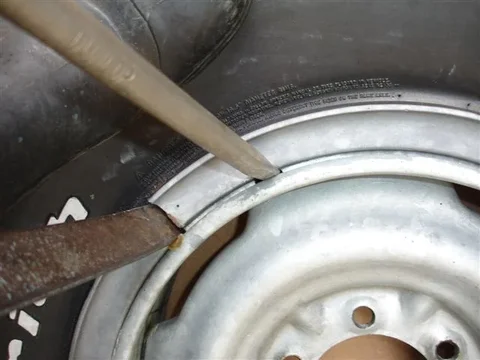
26Sept10 004.webp

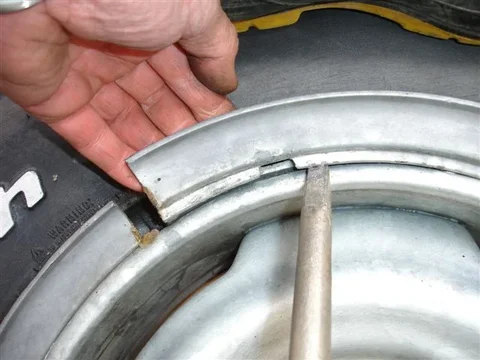
Once you have it started, gentle upwards hand pressure and "a wobbling-leverage on the ring with the skinny tyre-lever at various points" enables you to "work it out completely" from under the ridge:

26Sept10 005.webp

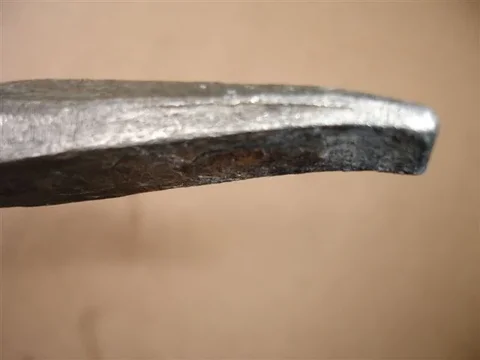
I find this little bend in my skinny lever/iron is very important:

26Sept10 006.webp
26Sept10 004.webp
26Sept10 005.webp
26Sept10 006.webp
 
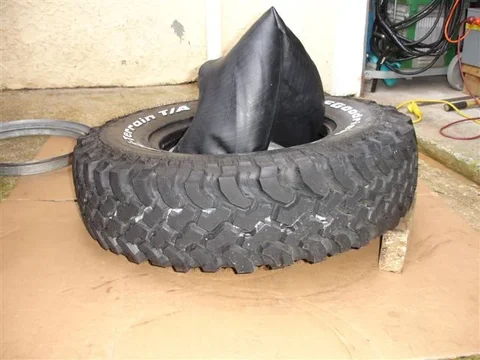
And a bit of 4x2" wood is great for making it easy to tilt the tyre for removal or insertion the tube

26Sept10 008.webp

Cheers
:beer:
26Sept10 008.webp
 
Thanks everyone for a great, informative thread. The 40 is the first vehicle i've owned with these wheels and i've learned heaps from this thread. :cheers:

Congrats on the new tyres too Tom. They look great! :beer:
 
Alright, I'll bite. What are flaps/liners? Can someone post a picture? Where does one find these things?

TIA,

Jim

Hopefully someone else will post a pic because I can't Jim. (I dumped all mine.)

If you've ever changed a tyre on a bicycle you should have a general idea because bicycle wheels have them too.

They are "bands" made of rubber that sit between the tubes and the metal of your wheels. (In the case of a bicycle ... they stop the tubes getting punctured by the ends of the wheel-spokes.)

With a big wheel like a 4x4 splitrim wheel they are thick and heavy and difficult to line-up symetrically within the tyre casing during fitment. This makes them 95% responsible for out-of-balance problems associated with splitrims IMO.

:cheers:

PS. Just went for a good drive up to 110kph and these KM2 tyres are just as quiet as the all terrains but lighter on the steering as expected. And again there are ziltch out-of-balance symptoms so no need for any balancing work.
 
...I never saw a glued on tag wear a hole in a tube ......Jim


This puzzled me when I read it first Jim.

But I've taken time to ponder it now ... and it soon dawned on me why this is.

Of course the edges of the flaps/liners extend up the sides of the tyre casings. And these stickers are on the sides so for most people (who run liners/flaps) their tubes never come into contact with them.

So people who run liners really need worry about a sticker only if it's been placed more in the centre of the casing.

:cheers:
 
I just wanted to say...great job on the writeup :) ...

I too had just replaced my toyo's yesterday with new coopers...went really well...ummm tyre plyers are great :)

heres a pic of my new 255/85r16 Cooper Discover S/T's that just replaced out of necesety my old worn out toyo m-55's that had over 35,000 miles on them.
IMG_4695.webp
IMG_4694.webp
IMG_4691.webp
 
Flaps for tube type

Alright, I'll bite. What are flaps/liners? Can someone post a picture? Where does one find these things?

TIA,

Jim

Tirbo

The link below to Coker Tire's website shows a picture of a flap.

They are generally used with tube-type truck tires on flat based rims with lock rings. It is a piece of heavy rubber and is not inflatable.

Installation procedure we used was to: (1) install tube in tire, (2) put just enough air in the tube to get the wrinkles out, (3) insert valve stem thru hole in flap and place the flap on the tube, (4) with soapy water lube the flap and tire beads, (5) insert valve stem thru slot in rim, (6) slide tire on to the rim, (7) install lock ring.

The flap covered the inside diameter of the tube and wrapped around the tube about half way up the tire sidewall.

The flap protected the tube from the rim which in the case of commercial trucks and farm vehicles was not likely to be smooth and pretty like the ones we see here.

The flap also prevented the tube from being forced out of the valve stem slot which was a leak waiting to happen.

Any real tire shop can order a flap and they are sized for specific tires.

Link to Coker Tire:

21 X 5 FLAP - Flaps - Tube Liners - Tire Accessories

Regards

Jim
 
With a big wheel like a 4x4 splitrim wheel they are thick and heavy and difficult to line-up symetrically within the tyre casing during fitment. This makes them 95% responsible for out-of-balance problems associated with splitrims IMO.

The truck stop where I worked sold Goodyear tires. New semi-truck tires came with a new flap tightly rolled up in a plastic bag inside the tire casing.

A coworker installed a new 10.00x20" tube type tire on a semi-tractor which came in off the road with a ruined tire.

Had him fixed up and on his way in a jiffy. Twenty minutes later the truck was back. Driver claimed the truck was shaking so bad he could hardly control it. My coworker disassembled the new tire and found that he had left the new flap, still tightly rolled up and in the bag inside the tire. He placed a new tube over it and installed a different flap.

That was two or three pounds of weight concentrated in a small area.

Yikes.

Regards

Jim
 
Lostmarbles:

Excellent job of explaining your technique.

Regarding your silicone lubricant - silicone is strange stuff. It is chemically inert meaning no soap, detergent or solvent will remove it from a surface. It will eventually wear off. Chemical inert also means it will not chemically degrade tires and tubes like a petroleum based substance will.

Since silicone is so hard to remove it can cause problems if you need to patch a tube or paint or plate metal contaminated with silicone - you can't get it off and nothing sticks to it..

Caterpillar Tractor Co banned silicone o-ring and seal lubricants from assembly plants because it caused paint adhesion problems.

Talc was used as a dry lubricant between tubes and tires. Talc is a first cousin to clay so if it gets wet it will turn to mud.

Other options for a dry lubricant are: (1) powdered mica, (2) powdered graphite, (3) powdered molybedenum disulfide. These things are slick and I do not think they would tend to soak up water and turn to mud.

For what it's worth I spent nearly 30 years in the rubber business. From developing new rubber materials to making production parts. If you or anyone else here has any questions regarding rubber or things made out of rubber, send me a PM. As is probably obvious to everyone by now, I enjoy talking about this stuff.

Jim

p.s. Don't rubber the wrong way.
 
I like the tall and skinny tires.

Are your new Coopers bias or radial?

Regards

Jim
 
Lostmarbles:
Excellent job of explaining your technique.
Regarding your silicone lubricant - silicone is strange stuff. It is chemically inert meaning no soap, detergent or solvent will remove it from a surface. It will eventually wear off. Chemical inert also means it will not chemically degrade tires and tubes like a petroleum based substance will.
Since silicone is so hard to remove it can cause problems if you need to patch a tube or paint or plate metal contaminated with silicone - you can't get it off and nothing sticks to it..
Caterpillar Tractor Co banned silicone o-ring and seal lubricants from assembly plants because it caused paint adhesion problems.
Talc was used as a dry lubricant between tubes and tires. Talc is a first cousin to clay so if it gets wet it will turn to mud.
Other options for a dry lubricant are: (1) powdered mica, (2) powdered graphite, (3) powdered molybedenum disulfide. These things are slick and I do not think they would tend to soak up water and turn to mud.
For what it's worth I spent nearly 30 years in the rubber business. From developing new rubber materials to making production parts. If you or anyone else here has any questions regarding rubber or things made out of rubber, send me a PM. As is probably obvious to everyone by now, I enjoy talking about this stuff.
Jim
p.s. Don't rubber the wrong way.

Thanks for all the fabulous info Jim

I've already decided that my use of silicone here was a mistake. I'll just wait and see if it leads to any real problems .... with my main fear being a tyre-bead losing its grip on a wheel under load. (Lucky my B-diesel isn't renowned for lots of power eh:D)

The last wheel I put together was the one with the KM tyre that had seen use previously. Because of this previous use, the rubber was accustomed to being in "ïnflated shape". And it scared hell out of me to see the beads slide right up into their final positions (lubricated only too well by the silicone!) before I had even added any air pressure at all to the tube.

And my purchase of the "tyre pliers" means I don't think I'll ever have trouble braking-the-bead again so I now have less desire to prevent beads from sticking.


:beer:

PS. Love the look of your new tyres Johnny
 
gday tom,
ever thought of using lanolin (no kiwi love juice joke here) it is really good and being a natural oil u can wash it off with soapy water.
Ps really digging the look of the new KM2 might be time for some new rubber.
 
Last edited:
gday tom,
ever thought of using lanolin (no kiwi love juice joke here) it is really good and being a natural oil u can wash it off with soapy water....

I do use a lot of that stuff elsewhere Tom and I particularly like the way it too doesn't harm rubber. For instance I use it between the leaves of my springs, in most electrical connectors, and as a coating on the aluminium alloy on my engine (for corrosion protection and/or lubrication). I feel it's moisture-excluding properties are a key attribute too.

But I find lanolin tends to stay around longer visibly than silicone does because it doesn't "soak into rubber" so much (although I am only too aware of silicone's status as the No.1 enemy of painters due to the fact that its residue remains hidden "waiting to repell fresh paint" for l-o-n-g periods).

I think next time I refit tyres I'll go with "soapy water" or "nothing at all" for the beads and "a good dusting of talcum powder with no surplus remaining" for all around the tubes. (But this decision is greatly influenced by my "Tyrepliers" purchase which look like making bead-breaking easy for me for evermore.)

:cheers:

PS. I think I'll go back now and put a warning on the post where I first-mention silicone.
 
Thinking of buying Tyrepliers.......but

I like the idea of being self reliant and can really see the benifit while off road/in the bush, but how do you address getting them balanced ? Don't you balance them after each dismount ?

Don't know for certain, but if you repair your own puncture and then take it in to be balanced, wouldn't a tire shop charge 'about' the same to balance it as they would have to fix the flat, balance & put back on the truck ? (here in the states & tubless tires). And how about a set of new tires...mount them yourself, then pay to have them balanced ?

Really want the Tyrepliers, just trying to get over this balance thing.

John
 
Thinking of buying Tyrepliers.......but

I like the idea of being self reliant and can really see the benifit while off road/in the bush, but how do you address getting them balanced ? Don't you balance them after each dismount ?

Don't know for certain, but if you repair your own puncture and then take it in to be balanced, wouldn't a tire shop charge 'about' the same to balance it as they would have to fix the flat, balance & put back on the truck ? (here in the states & tubless tires). And how about a set of new tires...mount them yourself, then pay to have them balanced ?

Really want the Tyrepliers, just trying to get over this balance thing.

John

good question. about the only thing i could think of would be to run centramatics. in tubeless setups, bbs or golf balls works. not sure how well balancing powders like equal would work in a tubed setup either.
 
.... how do you address getting them balanced ? Don't you balance them after each dismount ?

Don't know for certain, but if you repair your own puncture and then take it in to be balanced, wouldn't a tire shop charge 'about' the same to balance it as they would have to fix the flat, balance & put back on the truck ? (here in the states & tubless tires). And how about a set of new tires...mount them yourself, then pay to have them balanced ?....
John

No. I find I don't need to balance my wheels John. (So I avoid the problem you describe.)

And that's because I've taken the unusual step of running my wheels without internal liners/flaps.

Without those liners/flaps, I find I can run the wheels "as-fitted" without experiencing any vibration/shimmy at all.

In other words, my wheels end up "balanced" without needing to attach any corrective weights.

:cheers:

In my experience it seems to be the heavy liners/flaps (and the difficulty of getting them to sit properly within the wheels) that generates most of the out-of-balance forces.

 
No. I find I don't need to balance my wheels John. (So I avoid the problem you describe.)

And that's because I've taken the unusual step of running my wheels without internal liners/flaps.

Without those liners/flaps, I find I can run the wheels "as-fitted" without experiencing any vibration/shimmy at all.

In other words, my wheels end up "balanced" without needing to attach any corrective weights.

:cheers:

In my experience it seems to be the heavy liners/flaps (and the difficulty of getting them to sit properly within the wheels) that generates most of the out-of-balance forces.

a lot of tires aren't round either tho. that's why tubeless tires need to be balanced.
 
a lot of tires aren't round either tho. that's why tubeless tires need to be balanced.

That's what I am afraid of. At least once after a long trail ride & knocking off weights...that tire was undriveable at anything over 35mph (BFG AT tubless). Limped into town, balanced it & I was good. Maybe tubed tires make a diff ??

I'd still like to have the Tyrepliers...if only for the bush.

John
 
:hhmm: Perhaps BFG tyres aren't as bad as a lot of people think then? Because I haven't found any of mine (either the old AllTerrains or the new MUDTerrains) that have required balancing weights.

Or maybe it's my 16" OEM splitrims themselves that are so well-balanced? ("Factory off-set" must surely help too.)

(So far I haven't even had to bother swapping wheels around to try and get the most-balanced ones on the front either.)

Then again, my skinnies are nowhere near as bulky as the tyres many others here run.

:cheers:

PS. There aren't many kiwis here that are members of ih8mud to verify my "lack of need for balancing weights" (in case of doubters). However I plan on meeting up with an ex USA-based MUD member shortly who just happens to have imported his FJ25 into this country (and now lives near me).

PPS. Loosing an FJ25 serves you guys right for taking all our BJ42s :D
 
Back
Top Bottom