Splitrims, punctures, & puncture repair

This site may earn a commission from merchant affiliate
links, including eBay, Amazon, Skimlinks, and others.

I worked my way around that also...i use Equal Tire Ballancer in my tubes...

I bought a set of Toyota 16" rims for my FJ-40. Put on General MT 245 x 85 tires on them. These tires are heavy. Looks like a pound of wheel weights on each.

Have not installed these yet - want to change the diff gears first.

Thinking of using Equal balancer in these instead.

Regards

Jim
 
This "sticker discovery" now makes me nervous about all the other tyres on my cruiser because I remember thinking (when fitting them) that those little stickers were so small and insignificant that they could safely stay there!

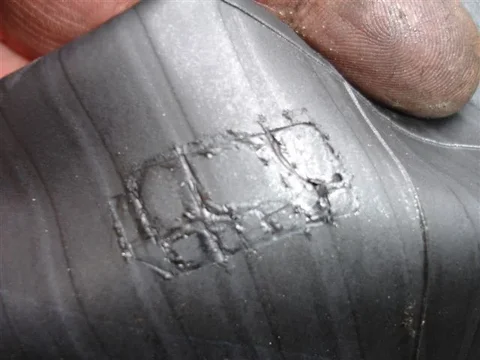
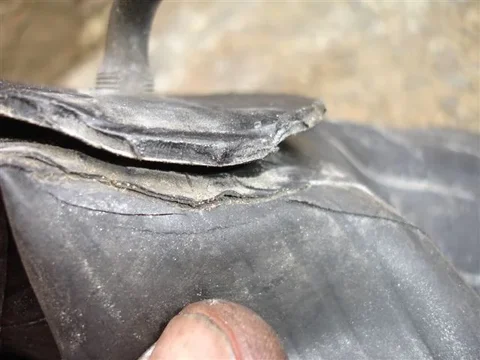
If you take a close look at my picture of the damage to that inner tube, you'll see that glue from the sticker made the rubber fatigue-crack along the impressions/indentations left by ribbing pattern inside my tyre.

So ALL my tyres are about to come off again! :mad: And since I've been wanting to fit "BFG KM2 MUD tyres" for some time ...All the tyres going back on are going to be brand spanking new ones! And I will ensure they will be entirely sticker-less and glue-less on their inner walls this time. :D

And since tubes only cost only $15 each here.... I never use patches but instead fit a new tube every time I remove a tyre.

While I can see that talcum powder is useful to enable a tube to slide easily against the inner wall of a tyre .... I don't use it because I often wade through water and I believe water entering the wheel (which is inevitable under such circumstances) would turn the powder into "useless clumps of dirt".

Instead I like to use silicone spray when assembling my wheels. I find it encourages the beads to slide easily into place .... But from now on I think I'll spray it liberally inside the tyres too. (Of course I'll also remove any stickers and all traces of their glue FIRST as already mentioned!)

Edit: Since writing these posts I've reconsidered this aspect. Now I believe my use of silicone poses TOO MUCH risk of "beads breaks free" (particularly in aired-down off-road driving where it may allow a rim to spin within a tyre). So if you're reading this with plans of following what I've done, I'd suggest you avoid the silicone (and use the traditional "soapy water" instead if you want to use an assembly lubricant at all on the beads). Unlike silicone, I believe soapy water lubricates for only a short period of time and may even encourage beads to "stick" longterm.

People may think that my silicone will encourage me to "spin my wheelrims within my tyres under load" (and thereby rip off my valve stems when aired-down offroad). And I admit this is a possibility. But I find the silicone soaks into the rubber within quite a short space of time and I still find "breaking the bead" to be a difficult chore even after using silicone spray during the previous assembly.

Thanks so much for all your info Johnny.

I don't know why I talked about hammers before ... because I've really always tried to avoid using them in tyre-changing. I've believed the "drive-over bead-breaking method" to be gentler on tyre casings than any "hammering and chiseling".

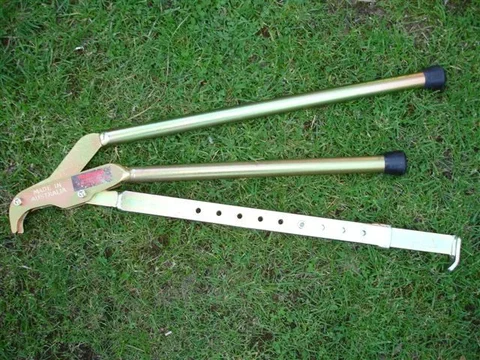
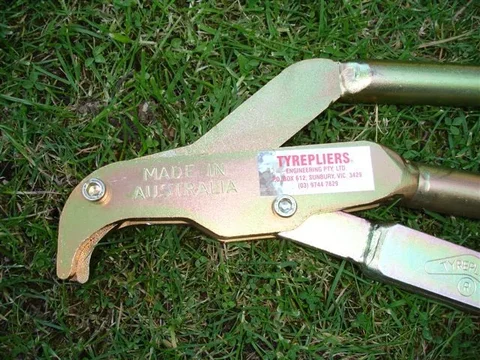
But one never stops learning and I liked your "tyre pliers" so much Johnny that I decided to get a pair for myself. I was even able to purchase a pair locally and they look to be a significant improvemnent over the "drive-over method".

Until buying a set, I wasn't 100% sure how they worked. So I think I'll add some photos here to help others understand.

Firstly here they are:
Split14TyrePliers.webp

Split15TyrePliers.webp
Split14TyrePliers.webp
Split15TyrePliers.webp
 
Last edited:
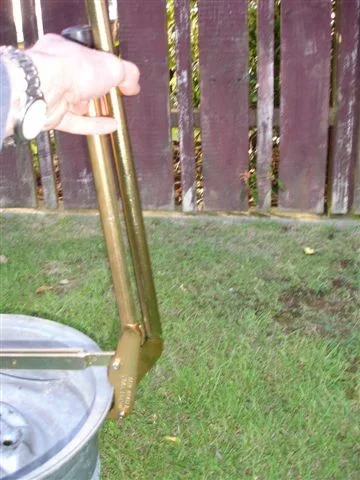
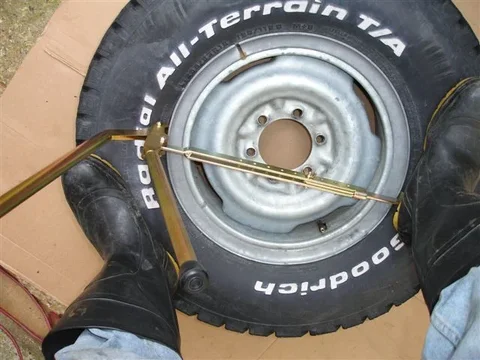
Ok. So you set the tool to the diameter of your wheel (which is 16 inches in my case) and securely wedge (with your foot) the far end of it under the diagonally-opposite point on the lip from where you wish to start breaking the bead.

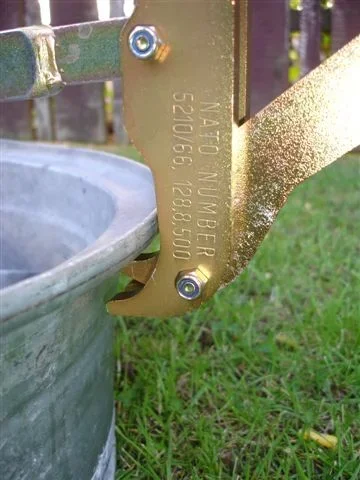
Then you move both handles outwards TOGETHER to wedge the 3-jaws (which are "combined as one" when the levers are together) between the rim and tyre bead:

Split16.webp

Next .... you move the two levers apart:

Split17.webp

The effect of this (as you can see above) is to leave the centre jaw on the rim while forcing the two outer jaws down against the bead ... thus encouraging the bead to separate/break-way.

And here is a photo showing a fitted tyre.

Split18.webp

As you can see, there's no chance of the ring flying off and killing me as I took this photo. And there's no more chance of this happening during airing-up after tyre fitment PROVIDED THE BEAD IS OVER THE BASE OF THE RING BEFORE AIR PRESSURE IS APPLIED.
Split16.webp
Split17.webp
Split18.webp
 
The Tyreplier looks to be a nice tool.

Do you use flaps between the tube and rim?

Regards

Jim
 
The Tyreplier looks to be a nice tool.

Do you use flaps between the tube and rim?

Regards

Jim

yeah the tyre plyers work pretty well....unless ....you painted the rims and didnt let the oil based paint dry all the way when you reassembled them....so the next time you went to tare down a wheel...it was not so easy...:rolleyes:

I do run flaps...but...i dont think lostmarbles does :hhmm:

good idea nuclearlemon about the highlift...i'll need to try that...i think i still have a wheel that was assembled with not so dry paint :rolleyes:
 
Do you use flaps between the tube and rim?

Regards

Jim

No I don't Jim. (But I used to in the past.) And I believe that's how I get away without needing any balancing weights now for "shimmy-free steering". (Neither do I run any balancing beads/gunk within my tubes.)

I find those liners/flaps weigh quite heavy and it can be extremely difficult to get them to sit symetrically/evenly. (They can also hinder tyre/tube fitment.)

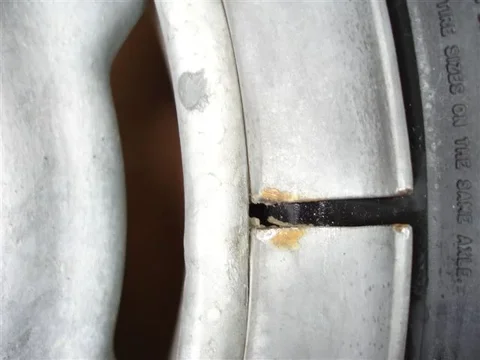
In my last photo you can see some yellowed silicone sealant in the gap between the ends of the "ring". This is necessary for me because, without a liner, a small stick (or whatever) could otherwise poke in there and actually puncture my tube.

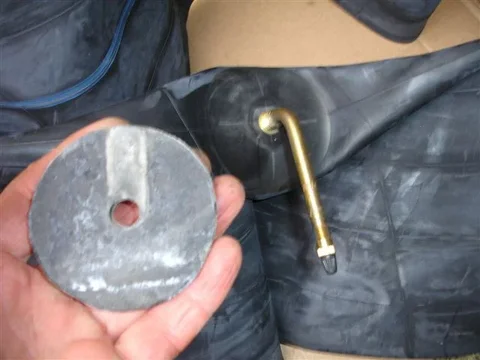
And to protect my tube where the valve stem is attached, I use a big plastic washer (with soft/rounded endges) there.

This is all a bit radical I know ...... and I don't expect anyone else to follow my lead in this. (I like doing things that are different from most :lol:)

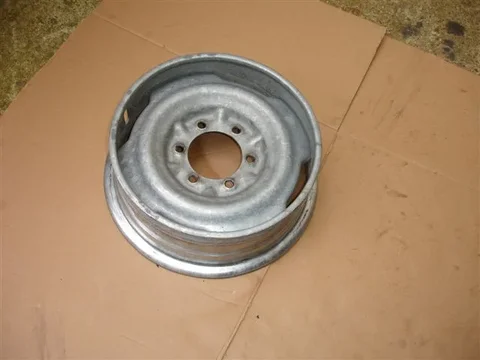
I think I can get away with it because my rims are hot-dip galvanised and therefore free of "rust-shards". And I've taken a lot of care to get the surfaces smooth too.

:beer:

PS. I wasn't keen to reveal this "absence of liners" because I think "the tyre-industry in general" would frown on it.
 
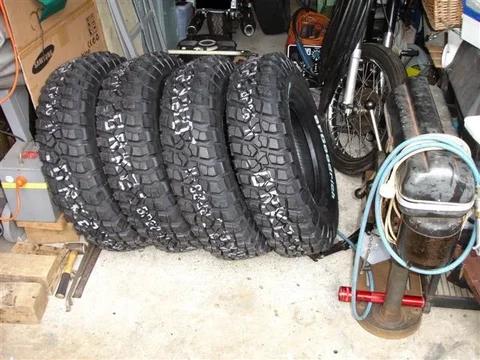
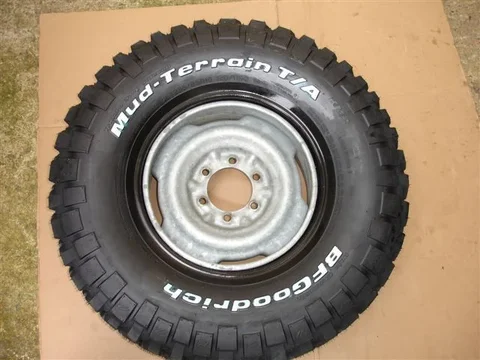
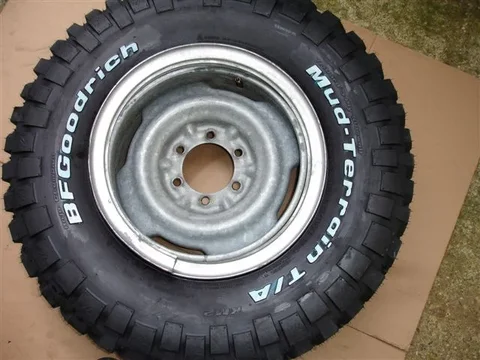
Well yesterday my new BFG KM2 mud tyres arrived just before I was about to leave for work:

25Sept10.webp

And I've managed to fit a couple of them today (before work again):

25Sept10 031.webp

They're going to make it feel like I've got power steering now! :clap:

(Less rubber on the road (than with all-terrains) = lighter steering)

And I'd rate these tyre pliers as one of the best tools I've ever bought!

Split15aTyrePliers.webp

Even with my fussiness .... I can change a tyre in about 30 minutes with these! They make "breaking the bead" so easy. (No need for ANY brutality now!)
25Sept10.webp
25Sept10 031.webp
Split15aTyrePliers.webp
 
Here's evidence of more "sticker damage":

25Sept10 023.webp

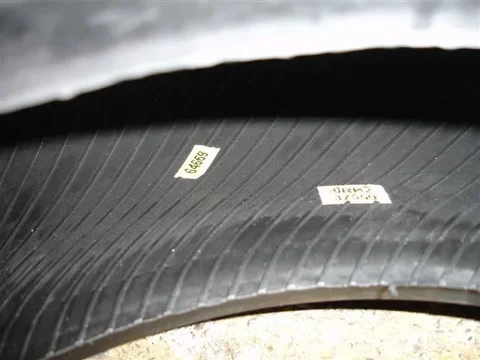
So needless to say, the new tyres got the stickers removed:

Split19.webp

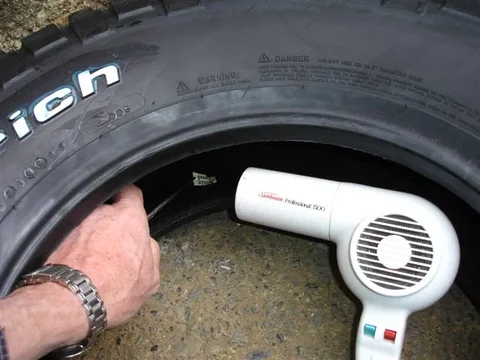
I found a hairdrier works best:

Split20.webp
25Sept10 023.webp
Split19.webp
Split20.webp
 
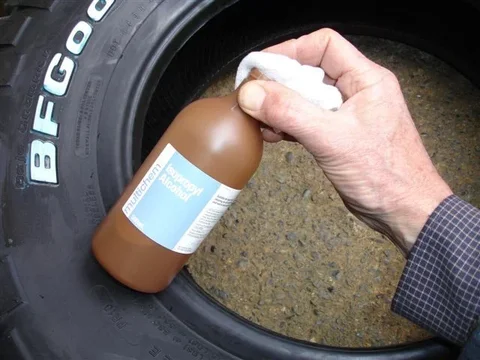
I used alcohol to try and clean up any remaining gue from those horrible stickers:

Split22.webp

But not satisfied with that alone, I also used emery paper.

Of course I thoroughly vacuumed out the new tyres before reassembly of the wheels. (An air gun is no good because it mostly just redistributed the cr@p.)

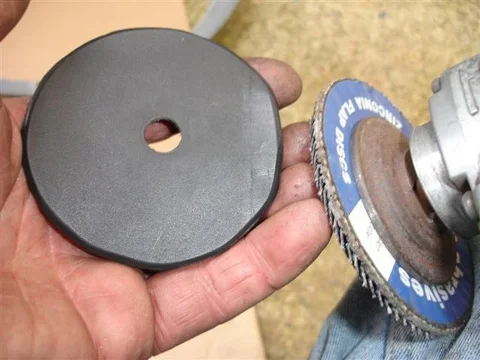
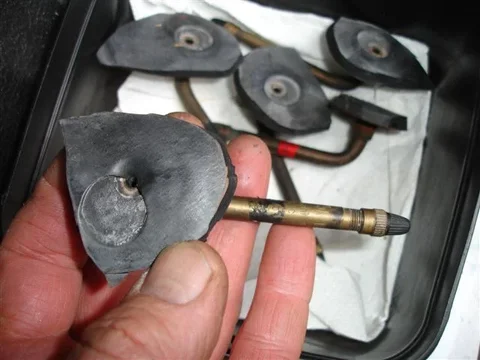
And I obviously didn't take enough care rounding the edges of this home-made tube-stem washer last time:

Split26.webp

That tube is so close to failure there! :eek: Edit: Closer examination showed this damage looked far worse than it really was and that the tube was in fact still quite sound there. (The rubber is multilayer-reinforced around the valve stem here.)

Easily fixed with a disc grinder and flapper disk for the new tube though:

Split27.webp

That should last at least 20,000kms (perhaps even indefinitely) without wear now!
Split22.webp
Split26.webp
Split27.webp
 
Last edited:
What else can I say (in this rambling thread)......:hhmm:

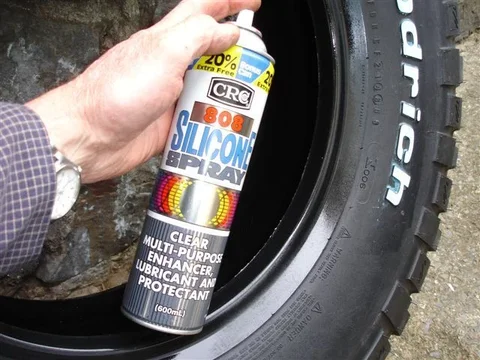
Ahhhhh...Well here's the silicone spray I sprayed liberally inside my new tyres and all over the metal upon which the tube will sit. I also applied it on the tyre beads too of course because I want them to slide up easily into place on the finished wheels ..

25Sept10 001.webp

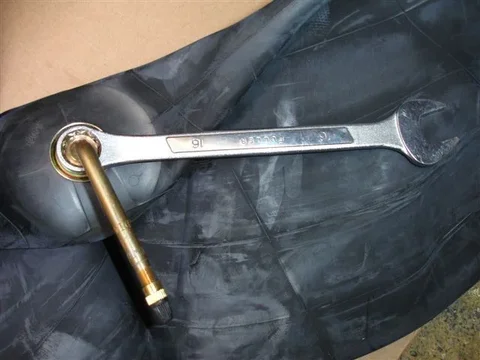
And this stuff (nut & washer) needs to be removed from the valve stem if you're going to run without liners/flaps like I am:

25Sept10 004.webp

And I put a big plastic washer in their place:

25Sept10 005.webp
25Sept10 001.webp
25Sept10 004.webp
25Sept10 005.webp
 
Reassembly involves (1) sitting the wheel down like this:

25Sept10 002.webp

(2) Deciding whether you want the white lettering to show or not - which determines which way up you have the tyre before plonking it down on the wheel so:

25Sept10 003.webp

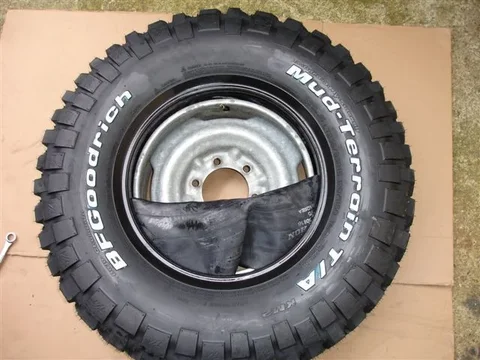
(3) Stuff the tube in (valve stem side first):

25Sept10 008.webp

(Make sure you have the plastic washer on if you are running liner-less and poke the stem through the hole)
25Sept10 002.webp
25Sept10 003.webp
25Sept10 008.webp
 
(4) Plonk the ring on with its gap opposite the valve stem to aid balancing:

25Sept10 010.webp

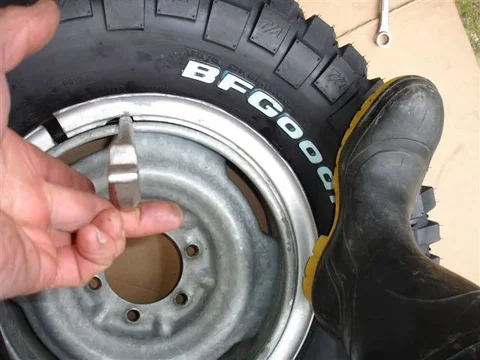
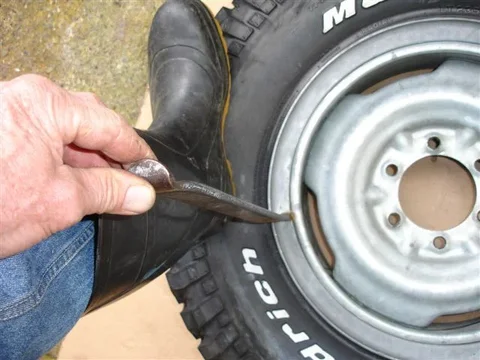
(5) Work your way around using the heel of a boot (and with the assistance from a pry bar to expand the ring ... however you like).

Here's me levering the last little bit into place:

25Sept10 011.webp

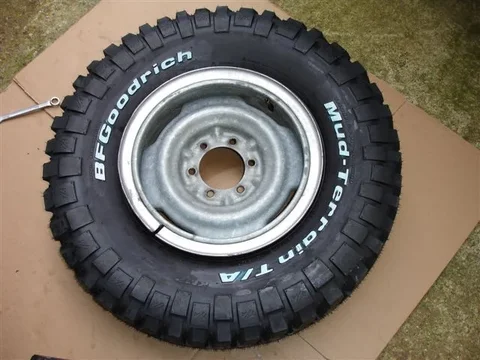
Voila.... That ring is clipped into place all the way around:

25Sept10 012.webp
25Sept10 010.webp
25Sept10 011.webp
25Sept10 012.webp
 
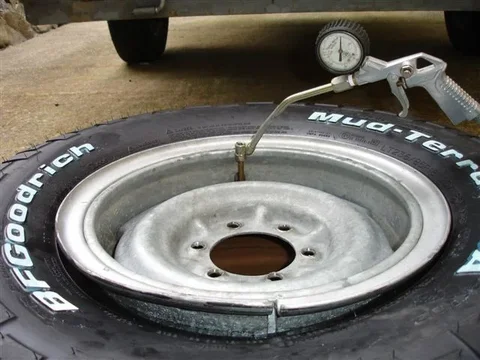
Here I am starting to apply air (with the valve removed!):

25Sept10 016.webp

Note that the bead is already over the base of the ring ALL THE WAY AROUND and there is only about 5 psi on the gauge (So the tube is applying very little pressure to the bead.) And I've deliberately aimed the camera at the "last bit to close up".

There's no way that ring can fly off already ...and the bead became fully-seated before I even got to 10psi.

Note: Best to have the valve removed because you need to apply air (and I just go up to my normal tyre pressure ...35psi) and then release it all again before fitting the valve and reinflating it. This is necessary to allow the tube to get rid of any creases/folds or whatever.

And here is a shot of the gap in the ring that I'll fill with silicone sealant sometime soon. (No rush.)

25Sept10 029.webp

Can't think of any more to add for the time being.

:cheers:

PS. My contribution in thread is really just for eccentric people like myself who love splitrims and like experimenting. And at least it explains why I always change my tyres myself and NEVER use a tyre shop eh?
Please note: I am NOT recommending that others do away with liners/flaps when they run splitrims. And I think no-one should even consider doing so .. unless they do all their own tyre work.
25Sept10 016.webp
25Sept10 029.webp
 
Just thought of something else worth mentioning here.

Apart from tread-pattern there is another difference between BFG "KM" and "KM2" mud tyres.

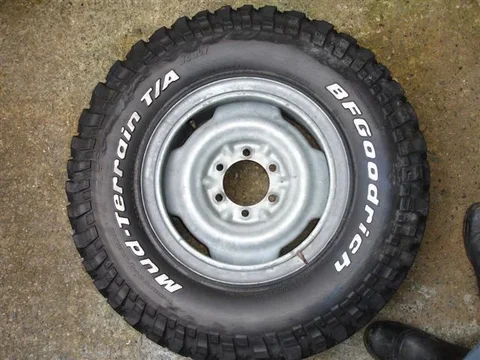
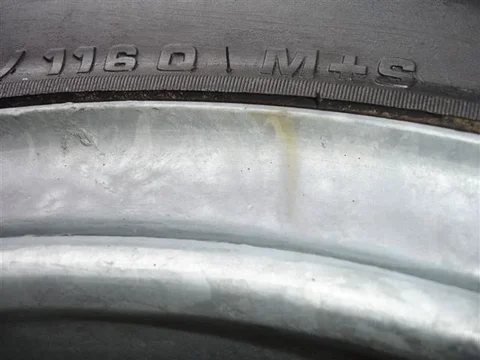
When they made the KM version, they placed a ridge in the casing (both outer sides) that I liked at first (until I thought about tyre-removal). It makes the steel of the wheel look "recessed into the rubber of the tyre".

The problem with it (and which probably led to them dumping this feature) is that it makes it so much harder to get anything in there to break the bead.

Here's a couple of shots of a KM version (which I'll be using as my spare tyre) to explain this:

Split24aKM.webp

Split24bKM.webp
Split24aKM.webp
Split24bKM.webp
 
that is what bfg called a rim protector. the point was to rub that edge before the edge of your rim. they are crap for off road though. i know i'm not the only one who had issues when aired down of them "scooping" crap inbetween the rim and tire bead and causing air loss. happend to me three times on snow runs when i'd start hearing the air leak, rush to get to a flat spot to change my "bad" tire only to get the tire hot enough to melt a piece of ice/snow out and have the leak stop.:mad:

haven't run bfgs since that horrible experience. always liked them from an economy/daily driver point of view before that.

btw, thanks from a two pair of split rims owner for the awesome pictoral.

Just thought of something else worth mentioning here.

Apart from tread-pattern there is another difference between BFG "KM" and "KM2" mud tyres.

When they made the KM version, they placed a ridge in the casing (both outer sides) that I liked at first (until I thought about tyre-removal). It makes the steel of the wheel look "recessed into the rubber of the tyre".

The problem with it (and which probably led to them dumping this feature) is that it makes it so much harder to get anything in there to break the bead.

Here's a couple of shots of a KM version (which I'll be using as my spare tyre) to explain this:

View attachment 453495

View attachment 453496
 
Don't you just love the look and smell of new tires!
 
No I don't Jim. (But I used to in the past.) And I believe that's how I get away without needing any balancing weights now for "shimmy-free steering". (Neither do I run any balancing beads/gunk within my tubes.)

I find those liners/flaps weigh quite heavy and it can be extremely difficult to get them to sit symetrically/evenly. (They can also hinder tyre/tube fitment.)

In my last photo you can see some yellowed silicone sealant in the gap between the ends of the "ring". This is necessary for me because, without a liner, a small stick (or whatever) could otherwise poke in there and actually puncture my tube.

And to protect my tube where the valve stem is attached, I use a big plastic washer (with soft/rounded endges) there.

This is all a bit radical I know ...... and I don't expect anyone else to follow my lead in this. (I like doing things that are different from most :lol:)

I think I can get away with it because my rims are hot-dip galvanised and therefore free of "rust-shards". And I've taken a lot of care to get the surfaces smooth too.

:beer:

PS. I wasn't keen to reveal this "absence of liners" because I think "the tyre-industry in general" would frown on it.

I believe the main purposes of the liner/flap are to: (1) prevent abrasion of the tube (if the rim or lock ring are rusty or burred), (2) prevent the tube from being forced up into the valve stem slot in the rim where it will eventually split or be cut.

You have cancelled out these concerns by keeping your rims smooth and clean and by using a washer around the stem. Looks like your washer was cut from an old tube and is the reinforced section around the stem.

In my opinion, a multi-piece tube type assembly is easier to breakdown and reassemble than a drop center tubeless rim. That is assuming the wheel and lock ring are free from rust, damage (and wet paint JohnnyC).

Seeing this reminds me of when I was in my 20's and working on larger versions of this wheel every day. Makes me wish I had a set for my '79 FJ-40.

Well done.

Regards

Jim
 
that is what bfg called a rim protector. the point was to rub that edge before the edge of your rim. they are crap for off road though. i know i'm not the only one who had issues when aired down of them "scooping" crap inbetween the rim and tire bead and causing air loss. happend to me three times on snow runs when i'd start hearing the air leak, rush to get to a flat spot to change my "bad" tire only to get the tire hot enough to melt a piece of ice/snow out and have the leak stop.:mad:

haven't run bfgs since that horrible experience. always liked them from an economy/daily driver point of view before that.

btw, thanks from a two pair of split rims owner for the awesome pictoral.

I see now that they actually have the words "rim protector" (in small lettering) printed on those bits of the casing. :o

And I find it interesting/helpful to hear your experience here Nuclearlemon.

At least that KM tyre is only my spare and the KM2s (on all my other wheels) don't have rim protectors. (BTW ...With that magnificent "tyrepliers" tool I just bought, the rim protector didn't hinder breaking-the-bead anywhere near as much as I thought it might.)

Regardless of the "rim protector feature", I've learnt that if anyone mentions almost any tyre brand, news of "bad experiences" seem to appear. :meh: So I'll stick with BFGs (for the timebeing at least).

Don't you just love the look and smell of new tires!

Yep!

And there's little else you can do to your vehicle that has as much effect as changing your tyres. (Both in appearance and handling/performance.)

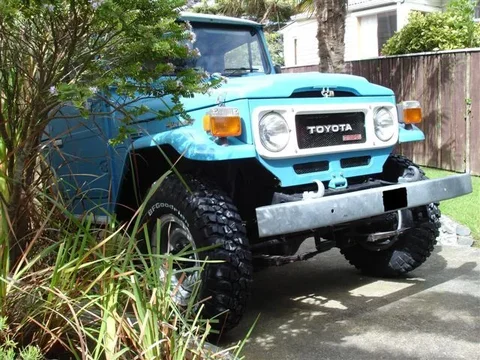
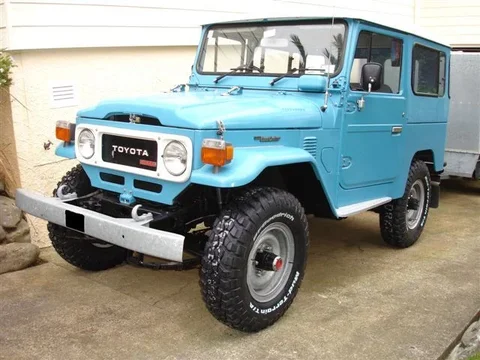
The tires (spelt the American way by me here for once :p) look a little skinny to my eye in this photo. (But nevertheless, I'm happy enough!) ....
26Sept10 007.webp

I believe the main purposes of the liner/flap are to: (1) prevent abrasion of the tube (if the rim or lock ring are rusty or burred), (2) prevent the tube from being forced up into the valve stem slot in the rim where it will eventually split or be cut.

You have cancelled out these concerns by keeping your rims smooth and clean and by using a washer around the stem. Looks like your washer was cut from an old tube and is the reinforced section around the stem.

In my opinion, a multi-piece tube type assembly is easier to breakdown and reassemble than a drop center tubeless rim. That is assuming the wheel and lock ring are free from rust, damage (and wet paint JohnnyC).

Seeing this reminds me of when I was in my 20's and working on larger versions of this wheel every day. Makes me wish I had a set for my '79 FJ-40.

Well done.

Regards

Jim

Thanks Jim.

I think I've got it all sorted pretty well now too. But that's not to say I couldn't have done better....

I often tend to go back over work I've done in my mind and reconsider things. And I must say I'm wary of my use of "lots of silicone spray" in the assembly this time round.

I now fear spinning my wheels inside my tyres especially since those new "tyrepliers" made it seem so easy to "break-the-bead" on my spare (the KM tyre) which had silicone used on its bead more than 3 years ago (back in March 2007).

I think I'll have to make sure I don't do any serious off-roading for a few months at least (and even then keep my fingers crossed)! No problem though ...I've got plenty of other things waiting to occupy my time beside off-roading at present.)

Perhaps if I'd sprinkled talcum powder inside the casings and then vacuumed up the excess .... as well as ...shaking the new tubes around in bag filled with talcum powder...and used soapy water sparingly on the beads ......... I may have been better off :hhmm:

I think my reluctance to use soapy water stems from the days when my rims weren't hot-dipped (and my fear of rust) .... And if there isn't any excess powder - I don't think it would tend to "clump" when water infiltrates. (And I know soapy water doesn't retain its lubricating effect for long.)

:beer:

PS. I've edited a previous post in which I said I thought one of my plastic washers had damaged a tube. Closer examination showed that that tube was along way off failing because the tube was in fact heavily reinforced there (near the valve stem). Nevertheless, I've rounded the edges of all those washers that I had previously neglected in this respect. (So the ONLY cause of real tube-damage that I've found here is actually restricted to "sticker damage" ...and that damage was widespread amongst all wheels that have seen any significant mileage.)

And my washers are actually made from a very soft plastic (and not from other tubes). This plastic was actually sold as "4x4 mudflaps". But while the plastic was ideally-soft for my use here it was actually a bit too stiff for use in mudflaps. (Hence I use thick/heavy "real rubber" instead as my rear mudflaps.)

26Sept10 007.webp
 
Last edited:
I want to use shraeder valves and valve stems in an onboard-air system I'm putting together so I've been cutting them out of the old tubes.

And this revealed this manufacturing fault :eek::

26Sept10 013.webp

In my experience, you don't get any choice of tubes here in NZ. Everyone sells "Marathon brand" (which are made in Korea).

But while that fault shows "shoddy work", it doesn't really affect reliability. And the NZ trucking industry use heaps of these tubes.

Incidentally, the spec of my tubes is "700/750 x 16 tr75" and I believe the "tr75" bit of the spec gets you the right style of valve stem.

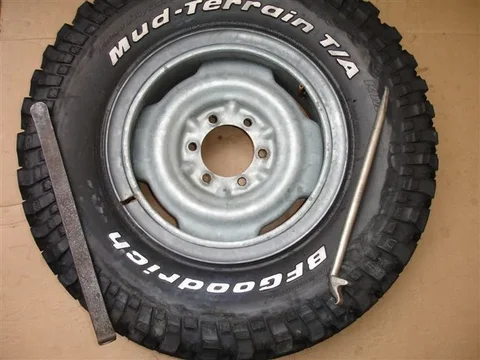
I took some more pics (when doing my last wheel) to show what "tyre irons" (pry bars) I use (because having the wrong type could make your job far more difficult):

26Sept10 002.webp

The sole purpose of the thick one is to open up the gap enough to be able to stick the smaller one in (to start levering up the ring):

26Sept10 003.webp

And you use your weight to keep the bead below the bottom of the ring at the same point where you're levering (otherwise the ring won't be able to expand to clear the lip/ridge).
26Sept10 013.webp
26Sept10 002.webp
26Sept10 003.webp
 
Back
Top Bottom