Dual Battery Planning

This site may earn a commission from merchant affiliate
links, including eBay, Amazon, Skimlinks, and others.

Joined
Apr 18, 2005
Threads
443
Messages
29,741
Location
Durham, NC
I recently picked up a second battery tray from http://stainlesstrays.com so that I can finally utilize this second battery. Fit and finish of the tray is absolutely awesome and I'd recommend these battery trays to anyone:

IMAG1345.jpg


IMAG1346.jpg


The question arises at how to hook these up for use. Right now my accessory fuse block, factory harness and starter are all hooked up to the PS battery. I've seen a number of setups where the accessories are all through one battery and the engine / harness is through another. To do that on my current setup would be a fairly significant rewire project, including the addition of a charging / isolation circuit for the second battery, as well as another fuse block that draws from the second battery instead of the first. Something along these lines:

http://www.westmarine.com/battery-s...---add-a-battery-dual-circuit-system--8646275

The primary reason why I wanted a second battery is simply to add amp hour capacity for when I'm running my fridge and radio at the beach. Having the isolated dual-battery setup would be cool, but I'm thinking of simply wiring the batteries in parallel to gain the capacity for now.

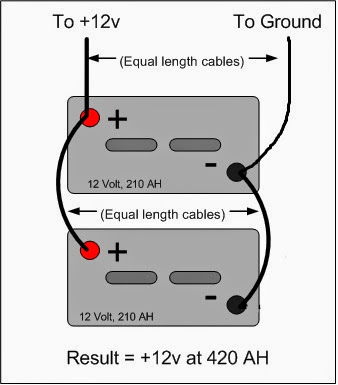
Being fairly stupid when it comes to automotive electrical systems, would the following schematics be functionally equivalent or no? If not, why? I ask because I want to be able to wire my secondary battery directly to my primary battery, without any other modifications, to gain the AH capacity without adding system complexity or necessitating a rewire (aka the second diagram).

Thanks!

2x12VoltinParallel.gif


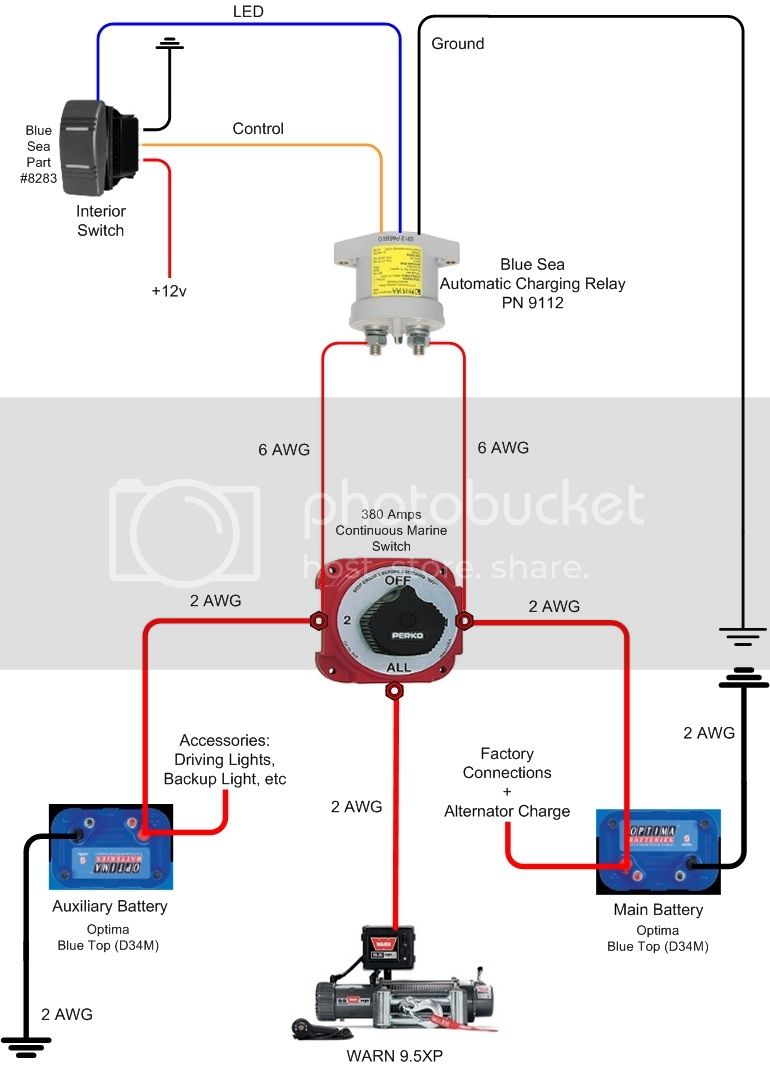
Battery.jpg
 
That's the system I run on my boat JC - it's great and well made. however, if you want dual battery for cranking (in parallel), you have to manually move the switch. I don't think this is an issue for you, since you've been running it single from the get go, and to my knowledge it's plenty of cranking power. But, with this system, you always are guaranteed a fresh cranking battery, and the system charges the "house" battery only after the cranking battery is topped off.

In the configuration you show above, the batteries are never isolated from one another. if you drop a cell on one, it will draw from the good battery and ruin it as well, in short order. HIGHLY recommend this type of SCR system for a dual battery setup.

:beer: R
 
My setup on the boat, just out of view at the bottom is the ground bus bar.

IMG_1731.webp
 
In that configuration, if a battery fails (which they do), it will equalize, drain the good battery and ruin both. I've always been advised to install an isolator so that this doesn't happen. With an isolator, the "primary" battery is charged first, then charges the second once it is fully charged.

In that configuration, if one were to leave the fridge/lights/etc on, it drains both batteries equally which may give 2 half-charged batteries.

I used a schematic similar to this, where I had all the aux stuff on one battery, where the primary (starting) battery was isolated to avoid draining it. I also had the switch such that I could use primary or aux or both in order to start the vehicle.

imagejpg1_zps2e345bad.jpg


DirtyPartskit-09.jpg


DirtyPartskit-17.jpg
 
So it's not recommended for me to wire the batteries in direct parallel?

Another option that Ramon also mentioned offline, was to get one of these 1/2/both switches. This way I could charge the batteries in parallel, draw charge off of only one for accessories, then put them together if I need extreme draw, like a winch. Thoughts on that as an alternative to a more expensive solenoid/controller setup?

http://www.westmarine.com/blue-sea-systems--350a-compact-battery-switches--P009_272_004_501
 
The wiring that Jerry shows above is clean and no nonsense. You do want to isolate one battery for emergency starts. What you choose to load on each battery is up to you. The whole idea is redundancy and backup. Your winch runs primarily off the alternator, pics up the balance from the battery. Using both batteries to winch could leave you stuck with two dead batteries. A higher output alternator is a good investment as well.
 
My alternator puts out 120-150amps, can't remember which one I have. It's got plenty of power.

Once again, the point of this project was to have added capacity without unnecessary complexity. The setup I put in the first post is what I will go with eventually. This was intended to be more of a mental exercise in the advantages / disadvantages of an isolator setup vs direct parallel wiring vs having a simple switch.

Looks like the only disadvantage of direct (parallel) wiring is that if one battery goes then it'll take out the other with it.
 
This is what I told Johnny, and this is with extensive experience and research of this issue for marine applications:

1. The SCR isolation system is by far the best choice. The ideal setup puts ONLY the ignition and starter on the cranking battery, and all accessories on the "house" battery. This charges the cranking battery first, senses full charge, and then starts charging the "house" battery. This also protects you from damaging 2 batteries if one of the two drops a cell (that happens sometimes for certain, then you are screwed if far from home). House battery should be deep cycle, and cranking a conventional "starting" battery.

2. A 1/2/Both switch would be the second best option if above is not in the budget. This has a similar effect, but adds a little risk. In this configuration you run is setting 1 (connected to cranking battery) by default. When parked (no alt output) for significant amount of time, you switch to "2", and effectively isolate your cranking battery ensuring you have power to crank the motor even if you drain "2". #2 battery should be deep cycle, and cranking a conventional "starting" battery. Then, you can switch to "both" to recharge "2" and cranking batteries in parallel. During that time, you run the risk of a failure resulting in damage to both batteries, but greatly reduce the amount of time you are exposed to this risk. You also have the option to go to "both" if you have a low cranking battery or need to use that reserve capacity in an emergency situation.

3. Two batteries in parallel at all time. Charge both anytime the alt is charging, drain both anytime there is any current draw, any failure of single battery will likely result in you buying 2 batteries instead of 1. Cheap, simple, but far from ideal. The only advantage that comes to mind is both batteries CCA are available, by default, during cranking.

:beer: R
 
I wanted to bump this to the top. With the 80 purchase I am extremely interested in adding the second battery to run a fridge, radio, lights, etc while maintaining the starting battery isolated from house loads. Unfortunately I am completely electrically illiterate so I would love to see and hear about everyone's setups when they are complete. This would definitely be something I would want help on for the install. It seems like for less 1000$ you can get a setup together with the battery and have a fuse block inside the cab for adding USB plugs etc. and a big wire to the back for a fridge.
 
Darin makes custom length battery cables as well.
@krzyabncanuck
 
This reminds me I need to do my dual battery swap.... still need to find a FZJ tray and make some cables.... already have everything else.
 
http://www.hellroaring.com/bic75150.php

Been doing some research tonight. They have schematics that look good and the product seems to get good reviews. A little more $$ than a blue sea unit. I'm only slightly less ignorant than when I started my seach several hours ago. Fluid dynamics is kindergarten math compared to roving electrons...
 
Back
Top Bottom