Ideal brake balance would give you the most possible rear braking power in every situation. Welcome to Adaptive Control Electronics and ABS.
Short of that there are two opposite balance needs present on this forum and those like it. The first is slow speed, crawling type operation where the front and rear braking power can be the same because there is little to no weight transfer. Identical front and rear rotors, pads, and calipers can work in this use just fine.
The second is higher speed operation, like in public roads driving, where weight transfer is significant. In this second case too much rear brake power is dangerous. To make matters worse, how much is too much depends on the speed and the vehicle's loading.
With statically set devices, like different front & rear piston sizes, rotor diameters and p-valves, you have to make the setting for the worst case and then suffer the reduction in rear braking power in all less extreme situations. Even adjustable p-valves can't make this any better, though I suppose that with trial and error (approach this with EXTREME caution!) you could find the settings for each typical loading. Find my post on p-valves in "Comments on Brakes", they are not a typical pressure regulator like an EFI FPR or a welding regulator. I see them as a necessary evil to be added only when the system can't be balanced well enough without them.
What is needed is something that automatically adjusts for both the loading and the weight transfer. The 62's LSPV does this. So did the LSPV on my Mini truck. I don't know about the 62 part, but the unit on my Mini ran out of adjustment range and has been rendered static. Which is a shame, because the promise is there.
Jim, have you done a setup with the minitruck rotors and Corolla calipers on the rear axle of a 60? Curious to see how you went about it if you've done one up before.
I do not like floating calipers, but those suggested by Jim would be worth looking into for an SF rear axle. Floating calipers can 'follow' the rotor as it moves in and out the tiny bit that the axle shaft is allowed to. That results in less pad knock-back which translates to less pedal stroke after a long period of no brake use.
The more that I think about it, the more that I am convinced that floating rear calipers are the best choice for the semi-floating rear axles. I'm not fond of them, but I do think they will be the best choice for this application because of the statement above. I too, am interested to learn more about this possible option.
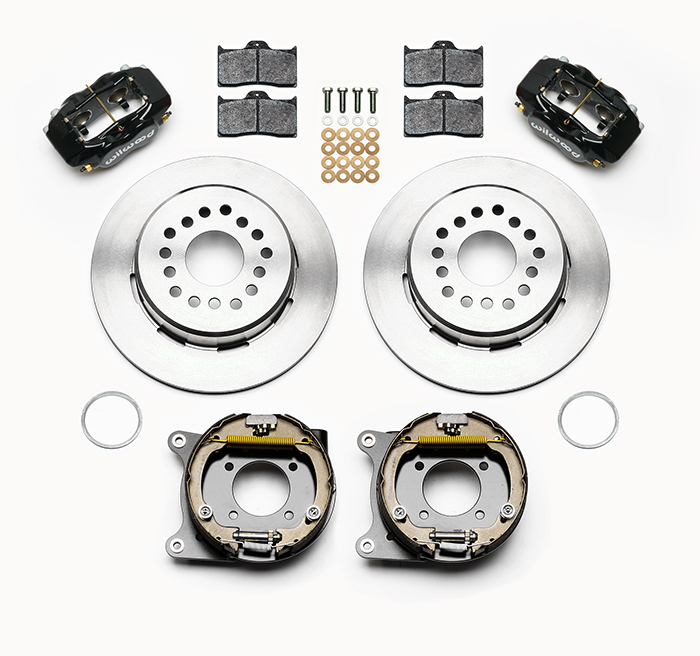
The wilwood kit shown above uses the Explorer p-brake components that I suggested some time ago. Late Corvette p-brake parts are similar, and I wouldn't be surprised to learn that the p-brakes on the rear disc equipped Ford F-150's and F-250/350's are a similar design too.