Build 4508 - Ultra4 Racetruck Build

This site may earn a commission from merchant affiliate
links, including eBay, Amazon, Skimlinks, and others.

So here is the current geometry for the 3 link that I've come to after sitting here for hours measuring over and over. I've been reading a lot lately, and although I know barely anything I think I have an okay idea of what will and won't work. More or less the things I'm shooting for is an anti-dive of 60-70%, as low of a roll angle as possible, and as much link separation as possible. I originally was going to shoot for 6" of up travel, but decided to drop to 5" of up travel to lower the roll angle. I have to mount the lower link above the axle centerline to clear the tie rod plus that lowers the roll angle, but the higher that goes the lower the roll angle but then the lower the link separation. I could move the upper mount higher, but that then decreases up travel because the link mount location is limited by the passenger side engine mount.

I'm not entirely sure how other people do it, though this is obviously a lot different build than a normal street rig but I'm trying to have good manners and most people appear to have a lot of roll angle as well as a very tall rig to have any decent up travel. As I said, I had to drop my ride height to get a roll angle that was under 2deg. I would like it lower, but since it's a function of the lower link location I can only get it so low. I made the lower links super long to decrease roll angle and anti squat/dive change as the suspension cycles and I think it should turn out decently (hopefully!).

I have some questions for the suspension gurus who can hopefully critique the design:
-This 3 link will be used with the stock drivetrain, can I drop to 7" of link separation? I plan to get wider axles next year as well as more horsepower so intend to change the axle link setup when the drivetrain gets changed, but moving the axle brackets up one inch will drop the roll angle to 0.32deg.
-Like I said, I'll mock everything up, but my upper link can be between 30-40" long, is there any reason to make it longer (and then change the mount a bit to maintain the anti dive I want)?

@nukegoat @JeepinPete @mudgudgeon @I Lean

Capture.webp

Capture2.webp
 
So here is the current geometry for the 3 link that I've come to after sitting here for hours measuring over and over. I've been reading a lot lately, and although I know barely anything I think I have an okay idea of what will and won't work. More or less the things I'm shooting for is an anti-dive of 60-70%, as low of a roll angle as possible, and as much link separation as possible. I originally was going to shoot for 6" of up travel, but decided to drop to 5" of up travel to lower the roll angle. I have to mount the lower link above the axle centerline to clear the tie rod plus that lowers the roll angle, but the higher that goes the lower the roll angle but then the lower the link separation. I could move the upper mount higher, but that then decreases up travel because the link mount location is limited by the passenger side engine mount.
Don't worry as much about anti-dive. For a front axle, worry more about instant center - low Z and long X. You want to make sure you don't have unloading/wheel recession when going over obstacles. Obviously don't go for -140% or 1000% anti-dive but it's far less important IMO.

I'm not entirely sure how other people do it, though this is obviously a lot different build than a normal street rig but I'm trying to have good manners and most people appear to have a lot of roll angle as well as a very tall rig to have any decent up travel. As I said, I had to drop my ride height to get a roll angle that was under 2deg. I would like it lower, but since it's a function of the lower link location I can only get it so low. I made the lower links super long to decrease roll angle and anti squat/dive change as the suspension cycles and I think it should turn out decently (hopefully!).
There's a lot of compromises between road cars and offroad cars w/ respect to spring rates and shock tuning, but suspension geometry is pretty consistent in terms of the basics that you want to shoot for. I would shoot for a lower roll axis if you can. You'll prefer erring on the side of understeer (0 to -3 degrees IMO) if you intend to do any sort of go-fast. How? You can mildly triangulate the lowers (inboard them on the frame) to improve roll axis a bit. Don't go too far with this, though, as it can introduce a kind of bump steer. Still, a mild triangulation will make a lot of difference. Next, lower the link mounts on the frame an inch or two if you can. They won't get hung up like you think, especially since the link angles will cause you to slide forward anyway once you clear an obstacle.

I have some questions for the suspension gurus who can hopefully critique the design:
-This 3 link will be used with the stock drivetrain, can I drop to 7" of link separation? I plan to get wider axles next year as well as more horsepower so intend to change the axle link setup when the drivetrain gets changed, but moving the axle brackets up one inch will drop the roll angle to 0.32deg.
You can run less separation, technically, if everything is super beef, but you'll wear through components (heims, etc) much faster with less. Also, bear in mind that separation is both X and Z. You can have 0 vertical separation and a ton of horizontal separation and it'll counteract brake/accel torque just fine (e.g. the stock toyota mounts - no vertical separation on the radius arms).

So what I'd do is get the lowers just below the centerline of the axle (so they're loaded more conventionally, especially if you're racing) and optimize per my suggestions above to get the roll axis neutral again. Then optimize the upper link bracket in the X axis with considerations to making sure you don't slam the upper link into the engine mounts and other stuff under there when fully stuffed.

-Like I said, I'll mock everything up, but my upper link can be between 30-40" long, is there any reason to make it longer (and then change the mount a bit to maintain the anti dive I want)?

@nukegoat @JeepinPete @mudgudgeon @I Lean

View attachment 1576856
View attachment 1576857

Generally speaking, longer links are only good because they act more linear through their range of travel. That said, it's not a requirement that you run stupid long links. If anything, it makes them much more susceptible to bending when slammed into rocks, it's extra unsprung weight, etc. Get your lower links where they need to be and then just go with an upper link length that works.

Few last thoughts:

1) yes, mock everything up. In full stuff, full droop, and flex both left and right - turn the tires to their limits under all 4 conditions and ensure you've got clearance. It's a PITA.
2) If you're retaining the factory drag link and track bar, then it's reasonably neutral for bump steer. If you're moving panhard or running high steer, be VERY cautious about where you put your track bar bracket on the axle. A 1/2" off will introduce some nasty bump steer which won't be pleasant at all, especially when you're exercising the suspension a lot (racing offroad?). I have a spreadsheet that does the math for you if you want it.
3) Important - model your suspension through it's range of motion (you can cheat by plugging it into Triaged's 4-link calculator and simulate bump and droop). If you have a CV driveshaft, make sure the pinion angle rotates as the suspension cycles. If you're running a single cardan shaft, then make sure the pinion angle stays as close to neutral as possible, at least especially during the 3" of bump and droop nearest to ride height.
4) Lastly - if you haven't thought about the rear link geometry, start now
5) Check your headgasket

Good luck.
 
@nukegoat thank you! That is all awesome advice! In regards to the lower axle mounts, is there any inherent issue with mounting them at or above the axle centerline? I don't think the lower links will clear the stock tie rod if I mount them underneath it. If I can get away with them just barely above the tie rod I'd rather do that for now and change it up in the future when I go to high steer.
 
@nukegoat thank you! That is all awesome advice! In regards to the lower axle mounts, is there any inherent issue with mounting them at or above the axle centerline? I don't think the lower links will clear the stock tie rod if I mount them underneath it. If I can get away with them just barely above the tie rod I'd rather do that for now and change it up in the future when I go to high steer.
Its what my first 3 link looked like and its what 4wheelunderground does in that kit. It totally works but you are loading the links either both in tension or both in compression, which usually means youre trying to peel something off. Anyway if you do it, it will be just a good idea to overbuild the lower mounts and use good joints.
 
Well I've hardly gotten any work done on the truck it feels like and getting really pissed off about it. I did a bunch of welding in the rear on the axle and shock mounts, and a bunch of unbolting and cutting and grinding in the front. The more I work on the truck the more I want to never modify something this heavily again and just start with a tube chassis in the future. I thought the 3 link would go quickly, but I have to cut off the stock link mounts, then grind those down, then there's barely any room to reach the welder in to weld the new brackets, so I have to cut more stuff out of the way, etc. Right now I've decided to notch the tranny cross member and weld the mounts right in front of it, I think that will give me the best option for laying a good weld and clearing everything.

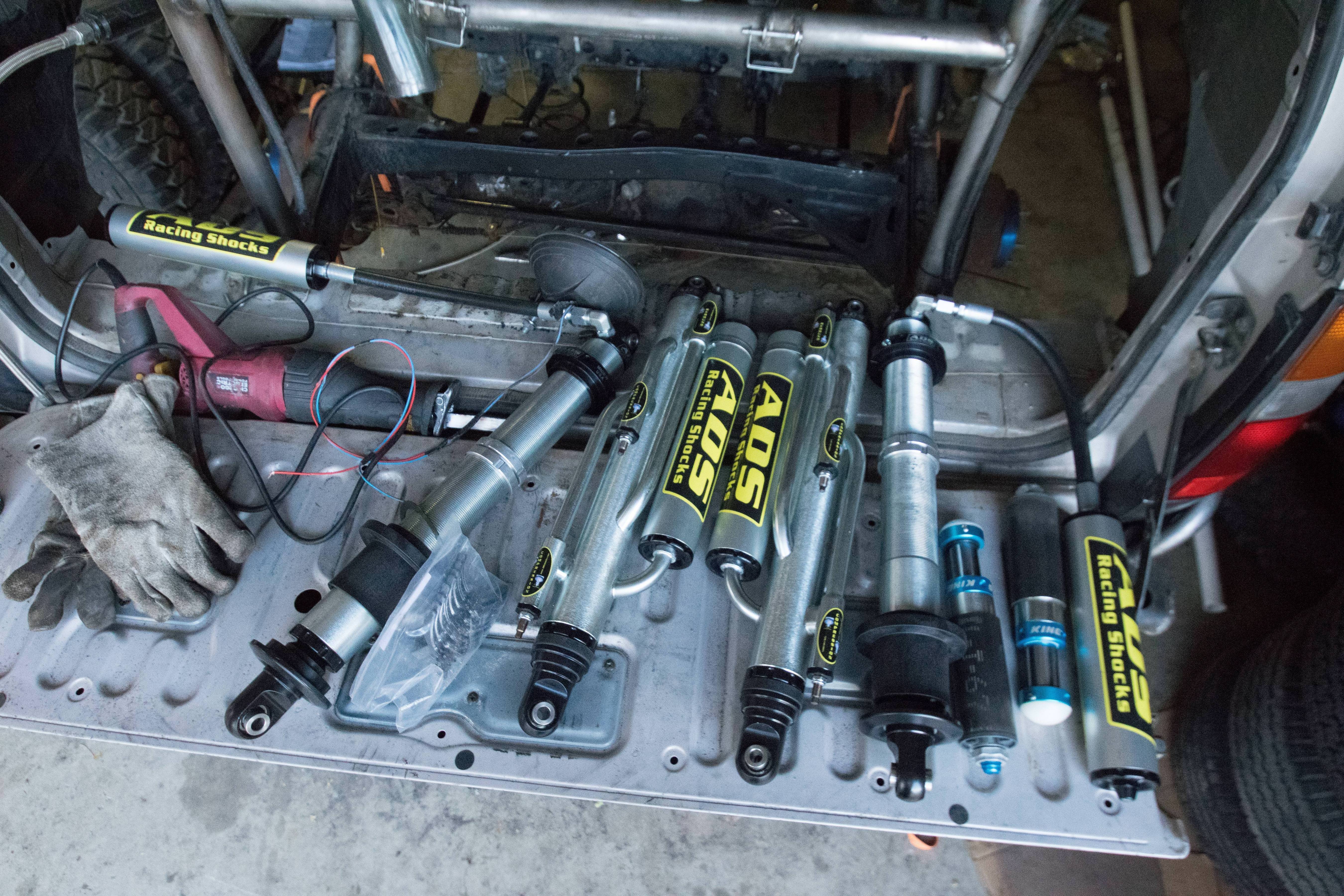
So no pictures since nothing has happened, just lots of the tedious grinding and welding s*** that no one likes to do. The fact I don't have a plasma or torch obviously doesn't help anything. On the bright side I got my King bumps in today, took about 3 weeks for those. Still no word when/if I'll ever get the original shock I ordered (going on 10 weeks), but at least I have all the shocks I need to finish the suspension. I think with Black Friday going on I'll order some springs for all the coilovers too, assuming I've calmed down and don't want to sit there beating the s*** out of the truck with a hammer.

CyGXd1g.jpg
 
Last edited:
Oh - and a pro-tip for getting brackets welded to the frame where clearance is slim - weld the bracket to a sistering plate on the bench, then drill holes in the sistering plate for rosettes that are near where the bracket will react on the frame. Then weld the plate to the frame (usually a lot easier since it's straight lines across a flat) and fill the rosettes for belt & suspenders. That may help you out.
 
Oh - and a pro-tip for getting brackets welded to the frame where clearance is slim - weld the bracket to a sistering plate on the bench, then drill holes in the sistering plate for rosettes that are near where the bracket will react on the frame. Then weld the plate to the frame (usually a lot easier since it's straight lines across a flat) and fill the rosettes for belt & suspenders. That may help you out.

Yup, that was my plan! Especially since I need to drop the brackets down an inch or two. I was gonna have two plates on either side of the bracket/frame and then a diagonal plate acting as a brace to go in the gap between the bracket and the frame and react lateral loads, and then box in the front and back.

I like the sway bar setup you did too! That's what I was planning in the future was to have it front mounted like you did. Sway bars front and rear will be high priority next year, I don't think I have enough time/money right now to add them in.


-----
I have the axle brackets mocked up as of last night, and hopefully tonight get the frame side mocked up. I had a cold all last week so am behind and trying to play catch up big time. I have a bunch of springs coming for the coilovers, and as of now the current plan is to head home in 2.5 weeks so need to have the 80 at least rolling by then (hopefully driving, I think I can just hook up all the grounds and some plugs and run it without coolant).
 
@nukegoat How much horizontal separation can I safely run? I can't find much info researching, right now my lowers are 35" long and have 5.75" of horizontal separation per link, with them angled out from the frame. I can get it closer to inline (or straight inline) but the link mounts will start moving onto the stock truss so I'll have to go in and mess with the mounts a bit, so if I can just run it how it is without any drawbacks that'd be nice.
 
@nukegoat How much horizontal separation can I safely run? I can't find much info researching, right now my lowers are 35" long and have 5.75" of horizontal separation per link, with them angled out from the frame. I can get it closer to inline (or straight inline) but the link mounts will start moving onto the stock truss so I'll have to go in and mess with the mounts a bit, so if I can just run it how it is without any drawbacks that'd be nice.
Not sure what you mean... like how much can the links be outboarded on the axle? In other words, how wide can the lower links be on the axle before the triangulation of the lowers is an issue?

If thats your question then i would say its going to be a function of your track bar and whether youre changing that geometry at all... but where are things landing for you?
 
Not sure what you mean... like how much can the links be outboarded on the axle? In other words, how wide can the lower links be on the axle before the triangulation of the lowers is an issue?

If thats your question then i would say its going to be a function of your track bar and whether youre changing that geometry at all... but where are things landing for you?

Yea, you mentioned that excessive triangulation can result in a bump steer like effect, is there a way to calculate when too much triangulation starts negatively affecting the suspension? I am keeping the track bar, steering, and axle location all completely stock.

EDIT: I was searching the wrong terms, if I look up 3 link triangulation I get a lot more results. The rough 3 link setup overview from Barnes 4WD suggests there's actually quite a few beneficial effects from having the axle mounts being wider than the frame mounts, and even suggests making the axle mounts as wide as possible. I also noticed the roll axis changes nearly 25% less at both full bump and full droop with how it's currently setup vs the mounts being all inline.

Capture.webp
 
Last edited:
Yea, you mentioned that excessive triangulation can result in a bump steer like effect, is there a way to calculate when too much triangulation starts negatively affecting the suspension? I am keeping the track bar, steering, and axle location all completely stock.

EDIT: I was searching the wrong terms, if I look up 3 link triangulation I get a lot more results. The rough 3 link setup overview from Barnes 4WD suggests there's actually quite a few beneficial effects from having the axle mounts being wider than the frame mounts, and even suggests making the axle mounts as wide as possible. I also noticed the roll axis changes nearly 25% less at both full bump and full droop with how it's currently setup vs the mounts being all inline.

View attachment 1583551
Right. The benefits are in roll steer. But how much bump steer you will get will depend on how flat your panhard is. I would say if the image you posted is your plan then its probably fine.
 
f5sesaI.jpg


u1PQaRx.jpg


OS3Oeqn.jpg


A5o26FM.jpg


xpxKTqu.jpg


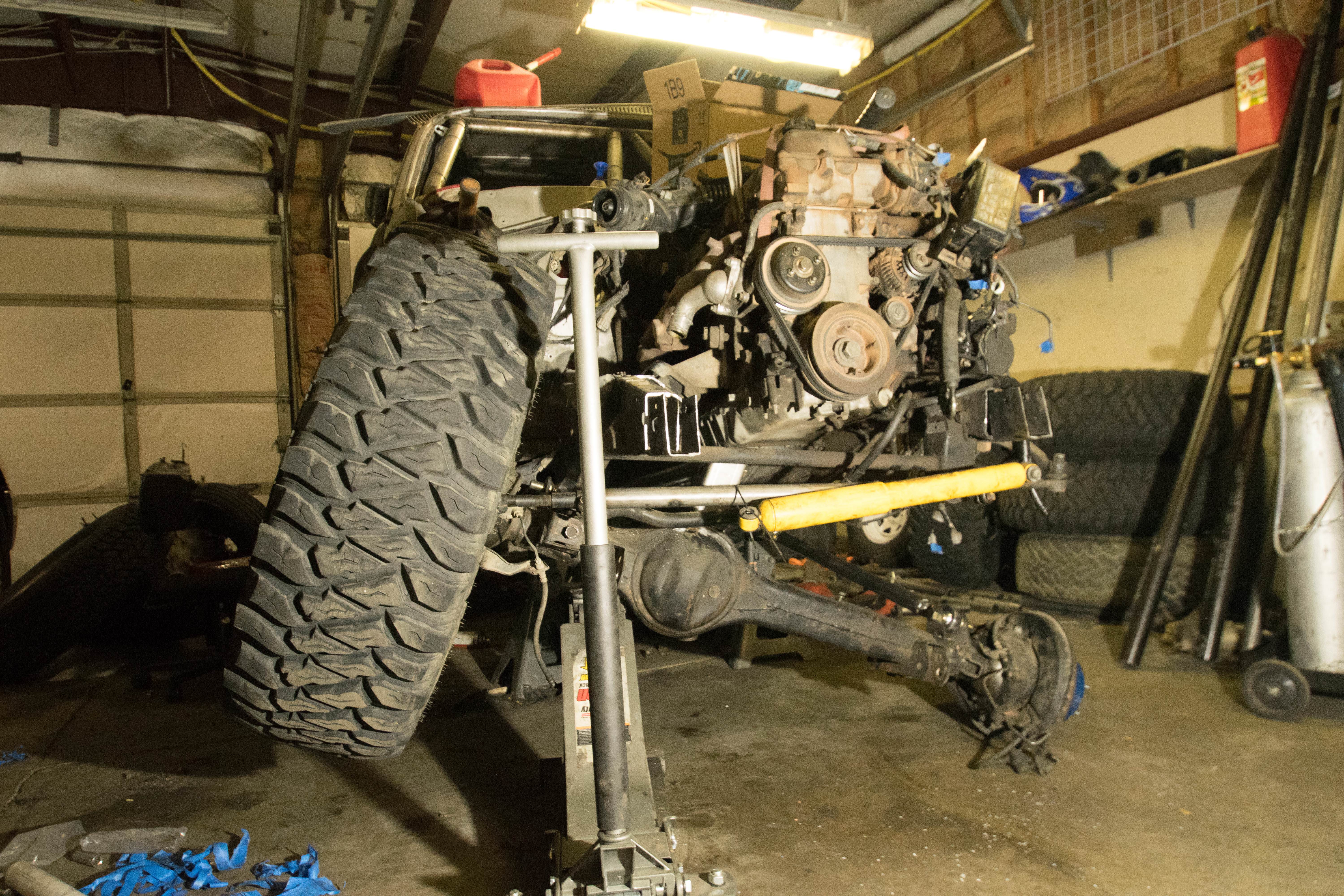
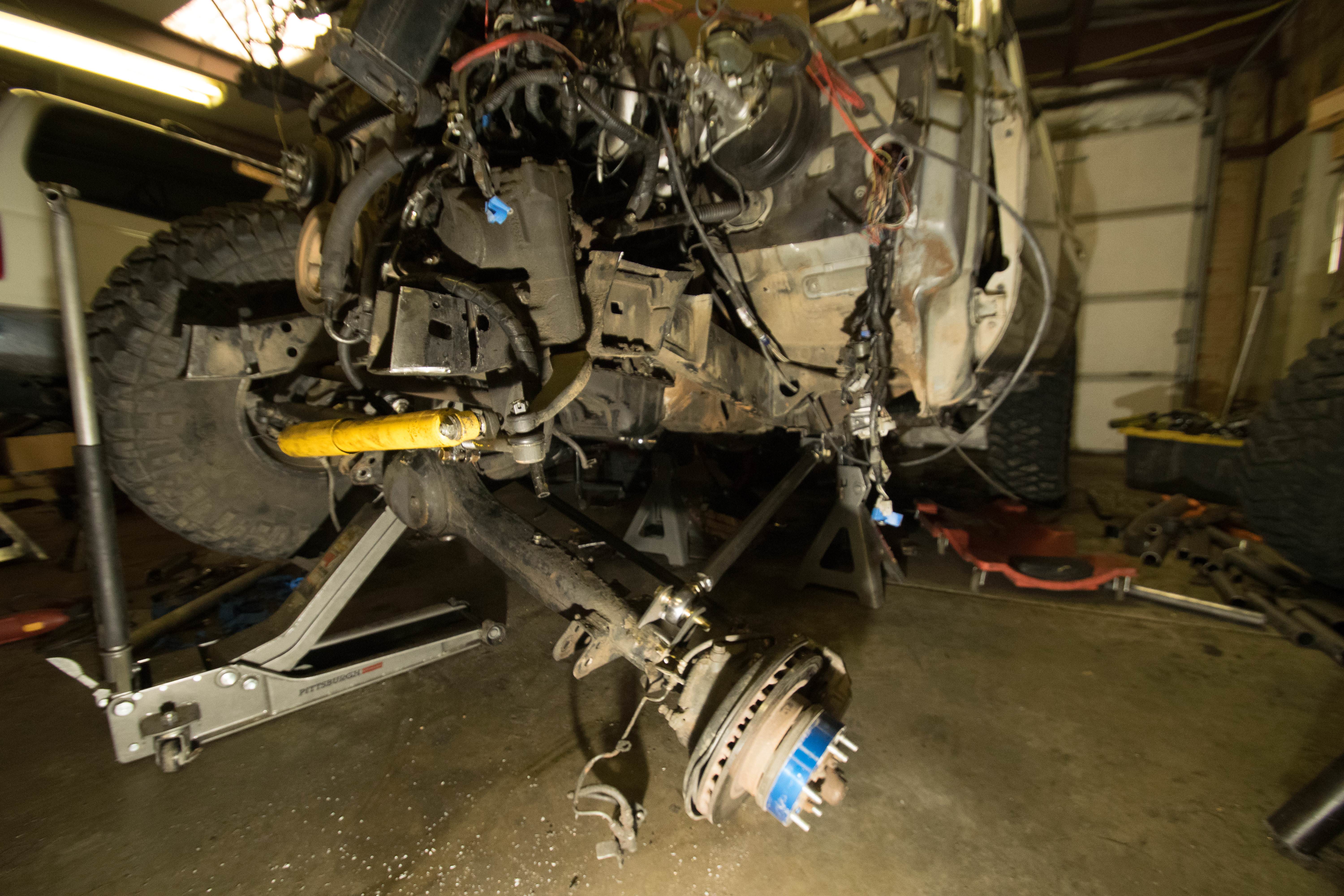
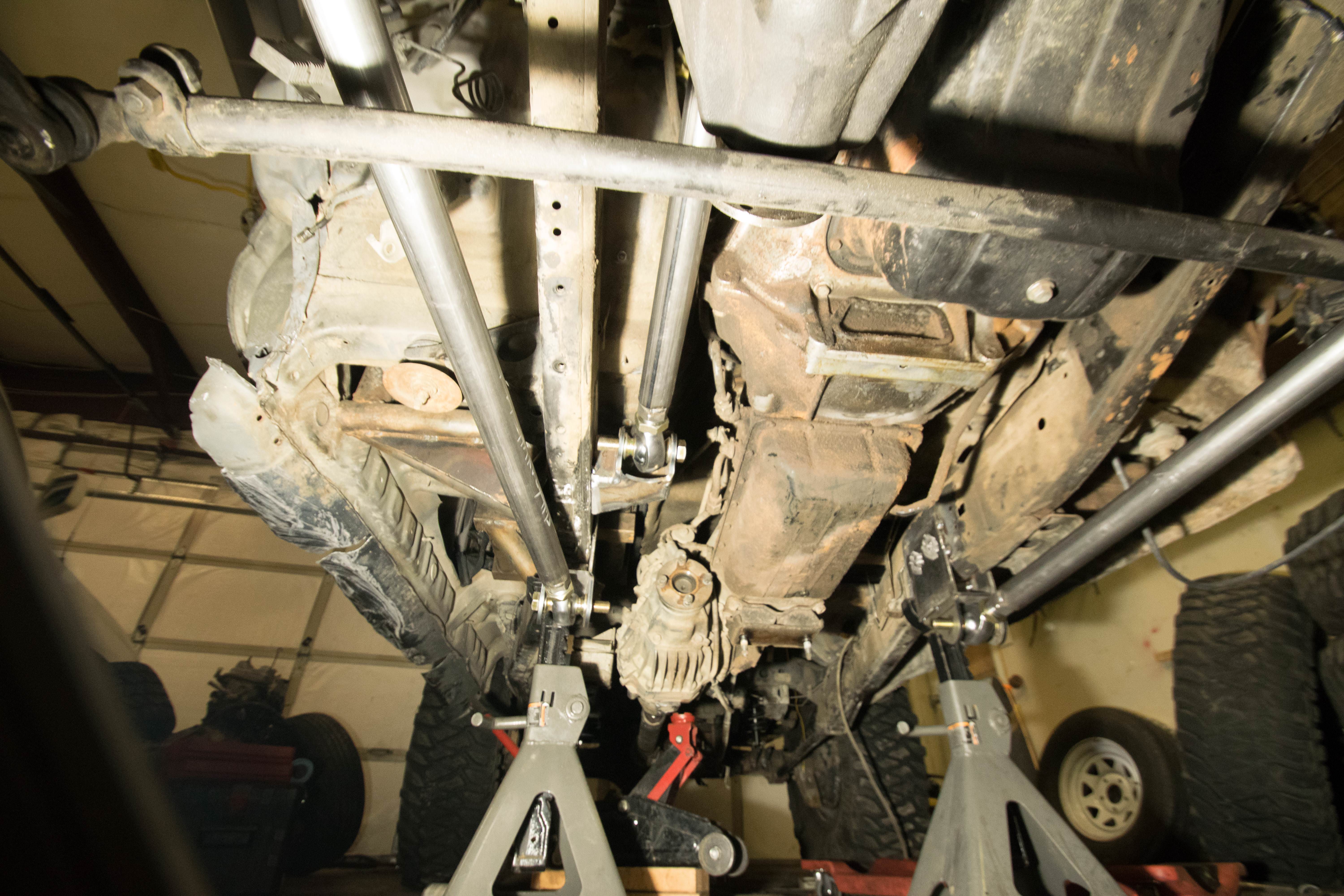
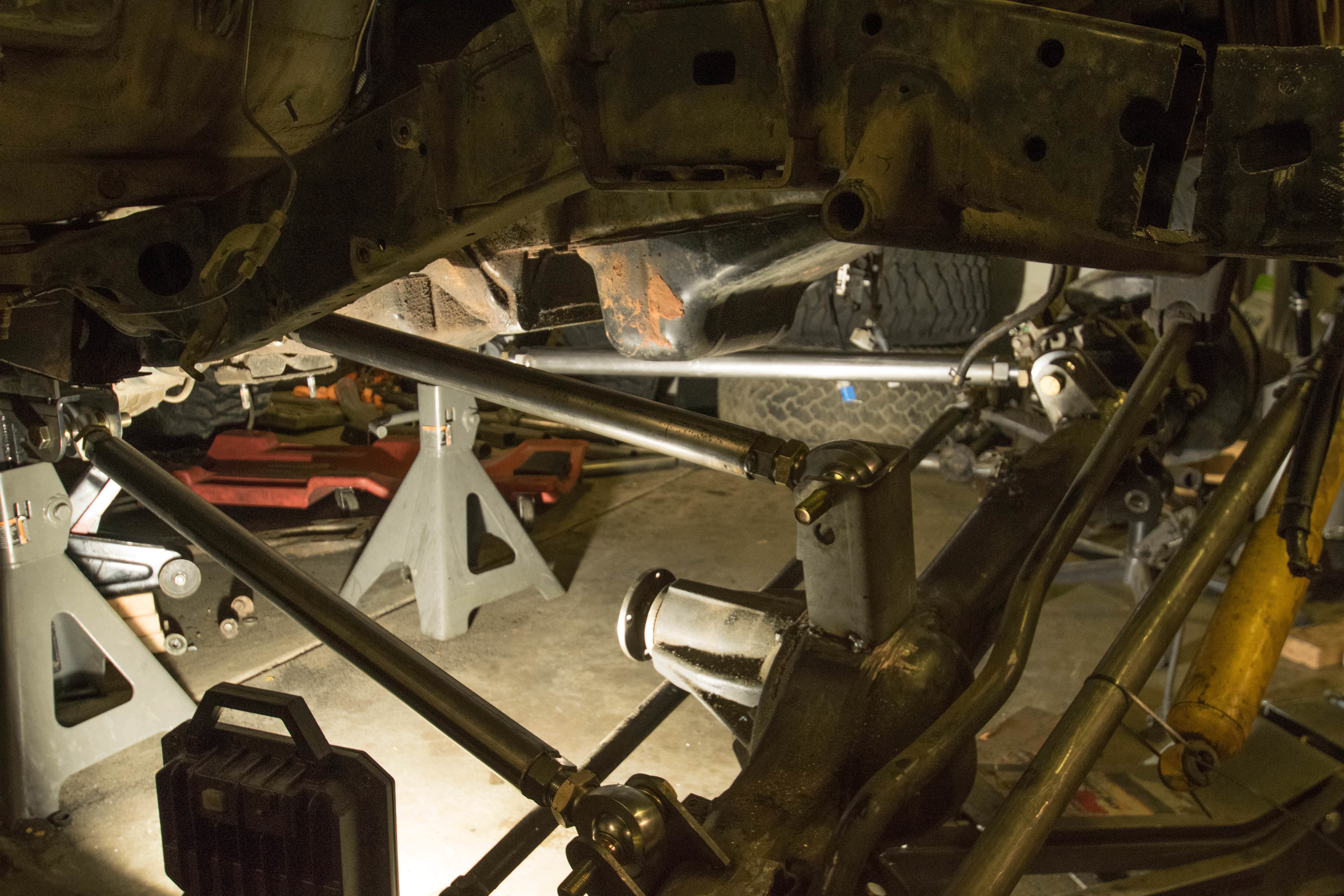
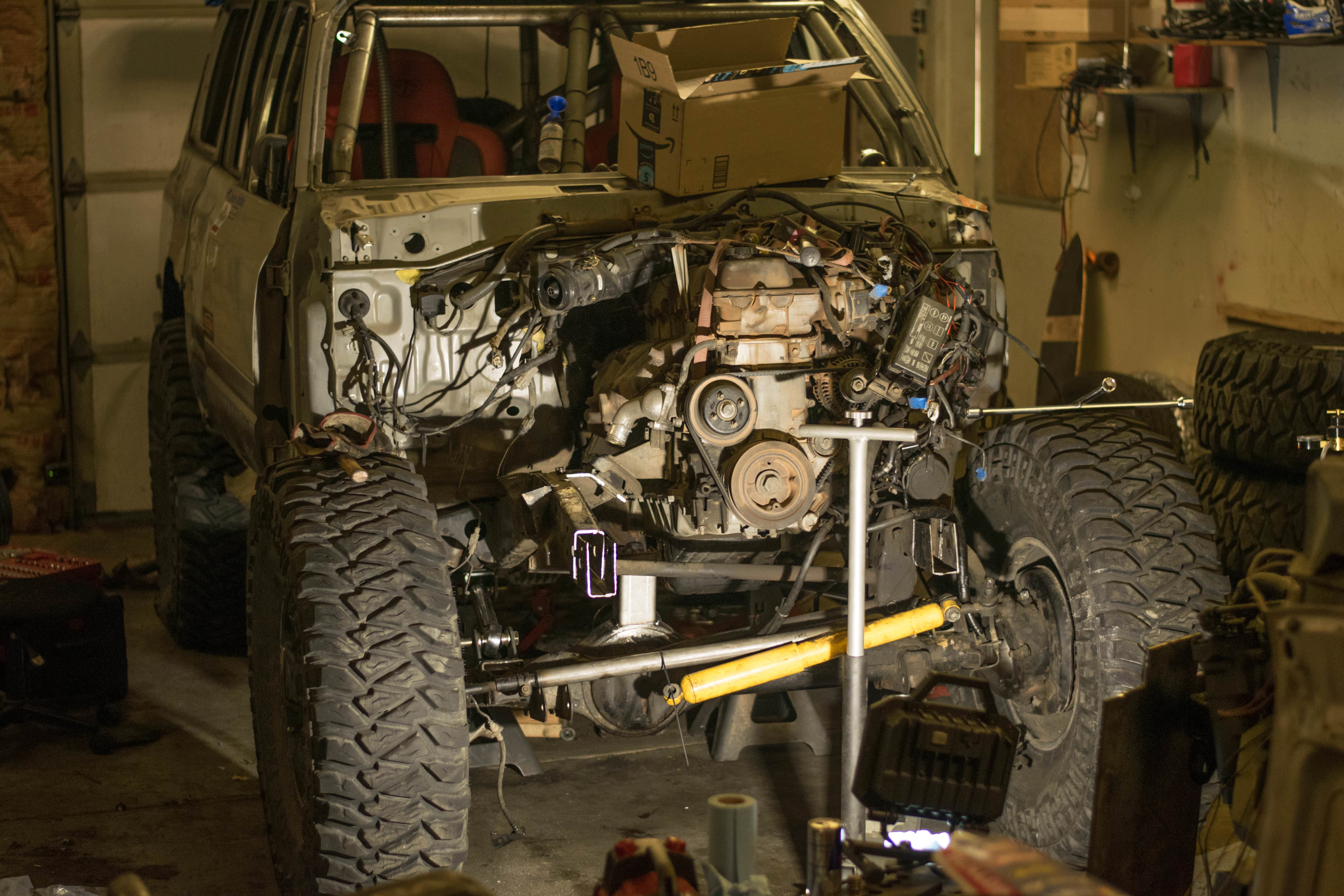
So the axle is back under the truck! Everything is tacked up, I just used some of my small tube to mock up the lower links though they will be switched out to 2.5" tubing. I worked on it a little bit before and after class this morning, so still have a lot of cycling and testing to do before welding it up but hope to start fully welding it tonight. The tires DO rub on the links, but I if they are limiting turning it's barely at all (I also rubbed on the radius arms, so it's no worse than before) and once I get new beadlocks it'll push the tires out so not worried about that. I do not have as much up travel as I was hoping, the upper heim is to blame since it's so big and I didn't compensate for it to stick out above the bracket. I have already trimmed the engine mount a bit, and with a little more cutting I can gain a bit more but I think max I'll have 4" of up travel without stretching the wheel base. Not a big deal, especially since it's within an inch or so of the rear's travel ratio. Since I plan to go to upgraded axles next year, and hopefully a different drivetrain, I can change everything then to fit better at full bump. Finally, the last "kinda issue" is the pinion angle, which I've adjusted to be correct but I need to tweak the lengths a bit more (thus why I used the cheap tube for mockup and not my big tubing!). The transfer case cross member is not bolted in, so the whole drivetrain is rotated back a bit so I need to throw that on to set the pinion angle right.

I tested the setup in triage's 4 link calculator and get minimal pinion angle change, even at full bump/droop so that should work out well. The lower links should clear the drag link BARELY at full lock and bump which works out great too! The next step once the axle is all welded in will be mocking up the shocks, since I have the link brackets so far outward there's not a lot of room for the shocks so I'll have to mess with the setup a bit (yet another reason to get wider!), but I don't think there will be much issue, I'll just have the link and shock brackets all tie together more or less. I do have a little concern that at full flex the drooped side will rotate into the frame, I don't THINK that will be an issue, but with dual shocks and bypasses there's a lot going on to squeeze between the frame and tire. I would notch the frame, but I'm required to have a "stockish" frame from the motor mount to the seats, and the motor mount is right above the axle obviously.

Other thoughts.... everything seems to fit really well actually, the oil pan seems to be molded almost perfectly to allow clearance for the upper mount to rotate next to it when flexed. Cycling the suspension is kind of a bitch since the diff is offset, and I can only bump it with the 40s unless I jacked the front up like 4ft in the air. I decided to sell my King bumps and buy ADS bumps, I have some people lined up to get them next week. I was gonna run the Kings but decided against it so everything is from one company. Switching bumps I'm not losing any money, though I'm not gaining anything so it works out; I should probably buy those right now, now that I think about it since it would certainly help with mocking up the front end.

And lastly, I am registered for KOH and the Ultra4 West Coast series! You get a discount at all the races if you commit to the season, and I was hesitant but decided that it's an Ultra4 build so let's race Ultra4! The next race after KOH isn't until May, and then there's 2 in California and 1 in Oklahoma, and finally Nationals, so a total of 5 race for the year for Ultra4 which should be a lot of fun! Additionally, I found out as of a few minutes ago that I will probably be partnering up with Eibach for all the springs on the 80, which would be pretty crazy and cool since I've run their gear since the very first truck I started modifying. Anyways, that wraps up the past couple days of work!
 
Badass work dude. Couple of questions:

1) Why are you going with 2.5" lower links? What wall thickness? IMO that's not necessary.
2) Glad your lower links only barely rub the tires. it's rare you turn full lock anyway so it should be ok even if it's a little rubby from time to time. But yeah, it looks pretty good from this perspective.
3) I hate to be this guy but you're going to seriously want to consider figuring out how to get more up travel. 4" of up travel feels very inadequate for go-fast. I would shoot for minimum of 6", even if it means having to make a bent upper link or something weird. It may even be better to have another inch of lift for the sake of getting a little more compliance in the desert. Any way you can get that to work? Sorry to be the naysayer. If there's no way to make it better, maybe you just live with what you got. Edit: just noticed you have a lower link mount position on the tower. Any reason you can't use it? You're just worried about link separation on the axle? The anti-squat (anti-dive) numbers are sort of a shot in the dark since we often don't know the real CG, etc) so don't trust those or base too much off of them until you drive it and see how it behaves.

Tip on the bump stops IMO - don't run stock pressure and oil levels. If you're going to be on the bumps a lot, you're going to want to run a rising rate (more oil, less overall nitrogen capacity) and a lower initial pressure. Hopefully you know what i'm talking about and how it affects riding dynamics - but go-fast means you're going to want to be on the bump stops a lot and you're going to want them to be a relatively smooth transition to stay fast.
 
I love the 40s on stock yota wheels. Anyway, like NG eluded to, 2" x 5/16" wall tubing is plenty stout for lower links, and you might not catch your lugs on em.
 
Last edited:
Thanks man!

1 - I've heard of 2"x.25 bending fairly often so figured may as well go 2.5" for the majority of the link. I'm still debating whether or not to do this since the tube is fxxxing HUGE, but at the same time I don't want to worry if I slam a rock that the link will get bent (though that's arguably better than the rest of the system taking more load). So not sure, especially since I'm running shorter (37" link lengths, so it's not crazy long)... but racing.... hmmm

3 - Yes I agree 4" of up travel seems pretty bad, but I'm trying to play the whole low CG - decent up travel game. As you pointed out, I have one hole down I can move the upper link (granted I'd have to trim the mount down though) and also since the lower link mounts are so high on the axle and are dropped 2" on the frame, I tried to design in as much leeway to jack the truck up as I could. So I can crank it up to 5", 6", hell 7" of up travel and still have a roll axis <1deg. I'm with you though, especially with a 2" travel bump, that's half the up travel right now is bump travel which isn't great. I think ultimately I won't be able to decide until I take it out wheeling and get a feel for hitting things straight on---plus once I get the beadlocks and push the front out a bit it won't feel quite so top heavy and narrow (and the 37s will lower it quite a bit from where it's at now).

I completely understand what you're saying about the bumps and will keep that in mind. I've only ever adjusted the pressure in previous setups, so adjusting that along with the oil volume I can see providing a lot more flexibility in tuning.

I love the 40s on stock yota wheels. Anyway, like NG eluded to, 2" 5/16" wall tubing is plenty stout for lower links, and you might not catch your lugs on em.

They don't look half bad! Only running them since I needed some cheap 17s and they were $40 haha. I definitely agree about it helping keep from catching, the fact the links are round versus the wide flange beam shape of the radius arms should help a bit.
 
Thanks man!

They don't look half bad! Only running them since I needed some cheap 17s and they were $40 haha. I definitely agree about it helping keep from catching, the fact the links are round versus the wide flange beam shape of the radius arms should help a bit.

The arms I had on my Early Bronco were .313 thick 2" tube, that's a tubing thickness that is available if you dont want to chance quarter wall. Are your factory arms straight still?:hmm:
 
Thanks man!

1 - I've heard of 2"x.25 bending fairly often so figured may as well go 2.5" for the majority of the link. I'm still debating whether or not to do this since the tube is ****ing HUGE, but at the same time I don't want to worry if I slam a rock that the link will get bent (though that's arguably better than the rest of the system taking more load). So not sure, especially since I'm running shorter (37" link lengths, so it's not crazy long)... but racing.... hmmm

It's just extra weight but material quality is probably going to start mattering more than thickness and diameter. If I were racing I'd drop the coin on 4130, tap the ends, and just get it heat treated. But that's money and time. You won't shear a link off, so the worst case from racing with a 2" .25 wall link is that you might bend it slightly but I doubt you'll taco one of them. Anyway, your call. 2.5" OD won't hurt but is a lot of extra weight. Note: rear links I think are more inclined to bend also since they angle back down to the rocks (rather than slide you away from the rock).

3 - Yes I agree 4" of up travel seems pretty bad, but I'm trying to play the whole low CG - decent up travel game. As you pointed out, I have one hole down I can move the upper link (granted I'd have to trim the mount down though) and also since the lower link mounts are so high on the axle and are dropped 2" on the frame, I tried to design in as much leeway to jack the truck up as I could. So I can crank it up to 5", 6", hell 7" of up travel and still have a roll axis <1deg. I'm with you though, especially with a 2" travel bump, that's half the up travel right now is bump travel which isn't great. I think ultimately I won't be able to decide until I take it out wheeling and get a feel for hitting things straight on---plus once I get the beadlocks and push the front out a bit it won't feel quite so top heavy and narrow (and the 37s will lower it quite a bit from where it's at now).
Yeah, just play it by ear. You'll need to tune and adjust and learn what works best for you. At this point if you're done engineering it, just run it and work with it as a constraint if you have to.

I completely understand what you're saying about the bumps and will keep that in mind. I've only ever adjusted the pressure in previous setups, so adjusting that along with the oil volume I can see providing a lot more flexibility in tuning.
Yeah, so I opened up mine, emptied the emulsion, let it stop foaming, then poured the oil back into the can, actuated the bump gently a few times, then set it to fully compressed, added oil till full, actuated it a few more times, then set it to fully compressed and added another 5 or 10ml or whatever it took to bring it to "almost full" and then capped it back up. Then I went to some 50-60 psi. It's a very very nice and gradual onset but it provides a *LOT* of resistance at full bump, which I was concerned about. In stock form, the rising rate goes from like 200 lbs to 600 lbs by the time it bottoms out. I wanted something more like 50 lbs to 1500 lbs. Anyway, sounds like you get what I'm saying. Very few people talk about tuning their bump stops, even in the desert racing circles. Like shock tuning - seems to be trade secret kind of stuff.
 
Back
Top Bottom