

1993 Specific year concerns

This site may earn a commission from merchant affiliate
links, including eBay, Amazon, Skimlinks, and others.

"Probably hard to see in this photo, but many wire sets (factory especially) will show the year they were made, these are from 1999:"

That's nothing! Changed mine in the spring and they were stamped "1993"
 
"Probably hard to see in this photo, but many wire sets (factory especially) will show the year they were made, these are from 1999:"

That's nothing! Changed mine in the spring and they were stamped "1993"

Understood! This rig just rolled over 292k miles and sat for 2 years (up until I got it) - safe to assume that since 1999 they've seen a LOT of miles.


In anticipation of the 'new to me' AFM showing up, I pulled the EFI fuse and decided to look at the AFM connector. There was a little bit of corrosion (AFM side only) on the far right (if standing at the front of the vehicle looking at the connector, as installed) prong. I used a razor blade to scrape the prongs best I could, used a small wire brush (it really could only reach the tips of the prongs) to clean them up, then razor bladed them again a little bit, re-installed the connector with some dielectric grease. Will throw the EFI fuse back in and see how it runs.

When the other AFM shows up - whether no change or not, I may play around with one of the AFM's in the same manner that many of the MR2/Supra guys do - which is opening up the AFM, check everything internally, and maybe even making some changes (you can increase/decrease the a/f ratio a bit by making some changes to the AFM). I actually haven't seen anyone mention these types of changes on this forum quite yet...

Also crawled under just to look.... the o2's are basically rusted to the pipes, so there's a good chance that I may look for something aftermarket then delete the cats (just in case). If the bolts on the o2's looked good then I would pull them and clean them, but right now that isn't something I'm going to dive into quite yet.
 
so cleaning the connector did very little other than maybe a tiny bit better throttle off idle.... that or my butt dyno isn't calibrated.

Ordered a TB gasket to pull that and clean it along with corresponding components.
 
Ok.... so I pulled the throttle body to check it out... dirty, but no ports are blocked.

Removed the IAC motor (valve) and now I'm confused/concerned..... there is a crack in the housing and when I test, I don't get movement. I do feel something internally trying to do 'something', but I'm also a tad confused on the instructions.

VERBATIM from the FSM:

(1) connect the positive (+) lead from the battery to terminals 5 (B1) and 2 (B2), and the negative (-) lead to terminals 4 (S1) - 1 (S2) -6 (S3) -3 (S4) in that order.

(2) Connect the positive (+) lead from the battery to terminals 5 (B1) and 2 (B2), and the negative (-) lead to terminals 3 (S4) -6 (S3) -1 (S2) -4 (S1) in that order.

OK (1) The valve moves to close direction.
(2) The valve moves to open direction.

HINT: The ACTIVE TEST mode of the TOYOTA hand-held tester can be used to change the step of the IAC valve as desired.

NG Repair or replace IAC valve.


I'm confused on the connecting terminals - is it saying to connect each terminal consecutively and LEAVE those connections in place, or is it saying to connect to each terminal in that order one at a time, removing from each. I did the latter and there's zero movement other than the motor trying to do "something" internally with no movement.

Thoughts?
 
Well I tried it the other way - I figured if it wasn't working the first method, and it wasn't working - then the 2nd method wasn't going to make it any worse than it already is. There was no change.

I did notice "movement" in the end of it - instead of in/out, it went back and forth. There's a definite issue with it. This does explain the low/lopey idle.... a lopey idle (if not from cams) can be cause from a low or high idle "flow", and the computer trying to compensate fuel wise.... it would also explain why the code 26 pops up (too little air is getting through, too much fuel for "idle" and code 26 pops up.... it tries to lean the mixture out and rpm's could rise and the system sees it's a bit lean, richens it thinking the idle speed is now correct, and the enrichment drops the idle because there isn't enough airflow to supply that much fuel... and the lope continues).

Part in question:
20150924_143505_zpshewgbfwk.jpg


The crack in the housing:
20150924_143528_zpsn7xdthjc.jpg


Where it was removed from:
20150924_143545_zps1r73ns2i.jpg


Testing:
20150924_165823_zpseob8yjf5.jpg


20150924_170046_zpsl07drx7i.jpg
 
It is a stepper motor. Keep positive connected to terminals B1 and B2. Then in sequence take and hook up one ground wire and touch one terminal at a time momentarily in s1, s2, s3 and s4 order. The plunger should rotate a very small amount in the same direction each time a terminal is grounded. This sequence can be repeated multiple times until the motor(plunger) reaches its limit of travel. When the sequence is reversed the direction will change. Holding on to the motor you can feel each pulse

This is NOT like a normal motor which turns continueously as long as the terminals are connected. You should be able to turn the plunger manually to make sure it turns without sticking.
 
just finished reading all four pages, toyotaspeed90 - thats some great diagnosis there.

I have questions:

1 - the lopey idle thing you mention, its there all the time, right? - advancing and retarding from the dizzy doesn't fix it? (if you havent tried this, mark the dizzy, short the TE1 and E1, and try advancing/retarding the dizzy, see what it does, these run best on 3-5 degrees - a timing gun would help a lot)
2 - What about throttle response? does it run perfect under WOT?
3 - is the kickdown cable adjusted properly? its not actually a kickdown cable - its called a throttle cable that adjusts the fluid passage switching based on throttle input - it adjusts the aggression of a SHIFT - like a modulator in old vacuum regulated transmissions)
4 - The TPS sensor should be good for the transmission to shift correctly, check the TPS thoroughly - the shift solenoids can be tested easily if you have access to an air compressor. FSM gives you the threshold pressure reading.
5 - Does your 80 have A/C if yes, push button type or lever type?
 
It is a stepper motor. Keep positive connected to terminals B1 and B2. Then in sequence take and hook up one ground wire and touch one terminal at a time momentarily in s1, s2, s3 and s4 order. The plunger should rotate a very small amount in the same direction each time a terminal is grounded. This sequence can be repeated multiple times until the motor(plunger) reaches its limit of travel. When the sequence is reversed the direction will change. Holding on to the motor you can feel each pulse

This is NOT like a normal motor which turns continueously as long as the terminals are connected. You should be able to turn the plunger manually to make sure it turns without sticking.

Plunger doesn't move manually, and I tried the one terminal at a time method (with varying degrees of length) with no rotational nor outward/inward movement.

just finished reading all four pages, toyotaspeed90 - thats some great diagnosis there.

I have questions:

1 - the lopey idle thing you mention, its there all the time, right? - advancing and retarding from the dizzy doesn't fix it? (if you havent tried this, mark the dizzy, short the TE1 and E1, and try advancing/retarding the dizzy, see what it does, these run best on 3-5 degrees - a timing gun would help a lot)
2 - What about throttle response? does it run perfect under WOT?
3 - is the kickdown cable adjusted properly? its not actually a kickdown cable - its called a throttle cable that adjusts the fluid passage switching based on throttle input - it adjusts the aggression of a SHIFT - like a modulator in old vacuum regulated transmissions)
4 - The TPS sensor should be good for the transmission to shift correctly, check the TPS thoroughly - the shift solenoids can be tested easily if you have access to an air compressor. FSM gives you the threshold pressure reading.
5 - Does your 80 have A/C if yes, push button type or lever type?

1) it's there when the problem is present. It hasn't been 100% consistent, but is becoming more consistent. I was going to time it, but now with the CEL kicking (at least older MR2's, corollas, and my old 86 4 runner) - won't go into base timing when a code is thrown. I do have a light.
2) it fine under wot once above 2k rpm. if rpm's are near or above 2k rpm it accelerates fine, if it downshifts it goes perfectly fine
3) good question
4) the TPS still has the factory yellow location markings on the TPS and the screws, it's never been off. It also isn't throwing a code. I also tried, at one point, to pull the TPS connector (as when it does throw a code it may not see idle anymore, but the ecu can run the engine well without the TPS, and there was zero change at idle)
5) Unsure on the differences.... push button for A/C on/off, buttons for vent changing and fan speeds, has a lever for temperature changes


A note regarding the transmission issue - I've noticed it will not go into 1st ONLY when the vehicle is first started (and not every time). A simple/quick resolution is to put the vehicle in reverse, move (literally just moving 1 foot works) then into "D" and the trans will drop into 1st. Putting it into reverse (without moving) then "D" doesn't drop it into 1st.

Also - since I made mention of this in earlier posts - I don't think the problem going up hills and feeling it 'kick in' is the transfer case. Since my "private roads" (trust me, it isn't as fancy as it sounds) are 15mph, I just threw the rig in 1st and made my way home - there were zero points where it felt like it was "catching". Upon coming to a bit of a flatter section, I bumped it to 2... where it then dropped to 2nd gear, then the next portion of the hill it did it again.... it's shifting down but just a bit harder than I'm used to. I'm starting to look into shift solenoids...


I was able to locate a complete TB with TPS and IACV from a local 4x4 specialty junkyard for a really good price (especially considering the cost of the IACV 'new'). I plan to throw my TB back in to get it back together, and leave the IACV in, but screws "loose" enough that they will come free in the vehicle (I couldn't get enough 'traction' on the screws when it was in the vehicle - hence why the TB came out entirely).

I still have an AFM on the way as well.
 
It engages first only under certain conditions, it pulls well in 2nd

But, under load it should shift to 1st so it can pull that 3500kg up

I'd suggest you check and adjust or replace the TPS

Check the fsm for the mechanical test of the tranny, if it passes mechanical test, id suggest adjusting the kick down cable
And check the shift solenoids, very easy to do, i don't remember the location of the solenoid harness, but i do remember that you can tap into the solenoid harness and apply 12v directly to check the operation, the chart is available in the FSM

If you're good with the DVM, you can test the AFM before replacing it, fsm has a very detailed set of instructions.

Also regarding the ac, can you send a picture of the controls

Does the ac work? If sometime during driving / ac use, the ac pushbutton light turns off - also at that time the compressor is disengaged
Plus if all the above mentioned tests are passed and it still doesn't shift and run properly
Id suggest removing the ecu and taking it apart for a nice look at the capacitors
Those era Toyota ecu capacitors are known to go bad at this age, you may be shooting parts and time at the wrong things

pls keep us posted
 
Last edited:
AC doesn't work right now. I was told it did by the last owner who drove it 2 years ago and he thought it just needs a recharge. I haven't looked into it. I'll get a photo of the climate controls soon.

The IAC motor didn't change anything.... although I bench tested the old one about 15 different times and ways, it never worked right. I even took it apart - nothing internally looked wrong (and the plunger does spin in and out when removed from the motor, it does not pull out) it doesn't open/close on the bench. I'm thinking Toyota wasn't sure how to appropriately control idle yet electronically because there seems to be every type of idle control on these things....
There's a vacuum controlled armature that leaves the throttle mechanically open until vacuum builds to close it (that's why the first few seconds are above 2k rpm)
There's coolant lines running to the throttle body - My guess is there's some type of waxistat in there (which is what they used, in conjunction with a mechanical screw in previous year of other models)
Then there's the IAC motor, which controls the throttle body plate bypass....

The AFM was swapped - upon first drive everything was great and working as it should (rough idle went away, no CEL... although what seems to be a partial lack of power down low, it seemed fine).... then on the return trip the CEL popped back on, and after sitting at home for an hour, the rough idle returned (though oddly not NEARLY as bad as before).

The transmission has been much better at shifting while driving after the TB was removed, cleaned, and then when reinsalled had the cables installed mildly taught.

Now this next piece is what I believe to be yet another 1993 variance....

The 1994 FSM I have seems to indicate that the EGR temp sensor is in all vehicles. Someone showed a screenshot of their FSM in another thread (unsure what year) but it was titled with "California Only" for the temp sensor. This is where it gets weird - my hood may not be stock it has an EPA sticker for 1994 for CA, but there isn't an EGR temp sensor. The hole in the EGR looks original, the plug was buried (back towards the firewall a bit) and it has a factory Toyota resistor in place. I've read in other threads that their 1993 models didn't have the sensor either.
 
Last edited:
Regarding the EGR....

it does make me wonder.... other threads have stated that the VSV in place becomes a moot point when the EGR actuation valve is bypassed (by looping the vacuum lines).... and then there are statements that the EGR only comes on while cruising on the freeway.

Unfortunately you can't have it both ways - you can't say that the EGR only opens while cruising (which in these vehicles VSS is electronic) and saying that EGR only actuates mechanically..... I say this because the vacuum reading that would cause the EGR to open at say 2k rpm and partial throttle at 60mph would be "mechanically" the same as 2k rpm partial throttle at 35mph.....

In looking at the ECM diagram, it looks like the VSV is an EGR "cut".... looks like it's based on battery voltage and coolant temp, not VSS....
 
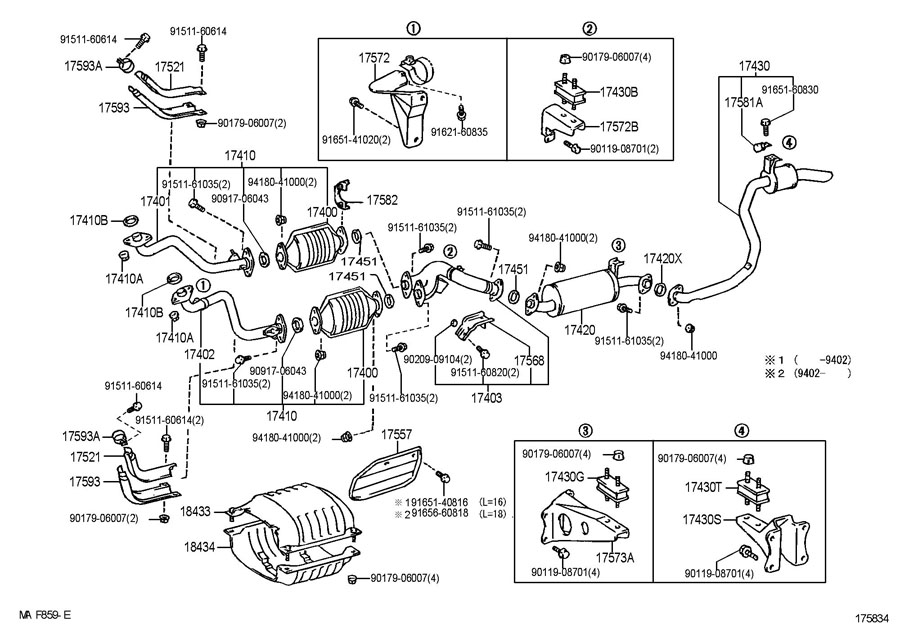
So I'm having an issue finding the right exhaust parts. Seems yet another 1993/1994 specific issue....

Even ToyoDIY I'm not sure is accurate.

I've done some searching and it's well known that pre-cat exhaust on a 93-94 is different than the 95+ models. The problem I'm having is the parts companies seem to question what engine a 93/94 has (3FE or 1FZFE) so this makes me know that their EPC isn't quite right for the specifics of a 93-94. The exhaust seems to be the same.

My down pipes are old, and I know I can't replace the 02's without busting the bolts off. I found a place that sent me some used but very good condition 94 pipes - I have them and ready to go in, but I haven't been able to find the right gaskets.

After some searching I was able to locate this diagram:

175834.jpg


This is the parts list from toyodiy:
http://www.toyodiy.com/parts/p_U_1993_TOYOTA_LAND+CRUISER_FZJ80L-GNPEKA_1702.html

17410B is the exhaust gasket reference at the front (for each pipe).... but that isn't a valid part number. Per Toyo-DIY it's part number 90917-06065

90917-06043 is the exhaust gasket part number at the rear (for each pipe)

Since ToyoDIY lists these as like $12-13 each (for a simple exhaust donut) I'm not willing to spend almost $50 on very simple/basic gaskets.... I'll be trying to cross reference them to another model to find the right gaskets at an appropriate price.
 
Using the ToyoDIY cross reference I see that 90917-06065 applies to many vehicles. The one that stands out as the easiest (only 1 engine choice in north america) is the ZZW30 (3rd gen MR2, 1zzfe motor).

Looking that up in Autozone, the MR2 uses (Victor Reinz) part number F20252 or felpro (there's 2 variants): 23591 or 61016

Using the ToyoDIY cross reference I see that 90917-06043 applies to many fewer vehicles. The one that stands out as the easiest is the MA70 (late 80's early 90's supra).... This could be a little harder as there are variants, I'm going to assume it's for the N/A model since it also applied to the SC300 and SC400 (that's a little more difficult to identify since those use 2 different engines... and also surprising not to see the last gen supra since the N/A model shares motors with the SC300).

This second one seems to be tougher... the supra has at least 2 if not 3 different donut gaskets....60461 (Felpro) pre-cat, 60512 (Felpro) post cat, 23561 (Felpro) flange... may need to go into the store with a pipe, or do more research
 
simple Google search yielded:
Toyota - GASKET, EXHAUST PIPE Part Number: 90917-06043

makes it look like it's the not-quite-round gasket, which from the Felpro would be the pre-cat..... still looking into it, though

and here we go, this is what I was hoping for:
90917-06043,TOYOTA 90917-06043; Seal, exhaust pipe

It is the 60461


So for 93/94, the 4 gaskets are:

Felpro
60641 (x2) $3.99
23591 (x2) $2.99 ea, you can substitute this for a variant of 61016 at $12.99 each if you wanted... which seems to be an all steel/crush gasket instead of your typical exhaust donut
 
Thought I would throw up an update for anyone who cares and/or is having similar problems.

Been another roughly 1000 miles and still zero issues, running great. Weather has been changing (sort of all over the place) with no ill effects. Seems that bypassing the EGR did something - probably what I had mentioned in posts 71 and 72.

Once I get some of the work done on the house (preparing for family Thankgsiving in a new-to-us house.... bathroom redos, bunch of cleaning/moving/rewiring etc) I'll finally get around to putting in the new keyless entry.... which oddly enough has me wanting it a little bit more now that I tried to get a key cut and their system couldn't read my key....

You can always buy the gasket sheet and cut or get it cut as per your needs, we do that here all the time. :p

The exhaust flange gaskets that are used for the pipes in question aren't the flat gasket material - I've had to do that on many vehicles, but these are crush and/or coiled exhaust type gaskets
 
You weren't able to call Toyota with your vin and have a new key cut and mailed to you? @beno was able to send me a new key no problem. Perfect fit!

that would require me to assume that the original locks are in the car, since the only key I have is a non Toyota key, I'm not sure I want to make that assumption.

I will take the passenger door lock out (or just take the rig to) a locksmith and have them cut one from it....
 
Mine was a worn-out non Toyota key. I figured if I got the correct key I could simply have the lock smith set all my tumblers. The extra cost would simplify any future key replacement. Turned out everything was original.

I did start with the locksmith, though. He said in his experience cars are rarely rekeyed and suggested I just try ordering a key from the dealer.
 
Back
Top Bottom