Voltage Reduction

This site may earn a commission from merchant affiliate
links, including eBay, Amazon, Skimlinks, and others.

Joined
Apr 4, 2003
Threads
422
Messages
23,681
Location
Panamá
Website
www.4x4panama.com
Hello folks ..

Long story short I need 6V ( actually anything between 1.5V and 11V will work ) in Tencha .. ( alternator swap ) and this will be only signal to my new alternator to power on ..

after some reading about resistors and the ohms required to reduce 12V on Tencha .. I cross with this .. and thought It will work better than just plain resistor ...

Painless Wiring 40027 Voltage Reducer 12 V to 6 V 4 Amp Maximum Load Each 749823400276 | eBay

comments are appreciated ..

thanks

David
 
Explain exactly what the 1.5V to 11V is needed for and maybe you can get some useful recommendations.

The ebay link appears to be just a resistor with a stud to cool it down. The fact they state 1.5ohms at 4A makes it sound like just a resistor.

Again, WHY do you need 1.5V to 11V ???? HOW much current do you need to provide???

cheers,
george.
 
sorry I would explain it better ..

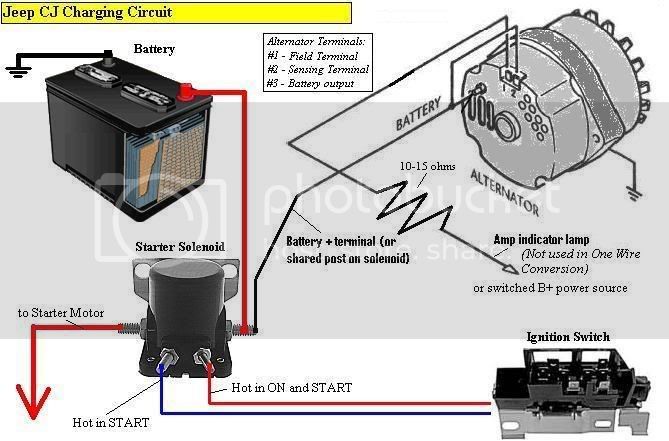
I'm swapping an GM alternator type in Tencha ( actually it's already in ) she used to have an externally regulated alternator with vac pump attached .. long story short, looks like HJ60 does not have any resistance in the light circuit .. so in the L port ( wire ) I'm seen full battery V and it's my understanding that full V will damage the unit ( as alternator supplier stated ) so .. I need to put a resistor or something to reduce the 12+V that I got at my L port ( wire ) in order to activate the unit ( alternator )

charging_circuit2.jpg
 
From my understanding the Pin 1 in your diagram is what provides the excitation voltage (starts up the field) to fire up the alternator. It does not appear critical, given it's normally powered via the idiot light.

I doubt that the alternator needs <11V on the excitation input (pin 1) to protect it from damage.

Basically Pin 1 excites (or creates a weak magnetic field) to kick the alternator to life. Once it fires up it will sustain the magnetic field itself. So, only a relatively small current is needed to get things running.

You certainly do NOT need a giant power resistor as in your ebay link and of such low resistance (1.5 ohms).

cheers,
george.
 
Last edited:
Looks like if you put in any 10-15 Ohm resistor that is 2 Watts or greater in power handling you will be safe. Digikey will have what you need. Electronic Parts, Components and Suppliers | DigiKey Here is a 5W 15 Ohm axial lead resistor: 25J15RE Ohmite | 25J15RE-ND | DigiKey

The deal with Digikey is they have a minimum order, under which they tack on a $5 handling fee. They have lots of stuff you may want, so look around. Warning, their catalog is huge!!! Actual costs for shipping is tacked on when shipped. They don't pad their shipping charges.

As for mounting it, just crimp it in line in the wire and cover with heat shrink with a seal. Place it in a spot where it would hang in line or be supported in a straight section of wire wrap. I wouldn't put it at a connector because of bending loads.

You could go for a chassis mount resistor, but it would cost more, and you would have to find a place to mount it.
 
Last edited:
You could go for a chassis mount resistor, but it would cost more, and you would have to find a place to mount it.

question or better .. my concern is .. chassis mount resistor will be more " safe and durable " for job ..?

I'm kinda worried with those " plain " resistors nos surviving in the engine bay environment ..

Another question is .. I was under the impression that those resistors must be in the line, I mean, interrupting the line but if I got you right it shouldn't be .?

thanks guys ..
 
Searching the net shows a variety of schemes to deal with the excitation pin. There's also a variety of resistor values and/or resistor/bulb parallel combinations.

It doesn't appear to be that critical and a lot depends on whether you want a indicator light on the dash. If you already have a voltmeter in your gauge cluster, then an indicator bulb is less important (though still nice to have).

For a resistor type, I'd recommend a wirewound (less vibration/heat/oil etc issues).

There's a lot of error on the net, folk thinking the resistor value is critical for part of the regulation function of the alternator - that's definitely not correct. Seems like anything in the 15 to 50 ohm range would likely work just fine, it's only purpose is to get the field established when first spinning up the alternator, after that it provides its own power to the field.

So, it would appear to me that your task is to find a nice wirewound resistor in the 15 to 50 ohm range that is something like a 5W resistor (plenty of safety margin) and wire it in series with switched ignition +12V and then to Pin 1 of the alternator.

cheers,
george.
 
question or better .. my concern is .. chassis mount resistor will be more " safe and durable " for job ..?

I'm kinda worried with those " plain " resistors nos surviving in the engine bay environment ..

Another question is .. I was under the impression that those resistors must be in the line, I mean, interrupting the line but if I got you right it shouldn't be .?

thanks guys ..
In line is right. Power in one end of the resistor, and out the other end. So, for a dash light, for the alternator it would be: Connection to Switched +12V supply, wire, indicator lamp, wire, resistor, wire, pin 1 on alternator.

The resistor will be fine under the hood, but it also could be tucked up under the dash. The heat shrink tubing will provide some support. If you feel more support would be needed, then it could be braced with something stiff. If it is under the hood, tucking it up on the side where the fuse box is would be good. Like all the rest of the wiring I'd keep it away from heat sources like the exhaust manifold.

Digikey has ceramic cased wire wound resistors if you are really worried about temperature, but then the insulation on the wires is only a plastic...
 
Got these will see if can be placed with fuse base

Sent from my GT-N7000 using IH8MUD
ForumRunner_20120814_144316.webp
 
Is your alternator a 10/12si, like is shown in the Jeep wiring picture above? When I ran a 12si, I had no light and no resistor, just a switched 12v to excite the alternator. When I swapped to a CS144, everything I could find (including directions that came with it) said the CS144 needed a resistor within a very broad range (something like 35-550 ohm). I ended up buying a wiring adapter from Alternator Parts that came with a resistor already in it, and it was 500ohm. Apparently it doesn't take much to excite a CS144.

For the rest, I did the same on both the 12si and the CS144, namely the sense wire over to the battery terminal of the alternator, and a big wire from the battery terminal directly to the battery, with an appropriate fuse.
 
Last edited:
I'm not sure if mine it's based on neither of both you mention .. but I do know ( by the DC Power E folks ) that I need reduced V to activate this one .. I will do the " magis " this weekend and will report back how that works ..
 
well it looks like that GM resistor values was specific for the circuit with the idiot light .. since I don't have it .. I would need bigger resistor .. since the 22ohm one do nothing to lower my batt voltage
 
Have you a) tried a resistor in the 30 - 200 ohm range and more importantly b) have you measured to see if the alternator has started generating current.

Really, you appear to be overthinking the whole excitation thing. The excitation input draws little current only during startup and does NOT appear to be too critical voltage wise.

You seem a bit obsessed about lowering the voltage. Obviously once the alternator self excites it will feed the field itself and you likely will see close to 12V since it is COMING from the alternator and not via your resistor...

So, HAVE YOU MEASURED if the alternator starts up when using a resistor to feed the input via your switched ignition +12V ???

cheers,
george.
 
I'm kinda afraid of putting 12V on the F / L port to excite it since I was warned doing that will burn it .. and I don't want to do that ..

Since I din't put 12V to excite it didn't start charging at all ..

Last try was with 22ohm 5W resistor and didn't make any difference .. so I'm looking this option as the best one ?

I know it's only required for initial exciting .. just don't want to screw the damn expensive alternator ..
 
I'm kinda afraid of putting 12V on the F / L port to excite it since I was warned doing that will burn it .. and I don't want to do that ..

Since I din't put 12V to excite it didn't start charging at all ..

Last try was with 22ohm 5W resistor and didn't make any difference .. so I'm looking this option as the best one ?

I know it's only required for initial exciting .. just don't want to screw the damn expensive alternator ..

So, HOW are you measuring the actual voltage on the exciting input. Have you actually wired things up and tried to start it with the resistor in place and then measured the alternator output???

A resistor without a load will not drop any voltage...

You wrote "Last try was with 22ohm 5W resistor and didn't make any difference .. so I'm looking this option as the best one ? " .... what do you mean by this? Did you start up the vehicle and measure the alternator output or what??

It's very hard for me to understand what you've actually tested or not and how you are measuring things.

cheers,
george.
 
A resistor without a load will not drop any voltage...

damn .. this ^^^^^ I didn't know !!! :eek:

? Did you start up the vehicle and measure the alternator output or what?

I identify 12V on ignition .. then place the resistor expecting see less then 11V across it .. so I weld one end of the resistor to the 12V wire and measure the other end .. since still was 12+ V I didn't connect it to the Alt .. :frown:
 
Well, like I wrote... a resistor with NO LOAD will NOT drop any voltage....

Some basics here... OHMS LAW....

V = I x R

V = volts
I = current (amps)
R = resistance (ohms)

With 0 amps you have V = 0 x R = 0, i.e. 0 volts dropped across the resistor....

Like I figured, at this point you haven't actually tried to run the alternator etc.

Connect resistor and start the vehicle and see if the alternator is putting out charge, i.e. you should see somewhere around 13.5V or higher at idle.

cheers,
george.
 
Back
Top Bottom