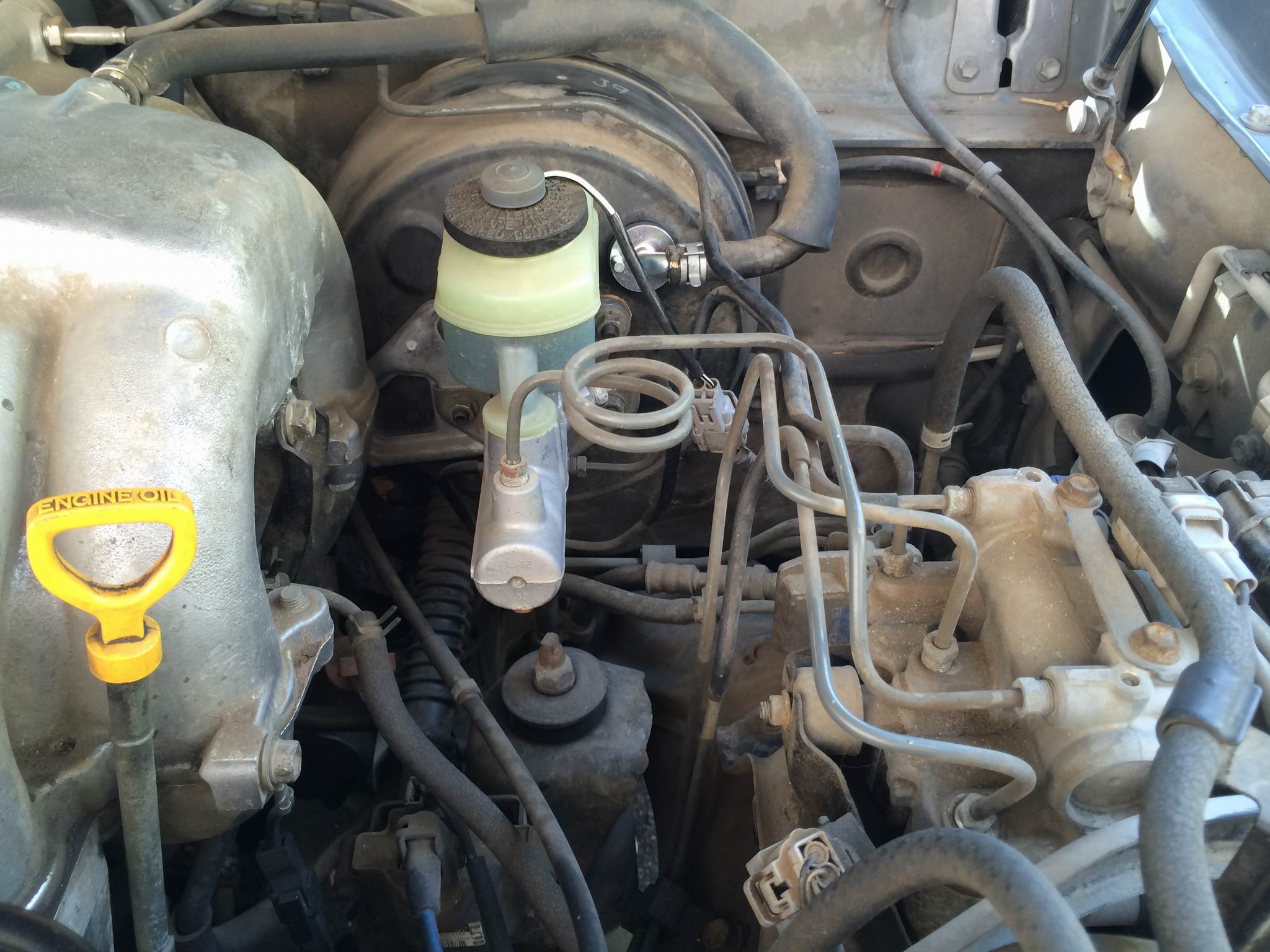
Thanks for the advice everyone. Here's how it went down in gross detail, just for future reference of anyone planning to do this job themselves. I'm basically dumping my entire recollection of how it went while it's still fresh in my mind. Wall of text, for real, so you may wanna just skip reading the rest of this unless you're about to attempt the job yourself and need some reassurance.
I managed to change my booster (1995 FJZ80) out just now with simple hand tools, took me about 2 hours, and I did not have to disconnect any brake hard lines or bleed any brake system components. Having an extra set of hands was helpful (roommate) especially at the end when I had to get the booster bolted back in.
First thing I did was bungee the brake pedal to the steering wheel (to keep the brake light from going on), disconnected the return spring (being careful to not let it fly off under the dashboard), and pulled the clevis pin out. Then I knocked the clevis out toward the passenger side. I then tried to remove the lock nut on the clevis bracket with no luck whatsoever. It was on there SO tight, I was starting to round off the lock nut with my flare nut wrench just trying to get it to budge. I also warped the clevis bracket (the U shaped metal that the clevis goes through to connect to the brake pedal arm) slightly while trying to get them apart (not good).
After giving up on removing the clevis bracket (which some people said would make the booster easier to remove, and I agree), I returned to the engine bay and removed the vacuum hose to the booster, unplugged the electrical connector to the master reservoir, and unbolted the master cylinder. The hard lines in the engine bay were surprisingly pliable, as I pulled the master cylinder almost straight away from the booster little by little. My 1995 FJZ80 has 2 extra brackets bolted on with the master cylinder, so I had to be careful to get them off as one of them had brake hard lines attached to it as well. The other extra bracket was just a clamp for the throttle cable running behind the booster. I found that getting this extra throttle cable bracket out first (after popping the cable out of the end) made things easier for the rest of disassembly.
Once the master cylinder had about 3-5 inches or so of clearance from the front of the booster, I got under the dash and unbolted the 10mm bolts on the cruise control bracket (the computer box to the left of the brake pedal assembly). I undid the little bolts pointed in the passenger side direction, not the ones pointing forward. Removing the whole cruise control, unplugging it, and getting it out of the way made disassembly and reassembly much easier. After that I was able to remove the 4 12mm nuts holding the booster to the firewall with a few socket extensions and a u-joint.
Next came the part where I was cursing and grunting and really hating life for a bit. I pulled the vacuum booster out of the wall until the left side hit the intake. I then started doing what people suggested -- start wiggling it, trying to get the bolts out of the firewall holes one by one, trying not to destroy the gasket in the process. Somehow after much wiggling, I was able to get all but the lower inboard stud out of the firewall. A little more wiggling, and that stud was free. I managed to turn the booster 90 degrees counter-clockwise, and I could tell it was ALMOST out, but the damn rubber boot going into the firewall was clearly hung up on something. The thing that pushed it "over the top" is when I had my roommate hold the booster and wiggle/pull on it while I got under the dashboard and started pushing on the boot from the firewall side. I managed, with the end of a wrench, to mush that sucker into the hole enough that our combined efforts popped it past the lip just enough so the booster could pop past the intake on the left. At this point I got out and started wrestling with it (noticing my pushing from the firewall side had torn the boot on the booster, so beware if you're not replacing your booster with another one) and somehow through some miracle it managed to pop everything free. From there I had to have my roommate hold it while I bent some of the overhead hardlines to get the booster out of the engine bay. Success!
So at this point I needed to get the clevis bracket off of my old booster. I had no success getting it off while I was mounted on the car because someone at some point (factory worker? some random mechanic?) had gone ape**** on the lock nut, and it was near-as-makes-no-difference welded together with the clevis bracket. The thing is the shaft, nut and clevis bracket still had that nice yellow coating on it, no rust or anything. Really weird to see a brand new looking piece of hardware like that stuck together. Even with a pair of vise grips on the shaft of the booster and a wrench, I was unable to get the lock nut loose. I couldn't apply too much force to the clevis bracket itself because it is soft and easily warped. I sprayed it liberally with some aero-Kroil (great stuff, highly recommended) and after a few minutes I was able to turn the clevis bracket and the lock nut off together (with great effort). Usually I use Kroil on rusty components, but in this case it worked amazingly, getting into the locked up threads and letting me remove this stubborn part. I did mar the shaft of the old booster quite a bit with my vise grips in doing this, unfortunately.
Putting the new booster in was relatively easy compared to removal, and I'm really not sure why. We maneuvered it in the same way the old one came out, and when the booster housing got hung up on the intake, I punched it with the soft bottom side of my fist a few times and it popped past the intake. It would probably have gone in easier if I had lubed up the intake and housing where they met with some grease first. I'd suggest trying this if you're planning to do this job, hell, it would probably have made removal easier as well.
After the booster was in all the way, I had my roommate hold the booster in place while I did two things. FIRST, I put the lock nut and clevis bracket onto the shaft of the new booster under the dash. You want to get it kinda dialed into where the old clevis bracket was (assuming you're replacing the booster with the exact same part -- my old one and the replacement were identical JKC units, not sure if it had been replaced before). I made double sure the brake pedal was between the arms of the clevis bracket before I started bolting the booster in, because otherwise the pedal doesn't have enough upward travel to clear the clevis bracket and I'd have to loosen the whole thing again to get the brake pedal arm in the right spot.
Now I was on the home stretch -- I bolted the 4 12mm nuts back on the booster studs and tightened them down, bolted the cruise control back in, pluged it in, then went back to the engine bay. A helper was useful here -- I pushed the master cylinder forward against the force of the hard lines, until my roommate could get the top right nut engaged (facing the booster). Next I put the throttle cable bracket back in between the MC and the other bracket (the one with the hardlines on it). This throttle cable bracket needs to go over all but the top right stud. I did more pushing and got the top left nut engaged as well, then I forced the lower bracket with the hardlines onto the MC and had my roommate get the nuts engaged while I was holding it. From here I just used a ratchet and slowly tightened down the whole MC, little by little, going in a standard pattern top right, bottom left, top left, bottom right, repeating until it was flush with the vacuum booster and tight.
Finally, I went under the dash, disconnected the bungee cable holding the brake pedal, and put the clevis through the clevis bracket and the brake pedal arm. I put the clevis pin back in, then I carefully reconnected the brake pedal return spring to the end of the clevis (being careful not to let it slip and go flying, putting an eye out or going missing). Finally, I reconnected the vacuum hose in the engine bay, and the wiring harness for the master reservoir cap.
I got lucky in getting the bracket installed -- I tried it out driving back and forth in the parking lot, and it feels like more or less the right amount of travel. It does grab much harder than before, and I think it may just be because I'm used to driving without a fully functioning booster. I can see myself having to adjust it some, but that seems relatively simple.
A few notes about the replacement booster I picked:
I looked at the genuine Mr. T part, and, being a broke ass graduate student on a budget, decided I would roll the dice on a remanufactured unit. I shopped around a bit, and found that RockAuto had the best price, plus I usually like dealing with them as their customer service is better than a lot of other places.
The part I ordered (September 2014) was this:
A-1 CARDONE 532728 (53-2728) Power Brake Booster. Price: $154.79, Core: $50.00, Subtotal: $204.79
Not a bad price, really. The part that arrived was obviously remanufactured, and was stamped with a JKC logo on the front, under where the MC connects. I'm not sure if that was the OEM manufacturer or not. I had thought I read somewhere that Mr T's choice was Aisin, but maybe that was for a regular FJ80; I don't recall.
One thing that bothered me a bit was the check valve was clearly old! It looked as aged as the check valve on my original booster, and was very different from the brand new Toyota OEM check valve I had in my hand. Clearly a cheap 3rd party component.
That's all I've got! Memory is starting to fade out, but I really wanted to get all this out there in case anyone else has questions about this job.
If everything goes smoothly, this job should take you about an hour. Once you get that old booster past the intake, you are home free.
Thanks again for the advice, gents. I love this forum.