Rear blower motor resistor?

This site may earn a commission from merchant affiliate
links, including eBay, Amazon, Skimlinks, and others.

Joined
Feb 25, 2003
Threads
290
Messages
5,157
Location
Seattle, WA
Hey there,
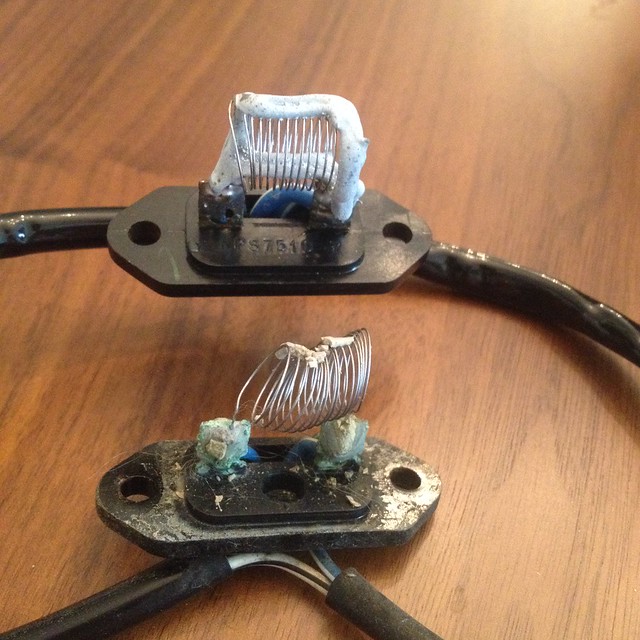
So while I have the interior floor ripped out of my FJ62 I took out the rear heater to clean it out/repaint and such. The rear motor didn't work on the low setting (works on high) and the resistor looks toast (bottom one in photo), so I purchased a new one (Everco 20169- top in photo). When I put it all back together to test it out the low speed still doesn't work. I can hear the relay make a loud click when it works on the high setting but nothing on the low. Any ideas on what the problem could be? I thought the new resistor would solve the speed problems (like it seems to for the front blower motors). Thanks for any help!
20233582075_2be4cf31d8_z.jpg
 
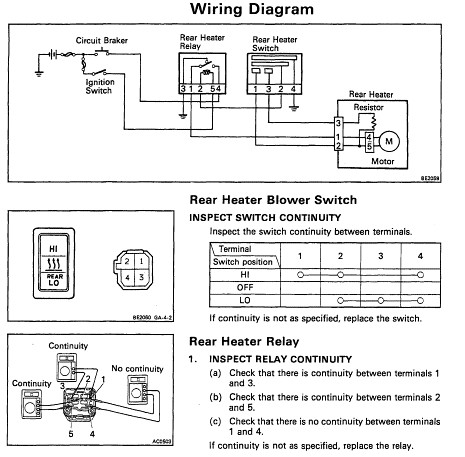
Ok.. So both resistors checked out. So did the switch. When I checked the relay I get a weird grrrring sound when I check terminals 2-5 instead of the constant beep for continuity. I also get a reading of 75 vs 0-1 for other terminals that show continuity.
20228904032_e7b42ab702.jpg


So I am guessing the relay is toast? I hope its still available!
 
So I think its part # 8863014010 which says it was used for FJ62-FZJ80s so it there is a good chance its still available. Thanks for the help!
 
Ok, so I got my hands on another relay, used, just to test it out and I am still not getting both speeds. I tested the relay with power and I can hear it clicking. I can also hear it click when I hit low or high on the switch. All conductivity checks out. I get a reading of 70-ohms (on both relays) when checking continuity between terminals 2-5 on the relay. All other continuity between the appropriate terminals is low (1). I get 12 volts to the motor in either the low or high setting on the switch. Everything passes the tests outlined in the manual, I am not sure what is wrong. Anyone have an idea of what to check next? Could the motor be at fault?
 
The motor is variable speed. The lower the current is applied, the slower it will/should spin.

To rule out the motor as the problem (perhaps at low setting it requires more juice now than it used too), attach a small 12V light bulb with jumpers to the plug that plugs into the motor. Then actuate the switch hi and lo. See what the bulb does. It should go bright on hi and dim on low. That will rule out the motor.
 
Couple pointers: The switch grounds the motor so it can run in both low and high, but in low grounds the motor thru the resistor for low speed. So you will measure 12V between fan motor terminal 1 and ground for both speeds. In either high or low position the switch also grounds one end of the relay coil so 12V goes to the fan terminal 1.

So if you get 12V in hi and low between fan motor terminal 1 and ground, and 0V when off, the relay is fine.

Not sure the value of the fan resistor (low ohms typically), but in low it will reduce the voltage across the fan (forms a voltage divider). So you want to measure the "actual" fan voltage applied to the fan by measuring the voltage between heater fan terminals 1 and 2, not pin 1 and ground. It should be 12V on high and something less on low. If not, check the resistor, switch, and all wiring.

HTH
 
Last edited:
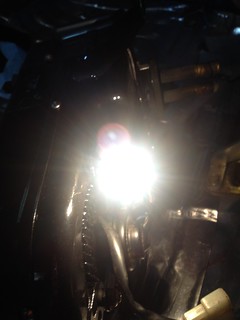
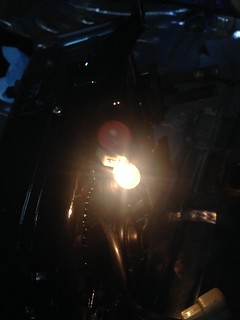
Ok, so I did the light bulb test:
High:
20532335418_f1ae13e918_n.jpg

Low:
20097736104_0189581aa1_n.jpg


I opened up the motor when I cleaned up the heater and it was clean inside, brushes were only a little worn. Commutator looked good, not gouged. Voltage measured between terminals 4 &5 in the diagram above at the motor are 12.04 volts for both high and low.
 
Was that voltage measurement taken with fan connected and running? If not, the high resistance of the voltmeter makes the resistor have no effect between high and low, and the test is worthless except to verify the relay is working, which we have already established.

No idea if the light bulb is the same load resistance as the motor, but I highly doubt it. So if the bulb goes bright and dim, that suggests the wiring is all good, but my swag is the resistor is too low a value to drop enough voltage to affect the actual fan much when set on low. In other words, the fan is higher resistance than the resistor, so most of the volts are still dropped by the fan.

Measure the resistor you bought, and post resistance. Make sure to disconnect it before measuring, using low ohms range on meter. Disconnect the fan and measure the resistance of the fan motor. Hook everything up and measure the voltage at the fan terminals (4,5) on high and low when it is running.

If someone has the same fan and it is working and could measure the stock Toyota part resistance, that would be good to know. Mine is a 60 and RH has been deleted.
 
Usually the resistor value in Ohms is very low (like 0.5 ~ 1 Ohm) and a cheap meter won't give an accurate measurement. Also they need to handle the fan current so they have to be very high wattage rating, which is why they are made of resistance wire and often mounted in the fan stream for cooling.
 
Ooooh, got it. I didn't fully understand the measure voltage while the motor is running. :doh: I'll do those tests later. Thanks for the help!

Edit: I can try and de-bunch the coil on my old Toyota resistor and see if the reading is different compared to the aftermarket. It still had continuity so the wire isn't broken.
 
Last edited:
Yeah, prob the resistance measurement requires something more accurate than a DVM, like a LCR meter. I have one, but I am an EE and have stuff the typical hobbyist does not have.

So, lets forget the Ohms measurement and just measure the fan voltage on high and low while running. That will tell us what we need to know, especially if someone with a stock FJ62 rear fan can measure the motor hi/lo voltages on a working unit. My suspicion is everything is working (as confirmed by OS's lamp test), just that the new resistor is too low resistance to drop much voltage with the old motor. You sure its the right part for a 62? These resistors will be different values for different fans/vehicles/brands/apps.
 
Last edited:
This is the DVM I have: http://www.amazon.com/gp/product/B000EVYGZA/?tag=ihco-20

My confidence in the part goes only as far as it looks almost identical to the old Toyota part and it is what the autozone parts website told me. As far as I know, the Toyota part is NLA. I am not sure how the aftermarket brands stack up against each other but based on pictures, they all look identical.
 
That meter is not going to be very accurate for low Ohms, but is adequate for most auto/home use, or "ballpark" comparisons, which is usually good enough. My Fluke cost over $400 new - but I'm a pro and need it.
 
Yeah, my cheap meter is already pushing me electrical skill set so your fancy one would be way out of my league. :) Turns out the rear resistor is still available from Toyota! The front one is the one that is NLA. If this aftermarket one is no good I might just go that route and get OEM.
 
Ok, So here are the results from my test (take them for what you will due to my cheapo meter :) ).
Motor voltage high= 10.69 volts
Motor voltage low= 2.5 volts

Motor resistance between 4-5 terminals= 22.8 Ohms
Resistor resistance between terminals 2 and 5= 7.5 Ohms
between terminals 3 and 5= 0.5 Ohms
I get the same resistor readings from the old Toyota resistor unit (no broken or touching coil wires, just no glue).
 
Back
Top Bottom