It is unsafe to make assumptions about airbag sensors.
My understanding is that early model 100s had mechanical sensors (consisting of moving and stationary contact points) while newer models had the electrical (deceleration sensor) type that you presumably are referring to.
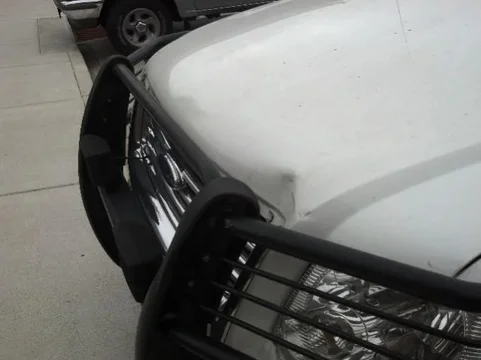
Yes, removing a crumple zone (taking off the bumper assembly and putting on a non-airbag compatible bar) will not stop your airbags working. It will however, eliminate the crumple zone that absorbs a lot of force in low speed crashes that decreases the rate of deceleration of itself. Hence reducing the rate of deceleration in a vehicle with a crumple zone -> avoids some airbag activations (well designed bars have crumple zones and usually spring steel absorption design that "bounces back"), but in a vehicle without a crumple zone no absoption -> higher decel -> lotsa $$$ in new airbag(s). It makes properly designed bars seem cheap (and they well have avoided all cost from the impact at all - except for the life of the kangaroo, deer or repairs to the Prius).
Here in Aus technically you are meant to replace factory bars with bars tested with airbags including low speed tests that do not trigger the airbags.
Cheers,
Andrew.
Agree. You are not removing a moderate or high speed crumple zone by removing the tupperware and the styrofoam support underneath it. You are removing the low-speed plastic designed for deflection in parking lots, etc, to keep insurance replacement costs low compared to the old-school steel bumpers that used to come on cars and trucks. However, I have NEVER heard of a "premature" airbag deployment that may have been contributed to by a non "airbag compliant" steel bumper. It's possible, but I've never read about one instance of this on a UZJ100. By having "crumple zones" in a steel bumper, all you're doing is making the bumper somewhat sacrificial to the frame and sheet metal. I have personally had an automobile accident, LOW SPEED, with an ARB Sahara on a 1999 4Runner. The sahara was toast. The ranger I hit pushed the bed into the cab by about 1-2 inches and the back window was shattered. This was from a 15-MPH impact at most. Air bags did not deploy. However the $1500 bumper was toast. The impact was with the sheet metal bed of the Ford Ranger, and was mostly spread across the face of the Sahara. I would say that the Sahara's performance in that instance was unacceptable, mostly due to deflection outward of the frame rails, which was due to the fact that it does not have a substantial hoop system.
By replacing the plastic facia with a steel bumper, what you do is then provide a piece of hardware that simply spreads the load across BOTH frame rails. With the OEM design, if you get an offset hit, it will crush one frame rail and not spread the load to the other rail. With an offroad steel bumper, now you have something that will spread that load, and essentially it will increase the effective strength of the crumple zone for an offset hit, but it will be exactly the same for a head-on hit. You do not impact the overall safety by adding a bumper. You most-likely improve it because the loads can be more distributed in an offset impact, reducing the likelyhood of passenger compartment intrusion by the front wheel on the side that's hit.
http://rightcar.govt.nz/ancap-test-result.html?q=151
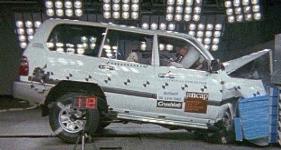
2004 Land Cruiser
... Frontal offset crash test
Body region scores out of 4 points each: Head/neck 4pts, chest 2.9pts, upper legs 2pts, lower legs zero pts. The passenger compartment held its shape well, except for the footwell . The road wheel moved rearwards substantially and intruded into the driver's footwell, which ruptured. ...
The UZJ100 does very well in crash tests EXCEPT for the front wheels encroaching into the passenger compartment.
Using a steel bumper to help spread any impact loads directly into the frame rail will help to prevent loading to the front wheel assemblies. Doing so will help to prevent rearward intrusion into the passenger compartment, which will dramatically improve the passenger sustainability, in my opinion.
Sometimes crumple zones work (full frontal impact) and sometimes they can contribute to your injuries (offset impact).
Check out this offset impact on a RAV-4:
http://www.youtube.com/watch?feature=player_embedded&v=jRo-ZO8eXo8
Here's the results of an offset impact in a UZJ at high speed: