KISS Dual Battery Upgrade

This site may earn a commission from merchant affiliate
links, including eBay, Amazon, Skimlinks, and others.

This or the single group 31 are the directions I'm considering @TexAZ, did you do a write up on your dual 27 setup? Thanks.


i haven't done a write up on the battery install. i'm working on a build thread and getting to the point where I did the battery and on board air system.

i have to admit, squeezing a group 27 in the passenger side was a challenge.
I bought a battery relocation kit from Summit Racing that came with a universal base plate and heavy duty cables.
i had to trim one side of the tray, and fold the bottom down to clear the power steering reservoir hoses.
i modified the stock power steering reservoir bracket and moved it as far forward as possible.
the airbox had to be trimmed, and the resistor for the Daytime running lights had to be relocated.
i'll get some pictures today.
it was a pain, but cost effective, and has worked out really well.
 
Not KISS nor cheap but awesome, Redarc Manager 30: The Manager30

Geebers. That's a piece of work. Thing should be known as THE Director30.

Speaking of DC-DC chargers. It's really a critical piece if anyone chooses to install more than a single battery/bank. Or if anyone wants to support a battery of a different chemistry.

Vehicles now, including ours use "smart" alternators. They don't produce excess power if they detect a battery/bank is full. So if one tries to maintain 2 different batts at different states of charge (SOC), one is surely never to get fully charged.
 
Last edited:
Hwres a couple pictures of the modifications required to fit a group 27 in the passenger side location.

Relocate the power steering fluid reservoir. The stock bracket can be cut and bent to fit in the front corner
20190508_181737.webp


I used a generic battery tray...it had to be trimmed on one end and the edge bent down to keep it from rubbing on the steering fluid hoses.
20190508_181804.webp

The rusty looking area is where I bent it....looks like time for a clean and touch up

The resistor for the daytime running lights got tucked up vertically between the battery and the fender
20190508_181834.webp


Finally, the airbox had to be notched out to squeeze the battery in.
20190508_181841.webp


Makes for a crowded engine bay,
20190508_181751.webp
 
Sharing some anecdotes from the camp site. I have very modest power needs. Basically just an ARB 50L fridge.

My single g27 X2 power would keep the fridge mostly happy but I would wake up to the voltage cutoff in the morning and have to start my 570 to bulk charge and get the fridge going.

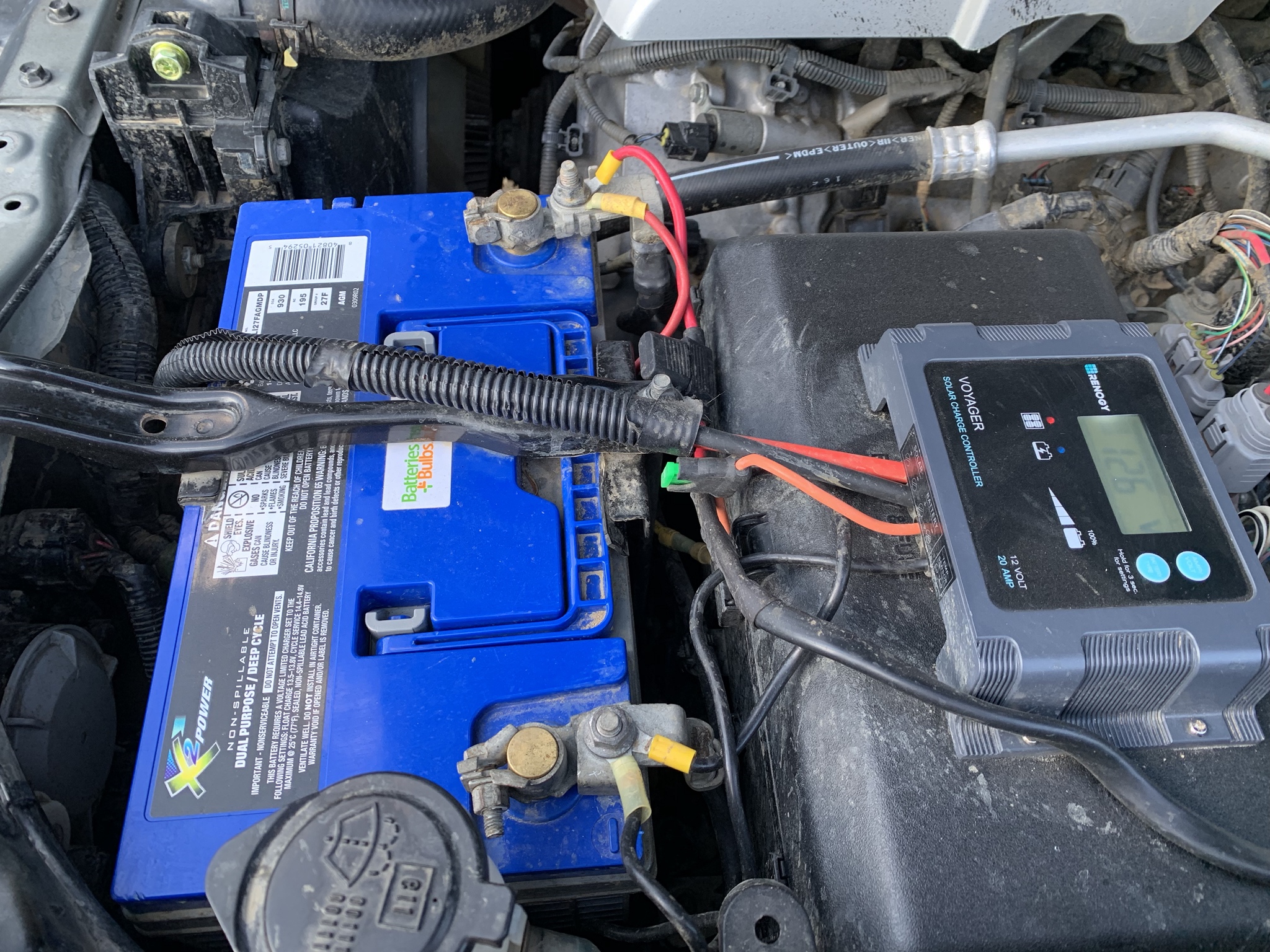
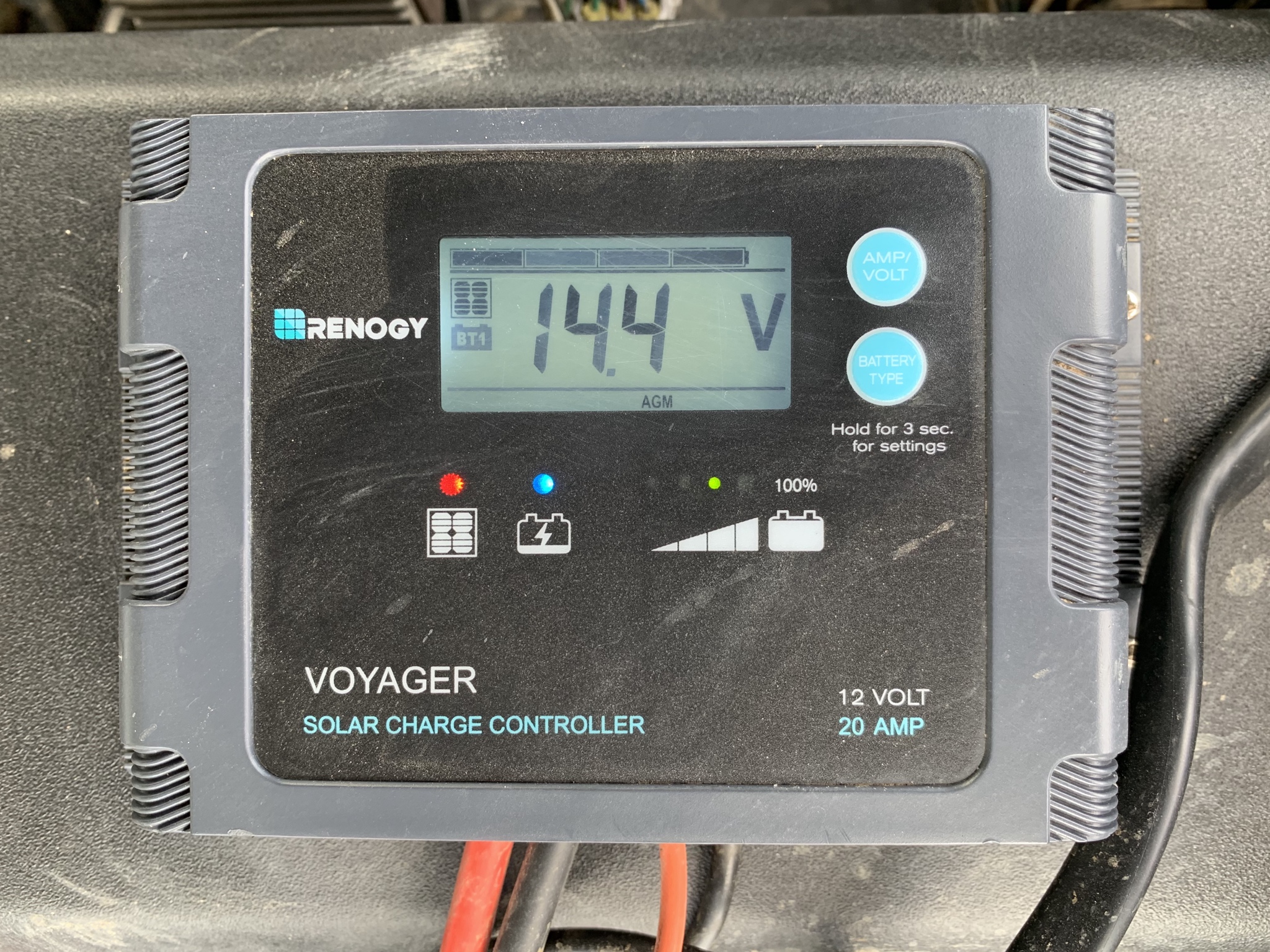
Last fall I added a Renogy Voyager and a folding 100w Renogy panel. This week I got to finally test it.

vmXL0D9.jpg


Truck was parked from 2pm — 8am. The voyage quickly topped the battery up to 14.4v:

lUnAD1z.jpg


WtPPN1Q.jpg


According to the readout on the voyager the panel put about 14aH back into the battery until the sun finally set.

This morning i woke up to a battery at 12.68v as indicated by my BlueSea voltmeter.

For fair-weather / weekend warrior / summer camping this meets my needs. I also keep a Noco lithium jump pack on hand in the event that the fridge fails to cutoff and kills my ability to start.
 
long story, but I have multiple (free) Optima red and yellow tops left over from work. I just mounted one of the yellow tops in a Slee secondary tray, and I've been reading all the things regarding dual battery setups.
My primary is still the factory lexus battery, and i can easily swap that out for another yellow top and go with KISS; however, the initial post stated that AGM is "not the right solution".

The Yellows are same manufacture date. Should I go for it?
 
Sharing some anecdotes from the camp site. I have very modest power needs. Basically just an ARB 50L fridge.

My single g27 X2 power would keep the fridge mostly happy but I would wake up to the voltage cutoff in the morning and have to start my 570 to bulk charge and get the fridge going.

Last fall I added a Renogy Voyager and a folding 100w Renogy panel. This week I got to finally test it.

vmXL0D9.jpg


Truck was parked from 2pm — 8am. The voyage quickly topped the battery up to 14.4v:

lUnAD1z.jpg


WtPPN1Q.jpg


According to the readout on the voyager the panel put about 14aH back into the battery until the sun finally set.

This morning i woke up to a battery at 12.68v as indicated by my BlueSea voltmeter.

For fair-weather / weekend warrior / summer camping this meets my needs. I also keep a Noco lithium jump pack on hand in the event that the fridge fails to cutoff and kills my ability to start.

FYI, under the hood is a poor spot for the solar controller. You want it far away from the hot air under the hood - ideally mounted somewhere inside the cab. Some controllers should also be mounted vertically. Best to check the manual for your specific controller.
 
I have a yellow top 27f as the main battery in a single setup. I've done the alternator diode mod, and also bought an external battery maintainer for every other month use. the regular alternator with the diode modified voltage doesn't get it up to full charge.

A redtop and yellowtop sounds like a pretty good option. But mixed chemistry so probably wouldn't put them on the same circuit permanently. Two yellow tops is a good option too, but you'll probably need a separate charging solution to keep them at full charge.
 
FYI, under the hood is a poor spot for the solar controller. You want it far away from the hot air under the hood - ideally mounted somewhere inside the cab. Some controllers should also be mounted vertically. Best to check the manual for your specific controller.
Hey thanks! Today I learned!
 
upload_2018-12-13_11-2-37-png.1853542


Has anyone found a post adapter to connect to the factory negative cable in order to extend it across to battery #2?

meaning, the 200's positive cable will connect to factory battery #1, but then you need to extend the factory negative all the way over to #2.

Also, this means that there will be 3 cables running across the firewall from the driver's side to passenger side?
1) Positive parallel
2) negative parallel
3) extend factory negative cable to Battery #2
 
FYI, under the hood is a poor spot for the solar controller. You want it far away from the hot air under the hood - ideally mounted somewhere inside the cab. Some controllers should also be mounted vertically. Best to check the manual for your specific controller.
Is it also true that you want to minimize the distance from the battery so the cargo area would not be ideal? That would be my preferred location.
 
upload_2018-12-13_11-2-37-png.1853542


Has anyone found a post adapter to connect to the factory negative cable in order to extend it across to battery #2?

meaning, the 200's positive cable will connect to factory battery #1, but then you need to extend the factory negative all the way over to #2.

Also, this means that there will be 3 cables running across the firewall from the driver's side to passenger side?
1) Positive parallel
2) negative parallel
3) extend factory negative cable to Battery #2

You want Mil-Spec terminals. Very flexible, very stout. Nice covers too. I see no need to move the ground from #1 to #2 (assuming you mean #1 is the upper and #2 is the lower). I ran 1/0 wire between the batteries, across the firewall. I highly suggest you avoid the temptation to run the wire the shortest route in front of the radiator, as if you have any sort of a collision in the front, you could have a direct short to the positive wire which would start a fire that would be very difficult to put out.

Is it also true that you want to minimize the distance from the battery so the cargo area would not be ideal? That would be my preferred location.

I have a NOCO dual charger behind my grille. It was a giant PITA to make the bracket, and I also fabricated a "splash shield" out of a scrap of plexiglass. No heat in that section, but it is out of the way so it doesn't block any cooling air to the radiator.

IMG_20190712_155611.webp
 
Sharing some anecdotes from the camp site. I have very modest power needs. Basically just an ARB 50L fridge.

My single g27 X2 power would keep the fridge mostly happy but I would wake up to the voltage cutoff in the morning and have to start my 570 to bulk charge and get the fridge going.

Last fall I added a Renogy Voyager and a folding 100w Renogy panel. This week I got to finally test it.

vmXL0D9.jpg


Truck was parked from 2pm — 8am. The voyage quickly topped the battery up to 14.4v:

lUnAD1z.jpg


WtPPN1Q.jpg


According to the readout on the voyager the panel put about 14aH back into the battery until the sun finally set.

This morning i woke up to a battery at 12.68v as indicated by my BlueSea voltmeter.

For fair-weather / weekend warrior / summer camping this meets my needs. I also keep a Noco lithium jump pack on hand in the event that the fridge fails to cutoff and kills my ability to start.
Yeah that idea that powering a fridge maintained on a battery only I don't agree with. Can it? Sure. But every time you're hitting that voltage cutoff you're cycling your battery down past where it should be cycled and it will die a quick death. I like your solar aided setup, for me mobile solar panels is the only way to go (or if you want to mount a solar panel on the truck, do both). Why? Cause who wants to park in the sun if you have the option to park in the shade.

I was getting about 2 days before my fridge would cutoff, and again it's just so bad for the battery. Then I added a second fridge. No bueno.

BTW.. these battleborn batteries are worth a shot. 3k - 5k cycles and 100aH of usable energy, plus only 30 some odd lbs. They seem expensive on paper, but given the number of cycles and the fact you get twice the power from an equivalent size lead acid, these "drop in lead acid replacements" should be a good solution. They have built in BMS and charge off the alternator just fine. Add solar and you'll never run out of power. Amazon product ASIN B06XX197GJ The downside is they don't like heat so an underhood placement isn't the best, but if you think about it when you're not moving it's really not that hot under there, especially if you crack the hood. And I know this has been mentioned in the past but that dude Will Prowse is a great resource, he does a ton of scientific tests, there are some GREAT solutions out there and more coming, and if you're DIY you can create awesome setups. Spoiler alert, the Yeti goal zeros test terribly. Charge slowly, don't cycle as many times, and the cost/power ration is the highest out there.
 
Last edited:
You want Mil-Spec terminals. Very flexible, very stout. Nice covers too. I see no need to move the ground from #1 to #2 (assuming you mean #1 is the upper and #2 is the lower). I ran 1/0 wire between the batteries, across the firewall. I highly suggest you avoid the temptation to run the wire the shortest route in front of the radiator, as if you have any sort of a collision in the front, you could have a direct short to the positive wire which would start a fire that would be very difficult to put out.

Yes, mil-spec to connect the second battery to the original in parallel; however, I'm getting hung up on the ground.

In order to achieve the "cross fashion connection", you have to move the ground to battery #2. That requires extending the factory ground cable all the way to the second battery.
 
Well, I see no reason to fret over where the ground connection is made. Battery #1 or #2, what difference does it make? And why not both?

(seriously, asking)
 
Is it also true that you want to minimize the distance from the battery so the cargo area would not be ideal? That would be my preferred location.

I have never read anything to suggest that. The solar controller itself doesn't care how far away your batteries are; the only thing I can see coming into play is voltage drop over long runs of wire, but even that will be very minimal over the length of an SUV. If in doubt, use oversized wiring. Unless someone can advise to the contrary, I wouldn't hesitate to mount a solar controller in the cargo area.
 
You have to pull voltage across the “bank” in a “cross fashion” otherwise battery #2 won’t be utilized correctly.
 
You have to pull voltage across the “bank” in a “cross fashion” otherwise battery #2 won’t be utilized correctly.
Ah! I forgot this was the KISS thread and the batteries are run in parallel, my dual-ground comment above may not apply. Man this setup sure sounds complicated haha...
 
Back
Top Bottom