is my carb undersized for 2F?

This site may earn a commission from merchant affiliate
links, including eBay, Amazon, Skimlinks, and others.

I'd start with fixing the regulator issue and checking the float height . If the float is too low it will cause a delay in main circuit timing - hence your cough, stumbling .
The 38 would be a better overall size and if jetted properly will run about the same mileage as the progressive 32/36 . That said , the stock carb or Trollhole's carb is still the best choices out there . My biggest complaint using a Weber on a Cruiser is a lack of a proper throttle attachment . If you plan to switch back to stock or THC keep in mind stuff like fuel lines/throttle pedal/linkage as those parts may be missing if had a Weber installed by a previous owner .
Sarge
 
I have decided on going back to Aisan. I am in the Army and my new job will pretty much take up most of my time so I will just start getting all the parts together and once I have it all, make the change. It might take me a year but I think it will be better in the end. I want the carb done right the first time so once I can get a suitable donor, I am going to send it to Jim and have it rebuilt.

You might want to see what Marshall (Trollhole) can do for you. He sells reproduction stock carbs that work very well (I have one) and he also probably has everything you need to convert back to stock (he sells used parts too). Check out Tollhole's Cruisers in the vendor section; https://forum.ih8mud.com/trollholes-cruisers/
 
Ok, decided to do another compression test with the plugs out & full battery charge. Here are the results; first reading is dry cylinder, 2nd is with a squirt of oil thru the plug hole:

Dry cyl. Oil cyl.
# 1. 112 lbs. 120 lbs
# 2. 110. 118
# 3. 102. 115
# 4. 120. 128
# 5. 110. 120
# 6. 110. 125
Don't know what the compression should be but I'm guessing 150# for rings and engine in good condition. Also, by the results I'm guessing my valves are prob ok. Maybe it's time for a major?
Could this be much of a cause for my carb issues?
 
That's what I figured too :(
In chasing this weber issue, I suppose my next step will be to either 1) buy another assortment of jets from redline (hmmm.. should I go up or down in sizes? ..maybe down?) and proceed to rejet again n again n again, or 2) take it to a local shop that "swears" they can fix it but won't give any guarantee...

I am kinda wondering if she doesn't have a burned valve though? ...at idle with shop tach and vacuum gauge connected, there is this small "miss" that I can see on both instruments - a bobble in rpm and a fluctuation/decrease in vacuum. I can't track it to plugs, or wires, or any ign components, or anything else, except that I can see that the "miss" could definitely be part of the carb issue... Correct?
 
Additional info as for the "miss": after the tank was completely empty, I just filled it with fresh mid grade fuel - gave her a taste of the good stuff as when she was born, gas was a whole lot higher octane and the regular then was higher than the premium is now.
 
That miss at idle could be just a valve adjustment , if you have one that's too tight it will do that . For the carb , we need to know throttle/pedal position when you run into problems . If it's consistently at basically the same point in throttle opening then I'll know what is causing the issue . The compression numbers are pretty low but not fatal . Did you do the test with the throttle wide open ? It has to breathe....

One thing : is that carb a Cruiser-specific kit ? I'm curious as to what emulsion tubes are in it currently . For the float and other settings I can easily walk you through all of them , even over the phone if necessary .
Sarge
 
Another piece of homework -
Get a can of brake cleaner (non-chlorinated) and use the straw to lightly spray around the base of the carb and it's adapter plates . If you have a vacuum leak this could be a major source of your issues . You can also use propane to avoid the risk of damaging painted surfaces or igniting the brake fluid on the hot exhaust . Just be cautious and use a low amount of flow you can lightly smell on a windless day . Don't force propane gas into any areas that it can be pocketed and ignite explosively - I've seen guys lose eyebrows or worse trying to track down leaks . Either way, if you do find a leak the rpm's at idle will increase as you are introducing fuel into the leak . Don't be surprised if you find a slight leak at the throttle shafts - this is common with Spanish castings and not really a concern unless you're building a race engine .

Let us know what you find - we'll go from there .
Sarge
 
Thanks sarge,
As for the engine miss, I've adjusted my valves several times and none are tight. I've thought that maybe one might be burned though cuz when I first got my habit, one of the first things I did was check the valve clearances and several were a little tight from the PO and I know if an engine is run very long with tight lifters, a burned valve will result.
It'll be this Sunday or Monday before I'm back home and I can do the vacuum leak test with a combustible substance like propane, etc. My 40 came with a weber kit for cruisers from the PO, which included the adapter plate, etc. I have read on a post somewhere here in mud before that the allen head bolts included in those kits are typically too long and will bottom out in the manifold before actually crushing the plate gasket(s). That's something I haven't checked but the propane leak test should reveal such a problem.
Thanks so much for your, and everyone else's help!!
Regards,
Cal
 
61n72cruisers said:
Thanks sarge,
As for the engine miss, I've adjusted my valves several times and none are tight. I've thought that maybe one might be burned though cuz when I first got my habit, one of the first things I did was check the valve clearances and several were a little tight from the PO and I know if an engine is run very long with tight lifters, a burned valve will result.
It'll be this Sunday or Monday before I'm back home and I can do the vacuum leak test with a combustible substance like propane, etc. My 40 came with a weber kit for cruisers from the PO, which included the adapter plate, etc. I have read on a post somewhere here in mud before that the allen head bolts included in those kits are typically too long and will bottom out in the manifold before actually crushing the plate gasket(s). That's something I haven't checked but the propane leak test should reveal such a problem.
Thanks so much for your, and everyone else's help!!
Regards,
Cal

I have not retread the thread to see if you know you have a leak, but I would start with a vacuum gage hooked to manifold vacuum. If you have steady vac above 16-17 Hg at idle then you most likely do not have a leak. If you suspect a leak them proceed to look for it as suggested, also check the intake manifold all along it's mating face with the head (top visible line & underneath). These can be a pain to find, but you will get an idle up when you spray in the vicinity of a leak. Good luck, I've had one and it was a PITA to fix properly.
 
Hi mustard,

Thanks, I should have said earlier that I've checked the vacuum several times and at steady idle, as steady as she will, it's from 11 to 13", a little erratic. But the fluctuation in inches mercury is possibly due to the fact that she won't idle very smoothly. The vacuum's a bit low and another reason why I suspect a possible burned valve, as well as worn rings. It won't be until Sunday or Monday when I can check for a leak with an accelerant but I'm on a quest now, and thanks to you, sarge, pinhead, and so many others, I WILL GET THIS RESOLVED!
Cal
 
Sarge gives good advice.
BUT, don't use brakleen for finding leaks. Right beside the brakleen on the parts store shelf is some kind of gumout carb and throttle body cleaner. It is meant to be sprayed into a running engine and burned. It is roughly the same octane and burns to the roughly the same endgas as gasoline.
 
Carbon tet or MEK or anything really good comes in the big dip bucket. Spray carb cleaner for use on a running engine does not contain the really effective solvents that can form phosgene or sulfuric acid or anything else particularly fatal to you or the engine (any more so than gasoline).
 
Still rough idle and backfiring through the carb, so here's what I've done on my cantankerous cruiser today:
1) rechecked compression with throttle and choke plates open - no change: 112, 110, 108, 123, 116, & 113
2) timing ok, still on the mark
3) check valve clearances, still ok
4) bought some CR "Clean-R-Car" carb cleaner, sprayed all around carb, car base, & intake manifold while idling with tach / engine analyzer connected: slight change (decrease) in rpm when sprayed at middle of manifold (appx #3 & 4 cylinders); tightened manifold nuts, same result, I think rpm change due to leak at throttle shaft bushing.
Was hoping I'd find a vacuum leak, or SOMETHING! ANYTHING!!
:-(
 
For the carb , we need to know throttle/pedal position when you run into problems . If it's consistently at basically the same point in throttle opening then I'll know what is causing the issue . The compression numbers are pretty low but not fatal . Did you do the test with the throttle wide open ? It has to breathe....

One thing : is that carb a Cruiser-specific kit ?

Hi Sarge,
The engine hesitates and/or backfires through the carb at all pedal / throttle positions / rpm when I stomp on the accelerator. The weber is supposed to be for the FJ40 engine, it did come with the adapter plate, etc
I'm pulling the carb too again now and will let you know emulsion tube sizes...
 
Here's a list of my current jet sizes, etc, Idle Mixture Screw is set at 2-3/16 turns, the Emulsion tubes are both #F50:

Air Corrector Jets: Prim: 200 Sec: 190
Main Jets: Prim: 160 Sec: 155
Idle Jets: Prim: 60 Sec: 50
Emulsion Tubes: Prim & Sec #F50
 
One thing further.. Been trying to check the float adjustment. Weber says it should be 18mm from gasket surface to the "tip of the float"...rather vague I say... What part of the float is the "tip" and, like on a Holly, is the float adjusted by bending the tab?
Determined me, "Old Dirt" WILL run, or else!
 
Ok , now we can get somewhere .
First off , that jetting is fairly rich with F55 tubes . I'd be curious as to the color of the plugs , they should be very sooty black .
The primary main jet at 160 with a 200 air corrector is enough fuel mix to feed 5+litres of engine .
Idle jet sizes are within range , need to find that damned book of mine that has the baseline jetting tables for all the Weber kits including the Cruiser . Trying to work with a guy that has a Lada as well and his Fiat engine isn't responding correctly ..... arrgh .

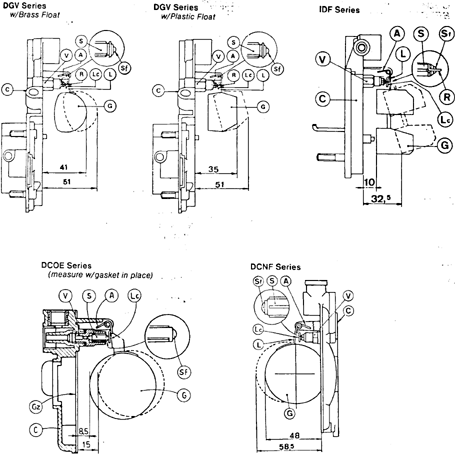
Weber floats are a bit tricky since they use a damper spring that is very light inside the float valve . Measurements are taken without compressing the spring - this is very important .


dgvfloat.gif

Make sure to set the float with the air horn (carb's top section) oriented just like the drawing above , slightly below parallel is where I set them for offroad use .

You mentioned re-checking timing and compression , that's good but what about timing advance when opening the throttle ?
Try disconnecting the advance vacuum line and see if there is any change - your distributor could have an issue that is advancing way too far - worn pins/bushings/stops . I seem to remember some of the Cruiser stock disty's have an adjustable advance and someone may have altered it . Just by the jetting alone someone has had a hard time with this thing in the past - we need to figure out why .

If that float is too low , and I'd suspect that it is this would cause a serious delay in the main circuit and even starve the progression through the idle jets - hence the popping/backfiring.

I'll pm my phone number , we'll go over a few things if you want .

Sarge
dgvfloat.gif
 
Back
Top Bottom