

I designed some sliders for my 60

This site may earn a commission from merchant affiliate
links, including eBay, Amazon, Skimlinks, and others.

Joined
Sep 7, 2006
Threads
74
Messages
1,104
Location
Denver, CO
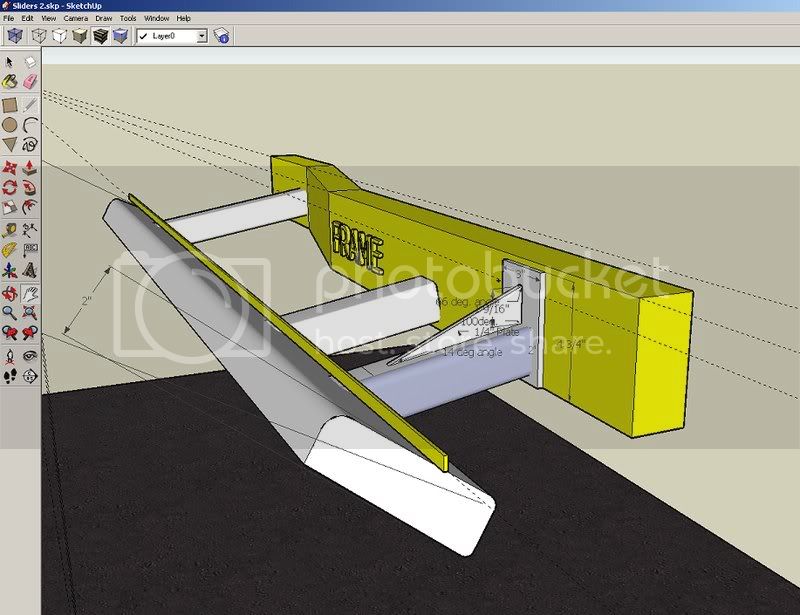
I designed these on Google's sketch-up, after i saw a thread in the Expedition section started by Bogo.

The bar is a 2x4 by 3/8" Steel tube, the Kickers are 2x2 by 3/8",
gussets and mounting plates are 1/4"

I have the kickers angled down about 10 degrees to get under the rocker panel which is represented by the yellow line. Keep in mind that my 60 has a 1" body lift.

Having never used the program before this took me about 5-7 hours to create the model.
SliderswFrame.jpg
 
Last edited:
I wouldn't use 3/8. It's overkill for the application and the cost will be significantly increases. Figure most tube sliders are .120 wall or just shy of 1/8".

Also, depending on where you wheel, you might want to move the outriggers out a bit more from the body. In this area, the sliders not only protect from rocks below but also help to keep the body away from trees and rocks from the side.
 
I wouldn't use 3/8. It's overkill for the application and the cost will be significantly increases. Figure most tube sliders are .120 wall or just shy of 1/8".

THe man speaks truth..

3/8 is wayyyyyyy too thick
 
I agree that beveled ends would help, especially if you're not SOA.

Great model with body contraints in yellow. You have a good touch with CAD.
 
5280Hawk you posted yours up before mine! I'm gonna finish up that bumper rendering tonight hopefully and I'll send it to you.

Sliders look awesome by the way. Where did you get the measurements for the frame from? That was my biggest obstacle in designing the bumper. It would be AWESOME if we could get together and design a frame in this program, with proper measurements, etc.
 
Last edited:
Thanks for the Input!

It just seemed that 1/8 was pretty thin, but Im all about cost savings.

The outrigger angles away from the body at about 35 degrees, and should give about 2 1/2 inches of clearance, enough to get my toe on there to reach the roof rack.

I have the ends of the outrigger angled back on the 4" dimension, i could pretty easly add an angle perpendicular to that to allow them to slide up over things.
 
Thanks!

The Frame is Just the thickness and Height dimensions and Height off the ground I measured with a tape out on my driveway.

The section that bends toward the center of the vehicle is really only accurate where the Slider attaches.

But it would not be to hard to generate an entire FJ60 Frame on Sketch-up.
 
Rarely do sliders take direct bottoming out hits. You mostly "slide" over rocks. Consider this when thinking about wall thickness. Other way to think is making sure it's .125" DOM and not cheap .125" tubing. Get the quality thin stuff and it will be good.
 
I told you you have good taste!

How do they work for ya?

Looks like he had the 45 cuts on the ends going the other way???
 
He welded them on backwards.
 
I was joking... Or at least I hope he purposely designed them that way. :)
 
Rarely do sliders take direct bottoming out hits. You mostly "slide" over rocks. Consider this when thinking about wall thickness.

I don't want to sidetrack 5280's thread but have to disagree with you on this Randy. I've taken lots of direct bottom hit with mine wheeling in Colorado and Utah. As a matter of fact I'm sure none of my doors would open due to those hits if I didn't have my Solid Rock sliders. Make them stout, overbuilt is better than underbuilt.
 
Along that line I was looking at the gusset and thinking that it's a 'can opener.' I would switch to a double mitered section of tube for the gusset. The flat top 'plate' from using a tube will be significantly stronger than the vertical gussets. What will happen, with enough load, is that the top edge of the gusset(s) will buckle and fold.

At the very least move the gusset to the edge of the tube and add a second one on the other side. The single gusset in the middle of the tube pushes on the tube wall similar to standing in the middle of a simple foot bridge and jumping up and down. Moving the gussets to the edges is like standing at either end of that bridge and jumping up and down.

On the doubler plates, it isn't a great idea to have a weld seam running vertical up the frame rail. It's done a lot and it works for while, but with enough time under load it will crack the frame along side the vertical bead. Diamond shaped, or "Fishmouthed" (notched) or even just a simple diagonal will let the frame rail live a lot longer. Alternately, don't weld the verticals. Double alternately, poke a large hole in the middle of the plate with a holesaw and weld there, but not the vertical sides of the plate. Then weld on the slider supports.

Some pics in case my wording sucks:
diamond doubler plate.webp
notched doubler plate.webp
diag doubler plate.webp
 
Last edited:
Back
Top Bottom