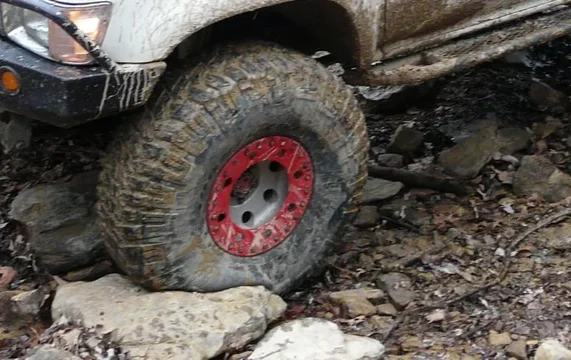
Beadlock info / debate

This site may earn a commission from merchant affiliate
links, including eBay, Amazon, Skimlinks, and others.

TeddyBoy

Knighted by the King of MUD himself
Joined
Mar 22, 2008
Threads
329
Messages
5,890
Location
Cumming, Ga.
Website
www.novatelco.com
Prior to now I ignorantly figured it was a cool looking bling factor type of mod with a few advantages but nothing dramatic. However, after running a pair of borrowed beadlocks I'm now convinced this is worth investment.

DIY steel beadlocks seem to be the cheapest path for those guys with steel wheels, which I don't have. Basically you purchase the BL rings from a vendor and weld them to your own wheels. Fairly simple process but certainly labor intensive.

Since I have Alum wheels this leaves me with few options--buy new wheels and DIY BLs for the $400-500 price (not bad) or buy new Aluminum wheels already forged with the BL rings, this is not cheap--roughly $300+ per wheel-ouch.

There is another option though...I shot an email to DIYbeadlocks.com for an inner Aluminum ring that welds to my alum wheels and then an outer steel ring that bolts on. Price came in around $350 which is slightly cheaper than the new steel on steel route.

Let the mental masturbation begin... :steer:
 
show me the data

OK, as unofficial chief scientific officer here, I want to know what study you have to demonstrate that said bead locks are worth the investment. I am unconvinced in my mind....:steer:
 
One important question. Will you still be driving the rig on the road or will you be trailering it now? I know my beadlocks as well as most of them are not DOT approved.
 
Does your cost include hardware? nuts bolts and washers will run about 30.00 a wheel. :doh:

early rough estimates only for 15x8s and DIY BL put it at about 450 plus hardware, obviously could easily run closer to $550+ though--still undeterred. I checked pricing for Soft 8s in the 15x10 variety and they're running about $15 more per wheel so that may push it over $600 for all. Just one more reason to go alum/steel route on my wheels.

OK, as unofficial chief scientific officer here, I want to know what study you have to demonstrate that said bead locks are worth the investment. I am unconvinced in my mind....:steer:

Experience is a good teacher. I think it's pretty simple though. BLs= lower air pressure=flatter tire=bigger contact patch=more traction=leaving your arse behind :flipoff2:

Here's an experimentA--Go push your runner down your neighborhood road with 4 flat tires and tell me how easy it is. :idea:

While my observations are not exactly scientific I do think the experience of others will support my opinions.

One important question. Will you still be driving the rig on the road or will you be trailering it now? I know my beadlocks as well as most of them are not DOT approved.

THIS is a potential downfall. I have read it going both ways depending on state, can't say for sure in Ga, Al, TN and NC but all have fairly liberal automotive laws. I could see this being a major issue out west. though.

B/C I have to ride the roads (for now at least) the other unknown is how they perform on the road at <65 mph. :hhmm:
 
Last edited:
I personally haven't looked into this but "Staun" makes an interior inflating beadlock thingamajig that I believe is D.O.T approved.
:beer:
 
The other drawback is the sheer weight you will be adding to each wheel. Not very noticeable at 3mph, but once you air up and hit the pavement, you will definitely notice it.
 
Nope, I was wrong. Looks like you can still order them from 4wheelparts. This maybe your best bet Ted.

Yeah--I saw that at about $200 per corner

The other drawback is the sheer weight you will be adding to each wheel. Not very noticeable at 3mph, but once you air up and hit the pavement, you will definitely notice it.

Agreed especially if steel on steel but the aluminum are very light, barely noticeable even. Yet another reason.
 
Does your cost include hardware? nuts bolts and washers will run about 30.00 a wheel. :doh:
This can also vary greatly depending on grade 5 or 8 AND if you've got 16, 24, 30, 35, 36... bolts per wheel.

B/C I have to ride the roads (for now at least) the other unknown is how they perform on the road at <65 mph. :hhmm:
This will depend less on the fact of simply having the rings, but more on the type tires and how well centered you can get them. The biggest downfall of DiY beadlocks in my opinion is having to "guess" where centered is. A forged beadlock, and maybe any "good" purchased beadlock, will have a centering ring in which the outer bead centers exactly where it would on the inner bead but obviously on the outer bead instead.

~I know my beadlocks as well as most of them are not DOT approved.
I'm sure this depends on the state but according to the Champion Beadlocks website, this is more urban legend than fact. Also, if you do any DiY kit, the rim itself will have a DOT stamp on it; so if you want to prove most cops wrong, point out that DOT approved stamp and they wouldn't be able to say much.

I personally haven't looked into this but "Staun" makes an interior inflating beadlock thingamajig that I believe is D.O.T approved.
:beer:
This is a very similar situation to running a tube for tire air leaks. The Stauns do have a nylon cover that makes them push out on the beads and somewhat protects them from abrasion, but they're still very susceptible to punctures, tears and valve stem detachment just like a normal tire tube is. Saw a guy blow a Staun once at Superlift and it is not a quick fix - complete tire removal from the rim obviously and then a new Staun :censor:. Great idea but a real PitA in my opinion.

The other drawback is the sheer weight you will be adding to each wheel. Not very noticeable at 3mph, but once you air up and hit the pavement, you will definitely notice it.
I think if you go the aluminum wheel and steel ring, you would barely tell. Besides, the real thing you'll notice is the lack of power from the bigger tires if you run them on the street. If you're like me, you'll end up with a set of street tires (35 MTR's maybe?) and keep the bigger tires and beadlocks for trail use only with their only street time being camp to trail and back.


Ted - Run the 37's on the highway to see what they do for ya (just not for 100 miles please). Your place to John's would be a great "base test" because you drive it so often. Keep in mind they're not balanced, but I bet they'll be fine at street pressure other than the possibility of minor balance issues. Or at the upcoming ride, we can air 'em up and go to the store or something for a short ride; that'll keep ya from having to swap them twice.

Hope I've been helpful to anyone who made it this far through the post. :deadhorse:
 
I knew I would cause some controversy, but I had to ask. I agree with the theory that lower air pressure results in more contact area (see expedition portal article on lower air pressure) in tire.... but I think there is a point of diminishing returns in what the ideal low pressure for a tire provides the most traction.
Other concerns are additional unsprung weight, balancing issues etc.
 
... but I think there is a point of diminishing returns in what the ideal low pressure for a tire provides the most traction.
Very true, there is always a point that's "too much". I found this out the hard way at GMP recently when I went too low and was trying to rock crawl using my beadlock bolt heads :rolleyes:
Again though, this depends on things like terrain, weather and especially type of tire. If it's a bias ply you can and need to air down further to get the carcass flex going; in a radial, flex is a given but [worse] instability comes with that. More than anything though, beadlocks give you that choice of running whatever you'd like to depending on the above factors. As the terrain, weather and tires change, you can correct for the associated ups and downs.
Other concerns are additional unsprung weight, balancing issues etc.
Balancing will only be a problem on a DiY job. High-end rims, like my Champions, are forged and are no more unbalanced than a normal rim (which is to say they shouldn't be unbalanced at all). However you do have a point in that there is not going to be an outer bead to put weights on to. Back when I used to work at a tire shop, many nice alloys didn't even have backside beads to attach weights and a few didn't even front beads. In both cases, stick on weights were used - I'd say the same could be utilized here if needs be.
Unsprung weight isn't all bad either. Many offroaders actually add weight to the tires. My project will utilize this idea and will actually have as much possible unsprung weight as I can get down there. I think the idea is fairly obvious, but the more weight you can push the tread into the terrain with, the more bite they'll have. As well, the unsprung weight can significantly lower the vehicle's center of gravity. As stated before, there will always be that point of diminishing returns though. When coming to a vertical obstacle, ANY extra weight, not just unsprung, will add to the amount of traction needed to lift the axle up and over. But the added weight in the rear tires give them more traction to push the front tires into the vertical obstacle which, in turn, gives it too more traction. So it's all a bit of a wash until you come to the factor of driveline strength... there's always going to be a weakest link.

I think one of the biggest things to take away from all of this is the fact that the more you want to gain capability off road, the more you're going to lose capability on road. Just a simple matter of checks and balances.

Oh yeah, and there's another benefit that I'm surprised hasn't been mentioned yet: when running below about 10psi, as you can only safely do on the trail with beadlocks, your ride quality improves exponentially! Ted, chime in here and tell everyone how that's your very close second reason for wanting them now. :D
 
Oh yeah, and there's another benefit that I'm surprised hasn't been mentioned yet: when running below about 10psi, as you can only safely do on the trail with beadlocks, your ride quality improves exponentially! Ted, chime in here and tell everyone how that's your very close second reason for wanting them now. :D

I was running 6-8lb on my 35s then swapped out to your BL wheels with 3-4lb and the ride difference was tremendous. The softball sized rocks frankly just don't exist anymore.

I also noticed a big difference on the "gravel" roads where i could shoot through the rougher sections at speed w/o even noticing the bumps.

I suspect that you would notice it more in an older truck than in a newer truck. For instance, John in his 81 mini-would probably feel a much softer ride than Andrew or Robert in their late 90's trucks. I know it's an apples and oranges comparison but the newer trucks have a much softer suspension than older rigs ever wished to have.
 
I think there is a point of diminishing returns in what the ideal low pressure for a tire provides the most traction.

I agree with Steve that it will depend on terrain. My eyewitness experience is that the lower the pressure the better for hard core rock crawling with big tires - as long as ground clearance is still adequate. Being able to "wrap" the contact patch around a rock works wonders for traction. This is a very specific type of wheeling and 2 psi would not be great for all types of trails...The Cove, FS roads, etc...all would necessitate different psi for optimum traction and drivability.

Side note on unsprung weight...I've heard of some trucks running water inside the tires to help with CoG and traction, especially in monster trucks.
 
Being able to "wrap" the contact patch around a rock works wonders for traction.

example:
BB09 056-cropped.webp


Side note on unsprung weight...I've heard of some trucks running water inside the tires to help with CoG and traction, especially in monster trucks.

I mainly hear of antifreeze being used, been done in tractors for years.
BB09 056-cropped.webp
 
Wow!

Lots of good perspectives here, I guess I would focus on trails like TC and my favorite modest mud holes to have some fun. A bit of rock crawling is OK, but I think I would leave it to some of the buggy trucks and HC trail trucks.

For me to leap to that level would be too much of an investment in my truck.
For now, I will need to determine the ideal tire pressure for my truck. I have been running about 16 psi, but wonder if I should go a bit lower.
We need a test vehicle and some patience.
 
For now, I will need to determine the ideal tire pressure for my truck. I have been running about 16 psi, but wonder if I should go a bit lower.
We need a test vehicle and some patience.

16lbs? :confused:

now officially taking donations for said "Test Vehicle." Just to be certain though, I will also need a new set of 37" tires to properly perform these tests, I would not want the results to be askew. I will be happy to report the results after 1 year! :flipoff2:
 
Back
Top Bottom