desertdude said:
Yes - and be sure and seal - with zip locks or even double seal all meats - spillables and especially seafood - you will thank yourself later for this

He is absolutely correct. In the event that this sage advice goes unheeded...
recently at a party in Baja, a buddy handed me a bag of raw halibut fillets that were left over from the cookout. It was a typical grocery store plastic bag. I assumed that the fillets inside were secured in a ziplock baggie. I was soooo wrong. Consequently, after a hundred or so miles of off-road through the mountains, it became painfully obvious that there was liquid fish funk all over the bottom of my beloved Norcold 60.

The solution:
1. Use a damp rag to sponge up/wipe out as much fish funk as possible.
2. Sprinkle baking soda all over the bottom of the fridge.
3. Use a dripping wet rag to wipe the baking soda around (gently) until it becomes a paste.
4. Use the wet rag to spread the paste all over the interior floor and walls of the fridge.
5. Let it sit overnight.
6. Use clean damp rags to wipe out all of the baking soda paste until the interior is completely clean and dry.
7. Use one box of Arm & Hammer "fridge" baking soda - open and let sit in the fridge for a couple of days. This box is made with mesh screens that allow the odors to be absorbed into the box, while preventing the powder from getting out. So you can drive around without the box spilling.
This worked very well for me and the interior of the fridge is like new again

Also, regarding adding a temp. gauge to monitor the fridge. As has been mentioned, I have found this to be
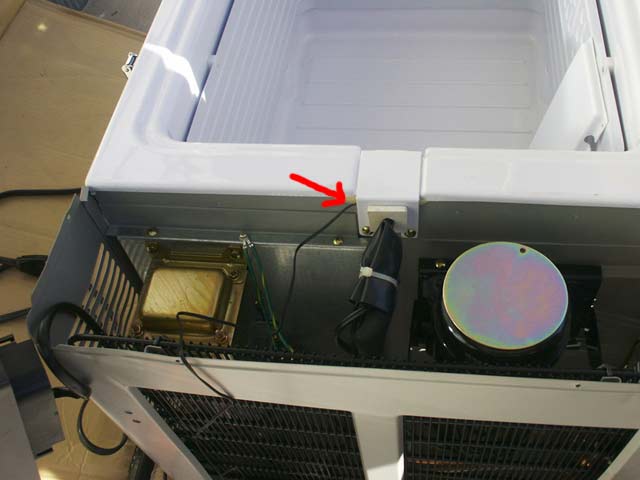
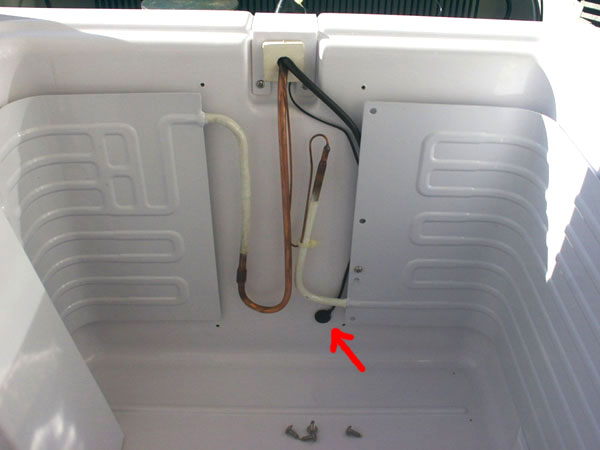
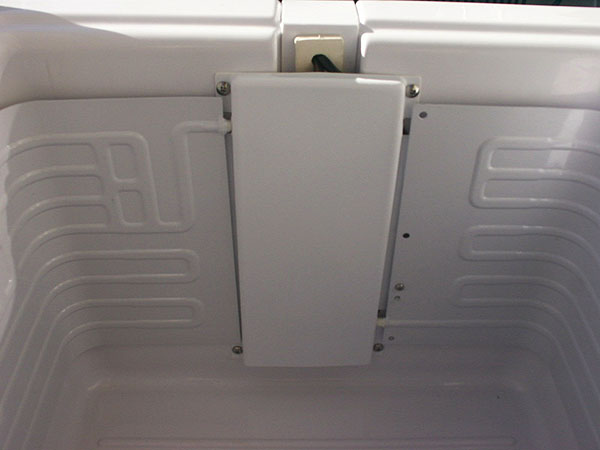
very helpful in monitoring the precious referigerated cargo. For my remote temp. sensor, I ran the wire lead into the fridge box by removing the plastic cover that sits over the box on the end where the motor and cooling line goes into the box. This is how it looks on my 60L.
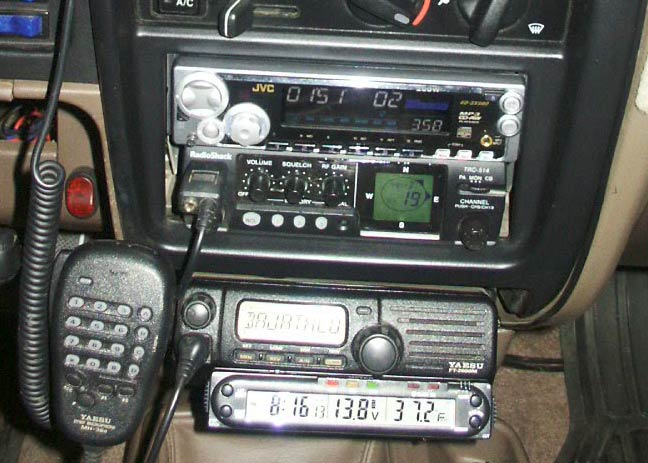
And here is the temp. guage...
It has been my experience that having the gauge somewhere that you can easily see it while driving makes a difference. It allows you to keep your goods just the way you want them. And as was mentioned in a previous post, it can avert disaster if you forget to turn the fridge on, or there is an elec. problem or something like that. In my case, the fridge temp. will vary depending on the ambient air temp. so it's nice to be able to see at glance if the setting you had it on in the morning needs to be tweaked a bit on a very hot afternoon. I generally run the temp at around 30F.
The full article on my setup can be found
HERE if anyone wants to see the freakshow... ;p a 60L fridge crammed inside of a Tacoma Xcab.