

Navigation
Install the app
How to install the app on iOS
Follow along with the video below to see how to install our site as a web app on your home screen.
Note: This feature may not be available in some browsers.
More options
Style variation
You are using an out of date browser. It may not display this or other websites correctly.
You should upgrade or use an alternative browser.
You should upgrade or use an alternative browser.
Advice request: How to wire aux equipment (winch/lights/GMRS) to GX460 battery
- Thread starter Roody
- Start date
This site may earn a commission from merchant affiliate
links, including eBay, Amazon, Skimlinks, and others.

- Thread starter
- #22
I did, out of budget unfortunatelyCheck out SDHQ. They have quality made terminals and lots of other things.
SDHQ Built Complete Billet Battery Terminal Kit
SDHQ'S Complete Billet Battery Terminal Upgrade kit is designed to replace and protect your vehicle's OEM battery terminals. These blocks distribute power for your accessoriessdhqoffroad.com

IMO a fire is pretty unlikely to occur on a GX with a stock wiring system. If your GX has hack-job wiring, a fire could start anywhere on the aux wiring. However a fire can also start if you are welding/cutting/griding on the vehicle while working on it (I was welding LCA braces on my rig recently and managed to catch Fluid Film inside the frame on fire). Aftermarket electrical accessories themselves (fridge, compressor, etc) would also seem to be at a risk of catching on fire.for those with experience, where do vehicle fires typically start? where do electrical fires usually start, and where do fluid leak fires usually start?
I have a fancy Element fire extinguisher mounted on the driver door, but do not believe I have trained enough reps should a fire occur.
After doing some digging on the Jeeps it seems the fires may be the result of oil dripping down on hot exhaust manifolds/cats. Can't say I've never seen or heard of that on a GX, and IMO it would need to be a lot of oil to catch fire. But it conceivably could happen if the vehicle was wrecked. Or, if you were wheeling in brush and managed to let's say rip off a transmission hard line, which is located next to the cat and could spill fluid on it (unlikely as the lines are robust and tucked up high, but I suppose it is possible).
I personally carry a fire extinguisher in case a fire starts on a defect I missed when building my add-on wiring. I also cook using a rear door table, which is certainly at a risk for starting a fire (open flame on a white gas stove).
Moral of my rambling post is to 1) not mess with the wiring unless you know what you are doing, 2) carry a fire extinguisher no matter what, and 3) be super vigilant when performing hot work on the rig.
- Thread starter
- #24
I've been carrying a fire extinguisher in every full-size 4x4 I have owned, and in the back box of most of the ATVs I have owned as well


Regarding the Element Fire extinguisher, just yesterday & today I was in the market to purchase one…to go along with my…what most would call a regular fire extinguisher.
After doing some YouTube research, I’m going to stay away from the Element brand. Better than nothing, yes, but the reviews etc were not in their favor. Just suggesting to do some research before purchase.
Sorry no links but easy enough to find.
After doing some YouTube research, I’m going to stay away from the Element brand. Better than nothing, yes, but the reviews etc were not in their favor. Just suggesting to do some research before purchase.
Sorry no links but easy enough to find.
Here is the one I have. The marine version fits better on my DS seat mount than the auto version, so that's what I got.
This is the mount I have. I did have to drill a couple more holes in it to mount the marine extinguisher.
About $80 all-in for both.
This is the mount I have. I did have to drill a couple more holes in it to mount the marine extinguisher.

About $80 all-in for both.
- Thread starter
- #27
"Purchased another variation 2 times" hahaHere is the one I have. The marine version fits better on my DS seat mount than the auto version, so that's what I got.
This is the mount I have. I did have to drill a couple more holes in it to mount the marine extinguisher.
About $80 all-in for both.

Not for everyone but...
Since you seem to be budget oriented I guess I will recommend what I once did in the bigger GX BS thread as far as wiring goes... which seems to be greatly poo-poo'd by everyone else but which has worked for me for approximately forever across various vehicles.
Just get a longer bolt for the battery terminals and continue to run your three items (not the winch) off battery with wiring as you have it. Terminal connectors on the end of each wire and just stacked on top of each other on the battery terminal, secured with a nut. I don't ever really understand why people want to build or buy power management modules if they are only running a couple accessories. 3 wires with inline fuses are perfectly manageable and can be neatly zipped to each other for a trim setup.
For the winch, connect / disconnect it as needed with a wing nut to the positive terminal (leave the negative "permanently" connected to battery).
You aren't describing any problems with your existing setup other than difficulty in diagnosing potential issues (which I don't really see how introducing more components via a power management system would help you diagnose something) so I would invoke the adage of "if it ain't broke..."

Having said that, a budget ($80) power distribution system that gets a lot of love in the motorcycle community is the Healtech Thunderbox. You could run all the low amperage stuff off of it and then run the winch separately. The Healtech as it is built supplies power only after startup but you can over-ride that if you want constant power.
Thunder Box (TB) - HealTech Electronics Ltd. - https://www.healtech-electronics.com/products/tb/
It's marketed for motorcycles but it works on any 12V system, and can run up to 32A through 8 connections.
Since you seem to be budget oriented I guess I will recommend what I once did in the bigger GX BS thread as far as wiring goes... which seems to be greatly poo-poo'd by everyone else but which has worked for me for approximately forever across various vehicles.
Just get a longer bolt for the battery terminals and continue to run your three items (not the winch) off battery with wiring as you have it. Terminal connectors on the end of each wire and just stacked on top of each other on the battery terminal, secured with a nut. I don't ever really understand why people want to build or buy power management modules if they are only running a couple accessories. 3 wires with inline fuses are perfectly manageable and can be neatly zipped to each other for a trim setup.
For the winch, connect / disconnect it as needed with a wing nut to the positive terminal (leave the negative "permanently" connected to battery).
You aren't describing any problems with your existing setup other than difficulty in diagnosing potential issues (which I don't really see how introducing more components via a power management system would help you diagnose something) so I would invoke the adage of "if it ain't broke..."
Having said that, a budget ($80) power distribution system that gets a lot of love in the motorcycle community is the Healtech Thunderbox. You could run all the low amperage stuff off of it and then run the winch separately. The Healtech as it is built supplies power only after startup but you can over-ride that if you want constant power.
Thunder Box (TB) - HealTech Electronics Ltd. - https://www.healtech-electronics.com/products/tb/
It's marketed for motorcycles but it works on any 12V system, and can run up to 32A through 8 connections.
- Joined
- Jan 6, 2003
- Threads
- 64
- Messages
- 1,206
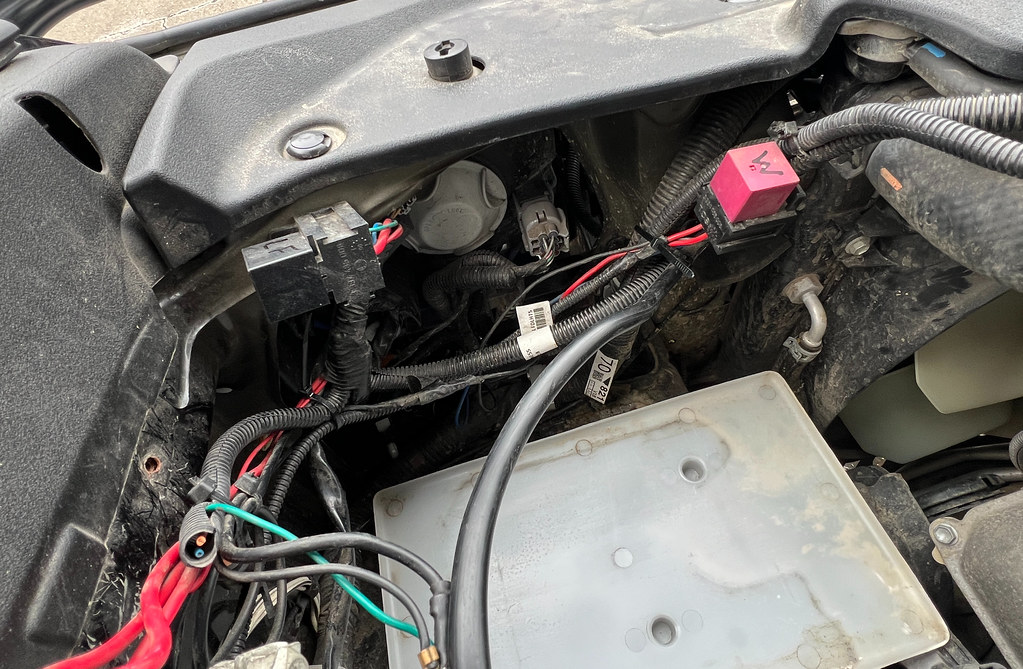
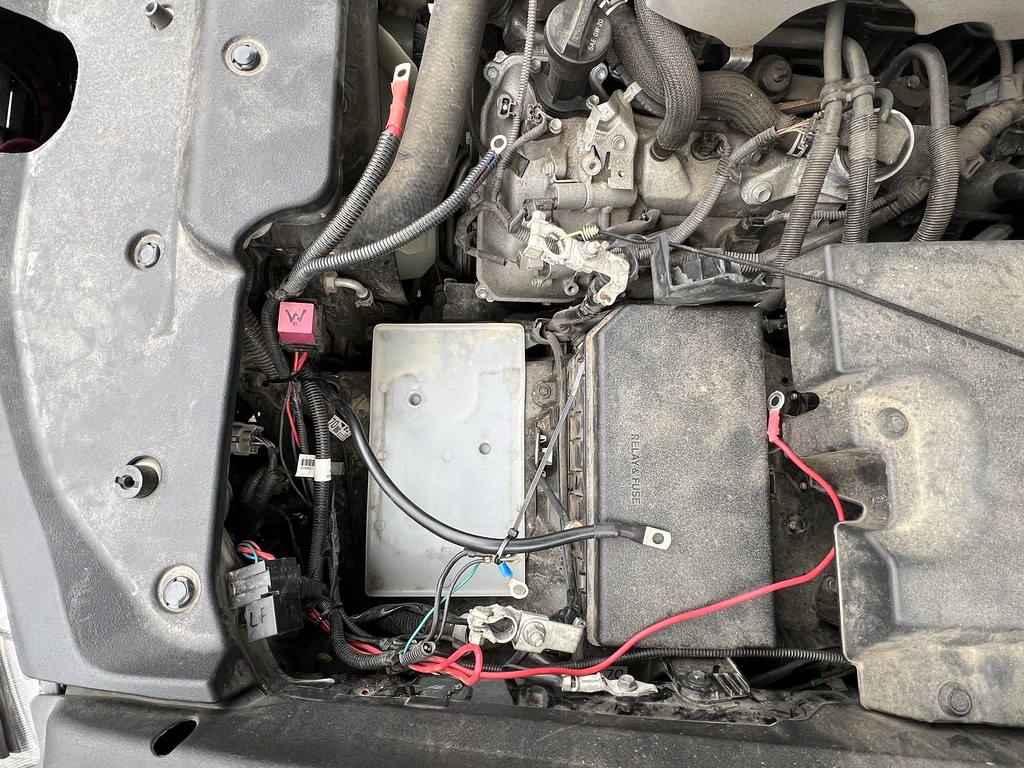
What are your future plans for electrical? If those are the only items you plan on having, then you can just run it as is with some minor tweaks. But if you're planning on adding more accessories and things like DC/DC charger and solar, the wiring can become overwhelming and it makes a lot sense to start with a distribution box .My GX460's auxiliary wiring situation needs some attention, partially because it's just a mess and partially because I want it to be easier to work on, track down issues should one occur, etc.
Currently, every auxiliary part going to the battery is a bit of a hodgepodge:
- Winch wired directly to the battery, with a large inline fuse
- Driving lights, with a large inline fuse
- GMRS unit with a small inline fuse
- GMRS antenna with small inline fuse
It looks like this sans battery:
I'm in analysis paralysis mode about how to remedy the situation. The options seem to be fuse block, bus bar, junction box, junction block... truth be told, I'm in over my head. A friend is recommending adding bus bars for positive and negative terminals, but he's also running an Auxbeam which is above and beyond what I have any need for. Maybe just a bus bar is the easiest path here? A way to incorporate the fuse into the ordeal would be great but if it adds complexity now might not be the time/place for me to do that much messing with things.
Anyways...
Requesting assistance from the GXOR hive. Thanks everyone.
I have mine setup the way Rednexus describes. One wire front the battery positive to a high amp circuit breaker then to an auxiliary fuse/relay box. They run about $25-$30 on Amazon. I have one similar to this one, but I've also used factory fuse panels in other vehicles for a more OEM look.
With this setup I can run all my wiring to a single location, and my control wiring that triggers the relays can be a much smaller gauge so I don't have any high amp loads going through the firewall. It makes things a lot cleaner and easier to troubleshoot because you can clearly label everything and you don't have hidden inline fuses wrapped up in wiring loom and random relays zip tied all over the engine compartment. Since you've already run the wiring it would be pretty easy to put one of these in the engine compartment and swap all your wiring into it.
Last edited:
- Joined
- Jan 6, 2003
- Threads
- 64
- Messages
- 1,206
I've seen a couple of car fires and both of them have been engine compartment, so probably not electrical more likely fuel leak or oil leak. I would think stock wiring or properly fused wiring has very little chance of starting a fire because it would also need to have something flammable right next to the short to catch fire. I have heard of dry brush getting caught up around the exhaust and causing fires.for those with experience, where do vehicle fires typically start? where do electrical fires usually start, and where do fluid leak fires usually start?
I have a fancy Element fire extinguisher mounted on the driver door, but do not believe I have trained enough reps should a fire occur.
I was looking at those element fire extriguishers also, they looked like a perfect solution. Someone recently posted in another forum about the Element fire extinguisher and their experience wasn't great. He had posted some real world (easy) test and it failed, so Element forced youtube to remove the video, so I don't think I'd trust them in an emergency. I should add that in one of those car engine fires I used a 5lb ABC type extinguisher and it did almost nothing so I unless you catch the fire within the first 30 seconds - 1 minute it's probably going to be a total loss no matter which extinguisher you have.
- Thread starter
- #31
After a ton of research and analyzing current/future needs, I think I settled on a solution. With cost and ease of install being front of mind, here's what I'm planning.
This (very primitive) bus bar -- 300A should be more than enough since the winch will be wired directly to the battery. Will likely mount to the top of the fuse box and do some kind of sealant around every hold I drill.

Amazon.com: 300A 12V Bus Bar with 6 x 3/8" (M10) Studs & Cover, Power Distribution Block for Marine Boat Solar RV, 12 Volt Bus Bar Terminal Block Kit with 4 AWG 1/0 & 8 AWG 2/0 Copper Lugs : Electronics - https://www.amazon.com/gp/product/B0G7Y6VH6G/ref=ox_sc_act_title_1?smid=AURES3XE1VYF1&th=1
and this to prevent any potential parasitic drain

https://www.amazon.com/dp/B00445KFZ2?tag=ihco-20
I was considering something like this instead of the junction blocks, but everything I'll be hooking up (lights x2, GMRS) already has a fuse in-line so I'd be doing extra wiring that I really don't want to do. So seems unnecessary?
https://www.amazon.com/Blue-Sea-Sys...sea&qid=1773674090&sprefix=blu,aps,913&sr=8-7
Thoughts?
This (very primitive) bus bar -- 300A should be more than enough since the winch will be wired directly to the battery. Will likely mount to the top of the fuse box and do some kind of sealant around every hold I drill.
Amazon.com: 300A 12V Bus Bar with 6 x 3/8" (M10) Studs & Cover, Power Distribution Block for Marine Boat Solar RV, 12 Volt Bus Bar Terminal Block Kit with 4 AWG 1/0 & 8 AWG 2/0 Copper Lugs : Electronics - https://www.amazon.com/gp/product/B0G7Y6VH6G/ref=ox_sc_act_title_1?smid=AURES3XE1VYF1&th=1
and this to prevent any potential parasitic drain
https://www.amazon.com/dp/B00445KFZ2?tag=ihco-20
I was considering something like this instead of the junction blocks, but everything I'll be hooking up (lights x2, GMRS) already has a fuse in-line so I'd be doing extra wiring that I really don't want to do. So seems unnecessary?
https://www.amazon.com/Blue-Sea-Sys...sea&qid=1773674090&sprefix=blu,aps,913&sr=8-7
Thoughts?

I run my HAM radio directly to the battery (with fuse of course) so when I'm parked and need to monitor the radio for whatever reason, I don't have to have my AUX on, just the radio.My GX460's auxiliary wiring situation needs some attention, partially because it's just a mess and partially because I want it to be easier to work on, track down issues should one occur, etc.
Currently, every auxiliary part going to the battery is a bit of a hodgepodge:
- Winch wired directly to the battery, with a large inline fuse
- Driving lights, with a large inline fuse
- GMRS unit with a small inline fuse
- GMRS antenna with small inline fuse
It looks like this sans battery:
I'm in analysis paralysis mode about how to remedy the situation. The options seem to be fuse block, bus bar, junction box, junction block... truth be told, I'm in over my head. A friend is recommending adding bus bars for positive and negative terminals, but he's also running an Auxbeam which is above and beyond what I have any need for. Maybe just a bus bar is the easiest path here? A way to incorporate the fuse into the ordeal would be great but if it adds complexity now might not be the time/place for me to do that much messing with things.
Anyways...
Requesting assistance from the GXOR hive. Thanks everyone.
Sealant should hold these things in place if you do not want to drill. I have one of those big switches on top the main fuse box for the past 2 years and lots of rough off road miles.After a ton of research and analyzing current/future needs, I think I settled on a solution. With cost and ease of install being front of mind, here's what I'm planning.
This (very primitive) bus bar -- 300A should be more than enough since the winch will be wired directly to the battery. Will likely mount to the top of the fuse box and do some kind of sealant around every hold I drill.
View attachment 4104031
Amazon.com: 300A 12V Bus Bar with 6 x 3/8" (M10) Studs & Cover, Power Distribution Block for Marine Boat Solar RV, 12 Volt Bus Bar Terminal Block Kit with 4 AWG 1/0 & 8 AWG 2/0 Copper Lugs : Electronics - https://www.amazon.com/gp/product/B0G7Y6VH6G/ref=ox_sc_act_title_1?smid=AURES3XE1VYF1&th=1
and this to prevent any potential parasitic drain
View attachment 4104032
https://www.amazon.com/dp/B00445KFZ2?tag=ihco-20
I was considering something like this instead of the junction blocks, but everything I'll be hooking up (lights x2, GMRS) already has a fuse in-line so I'd be doing extra wiring that I really don't want to do. So seems unnecessary?
https://www.amazon.com/Blue-Sea-Sys...sea&qid=1773674090&sprefix=blu,aps,913&sr=8-7
Thoughts?
- Thread starter
- #34
Good call. So I'd only be using the bus bar for fog lights and the Lightforce lights for now.I run my HAM radio directly to the battery (with fuse of course) so when I'm parked and need to monitor the radio for whatever reason, I don't have to have my AUX on, just the radio.
Good to know, thanks. Pardon my noob-ism when it comes to wiring here, how does the switch actually get wired into the winch wiring? Did you have to add any extra wiring? Or just wire the winch in there and through and out? (Learning about wiring as I go)Sealant should hold these things in place if you do not want to drill. I have one of those big switches on top the main fuse box for the past 2 years and lots of rough off road miles.
View attachment 4104109
Edit: Just looked at the 6006 (it arrived a little while ago), so it looks like I need to extend the cables somehow? The way I interpret it is the winch cables go to the on/off switch then other wires need to extend to the battery? Or does it just take the wires for the controller?
yes, I had to get some additional wiring. I used 2 awg https://www.amazon.com/dp/B0BSB29XYF?tag=ihco-20 from the battery to the switch, then wired the winch to the switch. Disclaimer: 2 awg is not rated to handle 350amp continuous current my winch draws at max, but 1. it was the only wire I was able to bend, 2. it was thicker than the wiring the winch (superwinch 10k) came with, 3. it' almost never draws 350a- only . 4/0 awg would be the properly rated cable for 350 continuous. you can find charts online, but what I see is that 2 awg can handle a 200a load for about 30 sec, then require 5 min of rest. Ideally, you use a thicker awg.

battery- short length of additional wire you will have to buy- switch- winch.
battery- short length of additional wire you will have to buy- switch- winch.
- Thread starter
- #36
Thanks, good stuff. What did you use for the negative terminal side of the connection?yes, I had to get some additional wiring. I used 2 awg https://www.amazon.com/dp/B0BSB29XYF?tag=ihco-20 from the battery to the switch, then wired the winch to the switch. Disclaimer: 2 awg is not rated to handle 350amp continuous current my winch draws at max, but 1. it was the only wire I was able to bend, 2. it was thicker than the wiring the winch (superwinch 10k) came with, 3. it' almost never draws 350a- only . 4/0 awg would be the properly rated cable for 350 continuous. you can find charts online, but what I see is that 2 awg can handle a 200a load for about 30 sec, then require 5 min of rest. Ideally, you use a thicker awg.
View attachment 4104113
battery- short length of additional wire you will have to buy- switch- winch.
@llm I am by no means an electrical guy, but 2 awg wire is significantly larger in size than 4 awg…& can safely handle a larger load than 4 awg.

Absolutely agreed. That would also imply the cable coming from the winch is 4 AWG, which seems to be the case in that photo.@llm I am by no means an electrical guy, but 2 awg wire is significantly larger in size than 4 awg…& can safely handle a larger load than 4 awg.
- Thread starter
- #39
2' of the cable is probably more than enough right

Hiluxforever
SILVER Star
I did mine a little different2' of the cable is probably more than enough right
I ordered a pre term cable set with an anderson connector at the winch. Will do the compressor the same way with another big fuse and kill switch.