



Some pictures and information about my 80 series build:

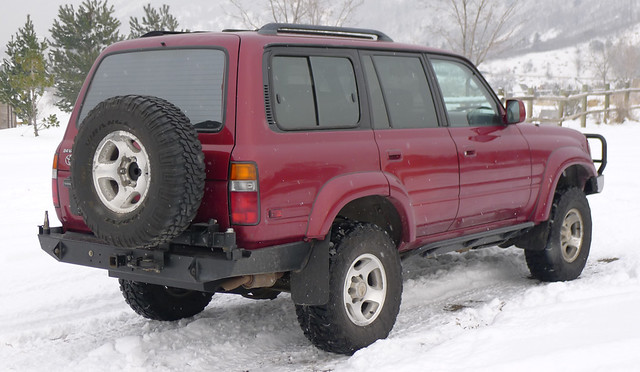
I bought a 1995 Landcruiser about a year ago.
I wanted it to be a vehicle I could use to access out of the way wilderness spots. I love to explore, fish, camp, climb, ski, etc. The Landcruiser is a means to get me and my family/friends off the beaten track in safety and comfort.
I searched for quite a while to find a Cruiser that would fit my needs. I wanted an 80 Series because of the solid axles, the factory lockers, and the general bad-assness of this model.
After lots of looking and test driving of local trucks, I found one on Slee's For Sale page that looked good. Less than 150k miles, factory lockers, and lots of upgrades and aftermarket parts that were just what I wanted. After corresponding with the owner for a while, I bought it sight unseen. I flew to Denver, met the owner at the airport, took the keys and title, and drove it home to Salt Lake.
When I bought it, the truck already had a very good start on the build that I wanted:
It had Old Man Emu J-Springs and a lift. I don't know how high the lift is, maybe 3 inches. (It's high enough, but not too high.)
An ARB front bumper, and a rear tire-carrier swing out bumper for impact protection and a place to put the spare tire.
Rock sliders, and a plate covering the catalytic converter provide some rock protection.
A pair of Light Force headlights for increased illumination.
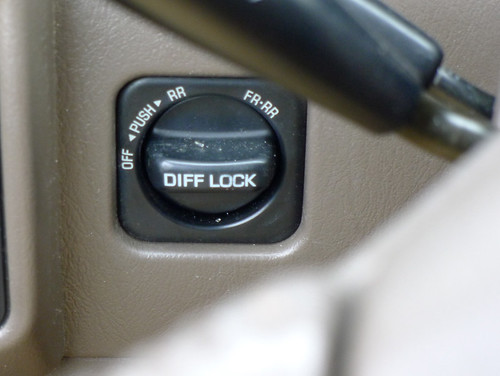
A center diff lock switch which allows for the truck to lock the center diff when in high-range.
An upgraded stereo with a Kenwood head unit and Pioneer speakers with a USB connection for my iPod.
The guy I bought the truck from was a serious HAM radio guy, (I'm pretty sure he could talk to Martians with his system,) so the truck is wired with various antennae cables, ground wires and mounts, and a Rigrunner fuse/power box in the center console box.
There's an in-dash battery monitoring system for both the main battery, with the capability to monitor a second battery too.
Tires are 285/75/16 Kumho Road Venture MT KL71 on stock wheels (just a hair under 33 inches.)
Lots of folks would have been content with the truck as it was when I bought it. However, I'm kind of a nut when it comes to modifying vehicles, so I couldn't leave well enough alone. Luckily, I live in Utah, not far from Paul May at Equipt and Kurt Williams at Cruiser Outfitters. Between Paul and Kurt, I was able to source and install all of the new goodies needed to complete my build.
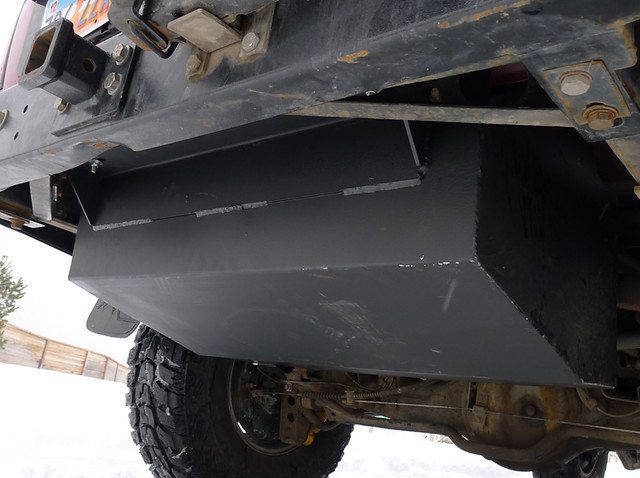
After driving the Cruiser for a while, I decided that I really needed more range. So, I installed a 40 gallon auxiliary fuel tank. It's a Front Runner kit I purchased from Paul at Equipt. It fits up under where the spare tire was. It is a transfer tank, with an electric pump that transfers fuel from the auxiliary tank to the main tank.
I like it, as it gives me a driving range of about 700 miles. However, if I were going to do things differently, I'd have installed a gauge with the tank so I don't have estimate/remember how much fuel I have in the spare tank.
While I was having the fuel tank installed, I also put a guard for the rear diff actuator mechanism (from Slee Offroad) put on for extra rock protection.
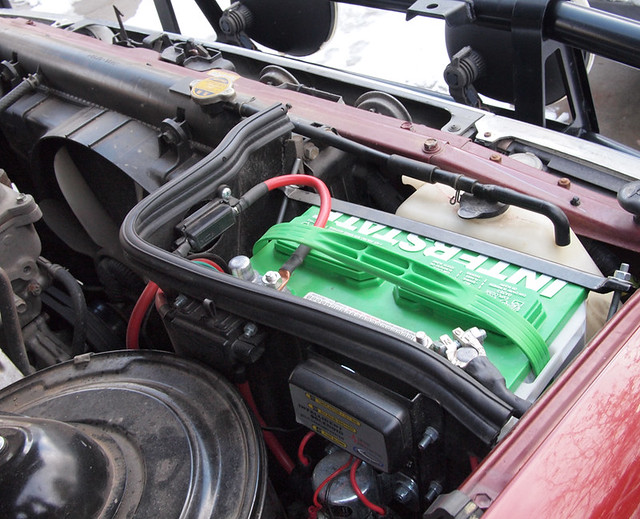
A National Luna dual battery system was next, so I could power my fridge. Kurt at Cruiser Outfitters procured and installed the system and while he was at it installed two 12-volt outlets to the rear of the vehicle, one a Hella plug and one a standard cigarette lighter type plug.
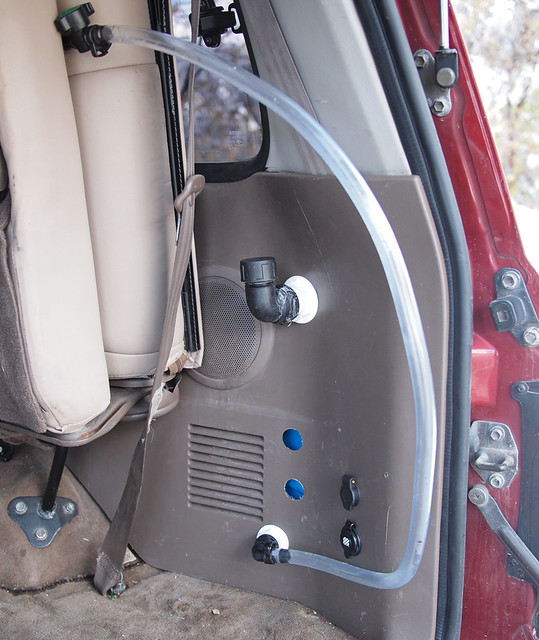
For camping convenience, I also had Kurt put in a 5 gallon Flexitank to hold drinking water. I purchased the Flexitank directly from the Flexitank company in Australia. The various Flexitank models are designed for individual vehicles. Mine was designed to fit inside the interior rear quarter panel (passenger side) of an 80 Series. The install of the Flexitank necessitated moving the 12 volt outlets as they were in the way, leaving 2 holes in the plastic panel. This turned out to be a good thing, however, as the two holes allow me to see how full the Flexitank is.
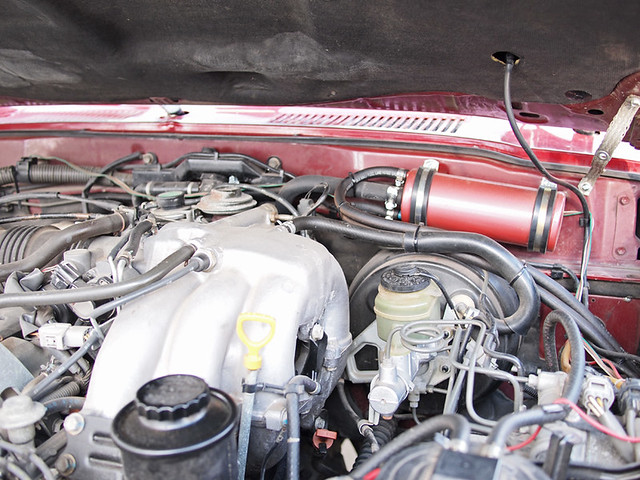
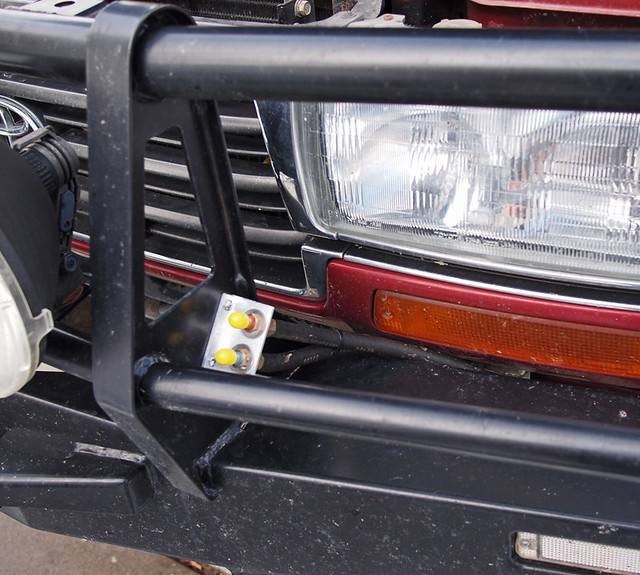
Along with the Flexitank, I decided I wanted I wanted on-board hot water. Kurt recommended a Helton heat exchanger shower kit. He mounted the heat exchanger under the hood. The temperature control is my heater thermostat, and the cold water intake and hot water output plumbing are attached to my front bumper. The hot water is nice for showers on extended trips and for doing dishes. I can pump the cold water from any nearby source, and the hot water comes out of a removable shower head.
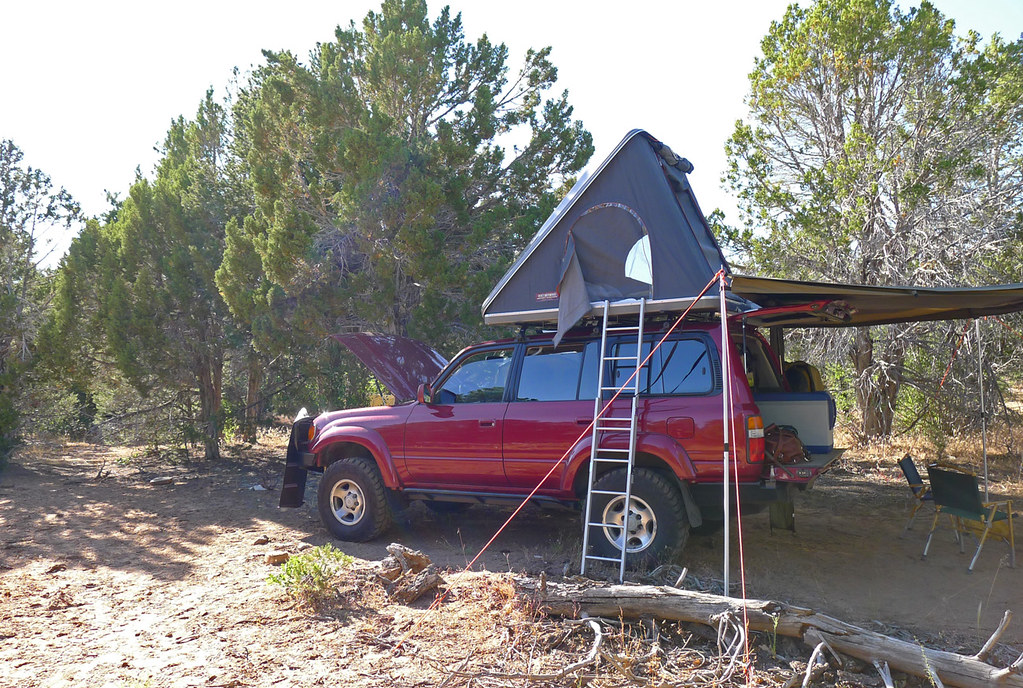
In the interest of reducing weight and keeping my center of gravity low, I decided not to get an "expedition" roof rack. Particularly because I have the roof top tent mounted pretty much all the time, it didn't make sense to mount a heavy roof rack. Instead, I've just got three Thule load bars. These load bars support my roof top tent and my awning. The roof top tent is an Autohome Columbus Carbon Fiber, which is pretty light for a hard shell tent. The awning is a Foxwing, which provides a lot of coverage. I removed the factory roof bars and sealed the holes with silicone putty.
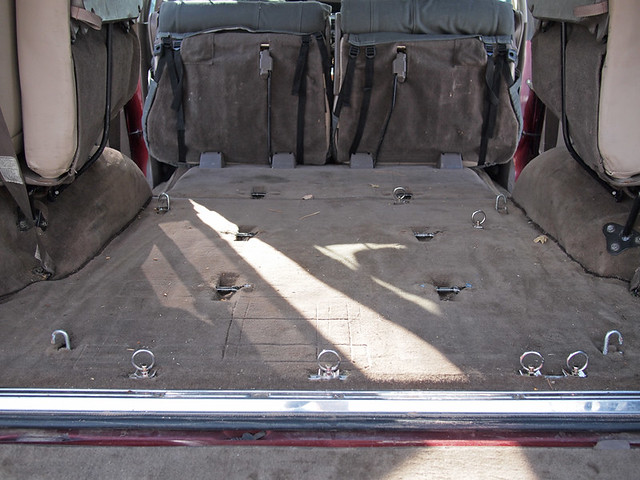
I found that stuff was shifting around a bit too much when I was off-road, so I installed additional tie-down anchors in the back of the truck. I bought a modular anchor system from Mac's Custom tie downs that is designed for pick-up truck beds. I sawed the base piece into smaller pieces with a hack-saw, and glued them down with JB Weld. Now my fridge, Bundu Boxes and other stuff can be securely tied down and don't bounce around.
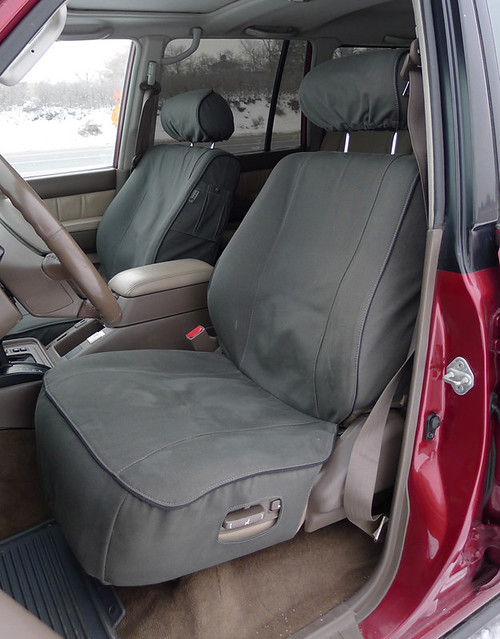
To protect the leather upholstery from the slings and arrows of time and travel with kids, I got some cotton canvas seat covers. They are Escape Gear covers from South Africa. I bought them from Paul at Equipt. They fit very well and look great. The cotton canvas is comfortable to sit on for long periods. I've had more compliments on the seat covers than I can remember. Everyone who sees them says, "those are great, I want some for my truck." Then they find out how much they cost and their enthusiasm wanes. However, I think they're worth it, and they are a lot less expensive than having to reupholster the leather seats.
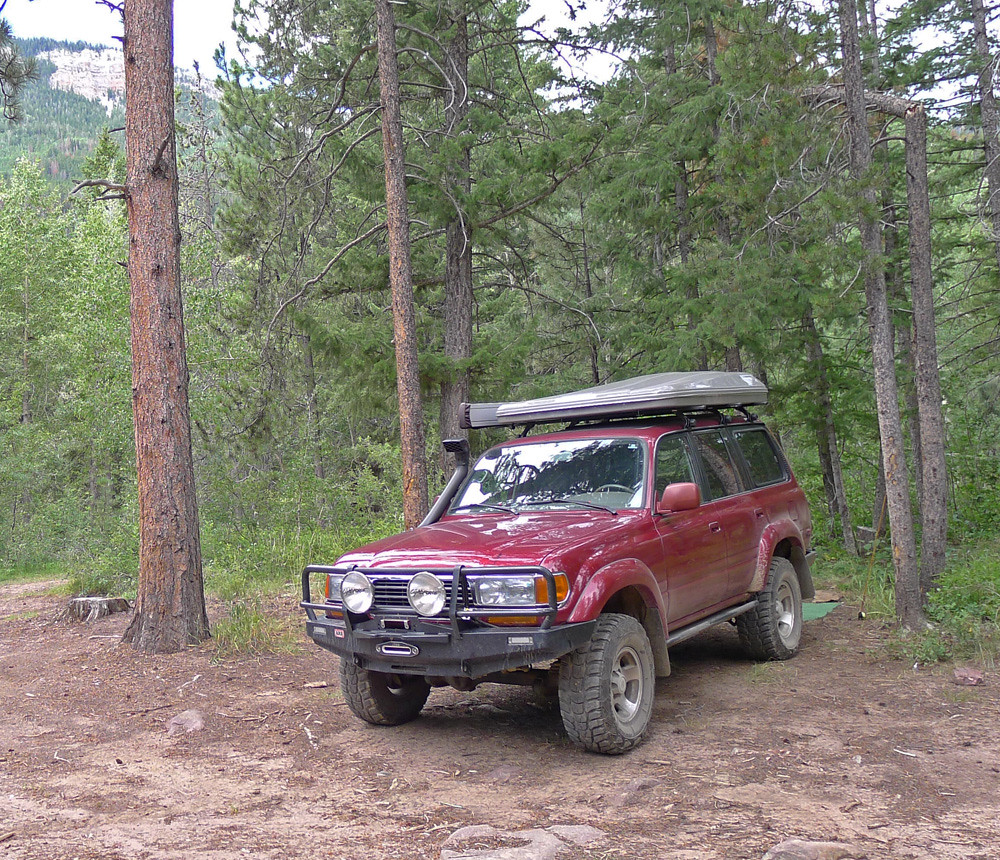
The heavy snowfall and resulting heavy run-off in the Utah mountains has led to a few creek crossings. With this in mind, I had Cruiser Outfitters install a snorkel, and extend the diff breather tubes up higher so that I could go through deeper water without fear of drowning my engine or contaminating my diff lubricants. My wife does not approve of the snorkel. She thinks it looks idiotic and out of place on anything other than a submarine. This has provided me with an incentive to seek out some deep river crossings to show her that it's perfectly functional. So far, I haven't been in anything deeper than half my tire depth, however.
With these mods, the Cruiser was almost perfect. However, there was the issue of power. With its small 6-cylinder engine, it felt somewhat underpowered on the highway, especially on the long uphill grades so common here in the West. I considered a super charger, a V8 engine swap, and a diesel engine swap. Ultimately, however, I decided to try some lower gears first. After agonizing between 4.56 and 4.88 gears, and running various spreadsheets and plots of rpm and mph with 4.56 and 4.88 gears, I decided to go with the 4.56 gears. I'm currently running tires that are just under 33 inches, and I don't think I will go larger than this. I do a lot of highway driving to get where I'm going, and don't engage in any serious rock crawling, so 33's are as big a tire as I'm likely to need or want. Along with installing the 4.56 gearing, Kurt also serviced the axles.
The gears have turned out to be one of my best ever modifications. Just the small difference in gearing has altered my perception of the truck's power. I go up hills faster, can pass slower cars easier, and overall the car just feels much stronger. I no longer think that I need forced induction or an engine swap to be happy.
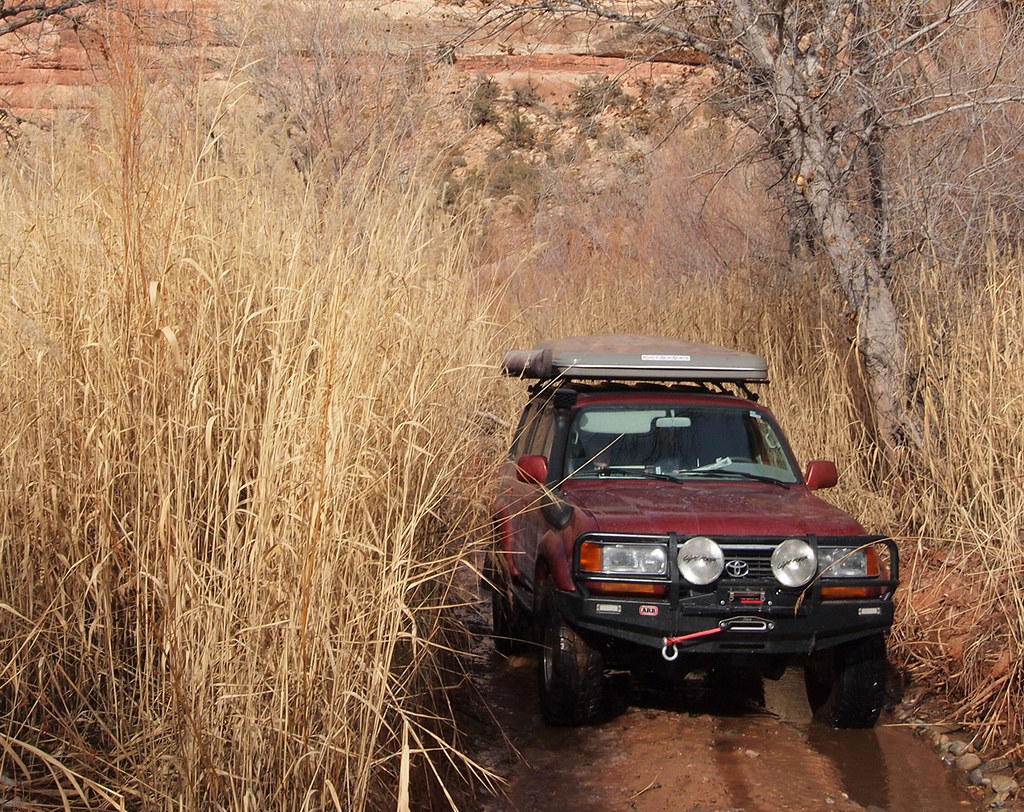
My latest addition is a KingOne TDS9.5 winch with a synthetic rope.
In addition to the upgrades, I did some preventative maintenance and fixed some things that needed fixing to bring the car up to spec mechanically, including replacing the pesky heater hose and some other hoses, replaced the brake rotors, power steering pump, belts, fixed the radio antenna, and a few other minor repairs.
The truck as it was when I bought it:
The magic dial:
Aux fuel tank:
Escape gear seat covers, front and rear:
Helton hot water system:
Flexitank 5 gallon water tank and 12 volt outlets:
Tie-downs:
Dual battery kit:
Snorkel and roof top tent:
New winch:
Camping:
I bought a 1995 Landcruiser about a year ago.
I wanted it to be a vehicle I could use to access out of the way wilderness spots. I love to explore, fish, camp, climb, ski, etc. The Landcruiser is a means to get me and my family/friends off the beaten track in safety and comfort.
I searched for quite a while to find a Cruiser that would fit my needs. I wanted an 80 Series because of the solid axles, the factory lockers, and the general bad-assness of this model.
After lots of looking and test driving of local trucks, I found one on Slee's For Sale page that looked good. Less than 150k miles, factory lockers, and lots of upgrades and aftermarket parts that were just what I wanted. After corresponding with the owner for a while, I bought it sight unseen. I flew to Denver, met the owner at the airport, took the keys and title, and drove it home to Salt Lake.
When I bought it, the truck already had a very good start on the build that I wanted:
It had Old Man Emu J-Springs and a lift. I don't know how high the lift is, maybe 3 inches. (It's high enough, but not too high.)
An ARB front bumper, and a rear tire-carrier swing out bumper for impact protection and a place to put the spare tire.
Rock sliders, and a plate covering the catalytic converter provide some rock protection.
A pair of Light Force headlights for increased illumination.
A center diff lock switch which allows for the truck to lock the center diff when in high-range.
An upgraded stereo with a Kenwood head unit and Pioneer speakers with a USB connection for my iPod.
The guy I bought the truck from was a serious HAM radio guy, (I'm pretty sure he could talk to Martians with his system,) so the truck is wired with various antennae cables, ground wires and mounts, and a Rigrunner fuse/power box in the center console box.
There's an in-dash battery monitoring system for both the main battery, with the capability to monitor a second battery too.
Tires are 285/75/16 Kumho Road Venture MT KL71 on stock wheels (just a hair under 33 inches.)
Lots of folks would have been content with the truck as it was when I bought it. However, I'm kind of a nut when it comes to modifying vehicles, so I couldn't leave well enough alone. Luckily, I live in Utah, not far from Paul May at Equipt and Kurt Williams at Cruiser Outfitters. Between Paul and Kurt, I was able to source and install all of the new goodies needed to complete my build.
After driving the Cruiser for a while, I decided that I really needed more range. So, I installed a 40 gallon auxiliary fuel tank. It's a Front Runner kit I purchased from Paul at Equipt. It fits up under where the spare tire was. It is a transfer tank, with an electric pump that transfers fuel from the auxiliary tank to the main tank.
I like it, as it gives me a driving range of about 700 miles. However, if I were going to do things differently, I'd have installed a gauge with the tank so I don't have estimate/remember how much fuel I have in the spare tank.
While I was having the fuel tank installed, I also put a guard for the rear diff actuator mechanism (from Slee Offroad) put on for extra rock protection.
A National Luna dual battery system was next, so I could power my fridge. Kurt at Cruiser Outfitters procured and installed the system and while he was at it installed two 12-volt outlets to the rear of the vehicle, one a Hella plug and one a standard cigarette lighter type plug.
For camping convenience, I also had Kurt put in a 5 gallon Flexitank to hold drinking water. I purchased the Flexitank directly from the Flexitank company in Australia. The various Flexitank models are designed for individual vehicles. Mine was designed to fit inside the interior rear quarter panel (passenger side) of an 80 Series. The install of the Flexitank necessitated moving the 12 volt outlets as they were in the way, leaving 2 holes in the plastic panel. This turned out to be a good thing, however, as the two holes allow me to see how full the Flexitank is.
Along with the Flexitank, I decided I wanted I wanted on-board hot water. Kurt recommended a Helton heat exchanger shower kit. He mounted the heat exchanger under the hood. The temperature control is my heater thermostat, and the cold water intake and hot water output plumbing are attached to my front bumper. The hot water is nice for showers on extended trips and for doing dishes. I can pump the cold water from any nearby source, and the hot water comes out of a removable shower head.
In the interest of reducing weight and keeping my center of gravity low, I decided not to get an "expedition" roof rack. Particularly because I have the roof top tent mounted pretty much all the time, it didn't make sense to mount a heavy roof rack. Instead, I've just got three Thule load bars. These load bars support my roof top tent and my awning. The roof top tent is an Autohome Columbus Carbon Fiber, which is pretty light for a hard shell tent. The awning is a Foxwing, which provides a lot of coverage. I removed the factory roof bars and sealed the holes with silicone putty.
I found that stuff was shifting around a bit too much when I was off-road, so I installed additional tie-down anchors in the back of the truck. I bought a modular anchor system from Mac's Custom tie downs that is designed for pick-up truck beds. I sawed the base piece into smaller pieces with a hack-saw, and glued them down with JB Weld. Now my fridge, Bundu Boxes and other stuff can be securely tied down and don't bounce around.
To protect the leather upholstery from the slings and arrows of time and travel with kids, I got some cotton canvas seat covers. They are Escape Gear covers from South Africa. I bought them from Paul at Equipt. They fit very well and look great. The cotton canvas is comfortable to sit on for long periods. I've had more compliments on the seat covers than I can remember. Everyone who sees them says, "those are great, I want some for my truck." Then they find out how much they cost and their enthusiasm wanes. However, I think they're worth it, and they are a lot less expensive than having to reupholster the leather seats.
The heavy snowfall and resulting heavy run-off in the Utah mountains has led to a few creek crossings. With this in mind, I had Cruiser Outfitters install a snorkel, and extend the diff breather tubes up higher so that I could go through deeper water without fear of drowning my engine or contaminating my diff lubricants. My wife does not approve of the snorkel. She thinks it looks idiotic and out of place on anything other than a submarine. This has provided me with an incentive to seek out some deep river crossings to show her that it's perfectly functional. So far, I haven't been in anything deeper than half my tire depth, however.
With these mods, the Cruiser was almost perfect. However, there was the issue of power. With its small 6-cylinder engine, it felt somewhat underpowered on the highway, especially on the long uphill grades so common here in the West. I considered a super charger, a V8 engine swap, and a diesel engine swap. Ultimately, however, I decided to try some lower gears first. After agonizing between 4.56 and 4.88 gears, and running various spreadsheets and plots of rpm and mph with 4.56 and 4.88 gears, I decided to go with the 4.56 gears. I'm currently running tires that are just under 33 inches, and I don't think I will go larger than this. I do a lot of highway driving to get where I'm going, and don't engage in any serious rock crawling, so 33's are as big a tire as I'm likely to need or want. Along with installing the 4.56 gearing, Kurt also serviced the axles.
The gears have turned out to be one of my best ever modifications. Just the small difference in gearing has altered my perception of the truck's power. I go up hills faster, can pass slower cars easier, and overall the car just feels much stronger. I no longer think that I need forced induction or an engine swap to be happy.
My latest addition is a KingOne TDS9.5 winch with a synthetic rope.
In addition to the upgrades, I did some preventative maintenance and fixed some things that needed fixing to bring the car up to spec mechanically, including replacing the pesky heater hose and some other hoses, replaced the brake rotors, power steering pump, belts, fixed the radio antenna, and a few other minor repairs.
The truck as it was when I bought it:
The magic dial:
Aux fuel tank:
Escape gear seat covers, front and rear:
Helton hot water system:
Flexitank 5 gallon water tank and 12 volt outlets:
Tie-downs:
Dual battery kit:
Snorkel and roof top tent:
New winch:
Camping:



 ... quick question, How do you like those seat covers/ where did you get them? And where did you find that aux fuel tank?

