Front Wheel Bearing Help -- Preload question

This site may earn a commission from merchant affiliate
links, including eBay, Amazon, Skimlinks, and others.

Joined
Aug 31, 2007
Threads
3
Messages
11
Location
East Texas
Website
www.oldwestracing.com
Quick history...

I just picked up an '01 100 with 96k. Drove it home last week which was a 170+ mile trip. I started hearing some noise from the front end when I was pretty close to home and it turned out to be the wheel bearing loose on the driver's side. Upon taking it apart, found the bearings looked to have been done, perhaps recently with a brake job, but figured they did not set the preload correctly. So, I picked up some new bearings/races/seal locally to get it back on the road. The only ones available were National (Federal Mogul) brand. The Timkens were, unfortunately, special order everywhere.

Got it back together tonight and am setting the preload. With 55 in/lb of torque on the nut, there is maybe 5-6 lbs of preload, measured with a spring scale. I have to really torque the nut down to get 10lbs.

I have lots of experience with 1st gen 4runner IFS and solid axles and the FSM always stated just torque to a certain ft/lbs on the nut to preload the bearings. I've never measured with a spring scale before but read here that is what you should do.

SO, is it normal to have to torque the nut down considerably to get the right amount of preload measurement with the spring scale?

Thanks

Paul
 
Quick history...

I just picked up an '01 100 with 96k. Drove it home last week which was a 170+ mile trip. I started hearing some noise from the front end when I was pretty close to home and it turned out to be the wheel bearing loose on the driver's side. Upon taking it apart, found the bearings looked to have been done, perhaps recently with a brake job, but figured they did not set the preload correctly. So, I picked up some new bearings/races/seal locally to get it back on the road. The only ones available were National (Federal Mogul) brand. The Timkens were, unfortunately, special order everywhere.

Got it back together tonight and am setting the preload. With 55 in/lb of torque on the nut, there is maybe 5-6 lbs of preload, measured with a spring scale. I have to really torque the nut down to get 10lbs.

I have lots of experience with 1st gen 4runner IFS and solid axles and the FSM always stated just torque to a certain ft/lbs on the nut to preload the bearings. I've never measured with a spring scale before but read here that is what you should do.

SO, is it normal to have to torque the nut down considerably to get the right amount of preload measurement with the spring scale?

Thanks

Paul


I've had the same dilemma. Going by the FSM it just seems tighter than any other wheel bearing adjustment I've performed on any vehicle (other than my Landcruiser). But I stuck with the exact procedure per the FSM. Per your comment: The amount of torque seems unduly high to me too. But after 70K miles I've not had any issue either.
 
I just used the torque wrench to "sneak up" on the preload. I've got it about 37 ft/lbs right now and it reads right at 10 lbs on the fish scale.

I'm probably going to button it back up and drive it and see how it does.

The in/lb torque measurement seemed a little odd anyway. I'm more in line with WildSmith's method than the FSM: IH8MUD Forums - View Single Post - Wheel Bearing Preload Methods
 
Another quick question...I plan on pulling the passenger side apart and checking everything to make sure everything looks good. I'll probably repack the bearings at a minimum just so I know. Since these will not be new bearings, should the preload be set different (i.e. less) or should it still be set at 9.5-15 lbs on the fish scale?
 
i just repacked my front bearing and you're right about the amount of torque. I thought i was tightening way too much but after a 1600 miles trip i have zero issues.
 
I too struggled with the inch pounds and then the scale torque. I even got a 10lb paint can to re-test and it was never what the torqe spec turned out to be. Just check and re-check and you should be good.
The one advise I have is once the first nut is on and torqued, grab it with both hands and make sure it seats - this is per the FSM, but a friend (Toyota Tech) indicated this is where potential issues can arrise. You then take it apart and then re-torque - don't bypass this step.

Also I put in new oil seals in the back as they were slightly damaged, make sure you check those as they could affect the install of all parts.
 
I had the same issue, 5 to 6 lbs breakway preload using the maximum nut torque setting. I attributed this to using synthetic wheel bearing grease. I left it at the maxium nut torque setting and rechecked it after 5000 miles, there was no change in the breakway preload. It has been fine for the last 15000 to 20000 miles.
 
I've gotten both sides finished now. Both took 35-40 ft/lbs to get 10 lbs on the fish scale. It just seems kinda excessive.

dcl -- you bring up a good point I forgot to mention. I am using Mobile 1 synthetic grease. I thought about it making it "slicker" and would expect it to affect checking the preload...but how much?

I'm taking the family on a 1600 mile round trip vacation in a few weeks. We are going to West Texas and we'll rarely be anywhere that a breakdown is going to be good. I don't like doing a lot of work on a vehicle before taking it so far, but I didn't really have a choice since I just picked it up.

So, what is the consensus? Good to go or too tight?
 
Were your nuts and bearing face dry or greased? I put mine on dry and I think that's why I end up using a high torque figure. If greased took that much torque I'd be a bit concerned.

After bearing work, I always do a few local drives with as little braking as possible and then check the hub temperatures. If that's ok then I'll do a 20 minute or so run at 50/60mph and check again. If the hub temps are still ok after that then I'd be confident to do a long run. I'd expect new bearings to make a bit more heat the first few runs and then settle down.
 
There was likely some grease on them. I didn't specifically try to keep it all dry so there was likely some stray grease. I didn't shoot for a certain torque figure but rather was trying to get within spec of the preload with the fish scale. The synthetic grease may skew that a little though but I set them to the low end of the spec. Still took a bunch of torque on the nut though.

I've ordered everything to do my 90k PMs and ordered new thrust washers, lock washer, gaskets, and c-clip along with it. I'll be pulling it down to replace those parts and I'll see how it all looks then repreload.

One thing that strikes me is that the FSM allows such a wide range of preload (9.5-15 lbs). 15 lbs would be pretty stiff no matter what. One theory is that we are all seeing success simply because the bearings can tolerate a fairly large variation, even a little on the tight side. I've always done it by feel until now and never had an issue. I can promise you none of those were anywhere near this amount of preload, but they were all two wheel drive and domestic (i.e. itty bitty bearings)
 
One thing that strikes me is that the FSM allows such a wide range of preload (9.5-15 lbs). 15 lbs would be pretty stiff no matter what. One theory is that we are all seeing success simply because the bearings can tolerate a fairly large variation, even a little on the tight side.
Pure speculation but I think it would make sense for Toyota to have specified values at the loose end of what the bearing manufacturer would specify. A bearing that's a bit low on preload will run for a long time without any major disasters and give a few clues that something's not right before failing whereas a bearing that's too high on preload can fail very quickly without much warning other than heat.

Sounds like yours will give you a lot of trouble free miles.
 
Another quick question...I plan on pulling the passenger side apart and checking everything to make sure everything looks good. I'll probably repack the bearings at a minimum just so I know. Since these will not be new bearings, should the preload be set different (i.e. less) or should it still be set at 9.5-15 lbs on the fish scale?
How do I check the preload with a fish scale, where do you place the scale?
 
How do I check the preload with a fish scale, where do you place the scale?

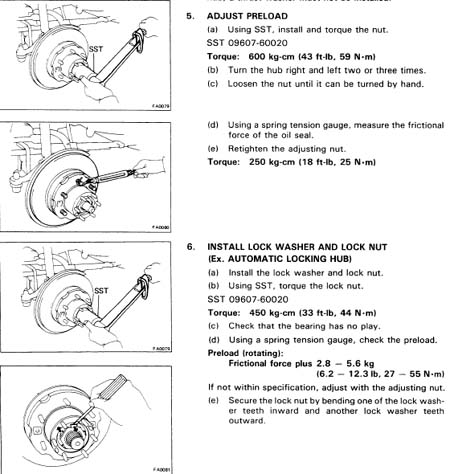
The following is from the 85 4runner/truck FSM but it shows how to check preload...
85fsm_wheelbearing.jpg
 
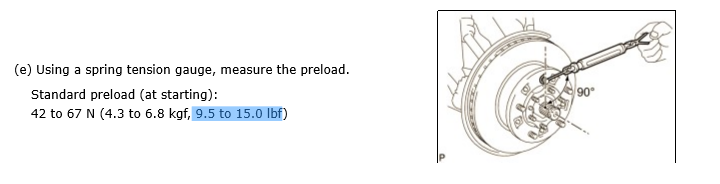
Resurrecting this old thread because I saw something interesting in the FSM:

h9SDRIa.png


Notice: the specified range of 9.5-15.0 is not given in pounds, it's given in pound-feet. The torque applied via the fish scale, and the force applied via the fish scale will have different magnitudes unless the radius is one foot, which it isn't.

For example, if the lever arm (distance from the center of axle shaft to the point where the scale is attached) is 6 inches, then you would need to apply 20 lbs of force to the fish scale to achieve a torque of 10 lb*ft. Perhaps this confusion is the reason the FSM preload appears to be too low, causing scoring and chatter for some.
 
You may want to test that theory.

Just take any fish scale and weight a 10lb object hung from it like a fish. Now tie a 10' rope to scale and weight same 10' lb. object hung from it. It will weight the same.

Lengthen of measure device comes into play on fulcrum.
 
You may want to test that theory.

Just take any fish scale and weight a 10lb object hung from it like a fish. Now tie a 10' rope to scale and weight same 10' lb. object hung from it. It will weight the same.

Lengthen of measure device comes into play on fulcrum.


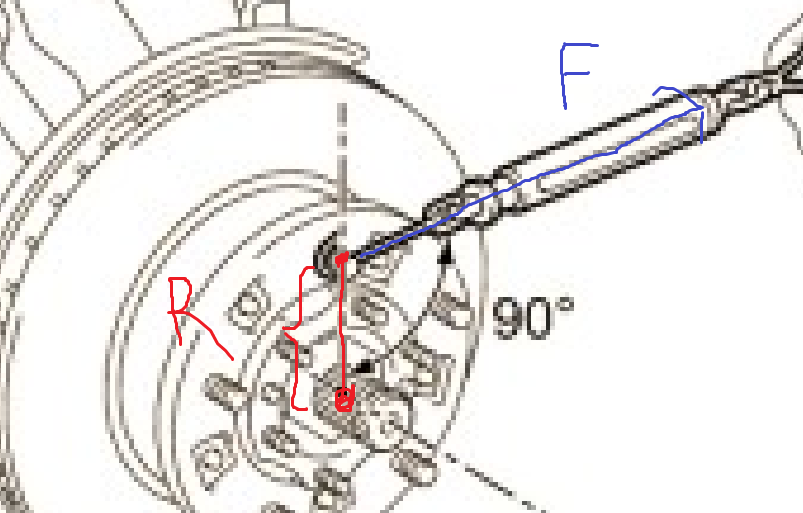
I'm not talking about the length of the fish scale. You're right that the length of the fish scale has no effect on torque. I'm talking about the distance between axle shaft and stud. Torque = force * lever arm:

JrZtxCm.png


In this case, torque = R x F. But I think I'm wrong for a different reason. The FSM gives values as lbf, which I assumed was pound feet of torque. But lbf actually just stands for pounds (force). Pound feet is lb ft. Imperial units :(
 
I’m getting ready to do this job in a few days and this thread answered a bunch of questions I had. I am an aircraft mechanic so my question comes from experience from those wheel bearings. In aircraft we continually turn the wheel as we are tightening and then back it off and set the torque value. Is turning the wheel as I am tightening it of any importance when doing the front ones on my lx? We don’t check preload on our planes as they are just set to a standard torque.
Thanks
 
I’m getting ready to do this job in a few days and this thread answered a bunch of questions I had. I am an aircraft mechanic so my question comes from experience from those wheel bearings. In aircraft we continually turn the wheel as we are tightening and then back it off and set the torque value. Is turning the wheel as I am tightening it of any importance when doing the front ones on my lx? We don’t check preload on our planes as they are just set to a standard torque.
Thanks
No other than to settle grease. That is old school and in simple free spinning wheel hubs, and not front wheel drive hubs. We do however spinn and pull in direct of travel, after settling.

Torque is not what we're after, breakaway Preload is the goal.
 
Last edited:
Back
Top Bottom