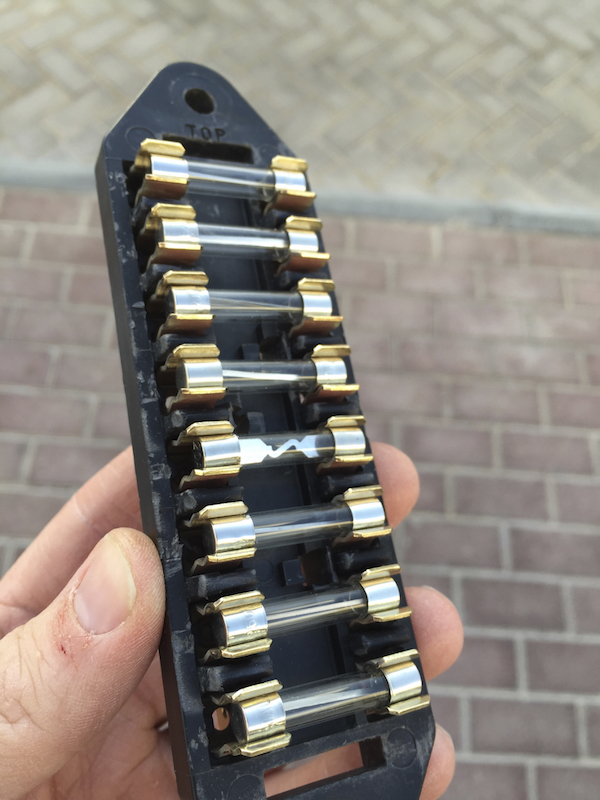
Short on my Engine Circuit - Help!

This site may earn a commission from merchant affiliate
links, including eBay, Amazon, Skimlinks, and others.

You say that heat is building up on the clips in the fuse box. Heat is a dead giveaway of high resistance - which you should NOT have at the fuse box. Are the connections tight? Are they corroded? Something is wrong at your fuse connections, if they are getting hot.

Take the fuses out and make sure the contacts are clean. Check the connections on the back side of the fuse box. Make sure the clips are tight against the fuses when the fuses are in.

Yeah, removing the fuse panel and cleaning all the contacts and tightening things up is on the list. I'll be doing that shortly... especially given the issues I'm playing with now. I went for a test drive earlier and this isn't as severe as I had thought.

Oh, and the negative on the ammeter just means you are using more current than your alternator is producing. Does it go away when you come above idle?

Going out to check the various ammeter and voltage readings now... will report back.
 
Your diagram is correct but the red B wire should be hooked up to the battery and not to the +B stud on the alternator.

From the two diagrams you have in your regulator thread...

VR3wire_zps03912e72.jpg


vr-6-wire-jpg.778514


...the B+ has to go back to the battery. Whether it goes to the VR or not has to do with the specific VR and if it has the idiot light feature or not. The way I read your diagrams is the red B wire should go from the battery to the +B stud, at a minimum. From my diagram it isn't clear but the red line, upon re-entering the old harness, goes back to the battery.

You say: Alternator works. VR seems to work... it's at least allowing the alternator to work.
How do you know that? What is the voltage on the battery at idle and when you rev up to say 1000 rpm?

What does the Ammeter do with key in the "on" position (engine not running)? It should going a tiny bit negative because your ignition and gauge cluster are using a bit of current.
What does the Ammeter do with the engine running at idle?
What does the Ammeter do with the engine revved up?

FYI: E, F and IGN are the wires for the voltage regulator to work.
N, B and L are the wires for the "charge indicator light" (aka idiot light) circuit to work.

Rudi

Battery voltage @ idle: 12.6V
Battery voltage @ rev: 13.0V

Ammeter @ off (no key): -5
Ammeter @ on (engine not running): -2.5
Ammeter @ idle: -15
Ammeter @ rev: -17.5

From this I'm gathering the following:
1. Battery may be on the way out OR
2. I need to adjust the VR
3. My ammeter's leads are reversed

Also, the short must be gone. I just drove 30-40km and had no problems. The only thing is that the fuse block is definitely getting quite warm... and not just the Engine circuit... the Headlamp circuit as well. Gonna pull the fuse block next and clean it and check all connections.
 
Two more questions before I dive in this puzzle.
What's the battery voltage when disconnected? (Take the + cable off)
What's the reading on the Ammeter when the battery is disconnected?

Rudi
 
Battery voltage @ idle: 12.6V
Battery voltage @ rev: 13.0V

Ammeter @ idle: -15
Ammeter @ rev: -17.5

From this I'm gathering the following:
3. My ammeter's leads are reversed

Also, the short must be gone. I just drove 30-40km and had no problems. The only thing is that the fuse block is definitely getting quite warm... and not just the Engine circuit... the Headlamp circuit as well. Gonna pull the fuse block next and clean it and check all connections.

I don't think you had a short, you either had a partial leak to ground, or bad connections....

1) unless you are changing something other than RPM, your amperage shoud NOT be going down as the voltage is going up. If the voltage is going up, the regulator is working (somewhat) and as long as you are not adding more things to the circuit, i.e. Rev up and turn lights on, the increased Rpm should be raising the voltage, allowing more current to flow....

I think your "gathering" number 3 needs to be investigated, if you flip the polarity on the readings you got, and perhaps adjust the ammeter zero, things would be looking decent.
 
Two more questions before I dive in this puzzle.
What's the battery voltage when disconnected? (Take the + cable off)
What's the reading on the Ammeter when the battery is disconnected?

Rudi

Voltage @ disconnect: 12.2V
Ammeter @ disconnect: -5
 
I don't think you had a short, you either had a partial leak to ground, or bad connections....

I've definitely got some bad connections to still sort out... I had a short as well I'm pretty sure. Two blown fuses on the same circuit. It may just have been that sliced wire I repaired that did that.
 
Here we go.......

Voltage @ disconnect: 12.2V
Your battery is fine.

Ammeter @ disconnect: -5
So your Ammeter is not centered. Should show 0

Battery voltage @ idle: 12.6V
Is a bit on the low side. Should be in the 13.2 - 13.6V range

Battery voltage @ rev: 13.0V
Is too low. Should be around 14.4V

Or your VR is defective (or needs adjustment) or your alternator is defective. Probably one or more diode's defective.

Ammeter @ off (no key): -5
Ammeter @ on (engine not running): -2.5
Ammeter @ idle: -15
Ammeter @ rev: -17.5
If the Ammeter is 5 Amp off and is cross wired, than these numbers are pretty normal (with a defective VR or alternator).

Rudi
 
Last edited:
Amp Meter connections are as follows:
White/Blue to NEGATIVE
White to POSITIVE
There should be a + an - stamped in the gauge cluster housing so you know which is which.

Also in your first drawing, the wire labeled E (which is ground and is White/Black) Check this wire to verify it does indeed attach to ground somewhere. Your drawing makes it appear to end at the old regulator connector?

Your fuse block, as was stated, is heating up due to high resistance caused by tarnish on the fuses, the fuse clips and the terminals on the back of the fuse block. A Dremel tool with wire brush will make short work of that task, but do it thoroughly! While cleaning stuff also clean the AMP Meter connector and posts.
 
Amp Meter connections are as follows:
White/Blue to NEGATIVE
White to POSITIVE
There should be a + an - stamped in the gauge cluster housing so you know which is which.

Also in your first drawing, the wire labeled E (which is ground and is White/Black) Check this wire to verify it does indeed attach to ground somewhere. Your drawing makes it appear to end at the old regulator connector?

Your fuse block, as was stated, is heating up due to high resistance caused by tarnish on the fuses, the fuse clips and the terminals on the back of the fuse block. A Dremel tool with wire brush will make short work of that task, but do it thoroughly! While cleaning stuff also clean the AMP Meter connector and posts.

So, first of all, ammeter is indeed backwards. Stuck my iPhone back behind the dash and came up with this...
049backward.jpg


I'll get that sorted soon enough. I'll Dremel the posts as well. Gauge cluster clean-up and revamp is in the plans.

I had bigger fish to fry first though. My fuse block was tarnished to the extreme which explains the heat through the block. Apparently, I'm not the first one to find this to be a problem. Behind the fuse block someone had patched into the wiring and bypassed the headlight fuse altogether... spliced directly from the battery incoming to the headlight outgoing. Sorted that out and as per @Coolerman I used my Dremel with wire brush.
046terminals.jpg


Many of the fuses were also tarnished the ends were loose. Went ahead and replaced all but one that seemed to be quite new anyway.
047shinyblock.jpg


Finally, I did check to ensure E is grounded... continuity check between E in the harness and the ground shows near-zero resistance.
 
Here we go.......


Your battery is fine.


So your Ammeter is not centered. Should show 0


Is a bit on the low side. Should be in the 13.2 - 13.6V range


Is too low. Should be around 14.4V

Or your VR is defective (or needs adjustment) or your alternator is defective. Probably one or more diode's defective.


If the Ammeter is 5 Amp off and is cross wired, than these numbers are pretty normal (with a defective VR or alternator).

Rudi

I wasn't convinced the VR or the alternator were faulty yet. With the amount of resistance going through my fuse block and the overall condition of my wiring I felt there were still too many variables. Also, I took voltage for the Alternator @ idle of 14.3V.

After the fuse block clean-up above and new battery cables (new starter cable, new ground to block, new ground to frame) I get better results.
Battery voltage @ idle: 13.16V
 
Here we go......
Alternator 27020-61150 has a N terminal (bottom right) and that tells the 6 wire VR the charge status and from there the L (Lamp) on/off.
So if you don't use the N terminal you can use the 3 wire VR for this alternator.
E from Alt to E from VR
F from Alt to F from VR
N from Alt not connected.
IGN from VR to +12V switched from Ignition key.
Make sure that the VR makes good ground contact to the firewall.

Rudi

So @bj40green, I just wanted to clarify one final thing. Since I don't need the N terminal (I have no lamp to indicate no charge) and since the stock VR was meant for a 40A alternator, it would be usable instead of the aftermarket. Correct? Or is there something to do with the field of the alternator that would further affect whether the VR is compatible?

Thanks for all your help on this one. You and Coolerman have been a big help.
 
If you use the 3 wire stock VR than there is no way to hook up the N terminal.
The N terminal tells the (6 wire) VR to work or not. If not it will also show by the idiot light.
Reading your voltage at idle tells me that your VR works fine so far.
Now, how much voltage do you have when you rev up the engine?

Rudi
 
Back
Top Bottom