This site may earn a commission from merchant affiliate
links, including eBay, Amazon, Skimlinks, and others.
What we gonna do today, Brain?
SILVER Star
Progress!
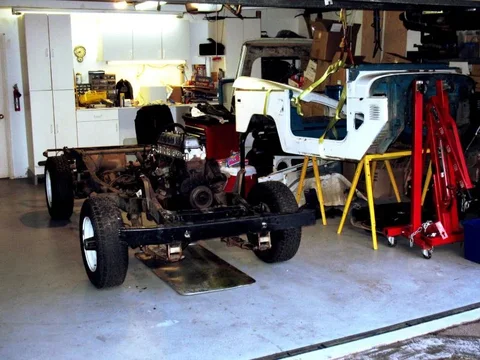
The next project was to locate two OEM fenders as the Cruiser came with some funky fiberglass fenders. (If you want them, pm me to pick them up or pay me to ship them to you and they’re yours.) After many emails and calls, I located a Cruiser mortuary above Santa Barbara. I’ll respect the caretaker’s wishes and not identify him, but it was an amazing place, full of LC parts and great stories. After three hours of talking, I picked up the needed fenders and headed home.
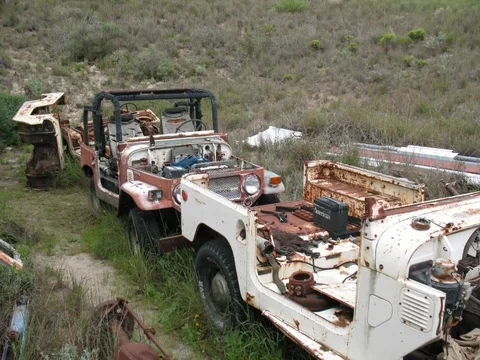
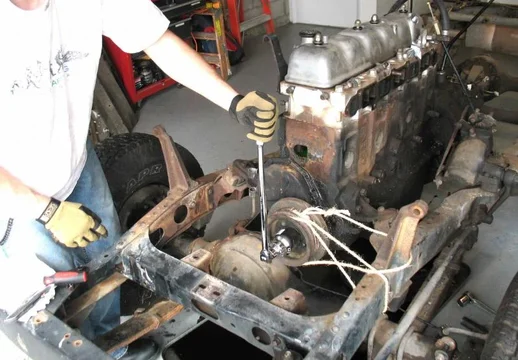
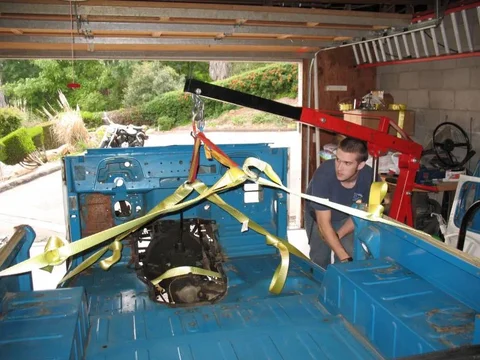
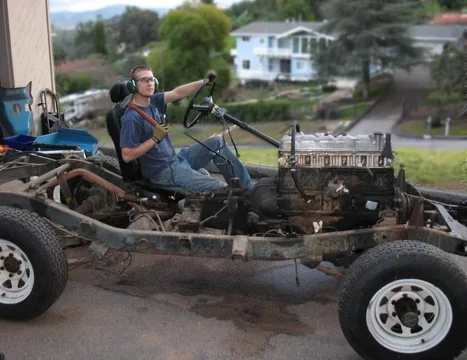
Next project, engine comes out and frame comes off.
What we gonna do today, Brain?
SILVER Star
I see at least a half dozen parts there I could use.
As a teenager, one of my worst automotive nightmares struck when I broke an allen bolt inside a constant velocity joint. It took two hours of drilling before the drill gave up and went to the great tool chest in the sky. I found another drill and eventually got the remaing bolt bits out. For years after, I saved the mauled hunk of German steel as a testament of my ability to dominate inanimate objects.
Nothing that bad has happened until March 2010 and the Battle of the FJ40 Oil Pan. It began innocently enough, before dropping the pan, I read the Mud FAQ and the prevailing wisdom was to sandwich a 2x4 between a bottle jack and one side of the oil pan, let it simmer overnight and the next morning, bada bing, the oil pan would be sitting on the garage floor. Except mine was still very much on the truck.
I verified that all the bolts were removed and went on to Mud trick #2: put the bottle jack on the frame rail, the 2x4 on top, and apply pressure against the side of the oil pan. I tried, waited and tried some more until the side of the oil pan was ready to deform. I swore. Next attempt was a thin kitchen knife into the oil pan gasket. After much persuasion, I finally got the knife blade through the gasket creating a 1” hole in the gasket. Progress! I pulled the knife out and began my next hole and the blade broke. I came up with new swear words.
Next was the box knife, broke 3 blades and developed a huge blister on the palm of my hand from pounding on the knife (despite wearing gloves.) One and half hours into the project, my sole success was measured by a 1” hole and an oil pan that I swear was laughing its drain plug off . So I broke out the Dremel, (I know, I wasn’t happy about this choice either.) The Dremel's cutoff wheel created a nice rooster tail of cork and my gasket excavation now totaled three inches. No joy on any oil pan movement. I once again counted all of the holes to make sure the bolts were out. Worried about damaging the sealing surfaces, I put the Dremel away and pounded a sharpened putty knife into that hole. 2 more hours passed and I was able to free one side of the oil pan completely. Still the pan showed no signs of surrendering.
I recreated the Dremel crime on the other side of the oil pan and worked the putty knife into that gasket and banged away at it for a full hour. I had now completely exhausted my knowledge of English adjectives and was thinking that what I really needed was a cassette tape where some sultry woman would teach me new bad words in 15 foreign languages. Trust me there’s a market for it.
Ultimately, I got the putty knife so that it had freed the gasket from the bell housing to the crankshaft pulley on both sides of the engine and still the oil pan remained stubbornly attached to the block. I spent another half an hour chiseling out the gasket behind the crankshaft pulley and the pan finally fell. Total time invested: 6 bloody hours.
Here’s what the bottom of the block looks like and the next shot is pieces of the oil pan gasket. The engine is going in for overhaul and I’ll ask the machine shop to address any problems with the sealing surfaces. The broken gasket pieces are pictured, the top side is smooth, black and rock hard. I’m not sure if the gasket was put on with J B Weld of if the oil pan had not been removed since the 40's birth day. Either one, I wouldn’t wish that task on any mortal.
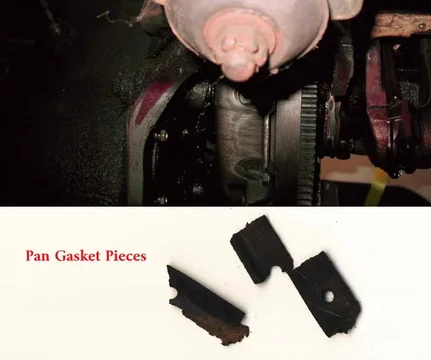
The rest of the engine removal went well. Richard and I began cleaning up 33 years of grease, sand and grime on the transmission and transfer case.
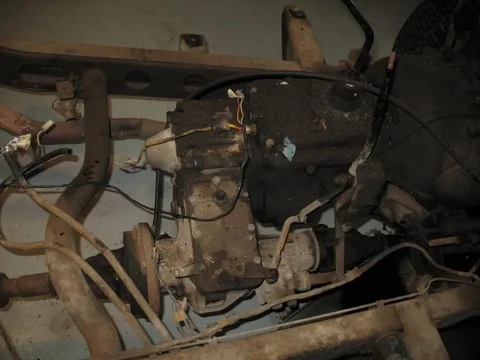
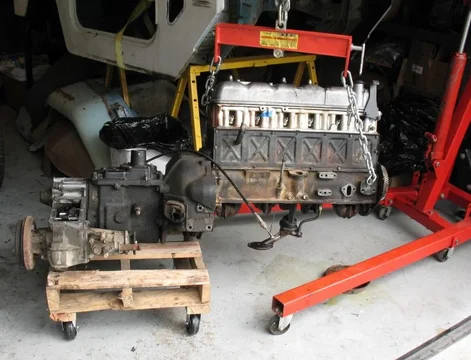
.
[