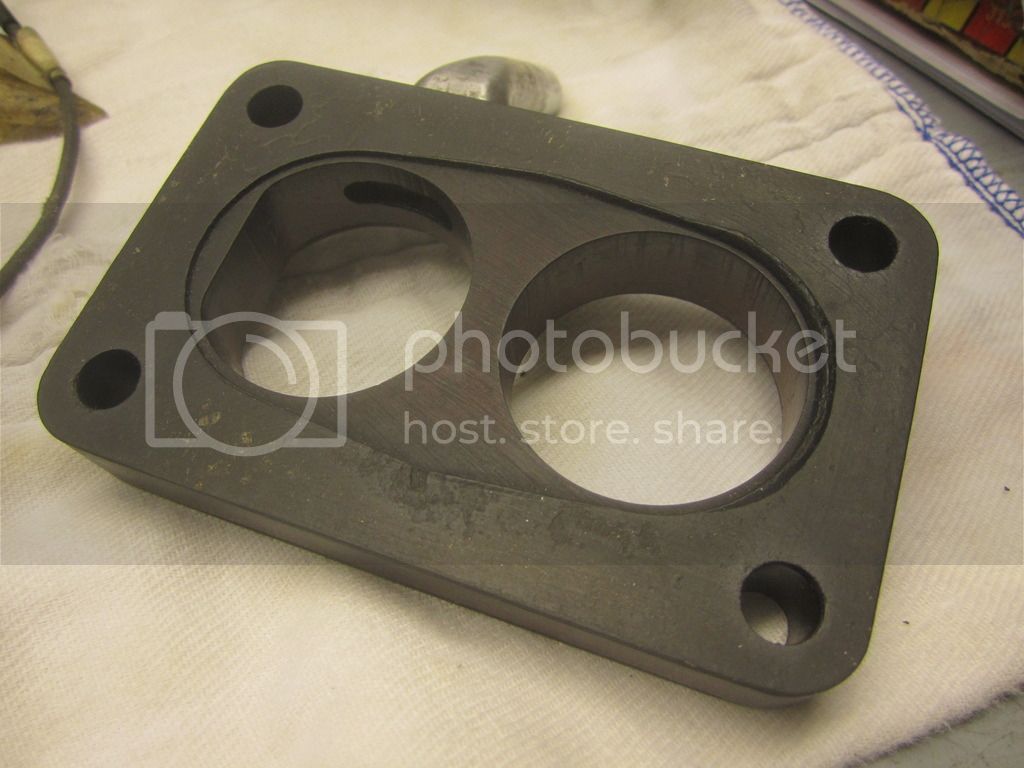
Missing carburetor insulator

This site may earn a commission from merchant affiliate
links, including eBay, Amazon, Skimlinks, and others.

Joined
Jun 6, 2013
Threads
7
Messages
51
Location
Virginia
Website
wolfcreekrcpark.com
Long story short. I took the carb off my '72 FJ40 a year and a half ago with plans to rebuild it. Ended up sending it to Mark's off road & had him rebuild it. I'm now putting it back on the truck.

I thought I was missing a gasket but after a bit of research, the carburetor insulator base plate is what I'm after.

I think I took pictures of everything I took apart... except what was between the carb & intake manifold. I don't remember taking this piece off (probably thinking that a replacement would be in the rebuild kit) but I saved everything including unsalvageable things like gaskets that came off in chunks. But can't make heads or tails of the zip-loc full of gasket chunks now.

Long story short, I don't have it and I'm not 100% sure what I took off but what is there now is metal to metal.

Is this basically all I need between the carb & intake manifold?

F and 2F Carburetor Insulator Base Gasket 1968-1987 [F2FBASE-GASKET] - $6.49 : CruiserParts.net, Toyota Landcruiser Parts
 
Item 2 and associated gaskets.

042-01D.jpg
 
I kinda recall Mark at one time talking about having reproductions of that insulator (they may have been aluminum?) ... You'd have to call to verify.

@65swb45
 
Thanks for the info. Yes, I had read where the gaskets were laminated to the insulator so thanks for clarifying that as I was a bit confused by that picture. I had come across that picture Googling & it was coming from SOR site but I couldn't find the actual insulator.

But now I'm real confused because I didn't take anything that thick off. I need to take another look at the manifold... I may have been looking right at it. I'm at work now & was pretty sure I was looking at metal but I was expecting to be looking at metal.

But wouldn't it need replaced regardless? I had it stuck in my head that there would be a gasket in the rebuild kit and even if it is still there, the thought of bolting my clean carb to a 40 year old gasket isn't sitting right in my head. But this is the first I've dabbled with my carb so... learning new stuff by the minute.

I plan to call Mark, he's west coast & I'm east so I have to wait till 4:00 which is just about now.
 
Yes, and I just spoke with Mark so I think I know where you're headed with this. My insulator is still on my manifold, right? Mark said to look for that hose.

By the way, the aluminum insulator he made was for the old model, '68 & older 1 bbl carbs.
 
When I got my '77 it had an old Rochester that was a completely plugged up piece of crap , so went with a Trollhole reproduction non-smog unit . Had to source the linkage set , pedal and that insulator plate/heat shield that is used on the later 2F engines that is bigger . That said , had the same issue - the used insulator had a lot of dried up pieces missing of that gasket . Being an old Weber rebuilder/mod shop I just made new gaskets and ground the old bonded material off - I have a platen plate setup that keeps things within .0001" of dead flat so it's no big deal here . Thought about doing used ones at the time that have bad gaskets for folks , could keep it to around $20 plus shipping...?
Never had a leak issue with mine since , not the first rodeo making things seal for carbs...
Sarge
 
When I got my '77 it had an old Rochester that was a completely plugged up piece of crap , so went with a Trollhole reproduction non-smog unit . Had to source the linkage set , pedal and that insulator plate/heat shield that is used on the later 2F engines that is bigger . That said , had the same issue - the used insulator had a lot of dried up pieces missing of that gasket . Being an old Weber rebuilder/mod shop I just made new gaskets and ground the old bonded material off - I have a platen plate setup that keeps things within .0001" of dead flat so it's no big deal here . Thought about doing used ones at the time that have bad gaskets for folks , could keep it to around $20 plus shipping...?
Never had a leak issue with mine since , not the first rodeo making things seal for carbs...
Sarge

I'd say there would be a market for it. Mark was telling me that he and Marv Spector had discussed doing that very same thing as he said he has a stack of insulators that are of no use because the surface had been marred up from someone trying remove the old gasket.

I have two houses, one I live at during the work week and one I play at on the weekends. The weekend house is on 60 acres in the National Forest so... naturally, that's where the landcruiser is. But it makes working on it challenging and I haven't been able to look at it and verify that the insulator is in fact still on the manifold. Based on the responses I've gotten here, I'm 99% sure it is but I'm not sure what kind of shape the gaskets are in.

As per Mark: he recommended removing it regardless so that the lower gasket could be inspected although I'm hesitant because the carb had been working for years prior to me removing it. It hesitated at highway speed and I thought that was simply because it needed rebuilt but Mark found a piece missing from when a previous owner (I've had it for 25 years so it was a while ago) had rebuilt the carb. I figured it had been rebuilt before because when I bought it, there were various spare parts including the left overs of a carb rebuild kit. Anyway, when I asked Mark if it would have run with that missing piece, he said yes, but it would have hesitation at highway speeds, which was exactly what the case was. He then said to inspect the laminated gaskets on both sides and if they were intact to just run with it and bolt the carb back on with the original insulator. This seemed counterintuitive to me to use a 40 year old gasket but... I've learned to trust his judgement... he knows a whole hell of lot more about my carb than I ever will. Finally he said if the gaskets are bad, remove and replace them with new ones. and I said "and be very careful not to mare the insulator?" and he said "be more than very careful"

Hopefully, I won't need one but in the event I do, I'd certainly pay $20 for those tolerances.

Let's face it, when you need a part, you need a part, and these old FJ parts aren't getting any easier to find. When I first bought this, Al Gore hadn't invented the internet yet but then again, I could just go down to the local Toyota dealer and for the most part, order what I needed.
 
The old, compressed gaskets don't seal well. I smooth them flat on the belt sander and use the aftermarket ones from a carb kit, never had an issue.
 
I've done the same thing, when required.
When I got my '77 it had an old Rochester that was a completely plugged up piece of crap , so went with a Trollhole reproduction non-smog unit . Had to source the linkage set , pedal and that insulator plate/heat shield that is used on the later 2F engines that is bigger . That said , had the same issue - the used insulator had a lot of dried up pieces missing of that gasket . Being an old Weber rebuilder/mod shop I just made new gaskets and ground the old bonded material off - I have a platen plate setup that keeps things within .0001" of dead flat so it's no big deal here . Thought about doing used ones at the time that have bad gaskets for folks , could keep it to around $20 plus shipping...?
Never had a leak issue with mine since , not the first rodeo making things seal for carbs...
Sarge

The old, compressed gaskets don't seal well. I smooth them flat on the belt sander and use the aftermarket ones from a carb kit, never had an issue.

Thanks for the tip. This makes sense to me... & the gaskets themselves are pretty cheap.
 
Unfortunately , unless you've got a very high tolerance leveling belt sander - none of them will provide a flat surface . The ends are always lower , sometimes by quite a bit despite best efforts to avoid this . I can build new insulators if they don't have a built-in vacuum nipple since I can source high quality phenolic insulator material locally and machine them to match the factory thickness/sizes . Once they are flattened on the platen , I'd use a slightly thinner and higher quality gasket material that won't dry out and crack - that's how I did the Weber carb setups with exception to the Sami and some Toyota mini truck builds which were aluminum adapter types . All surfaces spec'd out to less than .0001" , never had a leak and none reported in 10yrs yet . On a Cruiser six , the manifold itself is more of an issue at the cylinder head - we all know that from the start but at least removing the carb and any issues there is a start .

If someone has a pile of OEM insulators , both early and newer versions they could be re-surfaced and restored easily - just tossing that out there since used ones are getting stupid expensive to source . I'm sure someone could make up a stamp template and press out the later sheet metal heat shield as well - I'm not doing that as I just don't have the time here .

Sarge
 
The OE gasket material doesn't dry out & crack. It gets vandalized by people armed with gasket scrapers. The replacement gaskets dry out & crack.

The FSM says something like "Remove carb, inspect insulator block. If insulator gasket is damaged, replace insulator." Note that is does not say replace insulator every time or scrape off baked on gasket. It says inspect, replace only if necessary.

Case study of 1: The insulator on the dyno engine is 35 years old and has had 2,500 different carbs bolted to it over the last 20 years, no problems. Clean, flat carb on clean, flat gasket=good seal.

If an insulator block has OE gasket that appears to be too stiff to get a good seal, soak it with b'laster before installing. It will absorb the solvent and soften slightly.

When the insulator has been fuggled with a gasket scraper, it should be milled flat, than a new gasket(s) is shellac'ed to the insulator block, a little grease is brushed on the intake & carb base, then insulator & carb installed to clamp the new gasket between two flat surfaces while glue sets.

HTH
 
When I got my '77 it had an old Rochester that was a completely plugged up piece of crap , so went with a Trollhole reproduction non-smog unit . Had to source the linkage set , pedal and that insulator plate/heat shield that is used on the later 2F engines that is bigger . That said , had the same issue - the used insulator had a lot of dried up pieces missing of that gasket . Being an old Weber rebuilder/mod shop I just made new gaskets and ground the old bonded material off - I have a platen plate setup that keeps things within .0001" of dead flat so it's no big deal here . Thought about doing used ones at the time that have bad gaskets for folks , could keep it to around $20 plus shipping...?
Never had a leak issue with mine since , not the first rodeo making things seal for carbs...
Sarge

Sarge

Could you do this same clean up work on the EGR spacers that go between the fuel bowl and the throttle body? I have a small stack of messed up ones of those as well. It's been one of those 'get to it one day' things. Maybe that day has come.:)
 
The carb intermediate block is small & flat, so it is quickest to clamp in the 4-jaw.

The insulator base, either the 2F style w/ heat shield or the F with big PCV pipe, is better to setup on the mill.

DSC07727.webp


DSC07730.webp
 
The OE gasket material doesn't dry out & crack. It gets vandalized by people armed with gasket scrapers. The replacement gaskets dry out & crack.

The FSM says something like "Remove carb, inspect insulator block. If insulator gasket is damaged, replace insulator." Note that is does not say replace insulator every time or scrape off baked on gasket. It says inspect, replace only if necessary.

Case study of 1: The insulator on the dyno engine is 35 years old and has had 2,500 different carbs bolted to it over the last 20 years, no problems. Clean, flat carb on clean, flat gasket=good seal.

If an insulator block has OE gasket that appears to be too stiff to get a good seal, soak it with b'laster before installing. It will absorb the solvent and soften slightly.

When the insulator has been fuggled with a gasket scraper, it should be milled flat, than a new gasket(s) is shellac'ed to the insulator block, a little grease is brushed on the intake & carb base, then insulator & carb installed to clamp the new gasket between two flat surfaces while glue sets.

HTH

This is essentially what I was told by Mark. I guess I'll have to change the name of this thread... Missing insulator found! Good thing Toyota didn't use rattlesnakes as insulators. 44 years old, looks to be in pretty good shape. I will take you up on that marinade trick, excuse the noob but what is b'laster?

IMG_2077_zpsdm3lr3ng.jpg
 
Penetrant/lubricants like PB Blaster and such will soften gaskets that are old and hard . I've seen 5 insulators total , all were dried to the point that a fingernail could take sections off but then again I've seen other parts that just don't seem to age , ever . I think a lot of it is due to weather and driving conditions/overheating and other factors . Not to mention the rampant gasket-scraping cavemen that don't realize the damage they are doing . Yes, I prefer the lathe on resurfacing insulators/blocks as well - can't beat it .

The gasket material I use is aircraft-quality and should outlast all of us . I hate getting phone calls about carb leaks , ever . What I send out the door should never have an issue unless someone vandalizes it - and I have caught 2 people doing just that to get warranty work for their mistakes . I almost always use thinner gaskets on carbs that oem - it just depends on the thermal expansion of other materials involved . The phenolic I use to make spacers is heat rated to 550* F - should never be an issue to replace cracked insulators or I can make them from raw aluminum plate stock .

Mark - if you want those EGR spacers done , give me a buzz or a pm..
Sarge
 
Leave me a message at the shop with your #; we will definitely talk.
 
Back
Top Bottom