Lower rad hose heater - ineffective

This site may earn a commission from merchant affiliate
links, including eBay, Amazon, Skimlinks, and others.

Joined
Nov 3, 2008
Threads
107
Messages
1,146
Location
Winnipeg, Manitoba, Canada
I've always wondered about these heaters, and how they can work. I've never used one before, just had block heaters and once had a circulating heater hose heater.

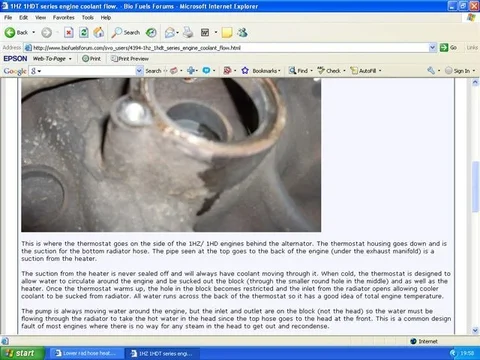
Anyway, I have a lower rad hose heater on my 1HD-T and it's installed in the...you guessed it...lower rad hose. But, the thermostat lies between the heater and the engine, effectively blocking the flow of heated coolant into the engine. The area around the heater is relatively wide open, so a considerable amount of heat is lost to the air. So how does heat make it to the engine? I'm just not getting it. And it doesn't seem to do much to help my truck on -30°C or colder mornings. The lower rad hose is hot, the thermostat housing is warm, the rest feels cold.

A large percentage of vehicles have the thermostat on the upper hose. On these I can see the heated coolant thermo-circulating through the engine. But on mine...?????

Someone please explain. I'm thinking I need a frost plug type block heater or an actual circulating one because this inline rad hose heater isn't doing much except waste heat and electricity.
 
I've always wondered about these heaters, and how they can work. I've never used one before, just had block heaters and once had a circulating heater hose heater.

Anyway, I have a lower rad hose heater on my 1HD-T and it's installed in the...you guessed it...lower rad hose. But, the thermostat lies between the heater and the engine, effectively blocking the flow of heated coolant into the engine. The area around the heater is relatively wide open, so a considerable amount of heat is lost to the air. So how does heat make it to the engine? I'm just not getting it. And it doesn't seem to do much to help my truck on -30°C or colder mornings. The lower rad hose is hot, the thermostat housing is warm, the rest feels cold.

A large percentage of vehicles have the thermostat on the upper hose. On these I can see the heated coolant thermo-circulating through the engine. But on mine...?????

Someone please explain. I'm thinking I need a frost plug type block heater or an actual circulating one because this inline rad hose heater isn't doing much except waste heat and electricity.

So ......I take it that your thermostat is in the housing to which your BOTTOM radiator-hose connects.........

I was surprised to find this situation with my wife's Nissan Pulsar car too (after fruitlessly searching for the thermostat in the traditional place - which of course is the housing to which the TOP hose connects).

Nothing is sacred to modern carmakers I'm afraid :mad:

If so - I think your conclusion that you can't use a "lower-hose heater" is correct.

:cheers:

PS. I know NOTHING about your engine.
 
Hmm, didn't know that was where the thermostat was located, haven't had to look for it. I do find my heater in the lower rad hose works, but that's only by observing an easier start and quicker warm up. Also the snow on my hood slushes off rather than froze as before.

If the thermostat is blocking the coolant's tendancy to rise when heated. How about drilling a small hole into the thermostat like one would do on the 22RE? That way a little coolant is allowed to pass through. Weren't not talking about a lot of flow here anyways.

Of course I'm speaking out of my :censor: as I haven't yet seen the thermostat for my 1HDT :meh:
 
I suppose it's possible, however I've never seen an engine coolant system configured as described. In every case I've seen the lower rad hose connects to the suction side of the water pump along with the heater return lines, which provides a thermosyphon path for the warmed coolant. The lower rad hose heaters in both my vehicles work just fine, even at 30 below.
 
Whatever it is, what questions was it supposed to answer?

Sorry.

I thought that link led to a site that shows his thermostat is indeed located in his INLET housing and therefore will be preventing heated fluid (from his hose heater) from entering his engine.

I guess I'm mistaken (or perhaps it doesn't show up on your screen the same as it does on mine).

How's this for a better link?:

1HZ 1HDT series engine coolant flow. - Bio Fuels Forums

Or here I'll try and insert the post itself as a pic??:

1HDthermostat.webp

Cheers
1HDthermostat.webp
 
Last edited:
yep, thermostat on hd-t is in the lower hose. Probably means that a lower hose heater won't work.
You might be able to install a smaller heater-hose heater on the heater return that goes to the tstat housing...
 
It was recommended to install the lower rad hose heater in my 1HD-T. I had a spare lying around so put it in knowing that I'd have a toasty warm rad hose and not much else.

For next winter, I think I'll install a proper circulating heater like the one pictured below. Made by Phillips and Temro right here in Winnipeg. Aftermarket Cold Weather Products

My wife's TDI has one of these and after an hour plugged in, the temp gauge reads 1/3 when she turns the key on. Almost instant heat!
zerostart2.webp
 
It was recommended to install the lower rad hose heater in my 1HD-T. I had a spare lying around so put it in knowing that I'd have a toasty warm rad hose and not much else.

For next winter, I think I'll install a proper circulating heater like the one pictured below. Made by Phillips and Temro right here in Winnipeg. Aftermarket Cold Weather Products

My wife's TDI has one of these and after an hour plugged in, the temp gauge reads 1/3 when she turns the key on. Almost instant heat!

How much one of those cost? and does anyone know where to find them in Calgary, AB?
 
Last edited:
I have one of those circulating heaters kicking around as well, used to have it on my bj40, and yes they get the engine a lot hotter than the lower rad hose heaters do.

Same deal, fire it up and the temp guage is already reading warm. instant heat.

Even had warmth ( not quite heat...) coming out of the rear heater before I'd even started it.


I was pretty disappointed in the rad hose heater I put into my wife's civic a few years back. ended up never plugging it in as it didn't make much difference. I'd hoped it would help clear the windows a little quicker with warmer coolant in the am, but not enough to bother with.
 
Funny, it seems to be the same set-up as the Nissan TD4.2. My engine never starts at 1/3 on the temp gauge but it does start like a warm engine. Maybe my inline gets the water hot enough to pop the thermostat open. I know the glow is a lot shorter, so the coolant heat sensor on the other side has to be getting some heat.
 
LOL!!
the PZ HZ HDT all share the same cooling configuration.

i have these lower rad hose heaters installed in my own trucks and they work fine.
the thermostate also has a small hole to allow the coolent to pass... think about it. if there was NO circulation then how would the water pump move the coolant when cold? the hot water will find its way around the system and the thermostate will open to allow easy flowing.

i have installed them in dozens of customers trucks with no issues.

how long are you plugging it in for?
 
... think about it. if there was NO circulation then how would the water pump move the coolant when cold?......

:frown:No-one is saying there is no circulation Wayne.

If it is the type of system I imagine, then the waterpump circulates the coolant within the engine (and the interior heater too if it is turned on) immediately on start-up while the thermostat is shut. But with the thermostat shut, the pump is prevented from sucking coolant from the radiator. And so the radiator coolant (including the coolant in the lower hose) is isolated from the engine coolant at this time.

In other words, nothing much has changed from the traditional cooling system where the thermostat is located at the top hose.

....the thermostate also has a small hole to allow the coolent to pass...

Some do - Yes.

(The non-OEM t/stat I just fitted to my wife's car doesn't whereas the OEM Nissan thermostat that I removed did.)

A lot of people make a big fuss about these "bleed holes" and about whether they are positioned "to the top" or not. All I can say from my experience is - "they help in bleeding/burping out air when you refill an empty system with coolant".

On a freezing cold morning (like you poor b#stards get over there), I doubt whether you could rely on the flow through that itzy-bitzy little hole to warm your engines much. :D

....and the thermostate will open to allow easy flowing....

I don't think the hose-heater would make the thermostat open because the "operating wax sensor" for the thermostat is located on the cold/engine side (as far as I can work out).

...i have installed them in dozens of customers trucks with no issues....

My experience is that a lot of thermostats never close fully. (After all, that's why I replaced the one in my wife's car - It had a rubber-seat that had deterioted to cause permanent leakage.)So in such a system (with a leaky thermostat) a lower-hose heater would probably work well.

But I can't imagine it working well in any system where a "lower-hose-connected thermostat" is closing properly.

Of course a little heat will indeed pass through the thermostat by conduction through the metal and via flow through that little bleed hole (if present) so you should still get marginal gains from a lower-hose-heater installation.

:cheers:


PS. When I had trouble finding the t/stat in my wife's car, I searched quite a bit on the internet and found that in some engines the thermostat is even located BEHIND THE WATER PUMP requiring engine removal for replacement!!!!!

And ----- I live in a "sub-tropical" climate (tempted to say "paradise" here :D) so I have absolutely no experience of any form of "plug in heaters". So feel free to wipe-out my entire input due to this "lack of experience".
 
not saying your prognoses is incorrect.
just saying the lower rad hose heater works for me...

and yes, the small hole would do little (if it is there)...
 
Mine works great

I was in Calgary over Christmas and overnight temps hit -30 celcius and in NE Calgary the wind howl's down McKnight dropping the temp even more. Woke up one morning and had not put the LC in and she would not turn over.... tried three or four times and she would not go :crybaby:. Plugged her in for 2 hours and even with a less than 1/2 batteries on start up she fired right over :). I now plug it in as temps drop below -20 celcius and start ups are so easy and smooth and warm up times are so low that I am okay with it not working 100% as good as a circulating pump cause I know hot air and other stuff rises and therefore should circulate and bring the block upt to at least 0 or higher and that is good for me for a diesel start.
:cheers:
Sheldon
 
I was in Calgary over Christmas and overnight temps hit -30 celcius and in NE Calgary the wind howl's down McKnight dropping the temp even more. Woke up one morning and had not put the LC in and she would not turn over.... tried three or four times and she would not go :crybaby:. Plugged her in for 2 hours and even with a less than 1/2 batteries on start up she fired right over :). I now plug it in as temps drop below -20 celcius and start ups are so easy and smooth and warm up times are so low that I am okay with it not working 100% as good as a circulating pump cause I know hot air and other stuff rises and therefore should circulate and bring the block upt to at least 0 or higher and that is good for me for a diesel start.
:cheers:
Sheldon

I totally agree that the heater must give the block some heat. The problem is that most of the 600W put out by the heater is wasted. Being a diesel owner (x2) I hate to see energy wasted. Next winter I'll install the circulating heater and be done with it.

I think most of the JDM importers should be installing circulating heaters instead of lower rad hose heaters as a default. The price of the heaters is not much more, and once you've installed a couple, they are not difficult - especially if you're flushing the coolant, etc anyway.
 
So we're coming to a consensus that the lower rad hose heater does work, which I have found also, but not efficiently due to:

1. Its location being not low enough to create and sufficient rise to the block
2. With the Thermostat at the bottom, rather than on top, it prevents the heated coolant from traveling up into the block.
3. The thermostat wax core is on the other side so the heated coolant wouldn't open the thermostat if it could.

My question is how would the heated coolant pump be better if the thermostat remains closed? If there is a small by-pass hole in the thermostat, is it sufficient to make the pump work? Wouldn't it then be sufficient for the convection currents of the lower rad heater?

Is this thread reached this point yet? :flipoff2:


:deadhorse:
 
So we're coming to a consensus that the lower rad hose heater does work, which I have found also, but not efficiently due to:

1. Its location being not low enough to create and sufficient rise to the block
2. With the Thermostat at the bottom, rather than on top, it prevents the heated coolant from traveling up into the block.
3. The thermostat wax core is on the other side so the heated coolant wouldn't open the thermostat if it could.

My question is how would the heated coolant pump be better if the thermostat remains closed? If there is a small by-pass hole in the thermostat, is it sufficient to make the pump work? Wouldn't it then be sufficient for the convection currents of the lower rad heater?

Is this thread reached this point yet? :flipoff2:


:deadhorse:

The tank style circulating heaters plumb into the block and heater core. You mount the heater quite low. They draw coolant from the lower block drain, heat it, then the heated coolant rises (flows) to and through the heater core and into the engine block. Once warm there is a pretty decent circulation despite no moving parts.

Since the t-stat is closed, the coolant ends up circulating around the engine and not the radiator.

You need to ensure your HVAC temperature selector is set to hot so that coolant flows through the heater core when plugged in.

There is a warning from the manufacturer stating: "Vehicles with heater hose connected to radiator cannot use circulation type heaters". There are also two series of these heaters: one with an integrated check valve, and the other with no check valve. I'm not sure of the check valve requirement on a 1HD-T. I have to study the coolant/heater plumbing first. The VW TDI's cannot use the one with a check valve.

And this thread's not closed until I say it's closed...:skull:
 
I think most of the JDM importers should be installing circulating heaters instead of lower rad hose heaters as a default.
Since the LRH heater works just fine on my JDM, I don't see any reason for making circulating heaters the 'default', but perhaps as an option on certain models with the thermostat in the LRH.
 
Since the LRH heater works just fine on my JDM, I don't see any reason for making circulating heaters the 'default', but perhaps as an option on certain models with the thermostat in the LRH.

Now imagine the temperature hovering around -35°C, you crank over your engine, turn on the heat and warm air comes out of the vents! You relax on your concrete seat and watch your windows thaw and your breath disappear.

I'm not sure where you are located, but instant heat makes a huge difference here in Winnipeg. Oh, and seat heaters will make quick work of those rock hard seats.
 
Back
Top Bottom