flooding a 40

This site may earn a commission from merchant affiliate
links, including eBay, Amazon, Skimlinks, and others.

sarca

I upped my wrenchin skills, now up yours!
Joined
Jun 2, 2012
Threads
101
Messages
1,542
Location
Coastal NC
Website
onsc4x4.com
Here's the question..the only road out to the highway where we live floods in heavy rain. There were a couple of rainy seasons that we were marooned. Now I've got this beast 40. As she currently stands, how deep can I drive her through water? Here are pictures that I took one year, BEFORE the water crested. At it's worst and deepest, depth is 4feet for about 30 foot length.

Can Jane do it? The huz says Yes, slow and easy and do not stop and obviously if it dies, do not try to restart it..so is he right?

100000469659443_161052693920385.webp


ForumRunner_20130605_210314.webp

100000469659443_161052693920385.webp


ForumRunner_20130605_210314.webp
 
Cruisers were designed to take on water pretty deep. A little bit above the bumper and your still safe. Slowly push through the water with steady momentum.
 
Carb sits at about 4 feet? The breathers. Uhm. You mean on the diff, right? Sorry.. I wasnt prepared.. with the flooding expected from Andrea in the next few days I just began pondering the possibilities. My idiot neighbors are probably going to end up knocking on the door asking for recovery assistance (the pic I took above waste first of 4 vehicles that had to pulled out) I definitely don't want to ruin Jane in ignorance.
 
Look up extending breathers. You'll suck water into the diffs if you don't. Then there's the t-case and tranny (I think. I avoid water)... And keep in mind that your doors don't seal water tight so there goes the carpet or whatever you have in there. Don't try it just to be the hero when some idiot can't stay away.

That said, keep moving steady and keep a bow wake ahead of you.

--john
 
I would not drive thru water unless I absolutely had to. There can be hidden dangers and its not worth the risk. My 2 cents American.
 
TS and hurricane flood waters are a little different than coming off the mountains. As long as you're not near a river/stream you're probably just talking about low lying field flooding that will stick around until the ground absorbs it or it evaporates. Just don't hit the water and create a wave that goes over your hood and into the carb. Also remember that the fuse block and distributor is lower than the carb at around your knee...
 
Be sure and carry some WD-40 in case of a flooded dizzy. WD actually stands for "Water Displacement" and became known over time as an all purpose lubricant. It actually does what it was intended to do, displace water, a lot better than lubricate or penetrate. That's probably why we are seeing additional products from WD-40 specifically for those applications. A few squirts in dizzy will often get you back up and running if you get water in there.

:beer: R
 
I'm with the other guys. Make sure to extend not only your axle breather, but your transfer case breather up to the engine bay. That'll keep water out of the diffs and transfer case. 4' is pretty deep, but if you're in and then out, you shouldn't have a problem. At 4' depth, plan on water coming into the cab so make sure you don't have anything on the floor that you mind getting wet.

Is that a Chevy Colorado in the picture above? If so, that water isn't even 2' high. I wouldn't worry at all about 2' of water.
 
perfect reason to add a snorkel. Had the 100 in a little over 4 feet, and that's not a good feeling at all...
 
I'm not sure about the idiot truck in the pic. It was the first of 3 that our area claimed that time. The trucks kept getting ballsy-er and bigger..on day two a bunch of the older people in the hood were sitting in their lawn chairs with their PBRs egging on everyone else. Next door neighbor had a shiny new lifted Heep (the one that looks like a baby H2) which ended up being totaled. Not too bright around these parts..I've seen a video of a 40 in about the same flood stage..let me see if I can find it.
 
(fixed)


That's not 4' of water, that's closer to 4" of water!!
 
You are correct...remember that dip in the road to my house when you first come off the highway? Three times the water has crested right up to the highway. I suppose in either case I'd want to disconnect my inverter! bahaha
 
You are correct...remember that dip in the road to my house when you first come off the highway? Three times the water has crested right up to the highway. I suppose in either case I'd want to disconnect my inverter! bahaha

Crested up all the way to the highway? That's a bit of elevation.

The most concerning things are:
1. Water high enough to get into your distributer ( should be sealed and vented to the cabin from the factory )
2. Water high enough to be sucked into the intake of your motor

If the water is high enough to risk either, then I wouldn't go in the water. If it was just the dizzy and not the intake getting wet, then I'd consider it, but I'd be asking for some $$ in recovery fees for whoever I was rescuing. The risks are way high.
 
Damn I wish I had that problem... would be fun. I've done quite a few deep water crossings a few here at the outer banks, one that came over my hood and quite a few back in cali that came over the hood.

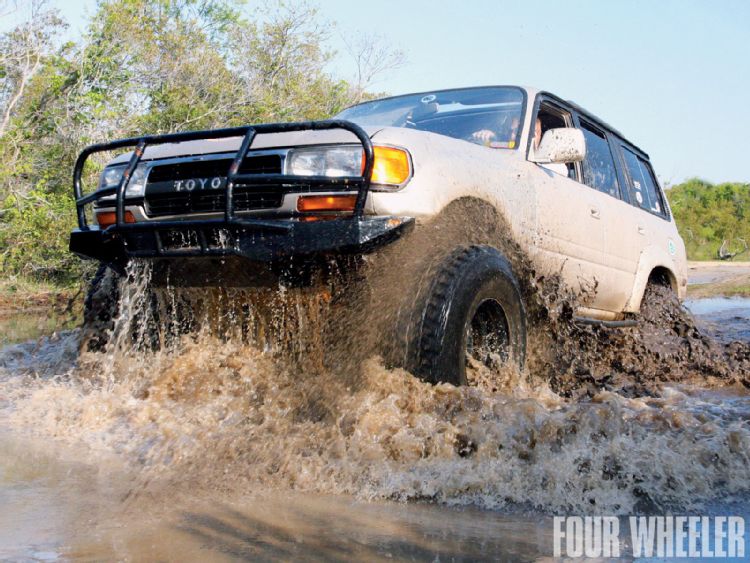
Here's me coming out of one that came of over the hood and was put in our 4wheeler onsc spring tide ride article. (sorry shameless plug but I love this pic :grinpimp:)

129_1101_02_o+129_1101_spring_tide_ride+1992_toyota_land_cruiser_fj80.jpg


as others have said you will need to extend your diff breathers and t-case breathers. Don't think that trans you have has a breather on it.

Don't hit the water too fast (even on small water holes) as I did once when I was caught up in the moment or you will get the dizzy wet.

To answer your question though... extended vents on all drivetrain part... plan on replacing fluids more often than not anyway... liberal use of silicon grease in all electrical connections. Sealed and vented distributor. Snug fitting spark plug wires and liberal use of silicon grease... or mixed silicon grease and silicon sealant. All electronic units under the hood and in the cab. sealed with silicon sealant at all seams... and heavy silicon grease at all connections.
 
Back
Top Bottom