

74 FJ55 Carb Help Needed

This site may earn a commission from merchant affiliate
links, including eBay, Amazon, Skimlinks, and others.

Joined
Oct 13, 2008
Threads
18
Messages
231
Location
Maricopa, Arizona
Posted this in the 40/55 section also.

I've been having some issues with my carb not being dialed in correctly and thought it was because of a vacuum leak at the intake manifold. Had the manifold machined flat, new remflex gasket and now it either has not get up and go or runs incredibly rich and sputter and dies. Mark A. rebuilt the carb for me but a few local shops have "tried" to dial it in. Now I'm not sure what they did to all of the settings and don't know how to get back to stock. I have a chiltons and haynes manual but can't find my haynes and I don't see anything in the chiltons that seem to make sense. I took some pictures of the questionable screws.

This is the backside, closest to the firewall part of the carb. How should these three screws be set up? The Green and Purple screw have been messed with by the shops and by me. I don't think the yellow one has been moved
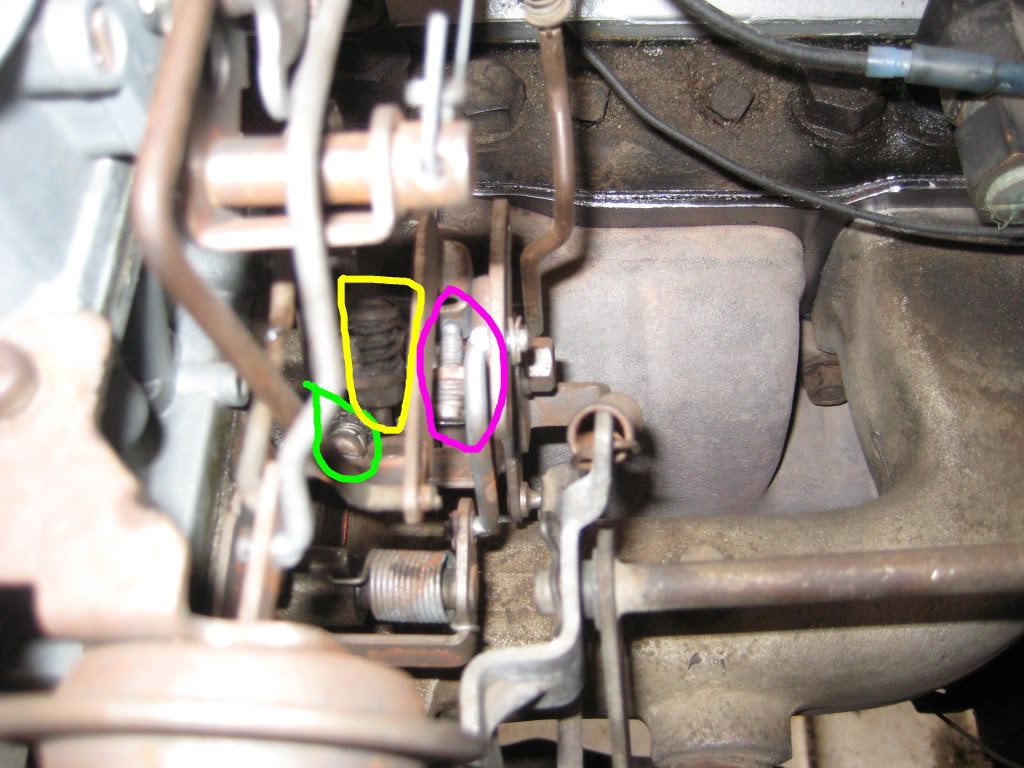
Carb1.jpg


Drivers side view of the carb, same ? as above
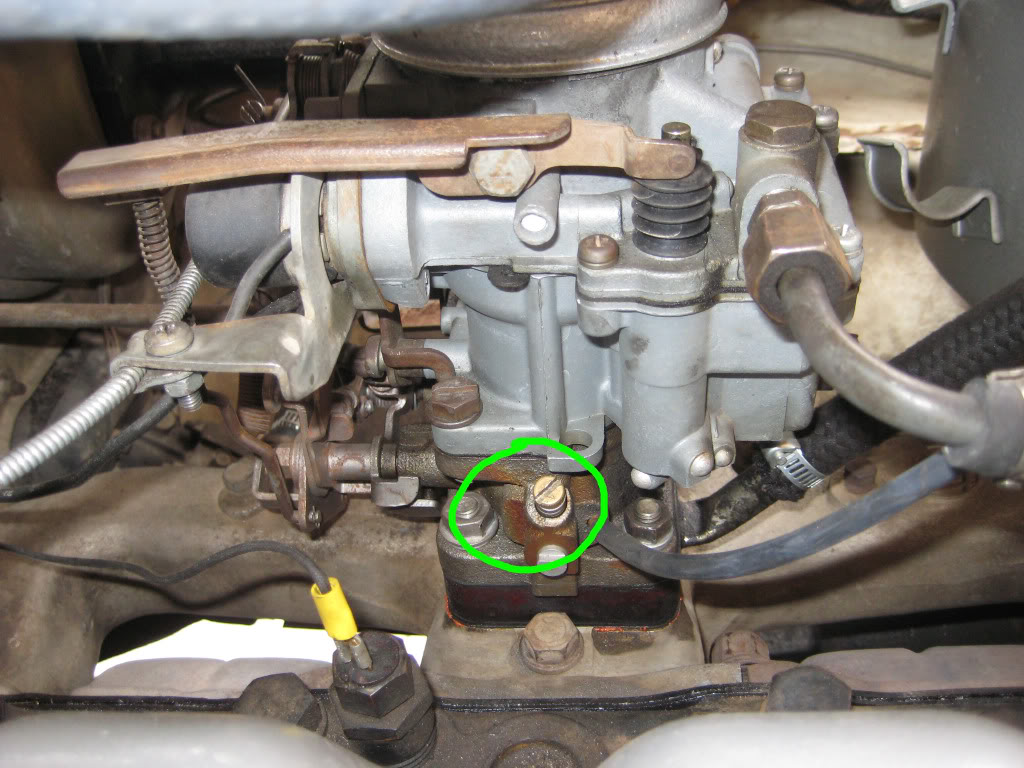
Carb2.jpg


Thanks, I'm waiting for a new manual and have been looking for the toyota fsm on the 73-74 models.
 
I'll take a shot:

1st pic purple - idle speed screw - determines how far the primary throttle blades are open at idle; I believe green is high idle, and the yellow IIRC is a choke break, but I'm not sure (and my excuse is that I'm a Chevy guy...).
2nd pic - holy accelerator pump lever batman! Green is idle mixture screw.

With the engine warm, it should not draw fuel from the primary venturi, but run off the idle circuit (i.e. the mixture screw on the pass side of the carb). IIRC initial setting for the idle speed screw is with carb off, measurement from the bottom, specs are in the manual.
A good thing to start is with engine off, turn the idle mixture screw in, and count how many turns it takes until it's fully seated. Turn the screw back to where it was, and repeat, this time with the engine running - note when the rpms start to drop. You should be able to stop the motor with this screw. A good starting point is 1/2 turn out from where the rpm drop was. If you can turn the mixture screw all the way in and the engine keeps running, back the idle speed screw out until the engine becomes responsive to the mixture screw.

The no go/rich condition may not be fuel alone, but also related to ignition - not enough timing advance to burn the mixture. The vacuum advance port next to the mixture screw looks a little weird in the pic (that's not loose, is it?); I assume this vacuum line goes to the distributor. A vacuum gauge would be useful, same for a timing light, and ways to measure rpm. Where's timing?
 
Thanks for the help. What's throwing me is that it was running fine for the last 2 months then it started running really rich like it was flooding. The Vac advance port is nice and snug, the dissy has the pertronix electronic ignition. I have a timing gun but nothing (no bb or mark thats visible) to base it off of. I just had the manifold machined and put on a new remflex gasket because I had maybe 11 hg of vacuum at the manifold port for the brake booster hose. It's a little higher now 14-15. I can only guess the timing is a little advanced but don't have any way to prove that.
 
why don't you see the ball/line with the timing light :confused: - how can you know that timing is o.k. and the dizzy wasn't moved ?

do you know whether the solenoid works properly ?
 
The bb is long gone and the line is covered in 36 years of oil and goo. The dizzy is still in the same place that it was installed from the mechanic that did the valve adjustment and timing. I marked it just in case it ever moved. I have a 2f motor that I'm in the early stages of rebuilding so I just want everything I have currently to work until the swap. But the old pig likes to fight me every step of the way ;)

The solenoid is hooked up and working, I unplugged it and it ran really bad. Did you do your engine swap yourself? If not who did it for you? I found a machine shop that will let me take apart the motor and help with it as long as I buy my parts from them.
 
some PO installed the new engine - no idea who and when

The bb is long gone and the line is covered in 36 years of oil and goo.
:confused: I don't know how it looks on a 1F, but the 2F has a little window to open and look for the timing mark - there better not be grime in there :eek:

if you are confident about the timing, it's down to chasing vacuum leaks and setting idle speed and mixture
 
In my carb experience the most often seen idle problems are:

Vacuum leaks, use carb cleaner spray on the manifold, etc to locate.

It must operate on the idle circuit to work properly. On yours it looks like the idle speed and choke idle kick up are screwed in too far. Look into the carb with it the motor idling, if there is fuel dripping, spraying from the booster venturi, it's running on the mid range circuit and will not set properly. This is most often caused by the idle speed screws being turned too far, often needed to mask/compensate for another engine running problem.

The early Aisin carbs are simple, reliable, bordering on crude. The main carb problems that prevent them from running on the idle circuit are, a passage/jet clogged or the idle cut off not working, this is pretty rare. Most often it's another engine problem (compression, valve adjustment, vacuum leak, timing, etc) that is being blamed on the carb. Most "techs" nowadays don't have much experience with carbs, most cars have been FI sense before they were born, so it's best to find the "old guy" to work on it.:hillbilly:
 
In my carb experience the most often seen idle problems are:

Vacuum leaks, use carb cleaner spray on the manifold, etc to locate.

It must operate on the idle circuit to work properly. On yours it looks like the idle speed and choke idle kick up are screwed in too far. Look into the carb with it the motor idling, if there is fuel dripping, spraying from the booster venturi, it's running on the mid range circuit and will not set properly. This is most often caused by the idle speed screws being turned too far, often needed to mask/compensate for another engine running problem.

The early Aisin carbs are simple, reliable, bordering on crude. The main carb problems that prevent them from running on the idle circuit are, a passage/jet clogged or the idle cut off not working, this is pretty rare. Most often it's another engine problem (compression, valve adjustment, vacuum leak, timing, etc) that is being blamed on the carb. Most "techs" nowadays don't have much experience with carbs, most cars have been FI sense before they were born, so it's best to find the "old guy" to work on it.:hillbilly:

Thanks, I borrowed and old FSM and was reading it last night. I agree that the motor probablly has a lot bigger issues and that was why the carb was adjusted incorrectly. I will try to get the settings all back to original and then go from there. I checked for leaks with the plumbers gas tank on but not lit, around the manifold and carb and didn't have any changes. The motor burns a lot of oil and is on it's deathbed so I'm not expecting much, just a little better than now :hillbilly:
 
alternatively, you could do what I do and bring it to Randy
 
alternatively, you could do what I do and bring it to Randy

That doesn't sound like a bad idea...

I adjusted the idle speed and mixture screws and seem to have it running pretty good. The problem is I've never driven or been in any old FJ other than mine. Nothing to compare it to. I'll see how it does this weekend :steer:
 
you are welcome to drive mine, Kevin sure likes it

but then you'll want a 2F :hillbilly:
 
Already want a 2F, have one sitting in the garage waiting for a rebuild.

Well I now think the timing is off but the vac advance nipple is hitting the oil filter, so I can't adjust it where I think it needs to go...
 
I don't think you would want to advance it any farther anyway - mine stops just shy of hitting the oil filter

but you should use a timing light and measure vacuum anyway
 
Back
Top Bottom