1HDT Coolant into Overflow - What am I missing?

This site may earn a commission from merchant affiliate
links, including eBay, Amazon, Skimlinks, and others.

I might have missed it, but has radiator cap been suggested?

My 1hd-t puked coolant a couple of times, but it was intermittent. I thought i had a cracked radiator tank, but couldn't confirm the source.
Eventually I was able to see the overflow bottle overflowing and coolant ran down the radiator and was dripping to the ground near the bottom radiator hose.

A new radiator cap fixed it for me. Coolant was pushing into the overflow tank, which is normal, but was not getting sucked back into the radiator, but normal.

After fitting a new cap, I never had it happen again.

This happened early in my owning this vehicle, and I later turned up the wick on fuel and boost etc and never had an issue again.
 
I might have missed it, but has radiator cap been suggested?

My 1hd-t puked coolant a couple of times, but it was intermittent. I thought i had a cracked radiator tank, but couldn't confirm the source.
Eventually I was able to see the overflow bottle overflowing and coolant ran down the radiator and was dripping to the ground near the bottom radiator hose.

A new radiator cap fixed it for me. Coolant was pushing into the overflow tank, which is normal, but was not getting sucked back into the radiator, but normal.

After fitting a new cap, I never had it happen again.

This happened early in my owning this vehicle, and I later turned up the wick on fuel and boost etc and never had an issue again.

Thanks for commenting @mudgudgeon . Not sure about others, but the radiator cap is where I started to try to fix this issue. I tried a couple different new OEM caps, an aftermarket cap, then yet another OEM version that came with the new radiator. I envy the success of your Occam's razor-style solution! No need to make things more complicated.

As mentioned above, I have all the parts to pull the head and see what I find, but still haven't dug in. I started the truck for the first time in many months to move it to my new shop space (the next building over) and it fired right up without issue. It would be so easy to ignore the issue and just keep adding coolant. However, I doubt that would be good for the long term health of the engine. And I'd have $1000 worth of ARP studs, various gaskets, etc. that would go to waste!
 
I would be going after the block and head flatness and also the RA of the head and block deck as the first culprits not allowing the head gasket to seal completely.
Mls gaskets need a pretty smooth RA (and of course flatness) to seal right
I had this issue on my 3b when i redid the head, and my (aftermarket) gasket was too thin by a hair and the block deck RA was too rough. After sorting both out it sealed well and pushes around 20 psi
 
@perrobravo I was reading on the Aussie 1hd Facebook group about the "pushing coolant" issue, which seems to be common. one guy mentioned that it could be the locating dowel relief in the head not being deep after a resurfacing. The thicker gasket should compensate of course. Have you looked into it?
 
@perrobravo I was reading on the Aussie 1hd Facebook group about the "pushing coolant" issue, which seems to be common. one guy mentioned that it could be the locating dowel relief in the head not being deep after a resurfacing. The thicker gasket should compensate of course. Have you looked into it?
good call,
you could also burn down the locating pin on a sander...
 
I have kind of the same issue with my 1996 manual 80 series, spit coolant after a long trip but only if I drive over 80mph, but after it cools down the radiator sucks the coolant again, maybe the 1.1bar radiator cap helps ? Or maybe the fan clutch ?

image.webp
 
Won’t hurt to do another block test to be 100% sure exhaust gasses are not pushing it thru and try radiator cap.
 
I have kind of the same issue with my 1996 manual 80 series, spit coolant after a long trip but only if I drive over 80mph, but after it cools down the radiator sucks the coolant again, maybe the 1.1bar radiator cap helps ? Or maybe the fan clutch ?

View attachment 3717544

Spits coolant as in, it spills out of the overflow bottle?
 
Maybe no issue it’s just the over flow overfilled?
 
For what it’s worth, a dribbling of small drops around the rad cap, and a leak (as pictured) from the overflow. If I keep it under 15 psi no issues. For this engine I have to guess the additional boost / floating is the issue. Interested to see the OP’s re build with ARP studs. @perrobravo which stud kit are you using? Neighbor races Cummins and I guess studs going through the block essentially clamping the head and block together with nuts on each end of the stud is standard for high HP diesel.

IMG_0069.webp
 
I
I have kind of the same issue with my 1996 manual 80 series, spit coolant after a long trip but only if I drive over 80mph, but after it cools down the radiator sucks the coolant again, maybe the 1.1bar radiator cap helps ? Or maybe the fan clutch ?

View attachment 3717544
I like this radiator any modifications needed to fit?
 
Spits coolant as in, it spills out of the overflow bottle?
out of the overflow bottle, the cap in the photo said that hould 0.9 psi but it only hold 0.3, I change the cap to a 1.1 from thailand and now its working just fine
 
I have experience with this exact issue on my HZJ80 about 6 years ago. In my case, it was a cracked head (from a previous severe overheating event). I didn't do the work in this case but I inspected the head when it came off, and it had a few good cracks in it. No pics, sorry. It seems air/exhaust was being forced into the coolant channels, but only when the engine was working hard enough for heat expansion to occur at the right places.

I could not reproduce this issue sitting in the driveway. It passed every test, compression, exhaust gases, no white smoke, etc. Local mechanics suspected gasket/head problems but could never prove anything wrong from tests. I have a theory you even needed the thermal differential of cool area rushing on the outside of the head at speed with heat generating inside when working hard to open those cracks up, while when sitting stationary they'd close again as the metal temps became more uniform. I drove with these cracks for about a year, until they widened more and the coolant loss became more severe and more frequent. I drove 3000km round trips between states in Australia with the engine like this, and at first I'm topping up coolant every few thousand kms. Over time it worsened and eventually I'm getting a visible trail of green and losing a few hundred mls every trip to/from work. Still passed all the tests. Pulled the head, and there were three or four good cracks in it!

Lesson here is, don't trust any tests. If you've run out of other possibilities, plan to pull the head and inspect. It's the only way you'll find out for sure.
 
I have experience with this exact issue on my HZJ80 about 6 years ago. In my case, it was a cracked head (from a previous severe overheating event). I didn't do the work in this case but I inspected the head when it came off, and it had a few good cracks in it. No pics, sorry. It seems air/exhaust was being forced into the coolant channels, but only when the engine was working hard enough for heat expansion to occur at the right places.

I could not reproduce this issue sitting in the driveway. It passed every test, compression, exhaust gases, no white smoke, etc. Local mechanics suspected gasket/head problems but could never prove anything wrong from tests. I have a theory you even needed the thermal differential of cool area rushing on the outside of the head at speed with heat generating inside when working hard to open those cracks up, while when sitting stationary they'd close again as the metal temps became more uniform. I drove with these cracks for about a year, until they widened more and the coolant loss became more severe and more frequent. I drove 3000km round trips between states in Australia with the engine like this, and at first I'm topping up coolant every few thousand kms. Over time it worsened and eventually I'm getting a visible trail of green and losing a few hundred mls every trip to/from work. Still passed all the tests. Pulled the head, and there were three or four good cracks in it!

Lesson here is, don't trust any tests. If you've run out of other possibilities, plan to pull the head and inspect. It's the only way you'll find out for sure.

The one I dealt with I believe was the same except the cracks are in the block.

Cheers
 
OP here.

Procrastination got the best of me, but I'm finally digging in to find and hopefully fix the root cause of my issue: Coolant being pushed into and out of the overflow reservoir under load/boost.

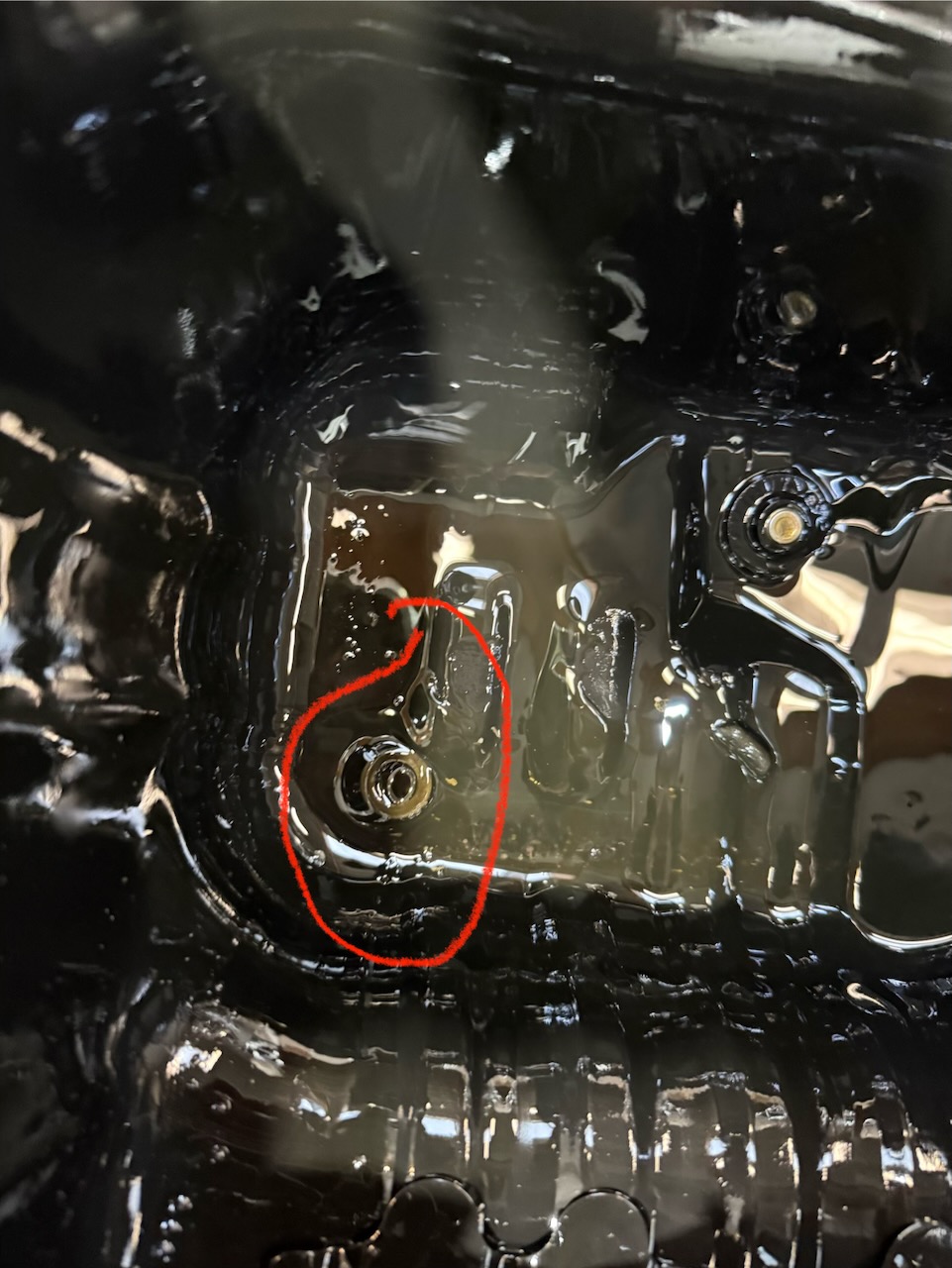
Got the intake and exhaust manifolds, fuel lines, timing belt, etc. off. Then carefully loosened all the head bolts per the FSM. Then, when pulling the first bolt at the back of the engine, the washer fell off and of course into an oil passageway and down into the abyss. Pulled the head and poked around with a magnet and using my borescope to no avail. Fearing the washer was caught up somewhere bad, I pulled the oil pan.

Several hours later...
HGv2SlightDelay.jpeg


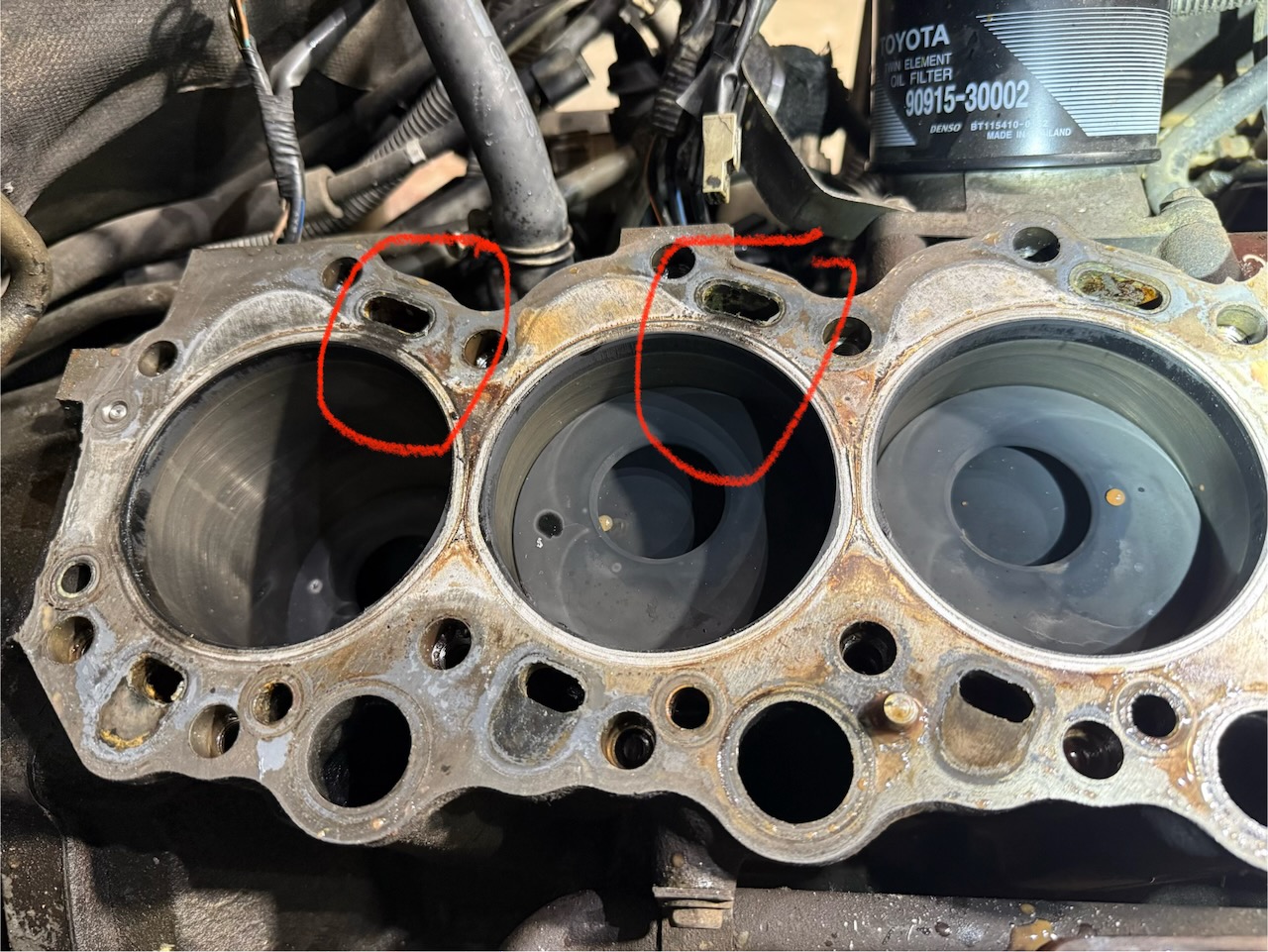
With that time-consuming mess behind me, I started taking a closer look for signs of the original issue. Maybe I'm seeing things, but it looks like combustion gasses have been sneaking into the coolant in a couple spots at the back of the engine.

Smoking gun supporting the theory that the head was lifting under high boost?
HGv2SmokingGun.jpeg


I have since cleaned up the block and head, checked both with a straight edge a dozen times, looked for cracks in the cylinders and elsewhere and don't see any other potential issues.

With the oil pan back on, next up is putting the ARP studs in and muscling the head back in place. Fingers crossed.
 
Many thanks to all who have posted here and provided tips and ideas! Some good news (with fingers crossed).

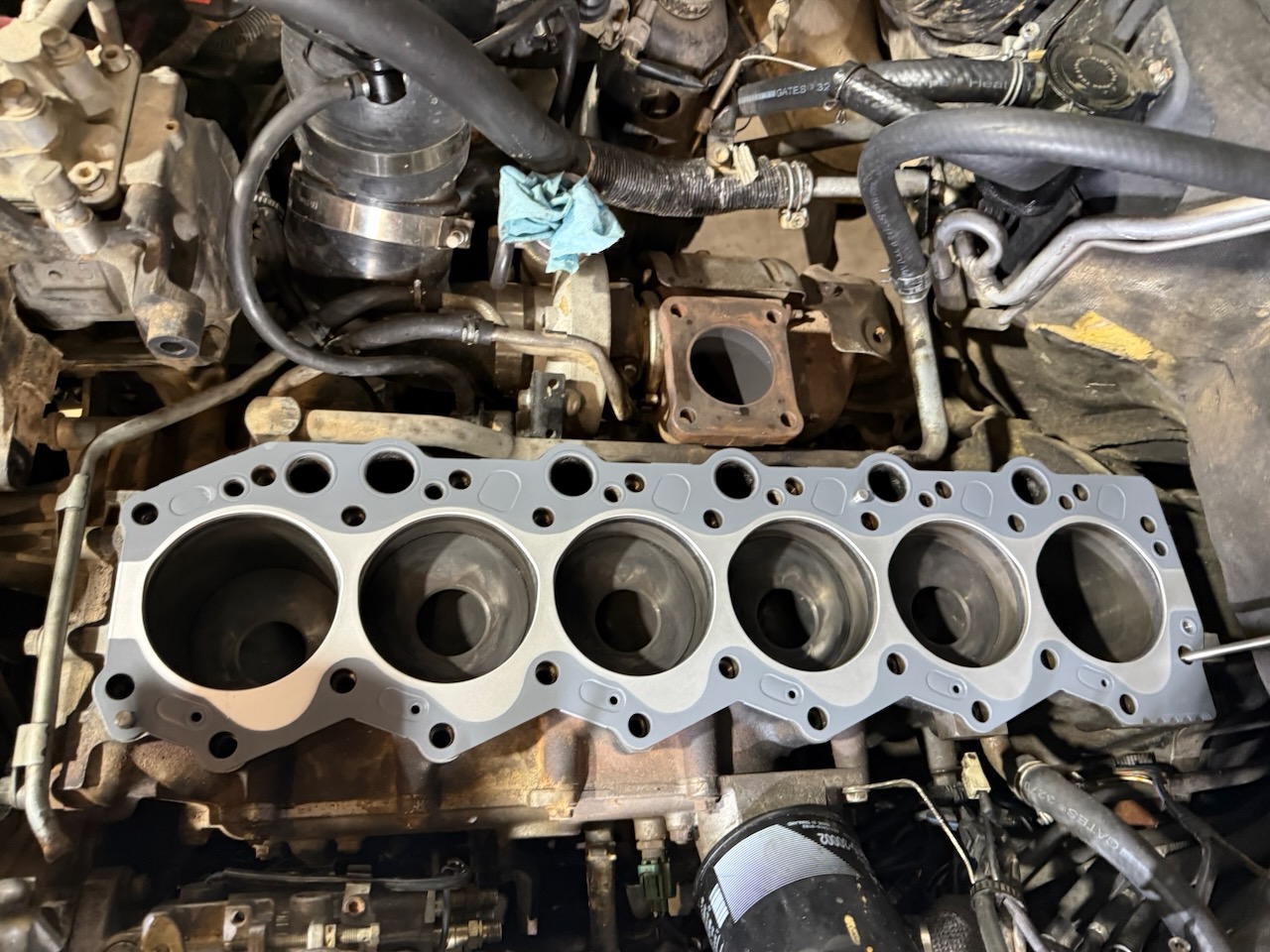
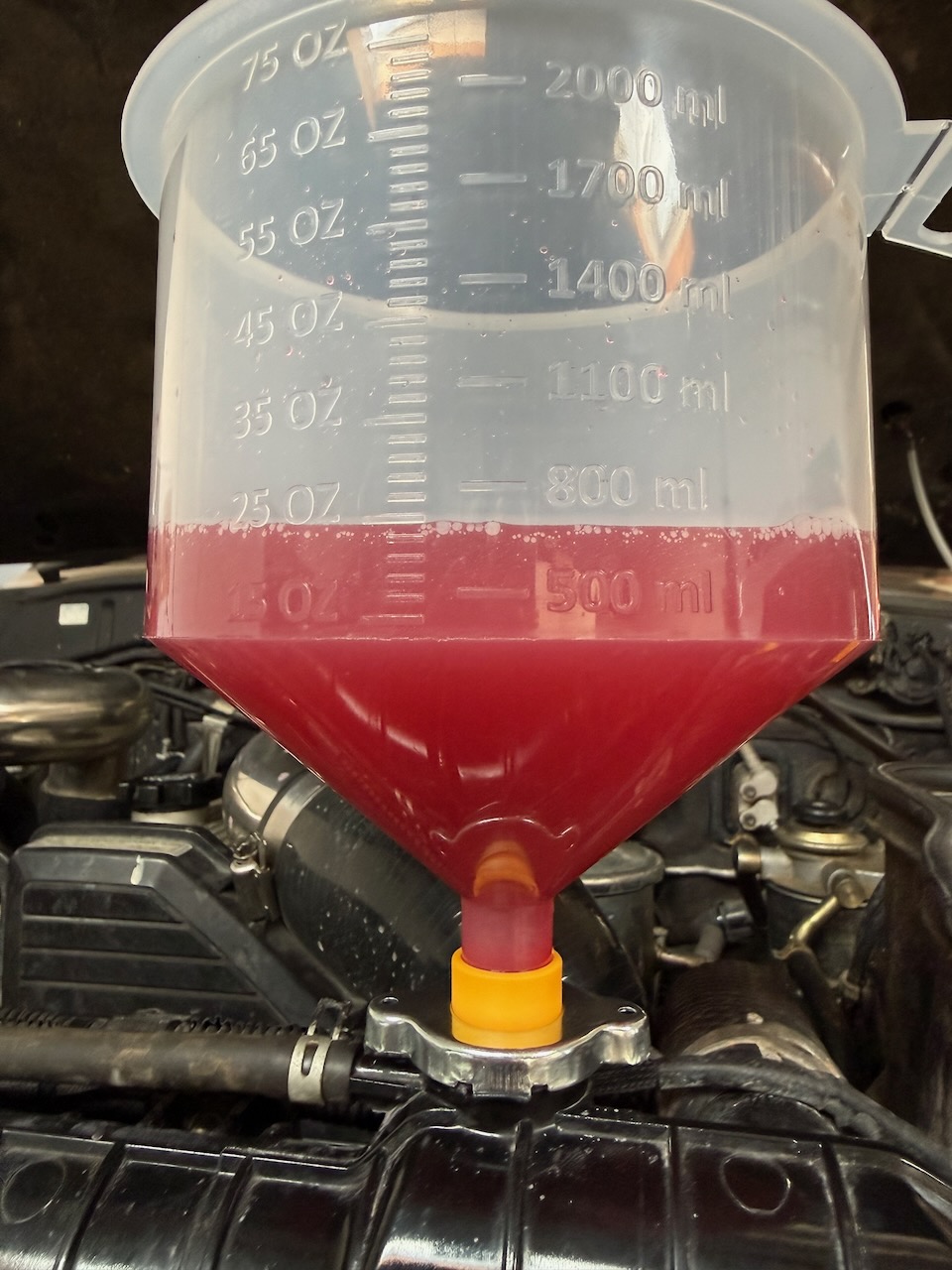
Installed the new 5 notch head gasket, head, and a set of ARP studs. Filled with fresh coolant and oil and the engine fired right up!

First start video here

Making progress
HGv2Progress.jpeg


5 notch goodness in place
HGv25notch.jpeg


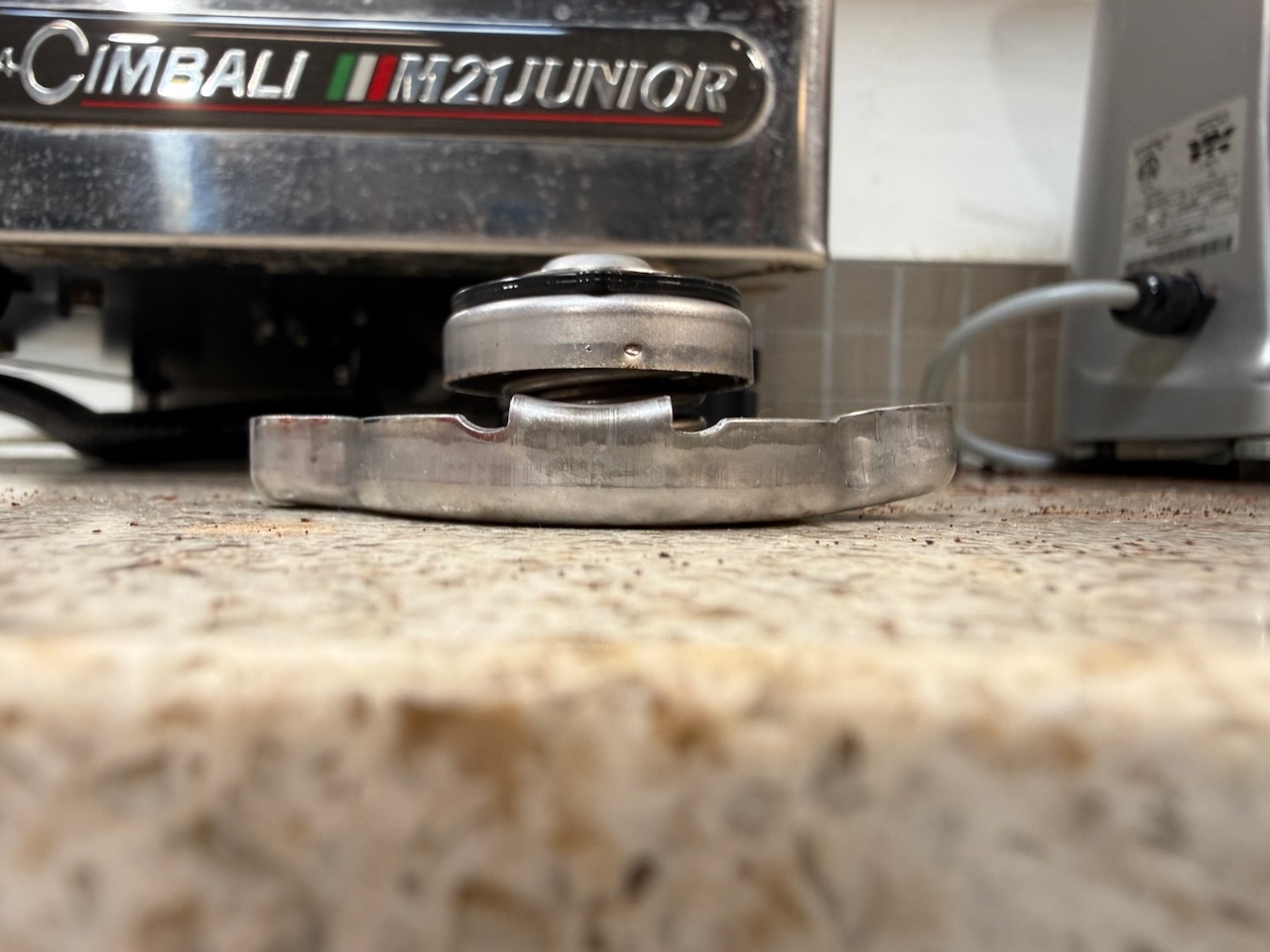
Decided NOT to use this "new" OEM radiator cap
HGv2Newradiatorcap.jpeg


On the first and subsequent drives, there was a disturbing amount of bluish-white smoke from the exhaust, mostly on deceleration, and even a random big puff of smoke. After some poking around and reading through the comments posted by @Loober in this thread, I started to question whether I'd changed the valve stem seals.

Blackstone labs didn't find anything suggesting a problem in oil or coolant analyses.

I used the same machine shop @Loober did (MJM in Escondido) and dug up my old records showing they had in fact been replaced...3 years ago. Grasping at straws, I thought maybe all that time sitting idle could have dried them out a bit, so I poured in a bottle of AT-205. After driving maybe 50 miles the smoke completely went away. Awesome. Getting close to declaring this a success.

I'll continue to closely monitor coolant levels to make sure the head gasket was really the root cause of what started this thread, but so far so good...so fingers crossed!

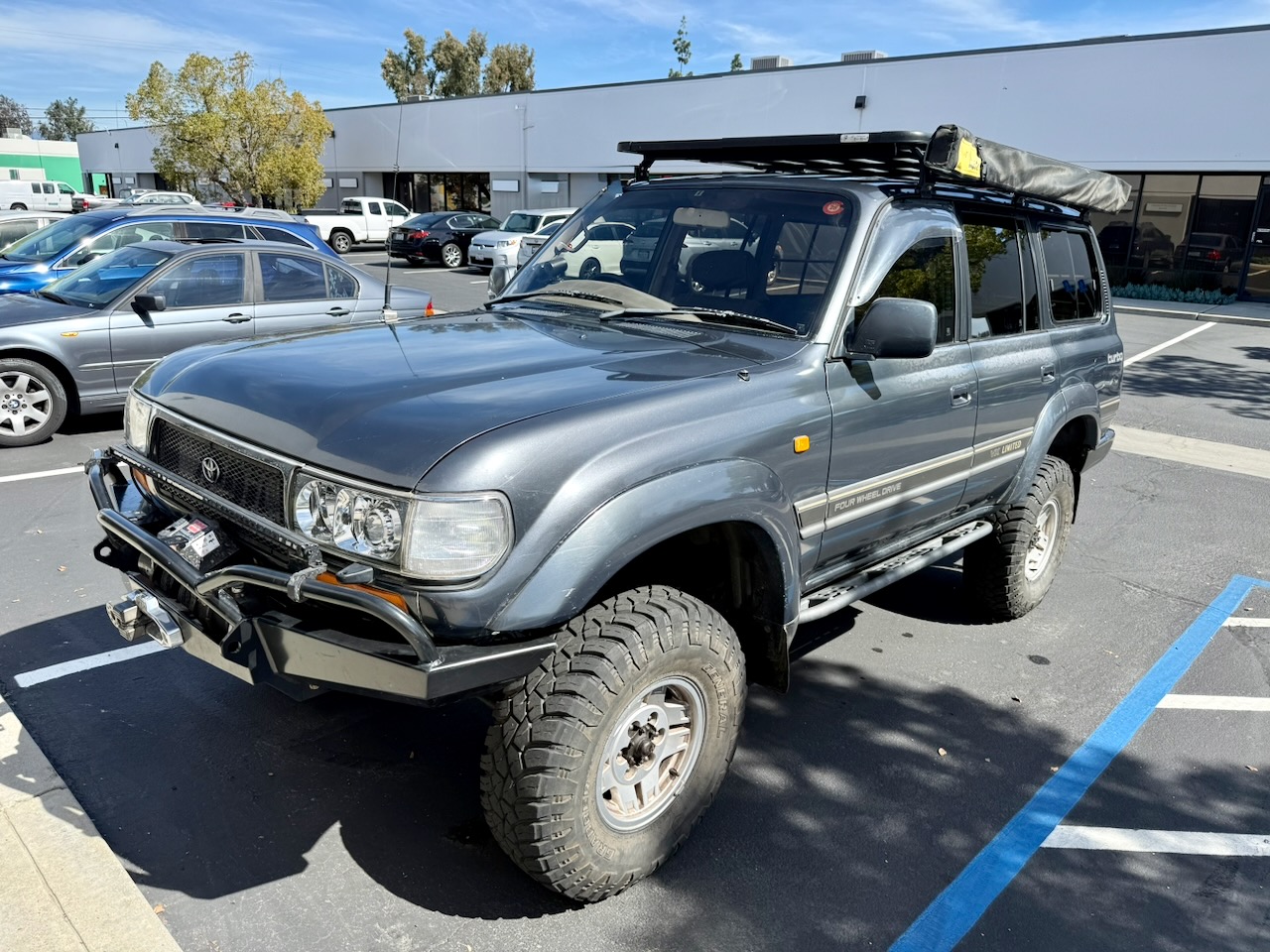
Back on the road (well, the parking lot at least)!
HGv2Itdrives.jpeg
 
Last edited:
Back
Top Bottom