Strange CV boot issue

This site may earn a commission from merchant affiliate
links, including eBay, Amazon, Skimlinks, and others.

Joined
Oct 7, 2010
Threads
6
Messages
59
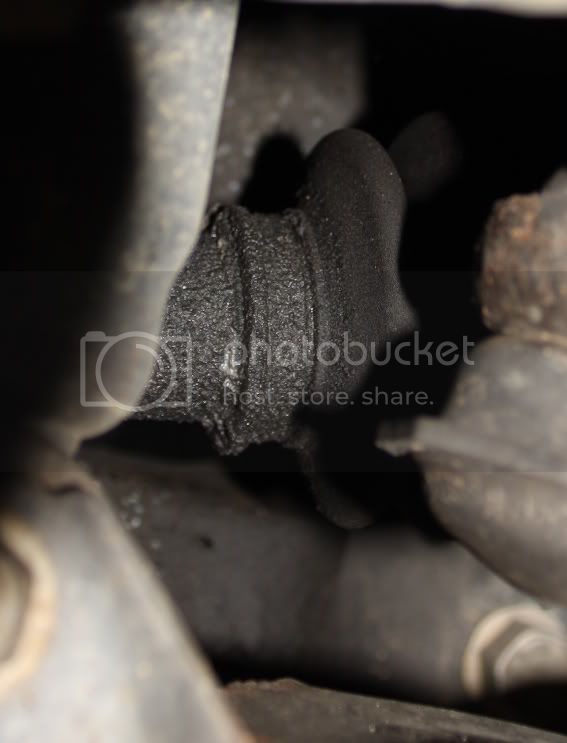
I noticed a really strange CV boot issue on my 2000 TLC. On the front wheels, BOTH inside boots have a <edit - a bit of> > TON of grease coming onut, presumeably around the seal. The ones on the wheel side are clean and dry. The wired thing is, I looked under the boot, around the boot, pulled the wheel and looked on top of the boot - the boots are fine. No cracking at all. The clamp ring at the small end seems to be where the leak comes from (again, on both sides) but the clamp is nice and tight. I'm not relishing the idea of doing my own labor on these, but I had what may in fact be a Very Bad Idea I wanted to bounce off the board. What if I cut/removed the clamp, shot the thing full of moly, then clamped it back up with a hose clamp and snugged it down nice and tight? Would it have a prayer of holding? Also, has anyone else ever seen both inner ones leak with no visible wear, but the outer ones be perfectly fine?

EDITED - Pics from reply below showed me what "a TON OF GREASE" looks like. This ain't that. Mine would be "a bit" by comparison.
 
Last edited:
Wow.... Mine's not nearly as bad - everything seeped out is dry. Plus mine is on the inner boots at the small end.. But yeah, looks like a reclamp is just what the Dr. ordered! I literally just walked in the door from taking pics for another thread, but if I think of it I'll crawl under and snap a few later.
 
Not sure one way or the other if moly grease is compatible with whatever type of lube Toyota uses in/for the CV.

Your issue is a fairly consistent complaint: Leakage from the small band side. To do it right you really need to remove the grease film under the clamp area (between the boot and CV shaft). And then move to a narrow style )1/4" wide) SS screw type band instead of the Toyota OEM style (others have stated they got them at West Marine).

Also of note: Toyota states some seepage is normal. Obviously if its globbing out that wouldn't be considered normal by anyone's standards.
 
Also of note: Toyota states some seepage is normal. Obviously if its globbing out that wouldn't be considered normal by anyone's standards.

That reminds me of an old saying back from when I flew airplanes as a job: "when it stops leaking it means the airplane is out of oil." Wonder if this is the case with the boots? :)
 
Mine may be normal then. Just snapped a few pics, will post them in a fe whours. Gotta run out for a few.

Here is what mine looks like - both INNER boots look the same, both outer boots and the shaft from them are nice and dry. I'm thinking the "overclamp" method may be for me. :

bootend.jpg


Also, does anyone have a recommendation on a good replacement unit when the time comes that has grease fittings so it can be lubed? I know my dad replaced the factory ones on his Chevy around 130k with the kind you can lube with a grease gun - new (frequently lubed) ones are still going strong at 350k+. Not sure if it's a good idea to go non-Toyota on those or not with this truck.
 
The issues is the same with any leak, HOW LOW IS IT (how much is lost). You can inject grease in the boot, just remove the leaking clamp, inject grease, then re-clamp with a NAPA clam or SS screw type, BUT their is problems with injecting grease into the boots:
1) They use a measured amount. (how much came out)
2) They use a specific lube (grease). (compatibility issues)

It's really not that big a job to re-boot, just pick-up OEM boot kit(s), they come with measured packs of grease which looks like a milky off white very thin grease (very similar to water contaminated oil). Good time to repack the axle with#1 grease, while it's exposed.
 
Last edited:
Here is what mine looks like - both INNER boots look the same, both outer boots and the shaft from them are nice and dry. I'm thinking the "overclamp" method may be for me. :

bootend.jpg


Also, does anyone have a recommendation on a good replacement unit when the time comes that has grease fittings so it can be lubed? I know my dad replaced the factory ones on his Chevy around 130k with the kind you can lube with a grease gun - new (frequently lubed) ones are still going strong at 350k+. Not sure if it's a good idea to go non-Toyota on those or not with this truck.

If thats all it's normal. When the time comes for a re-boot the OEM is the way to go.

Unless their is grease throwout i can't see in the picture or your cleaning the grease off very regularly so that what i see, is only a couple of thousands miles worth and it's been leaking a vary long time.

The clamp at NAPA is what the dealer uses, it's what I'm doing for my outer boot small clamp at this time. But before I change it, I've tighten the clamp, and will drive for a few hundred miles just to see if the leak stop. If I do change it, I'll clean between the boot and axle the best I can first.
 
An alternative to a metal hose clamp ( that will rust ) and the plastic zip tie is the the Flexi-Clamp. This clamp is made from super strong DuPont Nylon 66. Some of it's features include re-usable over and over again, will never rust, non-conductive and it can tighten to 75 psi ( which is tighter than most metal clamps ). Come visit the following link for more information and to view a video:

VIDEO :: Flexi-Clamp Hose Clamp

flexi-clamp-hose-clamp.jpg
 
An alternative to a metal hose clamp ( that will rust ) and the plastic zip tie is the the Flexi-Clamp. This clamp is made from super strong DuPont Nylon 66. Some of it's features include re-usable over and over again, will never rust, non-conductive and it can tighten to 75 psi ( which is tighter than most metal clamps ). Come visit the following link for more information and to view a video:

VIDEO :: Flexi-Clamp Hose Clamp

flexi-clamp-hose-clamp.jpg


Great info and a promising product. They don't say but it appears the clamp width might be about 1/4". And this would be lighter weight and no chance of tearing the boot because of the one-sided tooth design on the band compared to the typical slotted type steel clamps.
 
Back
Top Bottom