To VVTi Or Not To VVTi that is the ?

This site may earn a commission from merchant affiliate
links, including eBay, Amazon, Skimlinks, and others.

Yes, VVTi is all about broadening the torque band by optimizing volumetric efficiency via cam angle across the board. The cam angle is no longer fixed in a specific angle, optimized for only low, middle, or high. The 2UZ-FE is setup for low rpm grunt. So torque, and hence power, does fall off relatively early at higher rpms.

Where VVTi really makes the difference is upper rpm power as sligex mentioned. Which will make all the difference in highway running during passing and climbing. Especially with a load onboard, armor, or towing.

2001LC, I once had an IS300 too which I trailered a few time for track days:
DSC_9519.webp
 
Yes, VVTi is all about broadening the torque band by optimizing volumetric efficiency via cam angle across the board. The cam angle is no longer fixed in a specific angle, optimized for only low, middle, or high. The 2UZ-FE is setup for low rpm grunt. So torque, and hence power, does fall off relatively early at higher rpms.

Where VVTi really makes the difference is upper rpm power as sligex mentioned. Which will make all the difference in highway running during passing and climbing. Especially with a load onboard, armor, or towing.

2001LC, I once had an IS300 too which I trailered a few time for track days:View attachment 1184271
What does this (VVTi) do for MPG?

I bought the 2002 IS300 black on black 5sp manual for my son's 16th b-day. He loved that car for 10 years, until broadsided. He was fine but air bags deployed so a total. We did some minor modes like fly wheel. Taking off the Harmonic balancer for T-belt job, was the toughest bolt to break loose I've ever done....WOW.... Fun car on dry roads, but terrible in snow!

What had you done to your IS300, looks like you're set for road rally?
 
Last edited:
I recently sold my 2004 without AHC for an 06 with AHC. The 2004 rode slightly better but was fairly underpowered in comparison to the 06. I really am enjoying the extra HP in the VVTI and would recommend it if it's in your budget. And the AHC still offers a decent ride and it's fun to play around with. 06 seems to have better noise insulation too and all around seems more refined.
 
I would not let AHC dissuade you at all. It really is a stout design that has stood the test of time and the ride quality is excellent. The one proviso would be if planning on adding a ARB or Slee, et al front bumper as the added weight could require some tweaking.
 
What does this (VVTi) do for MPG?

I bought the 2002 IS300 black on black 5sp manual for my son's 16th b-day. He loved that car for 10 years, until broadsided. He was fine but air bags deployed so a total. We did some minor modes like fly wheel. Taking off the Harmonic balancer for T-belt job, was the toughest bolt to break loose I've ever done....WOW.... Fun car on dry roads, but terrible in snow!

What had you done to your IS300, looks like you're set for road rally?

VVTi allows for more optimal volumetric efficiency (read: breathing / cylinder filling) across the rpm band. Within each rpm point, it can optimize breathing for power or efficiency. It most definitely will be MORE efficient for MPG if driven with the same or lighter foot as a non VVTi motor, but can also be less efficient if driven with a heavier foot as it has power (deeper breathing) potential.

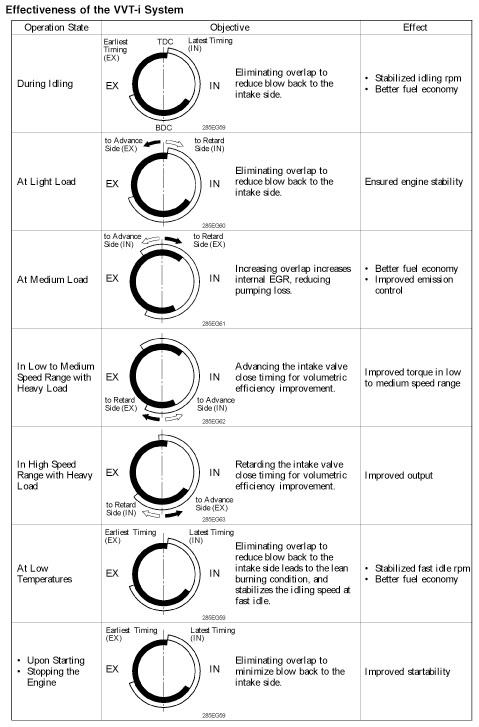
This chart might help:
VVTOperation.jpg


As for my IS300, I pioneered the 2JZ-GTE (supra twin turbo) engine and Getrag (supra 6 speed tranny) into that chassis. It was essentially a late gen twin turbo supra in a business suit. It was my daily driver. Only trailered to track as insurance against track incidentals (you never know when pushing a car) though it was always reliable and able to drive home under its own power.

I was also a tuner of many standalones and piggybacks for the turbo Lexus community so I know a little bit about VVTi and engine tuning ;) .
 
VVTi allows for more optimal volumetric efficiency (read: breathing / cylinder filling) across the rpm band. Within each rpm point, it can optimize breathing for power or efficiency. It most definitely will be MORE efficient for MPG if driven with the same or lighter foot as a non VVTi motor, but can also be less efficient if driven with a heavier foot as it has power (deeper breathing) potential.

This chart might help:
VVTOperation.jpg


As for my IS300, I pioneered the 2JZ-GTE (supra twin turbo) engine and Getrag (supra 6 speed tranny) into that chassis. It was essentially a late gen twin turbo supra in a business suit. It was my daily driver. Only trailered to track as insurance against track incidentals (you never know when pushing a car) though it was always reliable and able to drive home under its own power.

I was also a tuner of many standalones and piggybacks for the turbo Lexus community so I know a little bit about VVTi and engine tuning ;) .
MPG explanation makes prefect sense IMHO, you get my vote as the expert here.

Do you agree that these VVTi are true interference engine whereas the non VVTi is not? If so; any specific data differences that would account for this?

I've been looking for issues with the VVTi cam gear actuator or cam seals. I've not found issues in our 2UZ-FE VVTi like seen in other VVTi i.e seals and lock pin going bad. Do you know of any issues with the 2UZ-FE VVTi?

Very cool on your IS300, my son must of read about your car as this is what he once contemplated doing.
 
I'm not sure whether the VVTi allows enough timing change to cause interference or not.

I don't worry about it for a second as these motors are incredibly reliable. In the very very rare chance you catastrophically kill one, these long blocks are readily available for cheap in the used market.
 
Back
Top Bottom