Tips for welding a 1" thk shackle mount to my ARB bumper?

This site may earn a commission from merchant affiliate
links, including eBay, Amazon, Skimlinks, and others.

Joined
Mar 6, 2009
Threads
153
Messages
2,304
Location
Between pixels
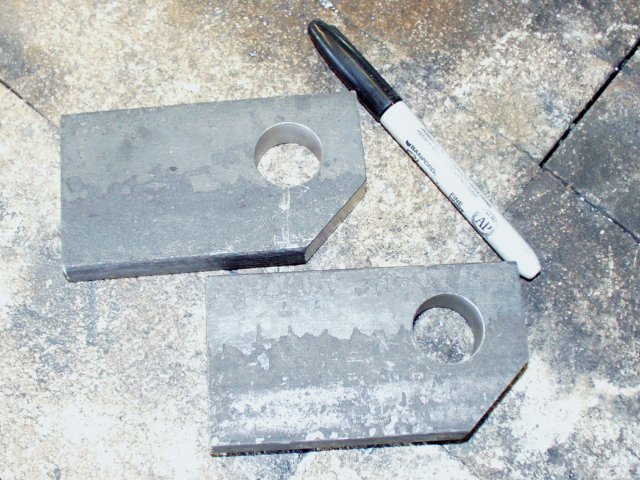
I'm about to weld some 1" thk shackle mounts to an ARB bumper and was wondering what tips or tricks should I use for welding these to the 3/16" thk bumper? I have a 220VAC Hobart 175 Handler with gas. I'm not an experienced welder, and want to ensure this is done correctly because this will be a critical structural joint.

image.webp
 
Last edited:
Your machine should have just enough stones to accomplish this. Tack it and preheat the shackle mount so that the heat doesn't get sucked up resulting in a cold weld. What size wire is in your machine?
Preheating is just that, no need to make it red hot. Your shackle mounts should be welded in line with your frame mounts for maximum strength.

A little more information on your machine set up will get you a better answer.
 
Thanks for the input. Right now I have a 2 lb spool of 0.30 wire. I do have an oxy torch I can use to preheat them. Is there some specific temp I should preheat them to, and if so, should I get some temp indicator paint/ marker? BTW, the shackles are located in line with the frame mounts, and the bottom of the shackle is about an inch above the the surface of the frame.
 
No need to spring $$ for temp stick. Tack it on with your machine setting hot, then heat your shackle mount a couple of minutes evenly. Guess around 800 degrees +/- 100. Don't make it glow. Ideally the minimum wire I would use is .035 but you can get away with what you have. What shielding gas are you running?
With the smaller wire you might end up with a hot root pass then two cover passes overlapping 50% of the root pass.
Can you stick weldd or have accsess to a arc welder? This would be perfect for 1/8" 7018 with minimal to no preheating.

Be careful not to distort your bumper if you preheat. From the photo, it looks like the bumper is off and sitting flat on a work bench. If so, clean off your bumper and layout. Preheat the mounts sepertly and locate on bumper to weld. Tack it good and weld the 1" sections (ends) first. If you start with the longer welds (sides) it could break a tack and pull on you.
 
How about using flux cored wire instead of gas? it isn't as easy to make a nice looking weld, but fwiu, the flux core wire penetrates deeper...Please correct me if I'm wrong. Also, x 2 on pre-heat. and FWIW, I used .030 wire from a Lincoln 125 volt mig with CO2 gas and a triple pass to weld my narrowed FZJ80 FF rear axle back together. I hammer that thing on the daily for the last amost 2 years now...get it warm, grind a valley to fill in, very slow primary pass followed by a cleaning and several more passes to fill the void...
 
I might have a spool of 0.035" lying around somewhere. I think I have an argon mix cylinder. My buddy also just picked up his old arc welder, so perhaps I should get that and use it if he'll let me borrow it, but I have never tried stick welding before.
 
Have someone who knows how what they are doing weld that. I wouldn't do it with .030 and 75/25. Use .035 and 100% CO2. That is not something I would mess around with welding if I didn't have the skills to do it right.. since it can kill someone if it comes off violently. Preheat and bevel that sucker. How thick is the bumper it's being attached to also? No point in going crazy hot on the weld, if the bumper is .120 or 10 gauge or something like that. All you'll end up doing is having the failure point be the bumper instead of the weld with the same results.. the mount coming off violently. If it is one of those thinner bumpers, I'd recommend beefing up behind it with a large thicker plate to spread out some of the force.
 
Maybe your right. I don't need this coming off during a recovery. It pass through the bumper, so it would be possible to weld it on both sides of the base metal which is 3/16" thk. What do people who build bumpers do?
 
I have done it both ways. Passing it though and welding both sides is good but the one in the photo you posted won't leave enough clearance for the shackle. If you have never arc welded then pass on that option. Put your .035 wire in, preheat and burn them in. Do one pass all the way around then do the same with the other one. Go back to the first one put your second pass....well you get the picture. The 3/16" base metal will be fine.
 
Your machine should have just enough stones to accomplish this. Tack it and preheat the shackle mount so that the heat doesn't get sucked up resulting in a cold weld. What size wire is in your machine?
Preheating is just that, no need to make it red hot. Your shackle mounts should be welded in line with your frame mounts for maximum strength.

A little more information on your machine set up will get you a better answer.
 
Might be too late, but here's what I did:

When I bought my FJ62 back in 2000, the PO had already installed an ARB but he had a bad habit of driving by Braille, those tow hooks were pretty much smashed flat and useless:

ARBMod1.jpg


I bought a couple of pre-fab'd tabs, they were cut and drilled out of 3/4" bar stock:
ARBMod4.jpg


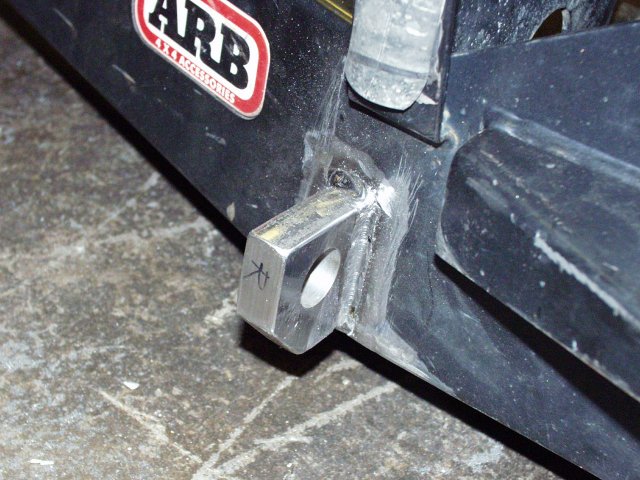
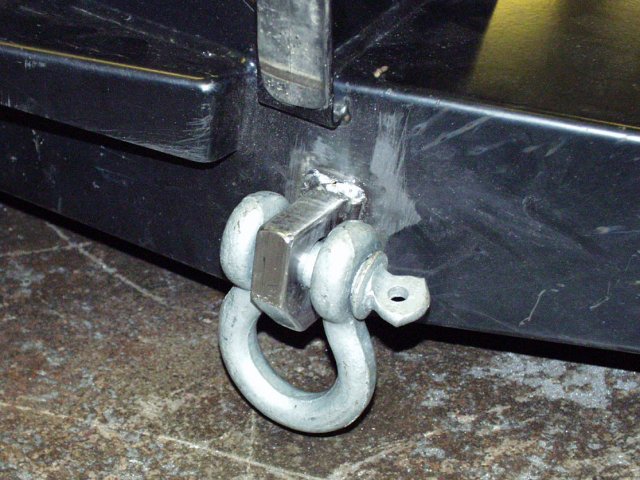
I plasma'd holes just to the side of the frame mounts, just big enough to pass the tabs through. I drilled the tabs and frame mounts (that was tough, busted a few knuckles getting the big Milwaukee drill in there), bolted the tabs to the frame mounts, then welded them up really well.
ARBMod7.jpg


Worked out well, shackles fit well, and the were VERY strong, at least as strong as the bumper.
ARBMod8.jpg


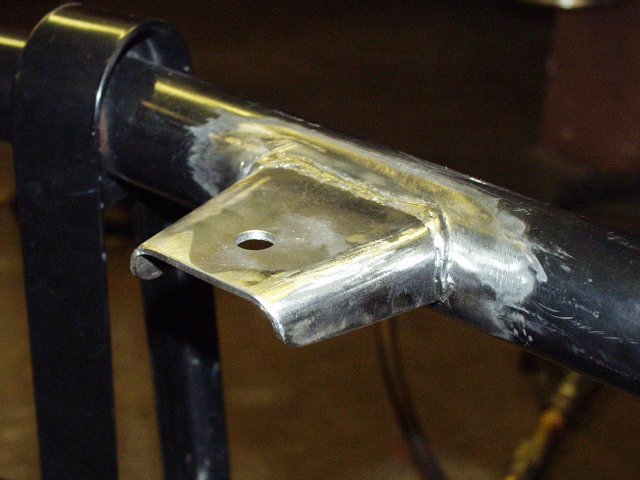
While I had the bumper off I added another antenna mount, and a couple of brackets at the ends that let me Hi-Lift the truck easily if necessary:

ARBMod11.jpg


ARBMod9.jpg
 
I have done it both ways. Passing it though and welding both sides is good but the one in the photo you posted won't leave enough clearance for the shackle. If you have never arc welded then pass on that option. Put your .035 wire in, preheat and burn them in. Do one pass all the way around then do the same with the other one. Go back to the first one put your second pass....well you get the picture. The 3/16" base metal will be fine.

The 40 has a air tank front bumper so recovery anchors where cut to match the radius of the 4"pipe (3/4") BTW, I welded this with no preheat using the Miller 350P and .035 wire and 90/10 gas.

The GMC rear bumper has 1" recovery anchors weld from the back side (pass though). Also welded with the said machine.
To the OP, if you are a competent welder, you can accomplish your job with what you have id you follow simple recommendations.
I was hoping to see some photos of your completed job by now. To be clear, if your not comfortable welding this project, take it to a shop that will charge you a minimum ($30.00) shop rate. Just make sure you provide a clean and laid out surface for them.
Peace.
IMG_0032.webp
20140724_183249.webp
 
I've been delayed while looking after the kids the last few days. I will first do some practicing on some other mods to the bumper. Biggest problem I have when welding is actually seeing the joint. If I could solve this problem, my welds would at least end up where they are supposed to. Thanks to everyone for the advice. I think I will give it a try myself first, and if I'm not satisfied, I take it to someone.

image.webp


image.webp
 
Biggest problem I have when welding is actually seeing the joint.

Are you pulling (dragging) the torch? If so, try pushing the torch as this will allow you to see your joint or weld path.
I almost always push when mig welding. There are situations when pulling is the only option.
 
Yes, I think I tend to drag/ pull for whatever reason.

BTW, your bumper and tire carrier are first rate. I like to think of myself as handy around the shop/ house, but your work is professional grade. Thanks again for the advice. I'm heading out soon to patch in those pcs and will post some pics later today.
 
Then give pushing a try and "get er done"!
I will look for progress after some shop time of my own.
Good luck my friend.
 
Back
Top Bottom