Serious engine/no start help needed

This site may earn a commission from merchant affiliate
links, including eBay, Amazon, Skimlinks, and others.

Joined
Jun 22, 2009
Threads
69
Messages
678
Location
High Point, NC
First of all, I know my 40 is far from "fitting in" in this section, but it's where the traffic is, so here goes...

I've been suffering from a no spark issue for the past week and half, but the engine cranked like a champ. Now to tonight after adding a second engine ground strap, there's spark and the timing was adjusted to TDC per the factory manual.

Attempt #1... no vacuum lines were hooked up or ports plugged. Engine cranked good but no fire. Called Cary at GotPropane and he said it definitely won't fire with zero vacuum.

Hook up vacuum lines, and recheck ignition timing. The dizzy rotor is now 180* off from the flywheel BB. Spin the rotor back to #4 cyl.

Attempt #2... cranking is a bit more labored and now back-firing out the end of the header (my exhaust ends there btw)

Call Cary back, tell him what's happening now and come to find out back-firing with propane can damage the mixer. Good to know. Rotated the crank pulley back to TDC to recheck timing, and dizzy rotor is back to 180* off. Come to find out there's a 2:1 rotation ratio between the crank and camshaft. Actual TDC was verified this time by pulling the valve cover and checking the pushrods and valves.

Attempt #3... video! What is happening? How do I fix it? Is the engine trying to divide by zero?
 
Last edited:
Will it fire with starting fluid? If you have spark and you give it fuel it should at least fire.

Check your assumptions about what is hooked up properly, as well as the timing, plug wires... everything that you "are sure" is right... start over.

Did the engine run "before"? Is there any chance that something is seized? With the plugs out and in neutral does it spin freely (by manually pushing the flywheel)?
 
Via the air intake? But you are right, I don't know how that is set up.

But disconnecting the propane and trying starter fluid might be an option?
 
Run "before" as in when I bought it before it was torn apart. Yes it ran then. Quite well even in its broken state.

With no vacuum lines hooked up, it cranked freely without any evidence of possible seizing.

I haven't tried starter fluid. Not sure that would make a difference if it can't even crank "properly".
 
Just trying to establish that it WILL run. If you want me to run through the vac lines on my petrol 40 I will, it is desmogged and pretty basic... just call me.
 
Just trying to establish that it WILL run. If you want me to run through the vac lines on my petrol 40 I will, it is desmogged and pretty basic... just call me.

I think it will run, based on the fact that it previously backfired. Maybe I'm wrong.

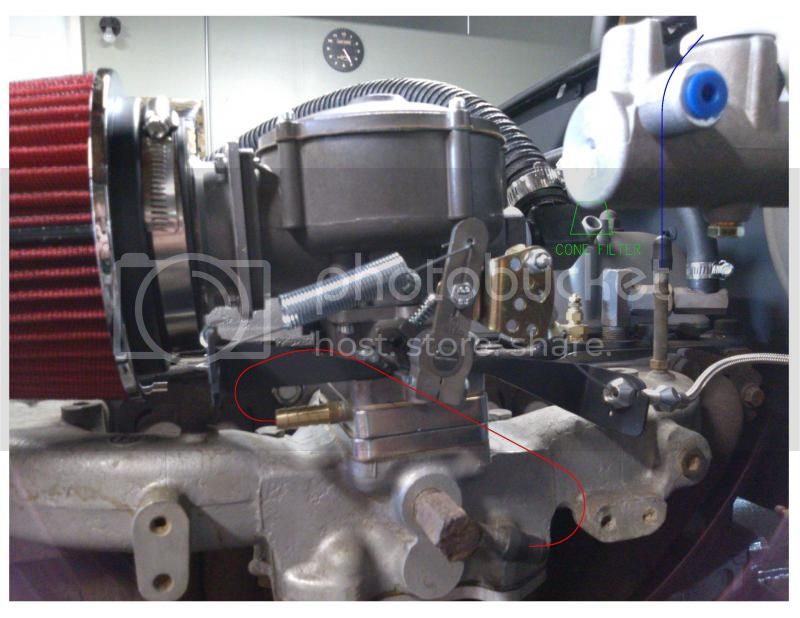
Currently the PCV is connected to the 90* fitting directly below the mixer on the vertical face of the intake manifold, and the valve cover vent (coming off the back driver's side at 45*) is capped. The ~4" vertical nipple on the back half of the intake manifold and the nipple on the Weber carb base plate (used for mounting the propane mixer), are both capped. The vac advance on the distributor is also capped.

After scouring pictures on there, I'm going to remove the hose from the PCV and valve cover vent hole and leave them open/install mini cone filters. There's no vacuum there so that shouldn't be an issue.

Since I don't fully understand vacuum, here's what I'm thinking for hose routing... ~4" vertical nipple on the intake --> brake booster, carb base plate nipple --> 90* fitting on intake manifold.

I was told by GotPropane that depending on how the engine runs the carb base plate nipple would be capped or connected to a vacuum hose, but we obviously haven't gotten that far yet.

Any holes in my logic?
 
I can't picture it... maybe another video or pics? I'll be available in an hour if you want to have me stand in front of my 40 and/or 60 for reference...

I would try to set aside assumptions and try to think fresh. Uncapping things sounds like a good start. Not sure where the pressurized propane flows so be careful you don't blow anything up!
 
My idea of vacuum routing...

vac-page-001_zps2266ec92.jpg


It's not completely evident, but the blue line connects to the brake booster. It would still seem to me though that if both the base plate nipple and the remaining nipples on the intake manifold were capped, there would be vacuum. Nothing else (besides the booster) requires a vacuum source that isn't already connected to the manifold.

Edit: Forget the red line, those will be capped off.
 
Last edited:
@mtweller , any ideas here? I'm ignorant when it comes to propane, but it sounds to me like the timing is correct now. How can we check the propane mixer function?
 
on a regular gasser 2f, the PCV valve gets plumbed to the 90deg barbed fitting on drivers side of intake mani. with a desmog you can cap the other one beneath the weber.

and realize that the vast majority of the flow through the PCV is OUT of the pcv and back into the intake. this relieves blowby pressure in the crankcase, so putting a cone filter, though often seen, is fairly incorrect. all it is doing is filtering oily vapor from going out into the engine bay and atmosphere
 
IIRC - I had that large port capped. Full manifold vacuum to the brake booster, and a small vacuum port from base plate to the dizzy and baseplate to the lock off valve. I haven't had time to read through all of this, but make sure your tank is properly oriented - LPG, it's liquid in the tank and has to flow out of the valve.

IMG_1831.webp
IMG_1834.webp
 
The video shows an engine with significantly overadvanced timing. It cranks past one or two cylinders, then fires a cylinder with the piston still way down the bore, which kicks back against the starter. Or it might have plug wires out of order.

On the hose routing, regardless of fuel type or emission status, the PCV system should be retained in a stock routing. Clean air from the air cleaner goes into the fitting on the valve cover. Oily air comes out of PCV valve and is drawn into the 90elbow on the side of the intake manifold. Remove the brass barb on the carb adapter and plug w/ allenhead pipe plug.

HTH
 
On the hose routing, regardless of fuel type or emission status, the PCV system should be retained in a stock routing. Clean air from the air cleaner goes into the fitting on the valve cover. Oily air comes out of PCV valve and is drawn into the 90elbow on the side of the intake manifold. Remove the brass barb on the carb adapter and plug w/ allenhead pipe plug.

HTH

Noted. I will remedy that first thing tomorrow.

Well I had a nice lengthy response written, and then decided to look for a diagram on the plug wire connections to the dizzy. Found one. Let's go grab the cap and plug wires and bring them inside to the a/c. Move them all over one spot, reassemble. BOOM! The engine fired up right away. Thank you Jim for the thought-inspiring plug wire comment. I will see you at Coal Mine.
 
15 36 24
too young
too old
just right
 
Back
Top Bottom