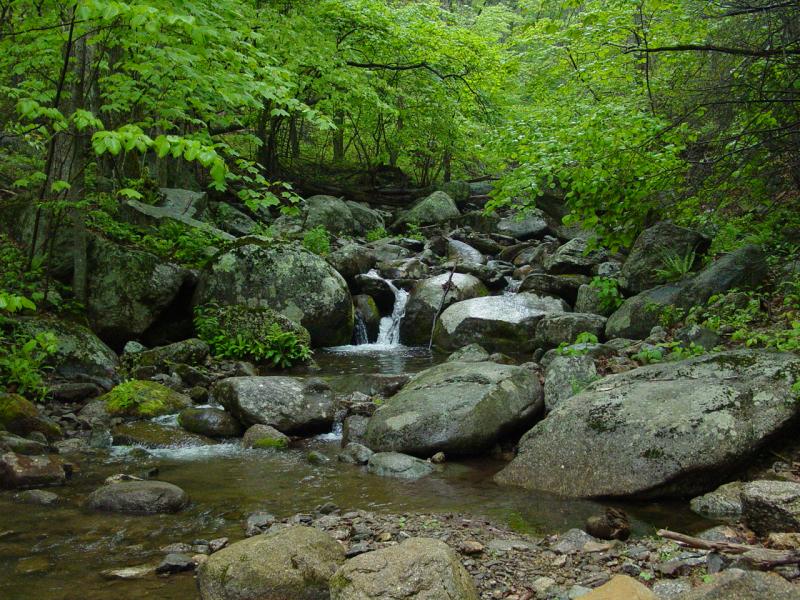
 Pedlar Ranger District
The Pedlar Ranger District of the George Washington National Forest gives the public access to 144,906 acres of the Blue Ridge mountains. It lies on both sides of the Blue Ridge Parkway between Waynesboro and the James River. National forest lands run east and west to the bottom of the main ridge. The district office is at Buena Vista in Rockbridge County. Under consideration is a proposal to close the Buena Vista office and use the Glenwood District Office at Natural Bridge.
Attractions on the district in the northwest corner include Sherando Lake Recreation Area, a favorite family refuge from summer heat, and the St. Mary's Wilderness, featuring a hike up a scenic gorge. On the east side of the Blue Ridge in Nelson County is Crabtree Falls, where hikers face a challenging climb along a scenic, five-tiered waterfall. Mount Pleasant National Scenic Area in northern Amherst County has more hikes and outstanding views.
The Blue Ridge Parkway comes into the Pedlar Ranger District from the north at about mile 2 and leaves it at about mile 64. Fifty-eight miles of the Maine-to-Georgia Appalachian Trail also run through the Pedlar District. The trail passes just below the district's highest point at the 4,072-foot summit of Rocky Mountain in northern Amherst County.
Fishing the Pedlar District
The Pedlar Ranger District has several options for anglers. Two lakes are available at Sherando Lake Recreational area. Mill Creek and Coles Run reservoirs—Augusta County water-supply lakes—opened to anglers in 1990. They are managed as put-and-grow lakes and were stocked with brook trout beginning in 1989. Historically, 13-inch wild brookies have come out of these waters. The stocked fish are now 8 to 14 inches. There are no facilities, and access is about a .5-mile walk to Coles Run and a 1.5-mile walk to Mills Creek. The Pedlar River is a seasonally stocked trout stream featuring numerous small falls and deep pools.
Sherando Lake Recreation Area
Sherando Lake has been popular with residents of eastern Augusta County since its construction by the Civilian Conservation Corps (CCC) in 1936. The beautiful, 24-acre main lake is set in a mountain hollow on the east flank of steep Torry Ridge, less than 5 miles from the Blue Ridge Parkway. The lake has a swimming area with a sand beach and a bathhouse with warm showers. The large, sturdy buildings are consistent with durable CCC construction. Those who prefer shade to the sunny beach can spread blankets on the spacious lawn beneath giant oak trees.
Picnickers also have shade at widely spaced lakeside tables beneath a canopy of deciduous trees. While the hamburgers are frying on the grill, families can hike the Lakeside Trail, which makes an easy 1-mile loop around the lake. Someone's got to go find Dad, who's found a spot between some alders where he can cast to largemouth bass, bluegill, redear sunfish, or stocked trout.
An upper lake (7 acres) was constructed in 1958 for flood control. Anglers who desire a more remote experience prefer this lake, which also has an encircling trail for bank fishing. No trout license is required from June 16 through September 31, when general statewide fishing regulations apply. From October 1 through June 15, a trout license is required. A National Forest Stamp is required all year and so is a Virginia fishing license. Visitors who come to the recreation area during the fall hunting season should wear blaze orange on the trails. The surrounding national forest is heavily hunted, especially during the two-week deer season in November.
Activities: Hiking, swimming, fishing, boating on lower lake (no motors).
Facilities: Visitor center with maps and interpretive materials, 2 lakes, swimming beach, bathhouse, showers, wading area, 3 campground loops with total of 65 sites, group camping area for 125 people (by reservation only), hiking trails, picnic tables, trailer dump station, drinking water.
Dates: Gates open daily, year-round. Swimming and picnic areas close at dark. Camping permitted Apr. 1—Oct. 31. Camping in organization area Nov. 1—end of hunting season (no water).
Fees: There is a charge for camping and day use.
Closest town: Stuarts Draft is 10 miles west. Waynesboro is 14 miles north.
St. Mary's Wilderness
St. Mary's Wilderness—even the name sounds like a sonnet on a breeze. A tinkling of water over moss-covered rocks. A play of light and shadows on crystal-clear pools. St. Mary's Wilderness has all these and more. In fact, this 10,090-acre wilderness would do better with a less lyrical name. The fragile beauty hinted at in the name draws so many hikers, campers, and partiers that the wilderness has been "loved to death," as one ranger put it. The well-traveled footpath up lovely St. Mary's gorge and the accompanying trail of human detritus has somewhat marred the wilderness ambiance St. Mary's once had.
The St. Mary's River empties a steep, narrow gorge on the southwest side of Big Levels in the southern tip of Augusta County. St. Mary's Falls, a double waterfall over big rock boulders about 2 miles up the gorge, is the destination for many hikers. A refreshing pool collects water at the bottom of the falls. Just about every level spot along the way has remnants of campfires.
Humans are not alone in leaving tracks in the gorge. In fact, torrential downpours from Hurricane Camille in 1969 and Hurricane Agnes in 1972 wiped out an old logging road up the gorge, divided and changed the lower course of the stream, heaped debris into great piles across what road remained, and helped a group of citizens obtain wilderness designation for St. Mary's in 1984. Of course, had the area not been mined and logged in the early 1900s, the trees and soil may have been better able to withstand the powerful floodwaters. Acid rain has been blamed for decimating the native trout fishery here, but some brookies remain to give catch-and-release fly-fishermen a thrill. Only single barbless hooks may be used.
Nature lovers and trout anglers who seek solitude should look elsewhere or visit the area during off-seasons. However, St. Mary's does have a lot to offer. Its reputation as a first-class mountain gorge along the pretty St. Mary's River is well deserved. About 17 miles of trails are in the area. Exploring some of the lesser-used trails turns up more waterfalls and rock cliffs and remnants of former manganese mining, including a settling pond, an old railroad grade, and several concrete footings of a former mining camp. A topo map and a compass are always a good idea when hiking such wilderness areas. Conscientious hikers and anglers help not only by packing out their own candy wrappers and aluminum cans but also by picking up trash left by others.
Crabtree Falls
Crabtree Falls
In a mountain gorge in western Nelson County is Crabtree Falls, consisting of five tiers of major falls and several smaller ones. Crabtree Falls plummets 1,200 feet down the northern flank of a 4,063-foot-high mountain called The Priest. The icy waters of the falls are in the headwaters of the Tye River, which gained notoriety in the devastating flooding rains of Hurricane Camille in 1969. The Tye River nearly moved the little community of Massies Mill on VA 56 off the map.
The falls have their own reputation for taking lives with no help from the Tye. Over the years, 22 people have fallen to their death. Many of the accidents occurred when people at the top tried to get a closer look by walking out onto the rocks. These rocks are covered with a clear, algaelike material which makes footing very treacherous. The U.S. Forest Service has installed handrails, steps, observation platforms, walls, and warning signs to make the falls accessible and safe. With signs and railings now in place, such accidents can be avoided by staying on the trail.
Despite the remote location high in the Blue Ridge, the falls are sought after for their scenery by hikers and photographers. The footpath to the falls leads from the lower parking lot across a beautiful arched wooden bridge that spans the South Fork of the Tye River. Then the trail winds through hemlocks and past an old family graveyard. It's an easy 10-minute walk to the first of five major cascades.
From there, the hiker climbs 1.7 miles up a steep trail with switchbacks. Moist air from the falls makes ideal habitat for several varieties of ferns, mosses, and wildflowers. Along the way, viewing platforms with benches enable hikers to catch their breath while enjoying views of the cascades, and children like to investigate the small cave on the trail. At the top, the trail continues 1.2 miles farther along Crabtree Creek to Crabtree Meadows parking lot on VA 826 (Crabtree Farm Road).
A .5-mile hike east on VA 826 from the upper parking lot will take you to a junction with the Appalachian Trail and Shoe Creek Trail. Just 1.2 miles east on the AT are rocky outcrops on the quiet summit of The Priest that overlook Rockfish Valley in Nelson County far below. The Shoe Creek Trail leads 3.5 miles south down the mountain to Piney River, a stocked trout stream on the Nelson County/Amherst County border. The trail can be reached from the bottom via VA 827 (Perkins Mill Road) west of Massies Mill and northwest of Piney River.
The state trout hatchery at Montebello is just 3 miles west on VA 56 from the lower parking area of Crabtree Falls. Visitors are invited to feed the trout and use the picnic facilities.
- Directions: Lower trailhead: From the Blue Ridge Parkway, milepost 27.2, drive east on VA 56 for 6.6 miles to parking area, on right. Or from the east, at junction of US 29 and VA 56 at Colleen in southwestern Nelson County, follow VA 56 west about 19 miles (through Massies Mill) to parking area, on left. Upper trailhead (requires high-axle vehicle or four-wheel drive): Drive 2.7 miles west on VA 56 from lower parking area. Turn left (south) on VA 826 and go 3.7 miles to large parking area.
- Activities: Hiking, primitive camping (and picnicking at nearby fish hatchery).
- Facilities: Hiking trail, vault toilets, viewing platforms with benches.
- Dates: Open daily, year-round.
- Fees: No
Mount Pleasant National Scenic Area
The 7,580-acre Mount Pleasant National Scenic Area was designated by Congress in 1994 as one of only seven such areas in the country. Here, the 6.2-mile Henry Lanum Trail forms a loop connecting the summits of the two highest mountains of the Pedlar Ranger District. Mount Pompey is 4,032 feet high and Mount Pleasant is 4,021 feet high.
Multitiered flat outcroppings of pre-Cambrian granite typical of the Blue Ridge Mountains provide breathtaking panoramic views of the valleys formed by the Piney River and Buffalo River.
Chestnut oak, yellow birch, and pignut hickory are in the hardwood canopy, while mountain laurel, rhododendron, wild hydrangea, mountain ash, highbush blueberries, and witch-hazel can be found in the understory. Wildflowers to look for include starry campion, tiger lily, bloodroot, and Indian pipe.
The forested mountain slopes provide acorns, hickory nuts, grapes, and blue-berries, staples in the diets of black bear. White-tailed deer come into the high mountain fields and meadows to browse at dusk. Bobcats, wild turkeys, red and gray squirrels, gray foxes, and cottontail rabbits also inhabit the woods. The high peaks are perfect places to observe the annual fall hawk migration.
The 3-mile Hotel Trail, completed in 1989, makes a 7.5-mile loop using part of the Appalachian Trail (AT). This trail takes off from the right of the parking lot as you enter from FR 48. It winds through open fields and meadows, along Little Cove Creek, and intersects with the AT at Cow Camp Gap. A three-sided AT shelter is located nearby. Hikers can then hike to the northeast on the AT about 2 miles to Hog Camp Gap. From there, it's a 10-minute hike back to the parking lot on FR 48.
In early summer, hikers along the trails in the Mount Pleasant National Scenic Area may notice trees losing their leaves. They may also hear the constant sound of something raining from above. What they're seeing and hearing is an infestation of the fall cankerworm, which covers about 500 acres of the Pedlar Ranger District, extending southward to US 60 (see Ghost Forests).
- Activities: Hiking, primitive camping, seasonal hunting.
- Facilities: Shelter on Hotel Trail/AT loop.
- Dates: Trails are open year-round, though winter weather may make access impossible.
- Fees: None.
- Closest town: Buena Vista is 16 miles southwest.
- For more information: Glenwood and Pedlar Ranger District, PO Box 10, Natural Bridge, VA 24579. Phone (540) 291-2188.
- Trails: Henry Lanum Trail (formerly Pompey and Mount Pleasant Loop Trail) is 6.2-mile loop connecting two mountain summits (combined with .5-mile spur to summit of Mount Pleasant). Hotel Trail combines with Appalachian Trail to form 7.5-mile mountainous loop.
- Elevation: Henry Lanum Trail: 3,400 feet to 4,032 feet on Pompey Mountain. Hotel Trail: 3,000 feet to 4,022 feet on Cold Mountain.
- Degree of difficulty: Moderate, with difficult steep sections.
- Surface: Natural forest floor with rocky sections.
[/B]




 Yeah, we got trout.
[She already gave me permission to do this.
]


 ]
]
 hahaha.


