Heater Blower Motor and Housing Differences

This site may earn a commission from merchant affiliate
links, including eBay, Amazon, Skimlinks, and others.

Joined
Dec 8, 2006
Threads
158
Messages
2,974
Location
Greenfield, MA
Website
thecarpentryway.blogspot.com
I recently picked up a NOS heater blower motor and resistor from Iran of all places. I decided to freshen up the heater blower and finding the NOS parts was a bonus, as there is very little available from Toyota.

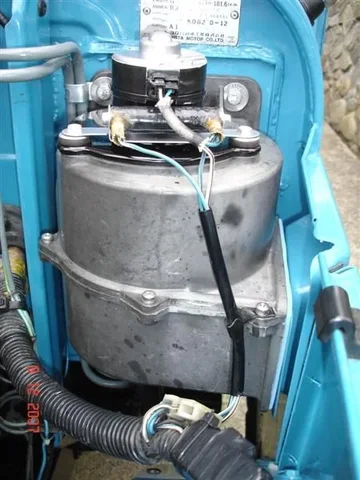
I pulled my old blower out and then immediately noticed some interesting differences between the old and the new blower motor. The old one, for instance, has the corrugated rubber hose going from the top of the motor to the top of the housing (see first pic attached below)

I guess it accepts some of the air pushed out by the blower fan, to cool (?) the motor.

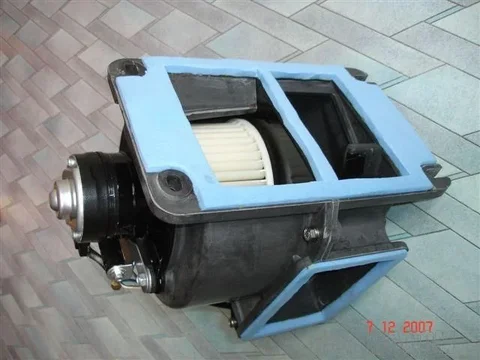
The new blower motor, part number 87104-60094 does not have the hose, nor does the top of the motor have an opening for the hose to be fitted (second pic below). While there is a black cloth tape wrapping the top of the motor to seal it, there is clearly no opening anywhere behind it. Further, with the rubber hose fitted to the other one, how would you then wrap the housing with tape as the hose would be in the way?

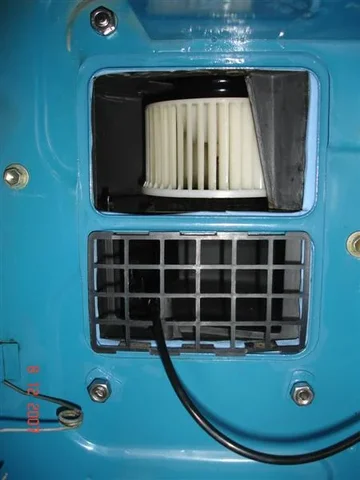
Also, looking at the underside of the motor housings, the old one has slots on the bottom of the housing, while the new one is completely sealed. I wonder what acocunts for the design change? Pic attached show the difference, old unit to the left, new one to the right.

I also noticed, when checking into part numbers on the EPC, that there is a different part number for the heater blower when fitted to trucks with the side defrost nozzles. I wonder what the difference could be between the blower motors whether there are side defrost nozzles fitted or not?

For those restoring a heater blower, I hope pics of the NOS one are of help in how you paint it. I'd be interested to hear from folks who have restored the plastic blower housing to see what the best methods might be. I know there are paints for plastics, but how you you clean it up? Armor All? soap and Water? Any solvents to avoid?

DSC08044-small.webp
DSC08045-small.webp
DSC08049-small.webp
DSC08050-small.webp
DSC08051-small.webp
 
I've been dousing the blower housing with a product from Home Depot called 'Lift Off' which is safe for plastics and intended for removing graffiti. It works well - I apply it and stick the part in a plastic bag overnight and wash it off the next day. The paint lifts off, but it takes several rounds and no damage to the plastic - i'm sure of this since the inked part number stamp has become visible with the paint removed.

I've determined that the pre-'79 blower housings are made of some sort of FRP type material, and have rubber corrugated hose going from the top of the housing to the top of the blower motor. The '79 and later housings were apparently just plastic and were flimsier.

Looking at it with most of the pair stripped off, I am left to wonder if these housings were originally black or more charcoal gray in color. Mine looks gray, not black - you can see the contrast clearly in the photo below between the plastic's color and the remnant bits of gloss black paint still to be stripped off.

The blower motor housing, being under the hood, wouldn't tend to get sun-bleached I don't think, though I could imagine the plastic aging and shifting color perhaps. Before I repaint this though, I would like to determine the original color of the plastic - anyone know for sure?
DSC08146-small.webp
 
Interesting Chris..

I wasn't aware before that they ever passed air through the motor...

Here's my July 1979 for what it's worth:

Blower1.webp

Blower4.webp

Blower2.webp

:beer:
Blower1.webp
Blower4.webp
Blower2.webp
 
Looks gray to me Tom - or grey if you prefer.

I also note that the brackets which hold the resistor to the housing are silver/pewter in color, or colour as I'm sure you prefer. :cheers:

Question: why do the housing mounting bolts on yours have nuts on the backside, in the passenger footwell?

Ha ha... Thanks for reverting to "down-under" spelling and lingo Chris....

I painted those resistor brackets silver because my cruiser is forever sitting out in the weather and water regularly gets blown in there through the left-hand bonnet vent-louvres. (I had problems with rust continually eating away at those brackets.)

But if they had been originally black then I'd have used black paint .. so I'm thinking they must have been pewter or silver originally ... but probably just not such a bright silver look.

I've similarly painted the motor with both black and silver paint (designed to match original colours but with no concern over the exactness of the colour match).

The main body was always unpainted grey plastic.

As for the fasteners, they've all been converted to stainless (including those big flat washers under the heads).

The nuts are added to act as locknuts (on top of the original "captive nuts") and they thereby eliminate the need for stainless split washers. Since there is a soft foam gasket in place here ... I think it's superior engineering practice to do it this way (because you can have the fasteners securely locked without having to over-compress the gasket)...

:beer:
 
The nuts are added to act as locknuts (on top of the original "captive nuts") and they thereby eliminate the need for stainless split washers. Since there is a soft foam gasket in place here ... I think it's superior engineering practice to do it this way (because you can have the fasteners securely locked without having to over-compress the gasket)...

Interesting idea. You used the same foam for the blower housing gasket as you used on the vent doors, yes?

I've been going over to stainless bolts for just about everything I've rebuilt in the past year, where possible as I'm sick of seized rusty bolts.

In the US, obtaining certain specialized metric fasteners is all but impossible and I've had to get stuff made at a machine shop. ARP stainless bolts are great for mounting the pintle hitch and tow hook :D
 
Interesting idea. You used the same foam for the blower housing gasket as you used on the vent doors, yes?

I've been going over to stainless bolts for just about everything I've rebuilt in the past year, where possible as I'm sick of seized rusty bolts.

In the US, obtaining certain specialized metric fasteners is all but impossible and I've had to get stuff made at a machine shop. ARP stainless bolts are great for mounting the pintle hitch and tow hook :D

I cut that blue foam from one of our family's "sleeping mats" that were designed to be put under our sleeping bags to insulate them better from cold ground while camping outdoors in winter. (They were never really any good at that, and they were blue, so one got sacrificed for a greater cause. :D)

As I recall, the two gaskets you see are the only places that I used this blue stuff. (It's rather soft.)

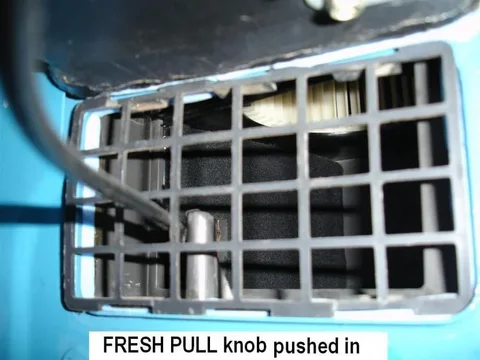
For the fresh air vent door I used some less-soft rubber stuff with a cloth backing as you can see from these pics I took just now:
HeaterFreshClosed.webp

HeaterFreshOpen.webp

Both the rubber and the cloth surface are black in colour. And as I recall I sacrificed a "stubby holder" for that material.

It's a similar stuff to what I used for my kick-vent gaskets .. although that material had red cloth one side (hidden) and blue cloth on the other side (exposed) as shown here:
kickventgaskets1.webp
kickventgaskets2.webp

I won't mention what I sacrificed to get THAT material...

(I couldn't remember what I used on the vent door so I just went and took a look, and since I was doing that, I took the photos too.)

:cheers:
HeaterFreshOpen.webp
HeaterFreshClosed.webp
kickventgaskets1.webp
kickventgaskets2.webp
 
Last edited:
Getting back to the difference with the heater fan motors having a hose connection to the blower housing, i came across these pictures on an Ebay ad for a '77 heater blower assembly - notice that there is a hose coming out of the top of the motor but it just vents to the atmosphere:

Not sure if this is a heater blower or the carb cooling fan.


Here are some pictures I took yesterday. The one in the vehicle is a 10/75 76 model. The two 78s are 11/78, I picked up a couple 78 cowls and these were on them. THe 80 I'm not sure just picked it up years ago as a replacement for my 3/79 FJ40. None has the hose.:meh:
004.webp
003.webp
002.webp
001.webp
 
"Not sure if this is a heater blower or the carb cooling fan."

Hah! That would explain why it looks so different. The ad on Ebay mislead me.

Thanks for the other photos - helpful!

I'm wondering if the hose is relating to 'cold weather spec.' somehow. I recently looked at a 24v. blower motor being sold up in Canuckistan, which does have the hose and is from a 1981 BJ42:
attachment.webp
 
Last edited:
I'm thinking the hose on the 77 blower may have to with environment it is in. Letting any moisture that collects in motor drain out. The hose on the blower motor have been a later improvement. Was they any date code you could find on you OEM replacement? Are these 12 or 24 volt? I know here in AZ my cab gets plenty hot with my gas engine. Would think a six cylinder diesel's heat would be even greater. The opening in the base of the motor are on the negative side of the bower wheel. The hose is on the positive of the blower wheel. This is designed to cool the motor. Not sure why it would be needed in colder climates. So my guess is a later improvement or a higher heat diesel application.
 
Interesting theory, however I'm going to poke a hole in it. The new blower motor I got is part #87104-60094. If you cross reference that part number, you'll find it shows up on both FJ4X, BJ4X and HJ4X in the European market. Seems like the connection between diesel engine, high heat, and blower motor design simply isn't there.

In North America, it appears only on FJ40 in the US, and FJ40 and FJ45 in Canada.

Here's the curious thing: the blower motor which is spec'd for use with side defrost is part #87104-60171. If you do a cross reference search on that, you'll find it was only used on FJ40 and FJ45 models.

Looking at Canadian BJ42 models, there is only one part number for the 24v version, #87104-60181. No differentiation in regards to side defrost or not, though I assume all CDN BJ42's were side defrost-equipped models. That part number was only for those CDN spec models. Australian BJ42's were 12v. definitely no side defrost, and the motor used there is #87104-60094 (same as what I bought). The European BJ42's, which were 24v as far as I can tell, had blower #87104-60141. Not sure about the side defrost or not on those models as the parts locator doesn't differentiate.
 
The hose is chopped off of that one because there is no port for the hose in a 78 heaterbox.

The vent hose on the blower motor appears in 1981-later 40 series.


Hmm. :confused:

You sound very sure of your conclusions, but if what you say is true, then the OEM blower motor I obtained, part number 87104-60094 should NOT be found after 1981 as it does not come with a port for the hose, correct?

I just checked ToyDIY under 1983 FJ40, the last year for FJ40 in the US, to see which part number is listed for the blower motor:

http://www.toyodiy.com/parts/p_U_1983_TOYOTA_LAND+CRUISER_FJ40LV-KCJA_8712.html

The correct part number for the heater blower motor is....

....87104-60094

Same part number as the OEM replacement I purchased, and same part goes for 1980 (August) onward for FJ40 in the US. That would appear to contradict your assertion, yes?

Not wishing to be confrontational, however if I see an assertion rendered i like to check it out if it doesn't quite jibe with what I have come across.
1983 FJ40.webp
 
I haven't looked up the PN's. Just observed that it seems the vent hose starts in 1981 (when it appears on FJ60 also). PBG says his has it, but maybe his is swapped. I have seen a lot of Cruisers over the years and remember seeing the hose, but am not positive if it starts in 78/79/81.
 
now i had to go look .i ran the part number on the plastic housing #87130-60130
76-79 with side defroster

FJ40Jim
could be right the motor may have been changed on mine but i know i didn't do it .:p if someone else did it they would of had to drill the hole in the housing also,
i know not very hard but ?

pic of my blower sorry for the crappy pic . could not find part number on motor

also pic of housing part number
,,,,
photo (Medium).webp
photoii (Medium).webp
 
Back
Top Bottom