fj 55 door latch repair

This site may earn a commission from merchant affiliate
links, including eBay, Amazon, Skimlinks, and others.

Joined
Aug 4, 2007
Threads
21
Messages
1,457
Location
Portland, Oregon
The cup that supports this gear shown, also acts as its' bearing. Given, it's a treated surface and all but time and rough service (ya, right, like that never happens, the rig defines rough service) tend to hog out the cup material around the gear shaft. I can think of much better (read easier X 10) ways to do this, SO, maybe a forum, what have you done? Okay, I'll admit, just another way to satisfy my nipple fetish! Picture shows a gear shaft bearing surface in good condition. And guys, that's 23 grease fittings.......me thinks. 24?
latchgear1.webp
 
Step one, how hard can it be?

Ya hu, how hard can you make it......Rip the cup off the latch, drill through from the back of the gear shown clean through to the other side, no country for hss drills there, no sirreee! AND THEN, to make it near impossible, chuck up a drive in type grease fitting, turn it down to hole size because you were too afraid to go bigger. There you have it....a door latch fitted with a grease zerk.
greasefittting.webp
 
No country for a grease gun

I challenge anyone to say that they went to their Papa when they were a kid and said, "Papa, I wanna be an automotive door tech. when I grow up". No room for a grease gun back here so the connecting rods will have to be disconnected to gain access to the grease fittting. Picture shows an unmodified, installed latch.
latchinstalled.webp
 
Heat treat

So you think I'm going to treat you to a lesson on the sophisticated science of heat treating steels? WRONG, get real, it's Bill Bob in his Carhartts doing some home heat treatin. Cook it till it is glowing orange, into the bucket of oil, I'm a thinkin thats what theys a meenin when they say oil hardened.
heattreat.webp
 
How hard can it be?

Fancy harness testing equipment? Come on, just picture the guy doing the heat treating. Another excuse to swing a hammer, smacked the insert with a punch. Not even marred and did not shatter, both, good signs.
hardnesstest.webp
 
Putting it all together

Good time to know a good Welder, thanks' Adam. The insert is welded to the cup, the cup welded to the latch. Greased and installed, it works, plenty of clearance. Like I said, there has got to be an easier way. Road testing is now under way.
latchgear2.webp
 
Wow, RSBC...on one hand, I like the way you think. But that is an awful lot of work and perhaps a bit of overkill. That door latch will probably be the only remaining part after the Pig has returned to it's initial elements.
Much easier is collecting Pigdoors. And swapping out a worn doorlatch for a slightly less worn out doorlatch from the collection...Or perhaps swapping in a rear doorlatch from another door (I haven't had to do this yet, not even sure if it's possible).
Not sure if I would bother with the zerk...that wheel doesn't do high RPMs for long periods, It turns maybe a quarter revolution each time you get in or out. What it does do is rattle around for thousands of miles at a time. Agree that hardened mating surfaces would be a great improvement over the stock pot-metal. Maybe some graphite -impegrinated bearings with hardened steel seats...
Heck, just weld the doors closed and climb in & out the windows, Dukes of Hazzard style...
But, heck of a job there. Maybe if i send you a spare driver's door latch or two, you could that again?
 
Thanks Lou, and Pighead, what can I say......Overkill, you bet, more for my own entertainment I think. Sure like the way you think there, the welding the door shut, OH YA BABY, You is my kind a people. Do ya one better, tried it last summer and liked it! Take the doors OFF. I know, I know, not original but a good un anyways.
 
that is pretty much exactly what I had in mind for a repair on mine. I have some sloppy latches that need this treatment. With a CNC lathe you could knock those caps out pretty easy.


I dont think a rear latch would work, dunno if it has the provision for the key lock???
 
that is pretty much exactly what I had in mind for a repair on mine. I have some sloppy latches that need this treatment. With a CNC lathe you could knock those caps out pretty easy.


I dont think a rear latch would work, dunno if it has the provision for the key lock???

Me likes the idea of reproducing the whole cup, using a material with a better bearing capacity, maybe heat treat the bearing area......That way it might be possible to rejoin the cup to the latch with the original technique (little ears bent over). My thought, if I go do it again, is to holesaw the cup bearing hole. Replace the enlarged hole with a bearing bronze insert. Maybe interferenced and / or glued into place. That way, no disassembly required, getting the cup off is a major chore.
 
Me likes the idea of reproducing the whole cup, using a material with a better bearing capacity, maybe heat treat the bearing area......That way it might be possible to rejoin the cup to the latch with the original technique (little ears bent over). My thought, if I go do it again, is to holesaw the cup bearing hole. Replace the enlarged hole with a bearing bronze insert. Maybe interferenced and / or glued into place. That way, no disassembly required, getting the cup off is a major chore.

I like it, but I doubt there is an effective repair for a failure like this:
293888181_5y2Jj-M.jpg


When it's gone this far, the back end of the shaft is very loose too. :crybaby:

It does look like an excellent preventative step. As long as the insert doesn't deform much over time, it could sure slow down the wear on the back end. If you start off with a relatively good part, I'd bet your solution will outlive the rest of the door.

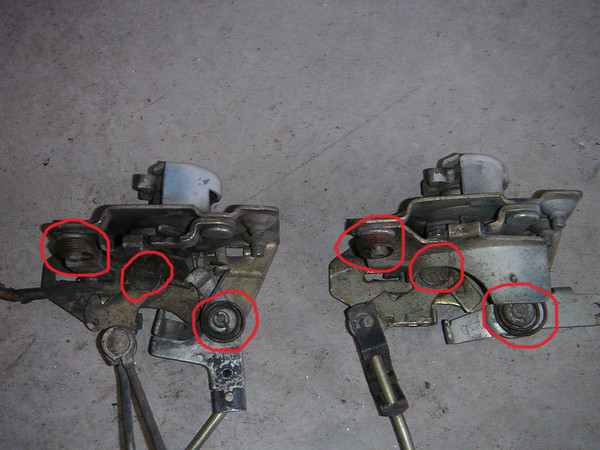
As for using a rear latch in the front, I looked at this a few months ago but haven't tried it yet. To make it a dead on match, you'll have to remove three pins and transfer over several pieces. Pictured below are the right side latches, front on the left and back on the right.
296275898_uxmaN-M.jpg


I don't have the machining/mechanical experience to know the right way to do this, but it would be valuable. I'm sure there are a lot more working rear latches than front, and the problem will likely always be the cup, frame, and ratchet/pinion shaft - which look the same on the front and rear.

:cheers:
 
Desert Lake, great imput! I was wondering the same thing as to the back to front switch. Excelent to see the whys and wherefores in picture format. Your suggestion is a definite could work. As you point out, those pivots would have to be drilled and tapped or something to perform the swap. Not impossible but some work. Funny you should mention the other gear support. My latch looked very similiar to yours' shown. The other bearing surface was not that bad yet. I have to admit, the original reason I drilled the gear shaft was to see if I could take it all apart (no WAY! crazy idea). I wanted to get to that bearing surface, maybe put a bearing bronze insert in there. I also wanted to cross drill so that lube would be supplied to that little collar (between the gear and latch body) and the inside bearing also. Now that there would be a bullet proof latch. Swapping the levers would look easy in comparison though.
 
Hey, I'm doing the easy part here - photos and ideas for someone else to try. I'd wanted to start a latch thread anyways - either that or I already did and forgot about it. In any case you're doing some very cool work there.


Here's what happened with mine. I suspect the door sheetmetal on the bottom hinge failed first, causing the door to sag. I have some serious cracks there. This caused the latch to not quite line up, requiring a serious slam each time the door was shut - there is lots of wear on the strike plate where the pinion was hitting it in the wrong place. The slam started causing the metal in the latch frame (between the pinion and ratchet) to start to fail at the same time the cup started to fail. Once it was loose enough for the shaft to pop out of the cup, each slam did even more damage to the frame because the shaft could pivot against it.

Lesson: don't let your doors sag.

I've rethought my earlier comment -- a stronger bearing on the cup side might be enough of a correction to make the latch workable. If I knew how to do the work, I would add your bearing to both cups. Assuming the bearing made the worn out latch work reasonably well, I would swap the worn out one to the rear to extend its life even further. I think what will happen is, the extra slop between the pinion and ratchet will cause it to pivot against your new bearing, wearing it out faster and possibly causing issues in the ratchet, long term - hopefully quite a few years. I don't know if the grease will help much, but it might...I suspect most of the wear is due to impact against the bearing surfaces.

I've got a parts rig, another set of doors, and yet another set of door internals, and none of the DS fronts are very good. I need to make some machine shop friends.
 
Ya if you look at it it aint nothin to put in a longer and thus more supporting bearing in place of the cup sheet metal. Making up for some slop in the other bearing. Also, guess you could Jim Bob those links front to back thus avoiding the need for a machine shop (bet some machine shop dude would jump right on that, look at it as a challenge, maybe end up cheaper route than you think). maybe a grinder and vice type of thing. Don't know, though when all is said and done nothin wrong with your current fix, Pigs do well doorless, seems to fit their way.
 
The door latch mod has been in place now for a couple of months. I noticed what looks like a little more strike on the top of the the modified latch. probably casued by a slight misalignment during welding but that is about all. Just an update to let you know it is still working. Planning on painting because there is rust on the weld.
latchgear3.webp
latchgear4.webp
 
Back
Top Bottom