Driveshaft Lubing - Am I in trouble???

This site may earn a commission from merchant affiliate
links, including eBay, Amazon, Skimlinks, and others.

Joined
Jul 7, 2012
Threads
32
Messages
130
Started getting the infamous clunk, so I just greased all the spots on the drive shaft and U joints. I bought my 01 LX used with 150k miles so I'm not sure when the last time it was done, if at all.

Started with the front shaft and it took about 60 pumps of a pistol grip gun to get it to move. Only moved about 1/4" at most. 20 pumps later still no grease coming out through the seal. I figured I would leave it be for now, drive on it a while, then try to pump some more in later.

Moved to the rear, and same story. 60 pumps to get it to move, finally got some to come through the seal. It was only coming out around 1/2 the seal, so I pumped about 10 times more to try to get it to push past around the whole seal. Nothing, not even coming out of where it had just come out. I'm thinking, ok, air pocket maybe, so I pump about 10 more times and then I hear something. I look up and there is grease coming out of the end of the DS right by the rear U joints.

I clean it up, grease the rear U joints and take it for a test drive. First thing I notice is I can't push the button on the shifter in. I had to push the whole shifter up some to get it to go in. So, I look and I notice that P and N are not lining up with the orange indicator. They're off by about 1/8". I go for the test drive to see if the clunk is gone. It is, so I'm thinking, drive for a while, get the pressure off the shafts and maybe the shifter will line up. I come home, put it in park and its still off.

With the grease coming out of the rear seal instead of the slip joint seal, and the shifter not lining up. How bad is this? What can/should be done next?
 
...Moved to the rear, and same story. 60 pumps to get it to move, finally got some to come through the seal. It was only coming out around 1/2 the seal, so I pumped about 10 times more to try to get it to push past around the whole seal. Nothing, not even coming out of where it had just come out. I'm thinking, ok, air pocket maybe, so I pump about 10 more times and then I hear something. I look up and there is grease coming out of the end of the DS right by the rear U joints.

I clean it up, grease the rear U joints and take it for a test drive. First thing I notice is I can't push the button on the shifter in. I had to push the whole shifter up some to get it to go in. So, I look and I notice that P and N are not lining up with the orange indicator. They're off by about 1/8". I go for the test drive to see if the clunk is gone. It is, so I'm thinking, drive for a while, get the pressure off the shafts and maybe the shifter will line up. I come home, put it in park and its still off.

With the grease coming out of the rear seal instead of the slip joint seal, and the shifter not lining up. How bad is this? What can/should be done next?
If you yank the driveshaft, you'll see the rear end doesn't have a seal...looks to me like a flat disk pressed into a counterbore in the driveshaft.

Mine leaks there also, so plan once it gets hotter around here is to pull the shaft and rear u-joint and braze or TIG the disk in place. With the leaky disk in place, you'll never be able to see grease at the forward slip joint.:mad:

hth

Steve
 
60 pumps is crazy high. I do about 4. Sounds like you put in so much that you bound up the drivetrain causing you issues at the shifter. I would pull the shafts off, clean them out then start over. There have been threads about too much grease causing serious transfer case issues, too much grease leaves no room for the shaft to work properly.
 
Just pulled the zerks on both front and rear. Front, nothing came out. Rear, about a 5" strand came out. I plan on driving it again around the neighborhood with the zerks out and see if I can get some more out.

I know 60 seems crazy. I was pumping until I saw the joint move. It took that many pumps just to see it. As a comparison, u joints took 6-10 pumps to get the grease to show.
 
So, after the relief from pulling the zerks, and taking a drive the shifter issue seems fixed.

I still have not seen anything come out of the front DS. Not from the zerk or seal
 
Do not over grease the slip on the drive shafts. We have seen that take out the pinion bearings on the front diff on the 100.

Any advice on how concerned to be if grease won't flow past the seal? If it won't is the best path to just pull the line, separate, and lube the splines/seals while apart?
 
Normally your telescoping driveshaft is mostly full of air, which can compress or escape when the driveshaft needs to compress. If you fill it full of grease it cannot compress when your rear suspension rises, and can actually break your transfer case housing ($!). It has happened. As you pump grease into the driveshaft, and it doesn't escape, it becomes a hydraulic cylinder pushing the rear axle back, and the transfer case/transmission/engine forward. You noticed things weren't lining up, that is why. A few pumps is all I'll do on the driveshaft splines, I see grease slung out onto the bottom of my truck, so I think I'm getting it lubed.
 
Agreed Scott, but it should also have a means of egress so SOP should be to pump until purging occurs. The system then should achieve equilibrium as the seals allow additional grease to purge with articulation. The trouble is you have no idea how much is in there nor if you have a plugged seal until it binds. This is further complicated by the success some users have by continued pumps freeing a partially frozen seal. As far as I can tell, you don't know until you've bound things up. Or perhaps a better approach is to pump a fixed number of times and then separate if no old grease is seen coming out the seal.
 
When I took the DS apart on my 80, I saw a nice glob of moly grease way at the top where it comes in through the grease fitting. Gravity, heat, and centrifugal force should eventually move it down to the splines. Pumping that cavity full until the grease is forced out past the splines would require filling the entire air space with grease first, a very bad idea I think.

I don't like this design, because there is no way to know if I'm running dry between services, or adding more than I'm using and gradually filling the airspace. I'm planning to take my DS apart this Spring for a proper cleaning and lubing.
 
So, after removing the zerk on the rear and getting about 7" of grease back out. I'm pretty comfortable that the rear shaft is fine.

What worries me is the front. No grease out of either spot.
 
So, whats the trick to removing the shaft? I crank down on it and it will just spin
 
Whats the deal with these nuts? I'm afraid to hit them harder. Finally got one to turn after using my 5lb hammer on the wrench. Is this normal?
 
Somewhere in the 80 section IdahoDoug wrote a long post on cleaning and inspecting the seal on the slip joint. If the truck is new to you, I would take the shaft out, mark it and then separate the half and inspect / clean. After that, I would assemble with a liberal coating of grease and then just 3 or 5 squirts every time you grease the shaft.

If you do it the old fashioned way of pumping grease until you see the slip move, you have a good chance of putting pressure on the flanges and taking out bearings.
 
Whats the deal with these nuts? I'm afraid to hit them harder. Finally got one to turn after using my 5lb hammer on the wrench. Is this normal?

A little PB and a breaker bar or double wrench......

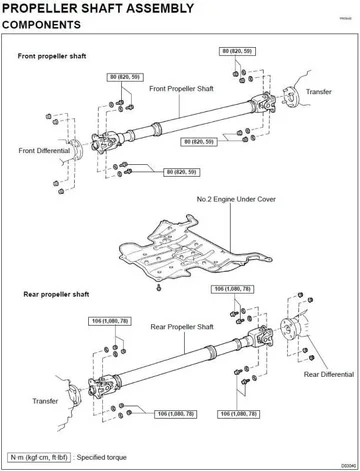
When you put it back together, the FSM Calls for 59 ft/lb front and 78 ft/lb.

Capture.webp

just 3 or 5 squirts every time you grease the shaft.

This is what I've done since purchase and have not had any issues.

Capture.webp
 
Under what conditions does this clunk come about? I've got a clunk that only happens going over bumps when the car rocks from one side to the other or while turning. Is this the drive shaft clunk you are all referring to and thus requires action?
 
Under what conditions does this clunk come about? I've got a clunk that only happens going over bumps when the car rocks from one side to the other or while turning. Is this the drive shaft clunk you are all referring to and thus requires action?

The clunk is the "Off the gas, back on the gas clunk." Say if you're approaching a red light and take your foot off the gas, then the light turns green while your still rolling and you get back on the gas, there is a slight clunk from the DS.
 
The clunk is the "Off the gas, back on the gas clunk." Say if you're approaching a red light and take your foot off the gas, then the light turns green while your still rolling and you get back on the gas, there is a slight clunk from the DS.

Oh ok yeah it's not under those conditions. Thread hijack but any idea what my clunk noise might be from?
 
Back
Top Bottom